

Greece: December 8–18, 2025
📌 Table of Contents
- Flights to Athens, a Roman Tomb in Zara, and Wandering Ancient Streets (December 8)
- The Acropolis, the World’s Oldest Theater, and Exploring Athens on Foot (December 10)
- Crete Bound: Minoan Palaces, Olive Oil Tastings, and the Best Meal of the Trip (December 11)
- Chania Harbor, Venetian Streets, and the Fortress of Rethymno (December 12)
- Byzantine Monasteries, WWII History, and the Road to Delphi (December 13)
- Thermopylae, Ancient Caves, and the Monasteries of Meteora (December 14)
- Mount Olympus, Medieval Castles, and the Sacred City of Dion (December 15)
- Thessaloniki: Byzantine Churches, Roman Ruins, and Waterfront Wandering (December 16)
- The Long Drive Back to Athens (December 17)
- Flying Home and Saying Goodbye to Greece (December 18)
December 8: Flights to Athens, Ancient Tombs, and First Wanders
4 a.m. Wake-Up Call and a Smooth Start
I woke up at 4 a.m. to get ready for our flight. We arrived at the airport around 5:30 a.m. and took off around 7:30. The flight was uneventful and we actually landed a little early.
During our layover we decided to grab a meal, which took up most of the time we had. Since we decided to be a little bougier this time around and fly Delta Comfort Select, we were able to board early.
The seat was great with lots of room, a footrest that sort of elevated, and a seat that reclined quite a bit. The food was also much better than what is typical on flights. After eating, we slept for a few hours at a time and then woke up for the final 1.5 hours of the 9.5-hour flight.
Arrival in Athens
We landed and immigration was a breeze. After collecting our bags we met our driver, which we had pre-booked at the urging of our hotel. The service was through Arrival Transfers, and the entire process was smooth.
Our driver was very friendly and gave us a lot of suggestions for things to see. We ended up booking him again for our return trip to the airport in two days.
Checking into the Parnon Hotel
The hotel we stayed at was Parnon Hotel, located in the city center.
It isn’t anything particularly special and honestly looks a lot nicer from the outside. The room itself is basic and small. The shower has its quirks, with glass doors that open in a corner. If the doors aren’t aligned perfectly, the whole thing floods.
The water was hot though, and overall the hotel was pretty much what I expected. They did let us check in early, which was a major plus.
Once we got settled it was about 11:30 a.m., and we headed out to explore.
A Clothing Store With an Ancient Secret
Our first stop was Zara, but not just for shopping.
The building was originally a 19th-century mansion built as a private residence, and beneath the floor is an ancient Roman tomb believed to date back to the 1st or 2nd century AD.
You can actually see it from the entrance through a glass floor.
The store was busy and the glass wasn’t the clearest, so I didn’t take a picture. But it was definitely worth popping in because how many clothing stores also have a chunk of ancient history under the floor?
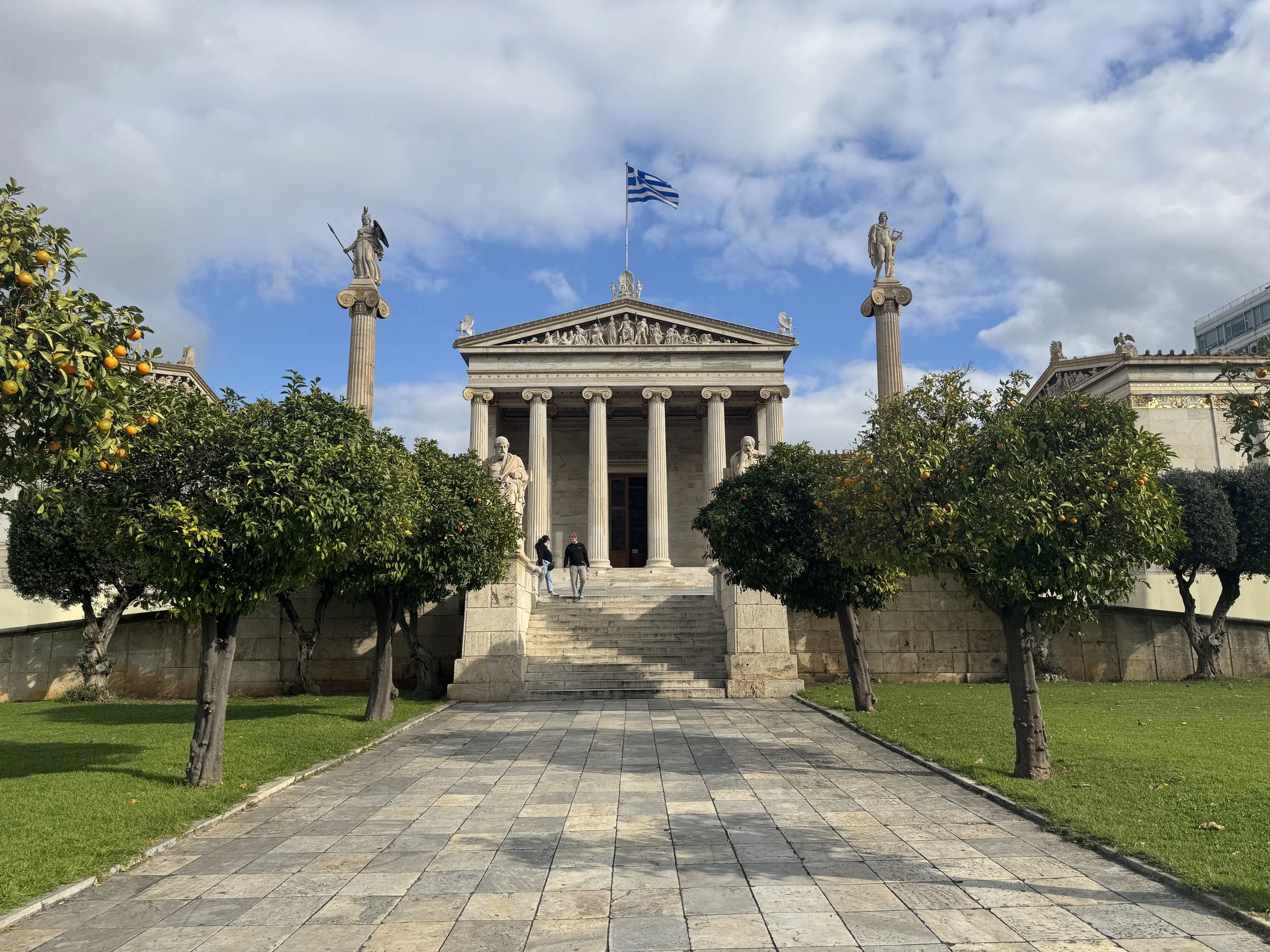
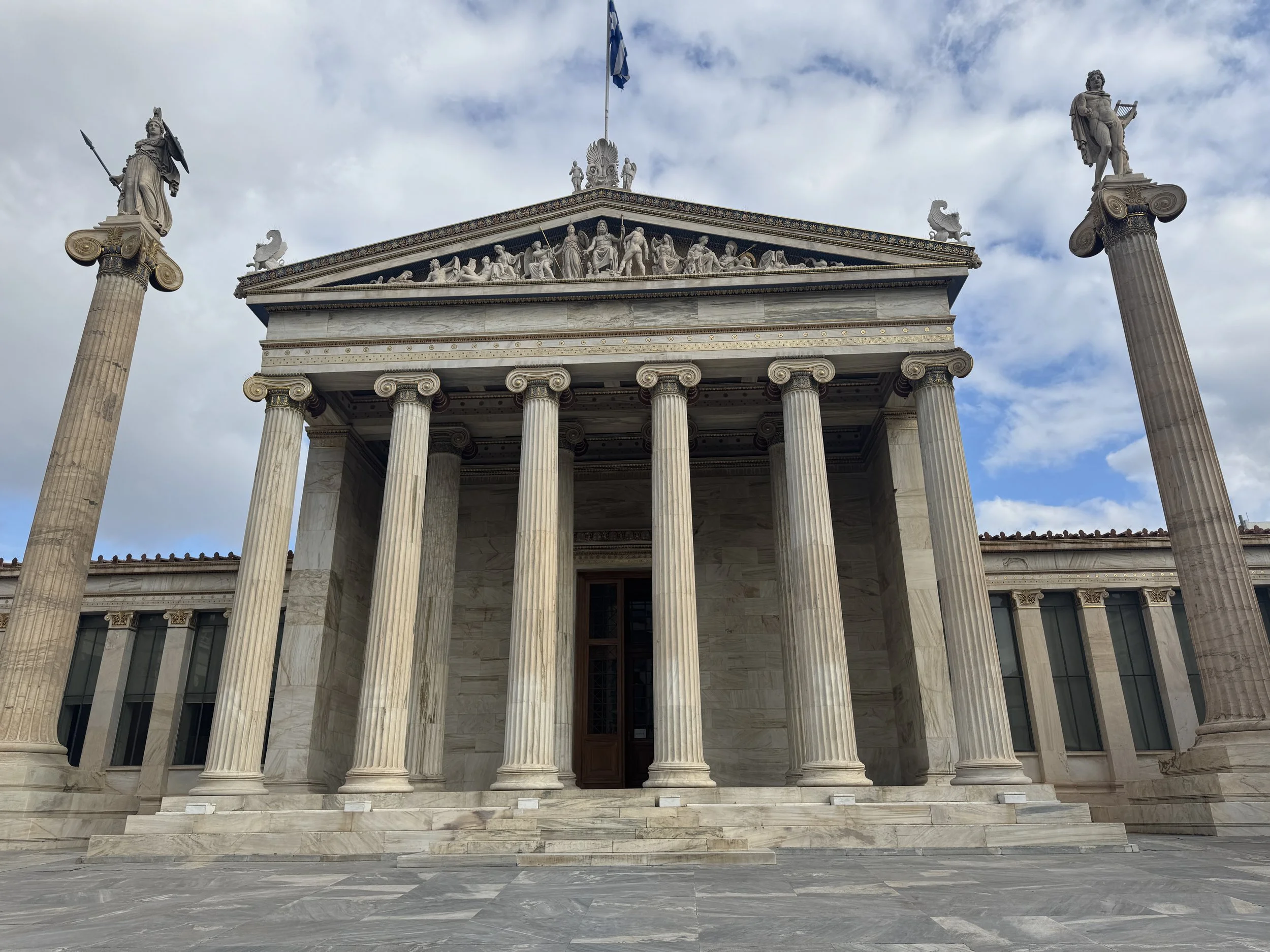
The Athens Trilogy: Greece’s Architectural Statement of Knowledge
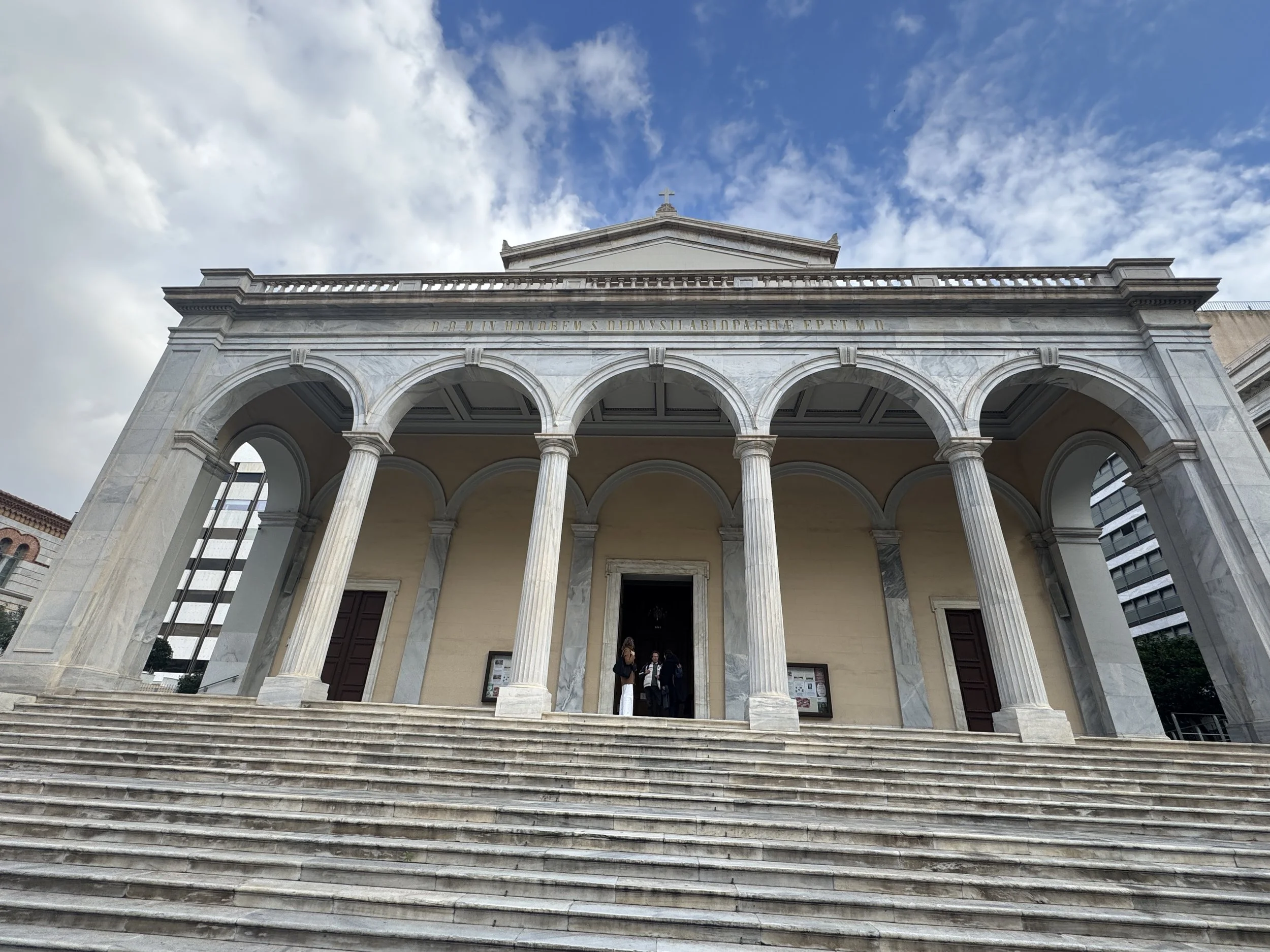
Next we walked along Panepistimiou Street, which features several impressive buildings:
National Library of Greece
National University of Athens
Academy of Athens
Cathedral of St. Dionysius
This area is known as the Athens Trilogy.
Together the Library, University, and Academy form the symbolic heart of:
Knowledge
Education
Enlightenment
in modern Greece.
They were intentionally designed as a unified architectural statement during Greece’s rebirth after independence from the Ottoman Empire.
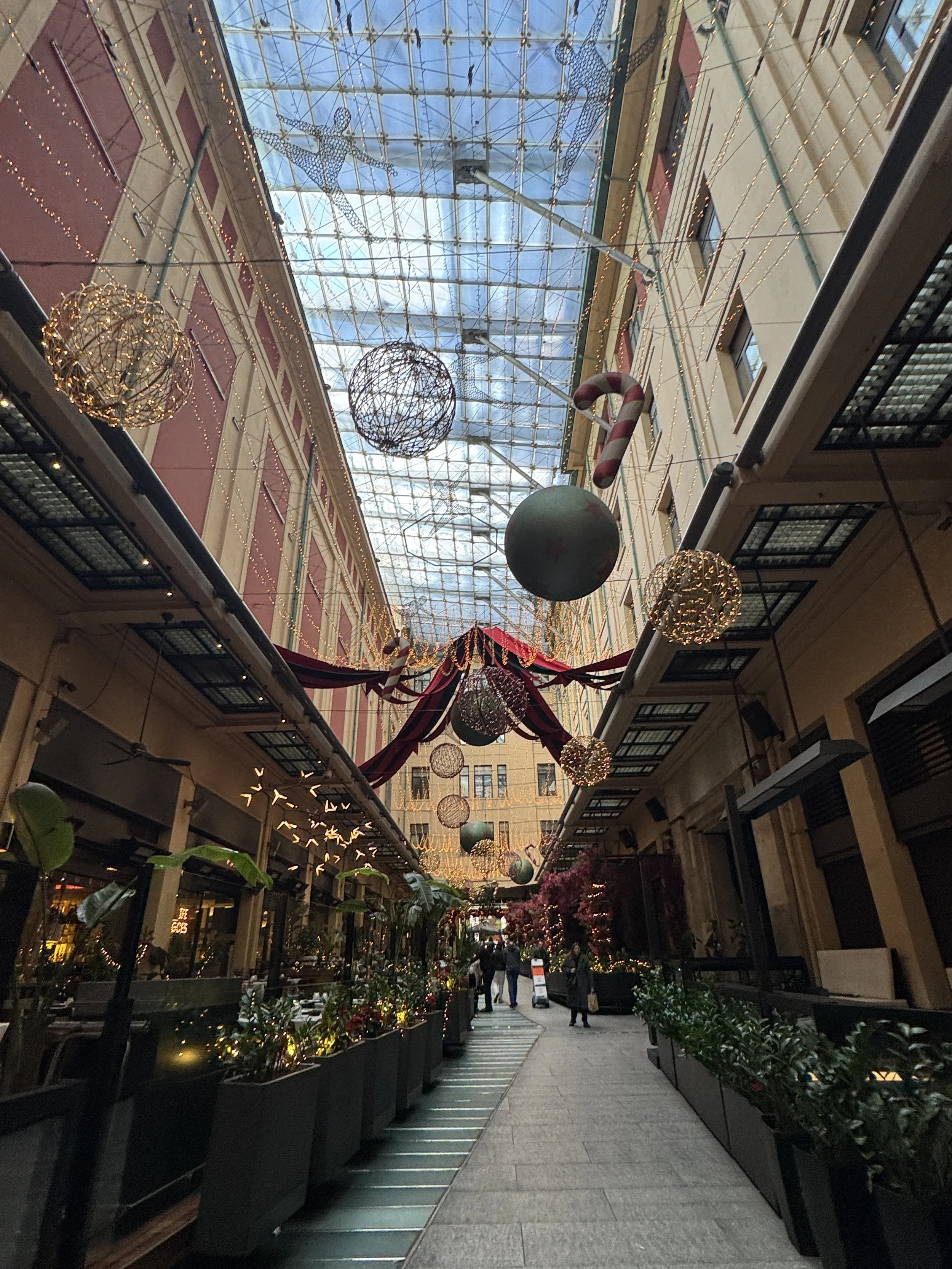
A Hidden Christmas Alley
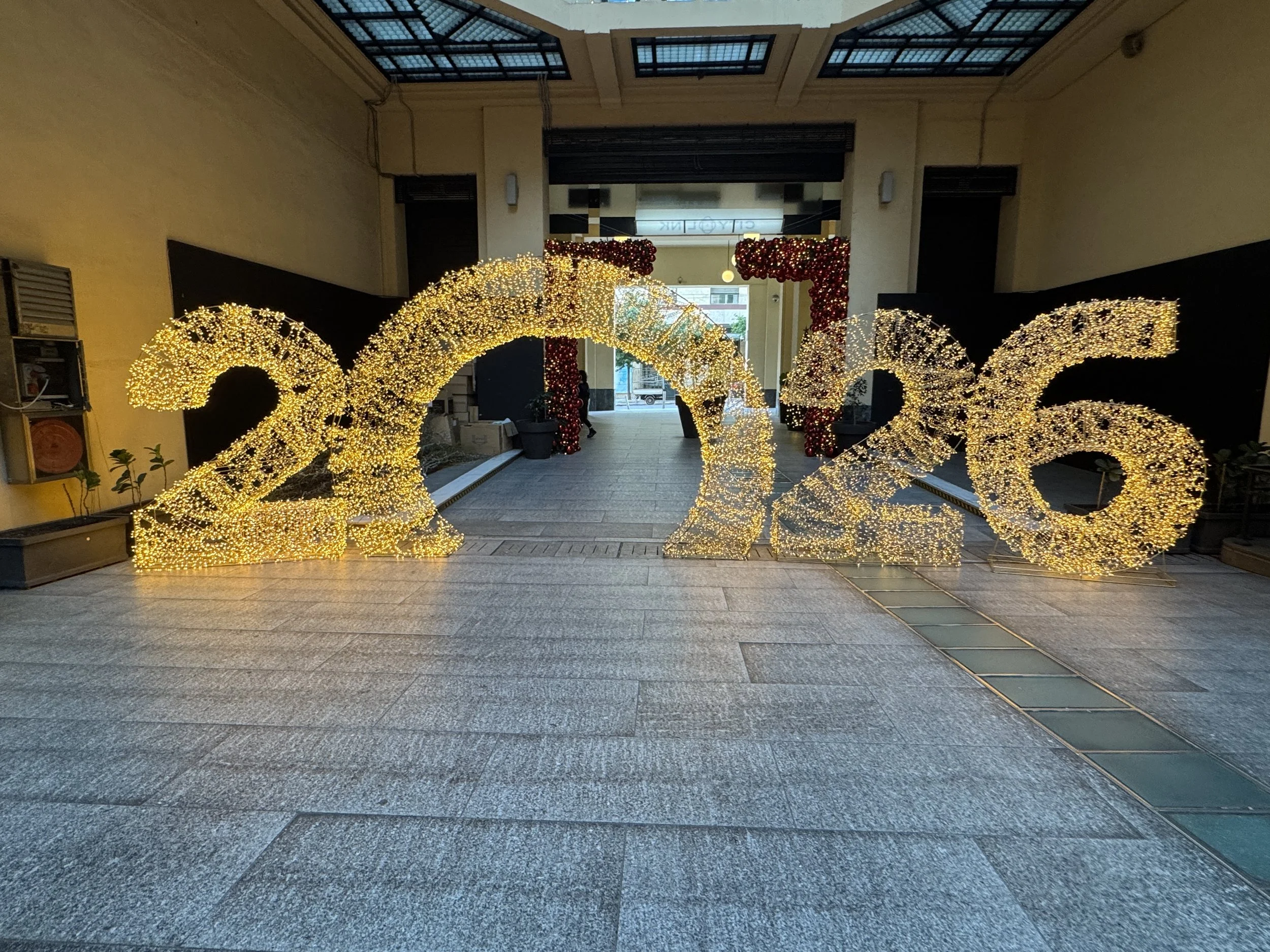
While wandering we stumbled upon a little corridor on Ameriki Street that had a festive Christmas display and several restaurants.
Unfortunately none of them were open yet, but it was still a nice little unexpected touch of holiday spirit.
The Church That Survived a Bomb
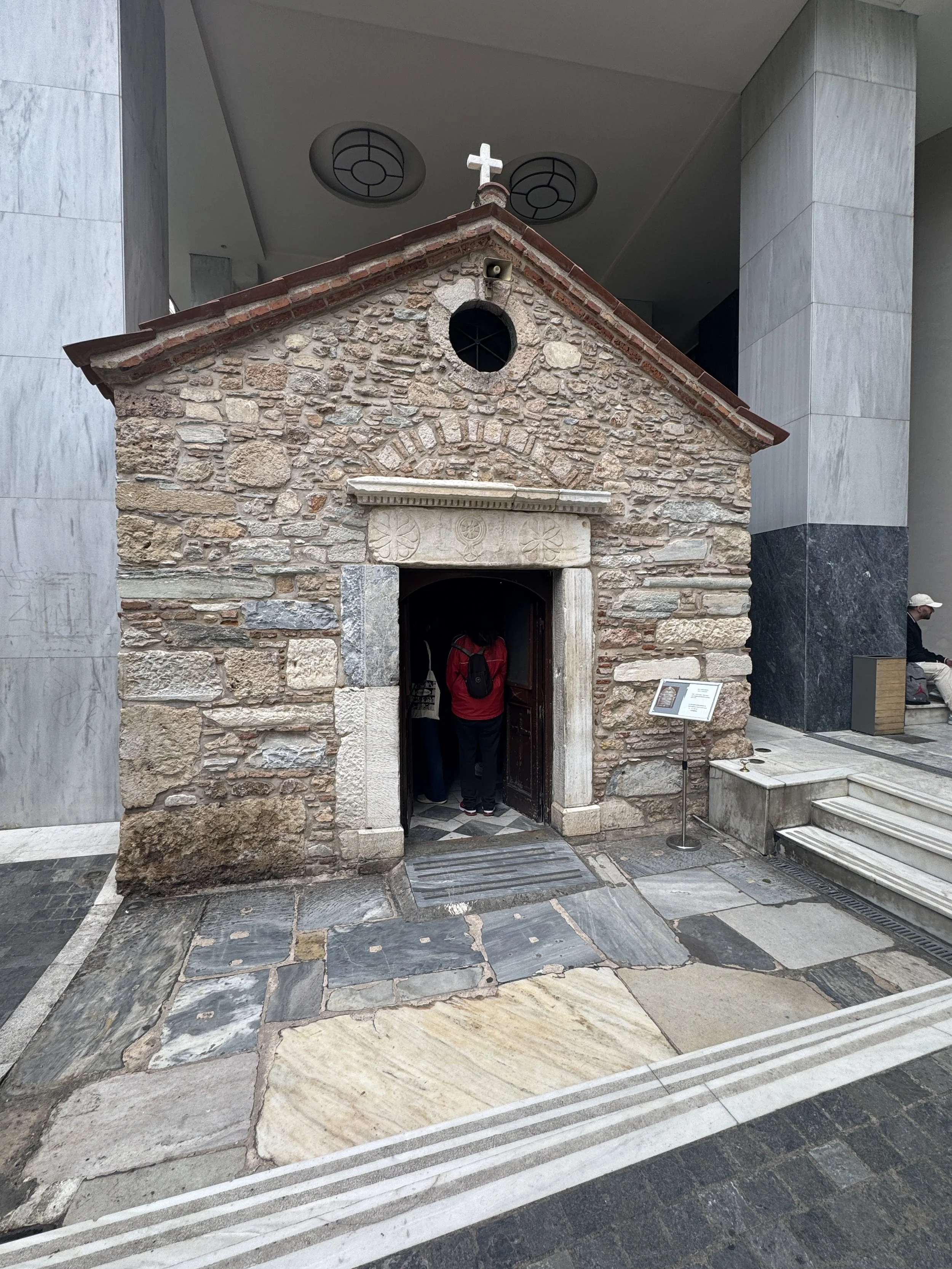
Our next stop was the Holy Church of the Sacred Power.
This tiny church is fascinating because the entire modern city was basically built around it. It literally sits below a large modern building.
The church is dedicated to the Virgin Mary, and for centuries pregnant women have come here to pray for protection and safe delivery.
It was built during 16th-century Ottoman rule.
During World War II, something remarkable happened. Athens was bombed by the Germans and a massive explosive device detonated directly above the church. The surrounding area was destroyed, but the church survived with minimal damage.
Because of this, it’s considered a symbol of divine protection and resilience.
You can literally stand in a place that should have been destroyed.
It’s tiny, but incredibly cool to see.
Our First Greek Meal
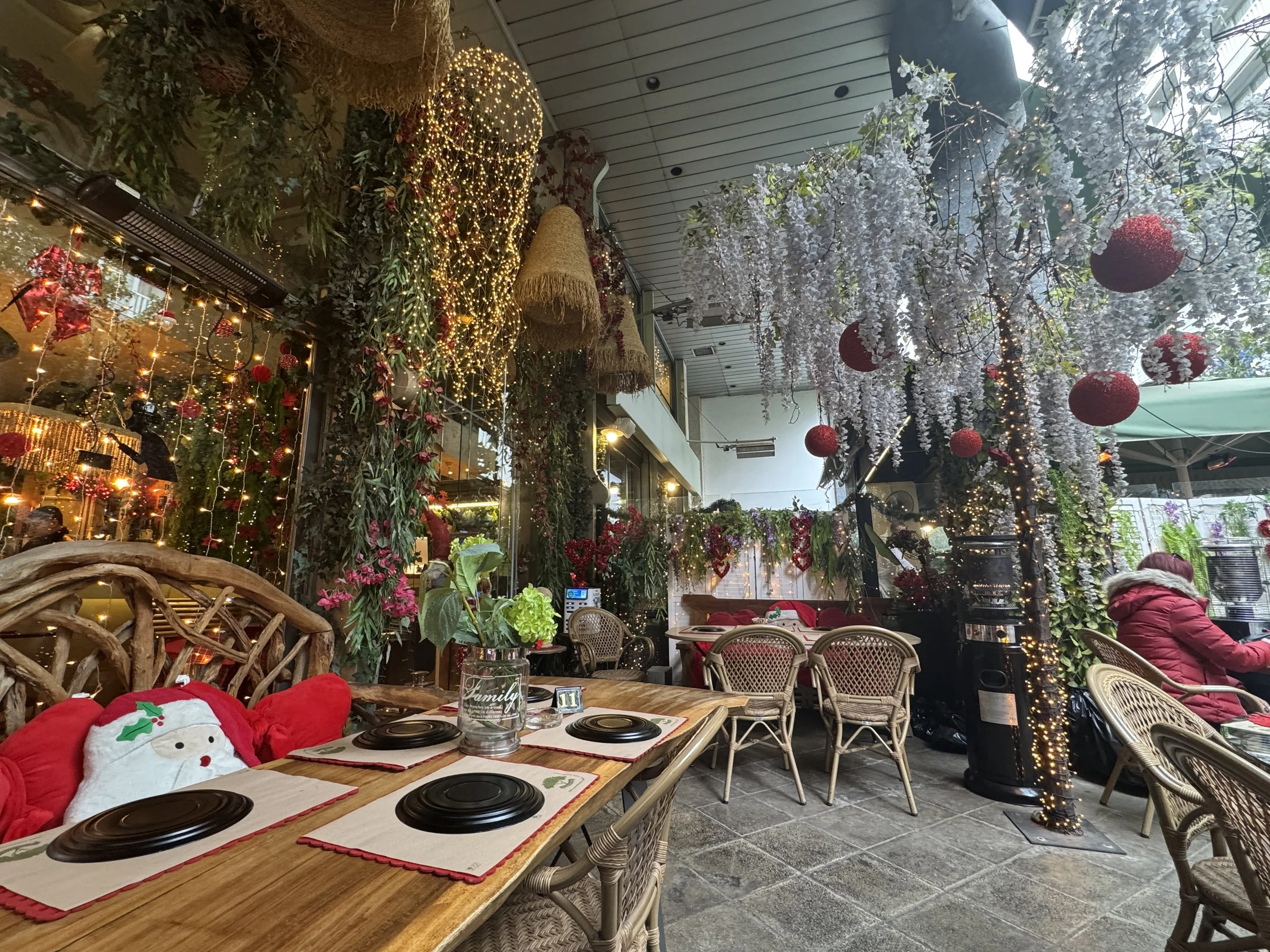
Right next to the church we found an eclectically decorated restaurant that felt like a mix of whimsy and Christmas called In Town.
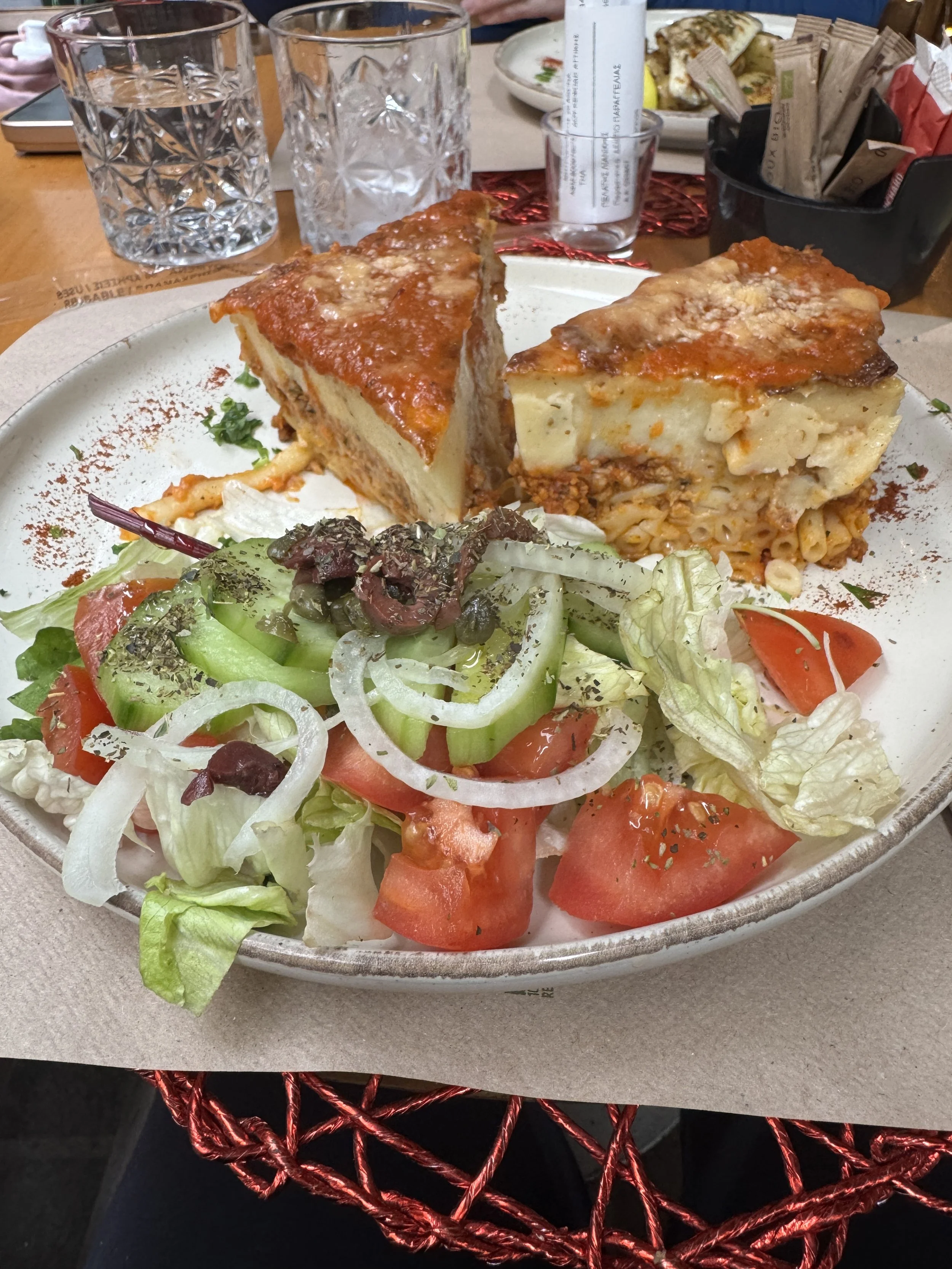
I ordered Pastítsio, which was homemade and served with a mini Greek salad. It was delicious and exactly what I wanted for my first Greek meal.
The restaurant itself was very cute, and the service was pretty typical for Europe.
A Peaceful Walk Through Athens National Garden
From there we walked past St. Paul’s Anglican Church on the way to Athens National Garden.
The park was created in the 19th century as a royal garden. Today it’s a peaceful escape filled with:
palm trees
quiet paths
small ruins
ducks
hidden corners
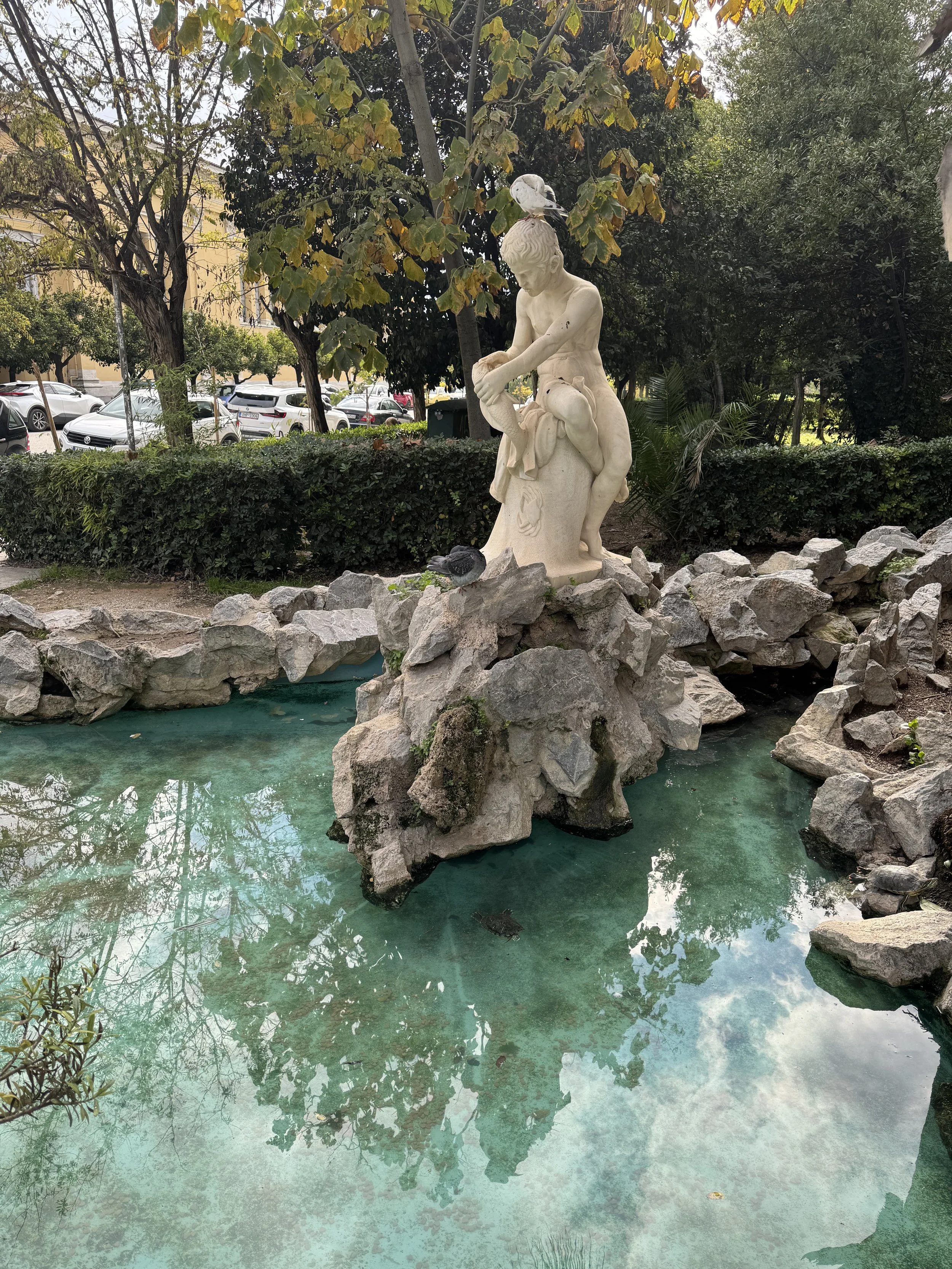
It was a relaxing walk and we saw a small turtle pond and even a large nest hanging from a tree.
The Marble Stadium of the First Modern Olympics
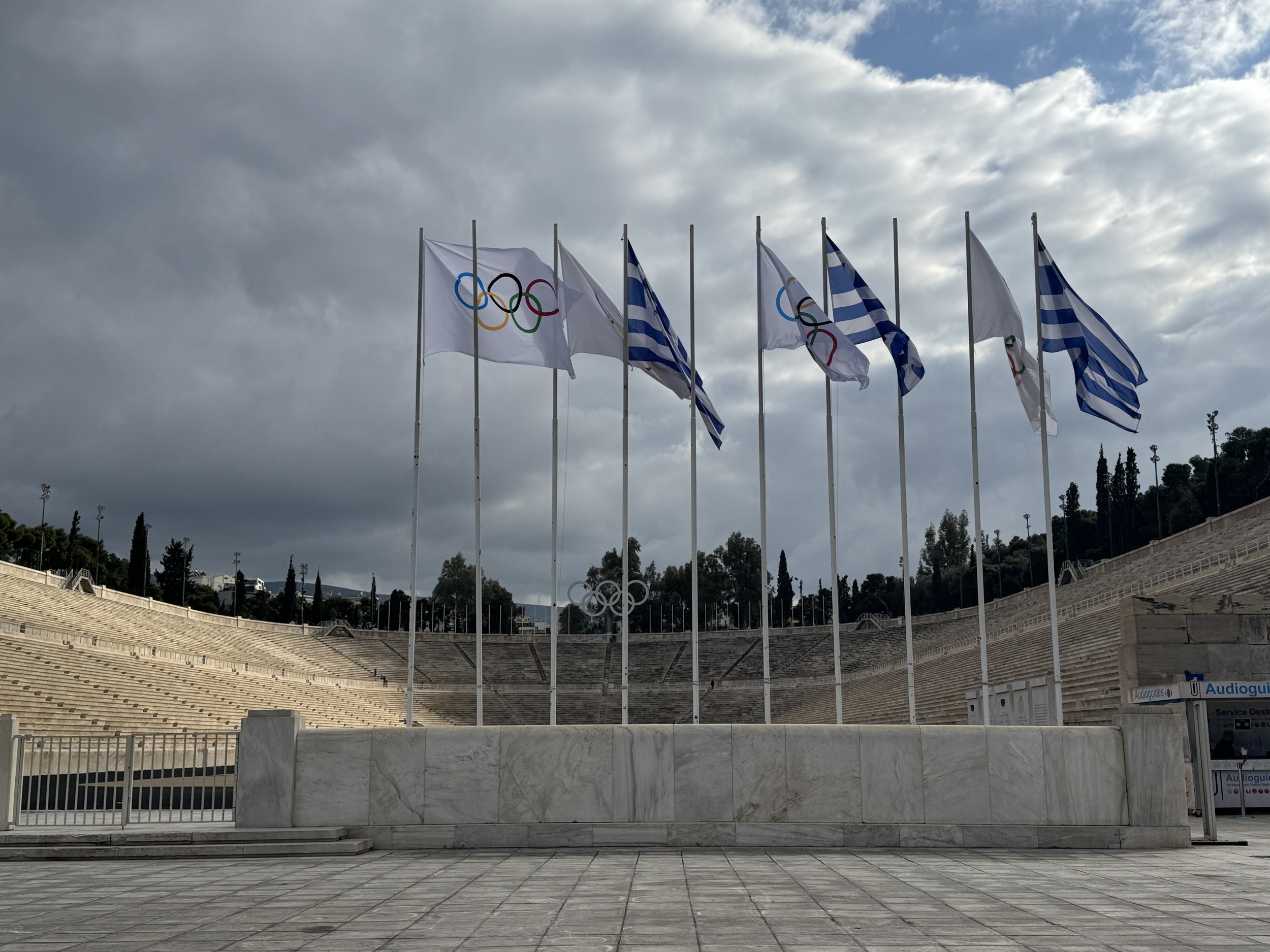
The park provided the quickest route to Panathenaic Stadium, which is the only stadium in the world built entirely of marble.
Its origins date back to 330 BCE, when it was first constructed for the Panathenaic Games, an ancient athletic festival honoring Athena.
In the 2nd century CE, it was rebuilt entirely in marble by the Roman statesman Herodes Atticus, turning it into one of the grandest arenas of the Roman world.
After centuries of abandonment, it was excavated and restored in the late 1800s.
It was then used in 1896 for the first modern Olympic Games.
You can pay a small fee (€12) to go inside, but we decided to enjoy the view from outside and save the money.
Google Maps Tried to Get Us Arrested
We then headed toward the Temple of Athena, which seemed accessible from an entrance that apparently does not exist.
I’m guessing you actually have to enter from the stadium and pay admission.
Note: Don’t follow Google Maps unless you’re prepared to climb a fence and enter illegally.
Luckily, we were planning to visit the First Cemetery of Athens nearby anyway.
Athens’ Historic First Cemetery
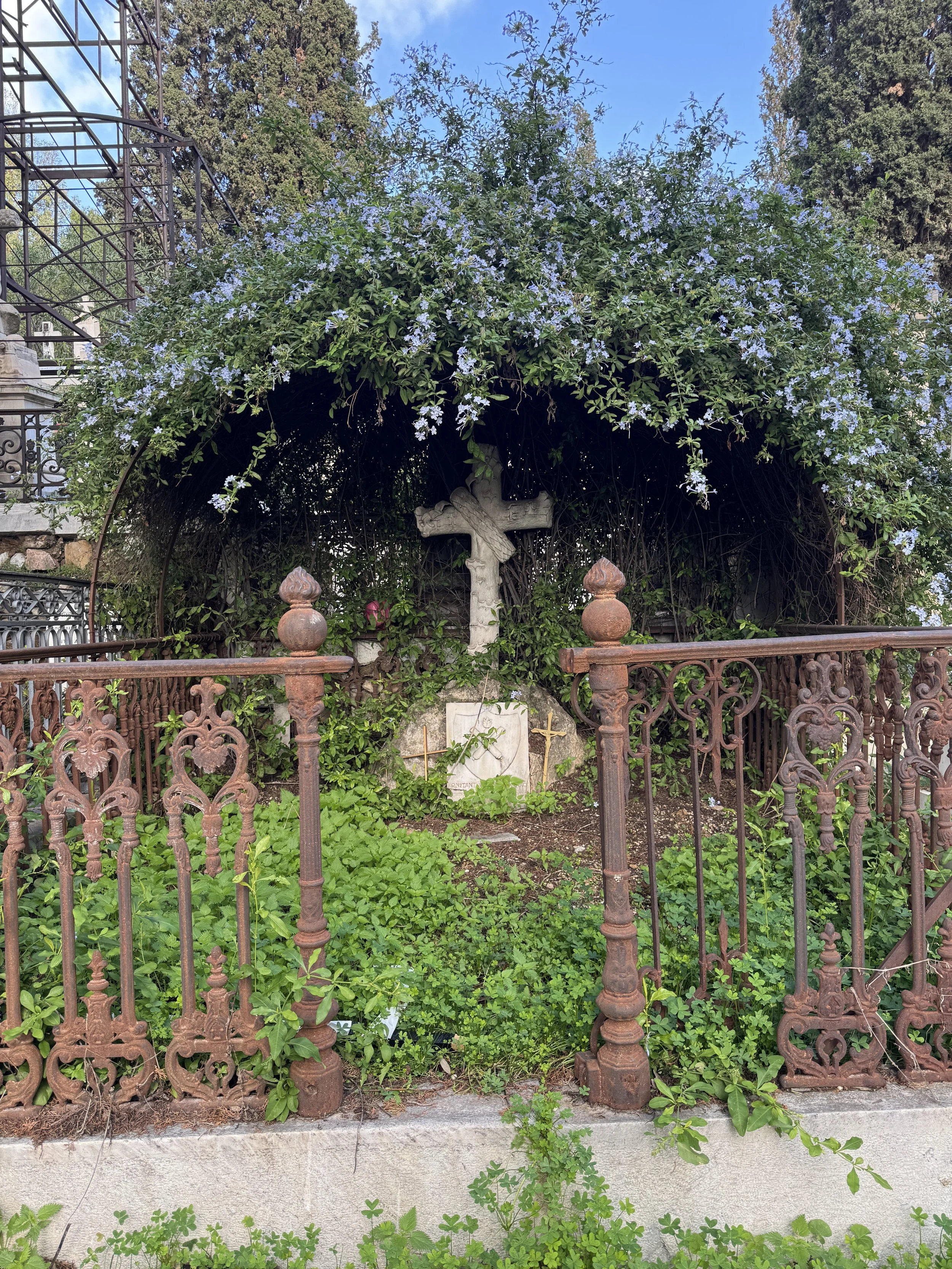
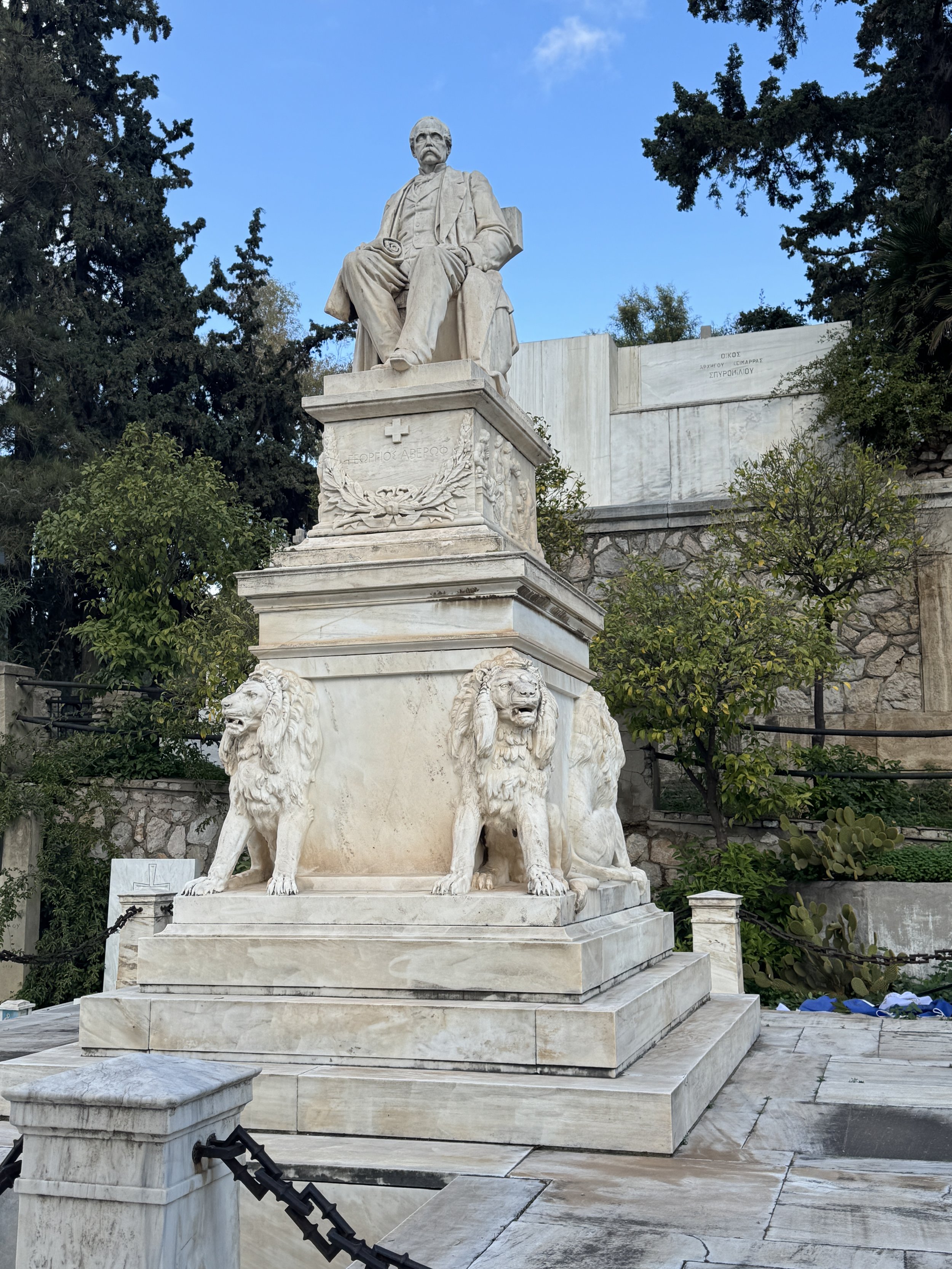
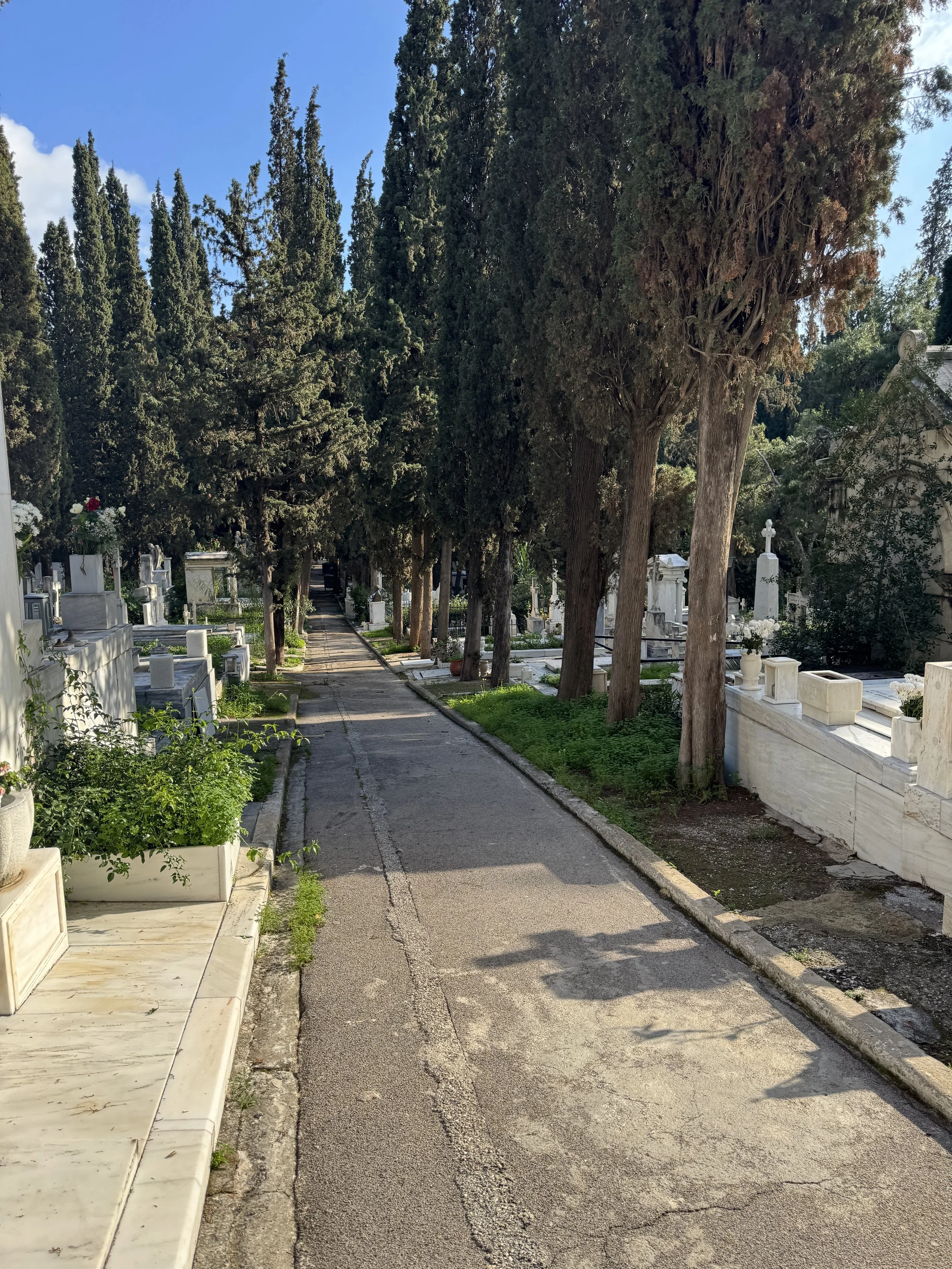
The First Cemetery of Athens was established in 1837, shortly after Athens became the capital of the newly independent Greek state.
It reflects the birth of modern Greece and serves as the final resting place for many of the nation’s most influential figures.
Inside we noticed three churches, along with some very impressive:
tombs
gravestones
statues
It was a beautiful and peaceful area of the city.
There were also lots of stray cats happily living there.
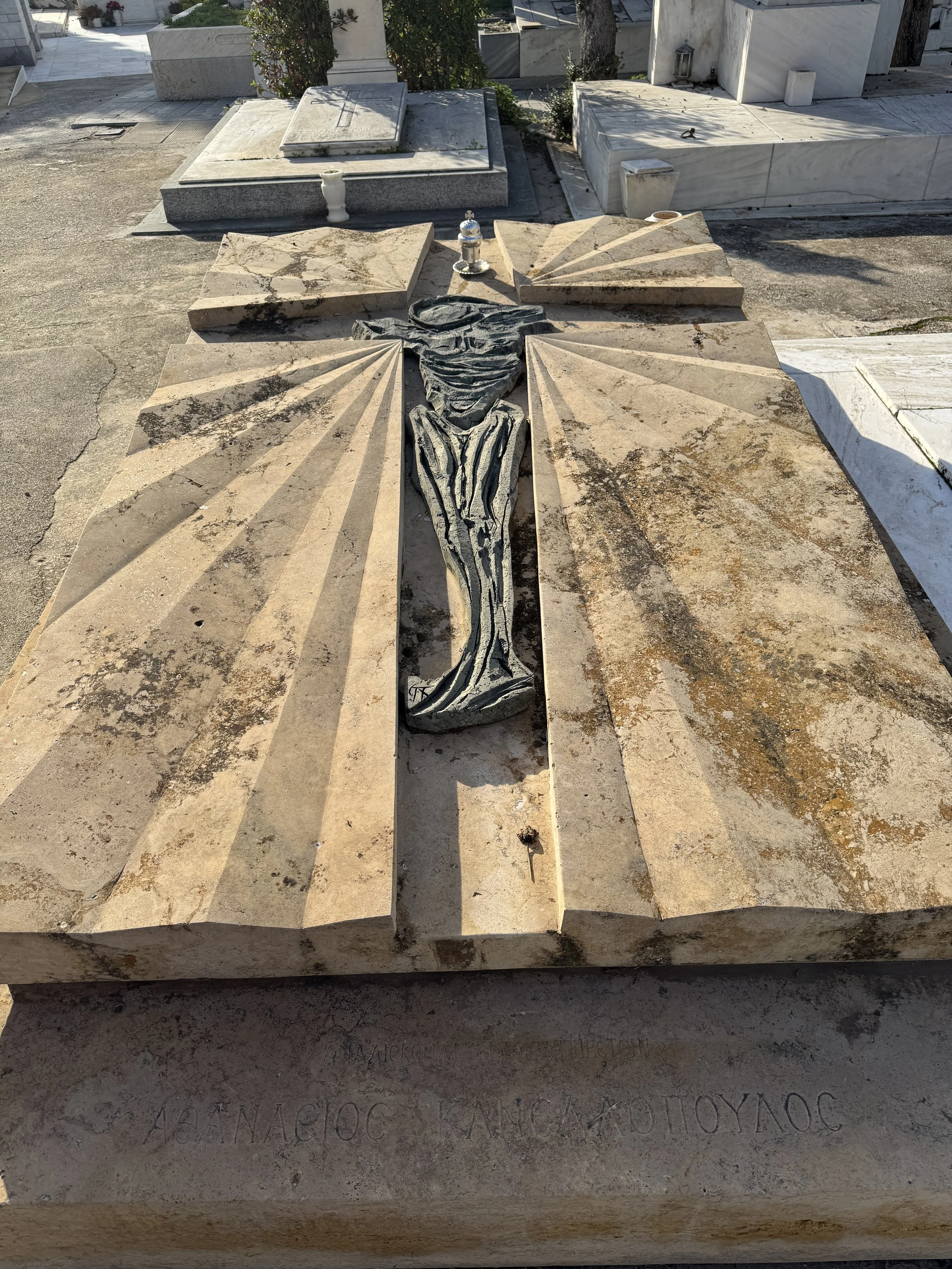
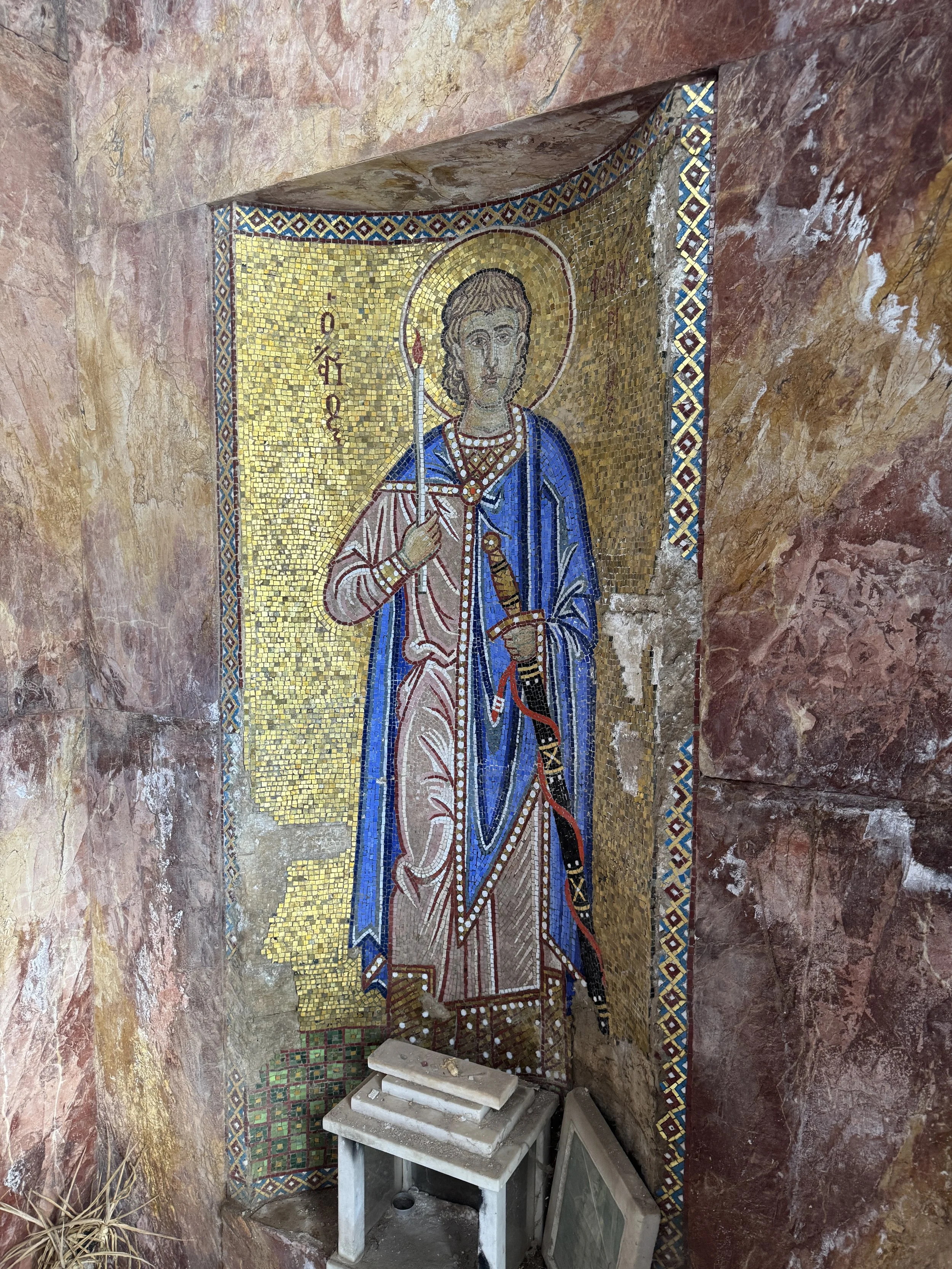
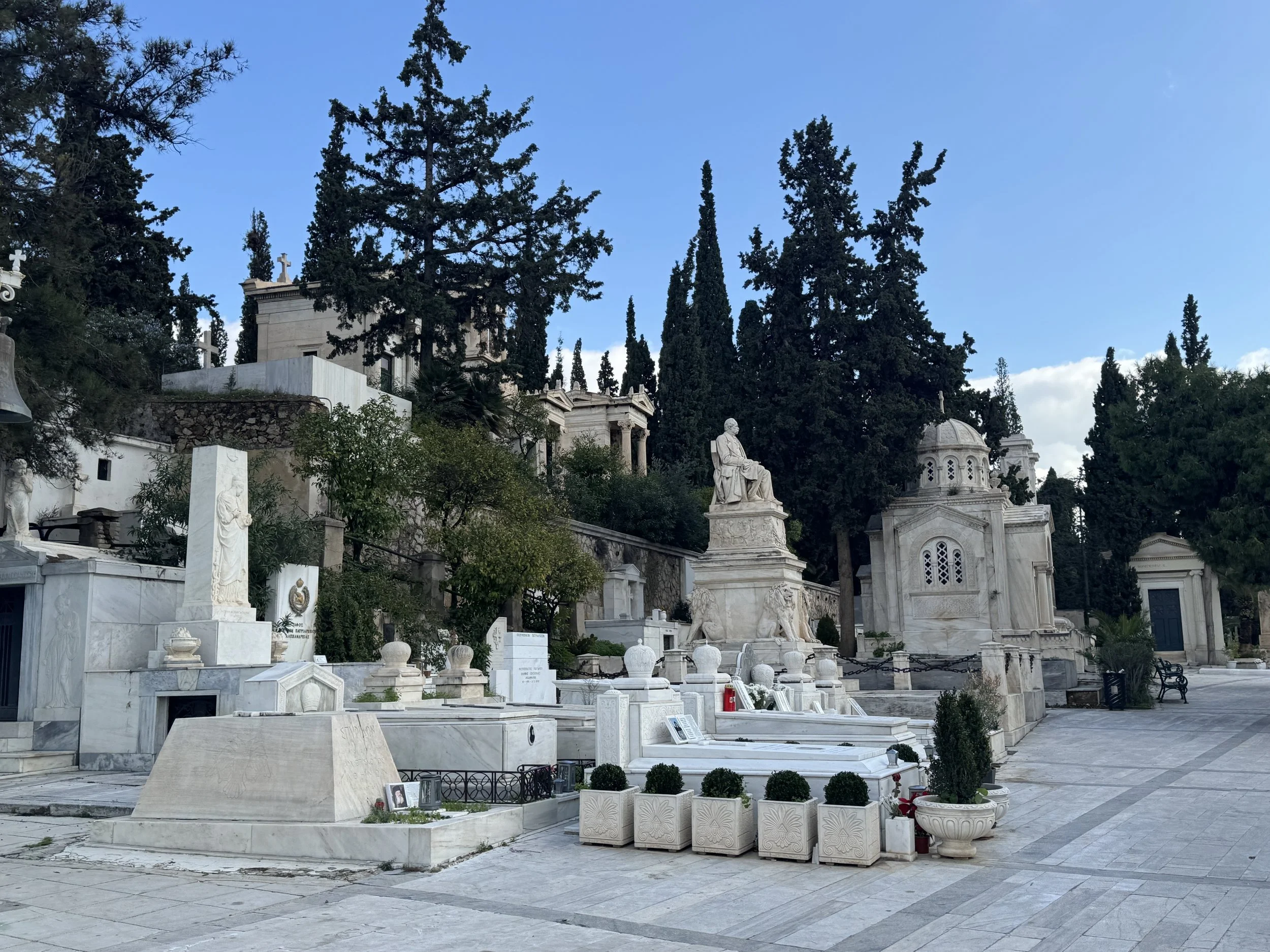
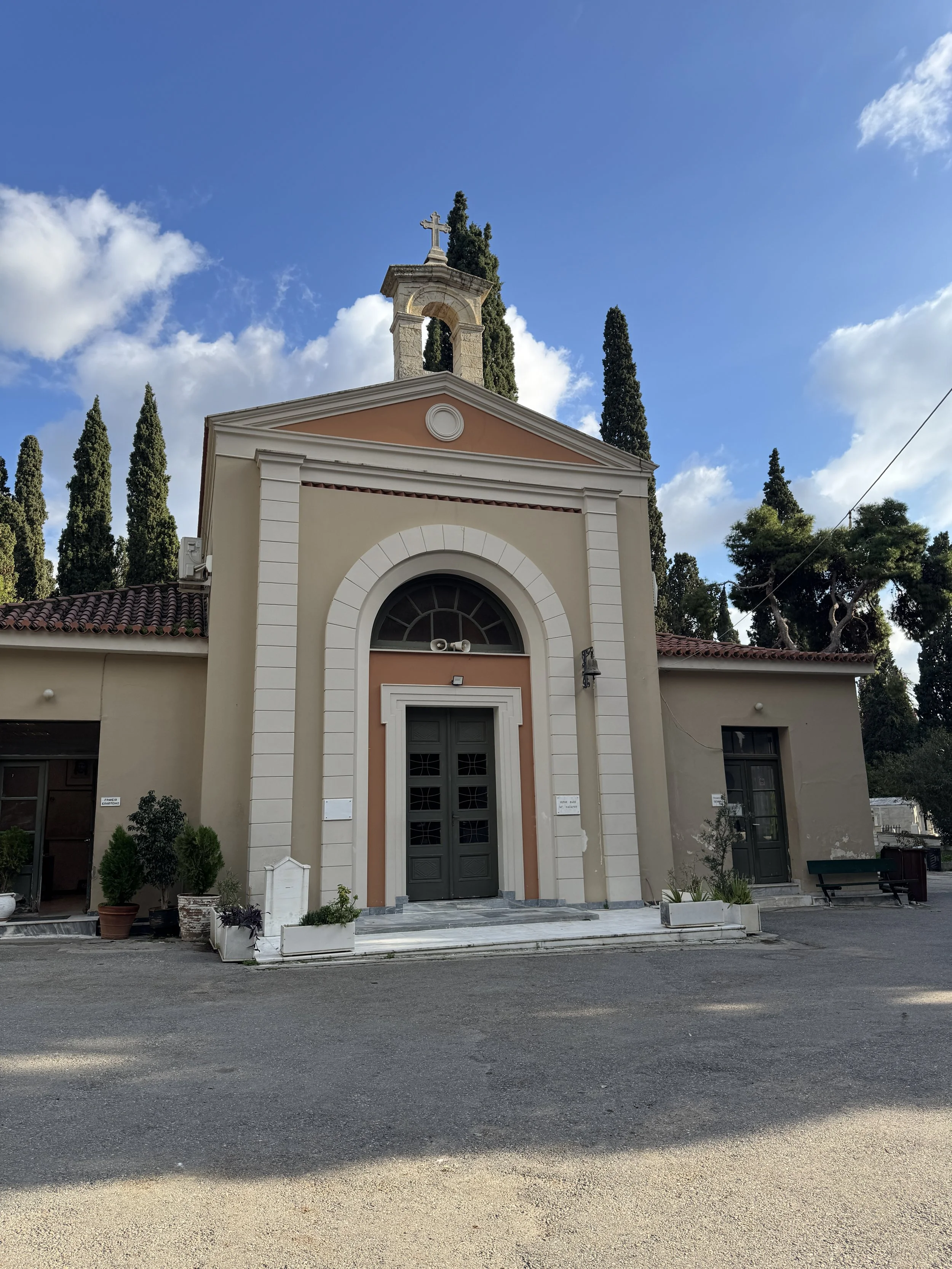
A Church Built from Ancient Ruins
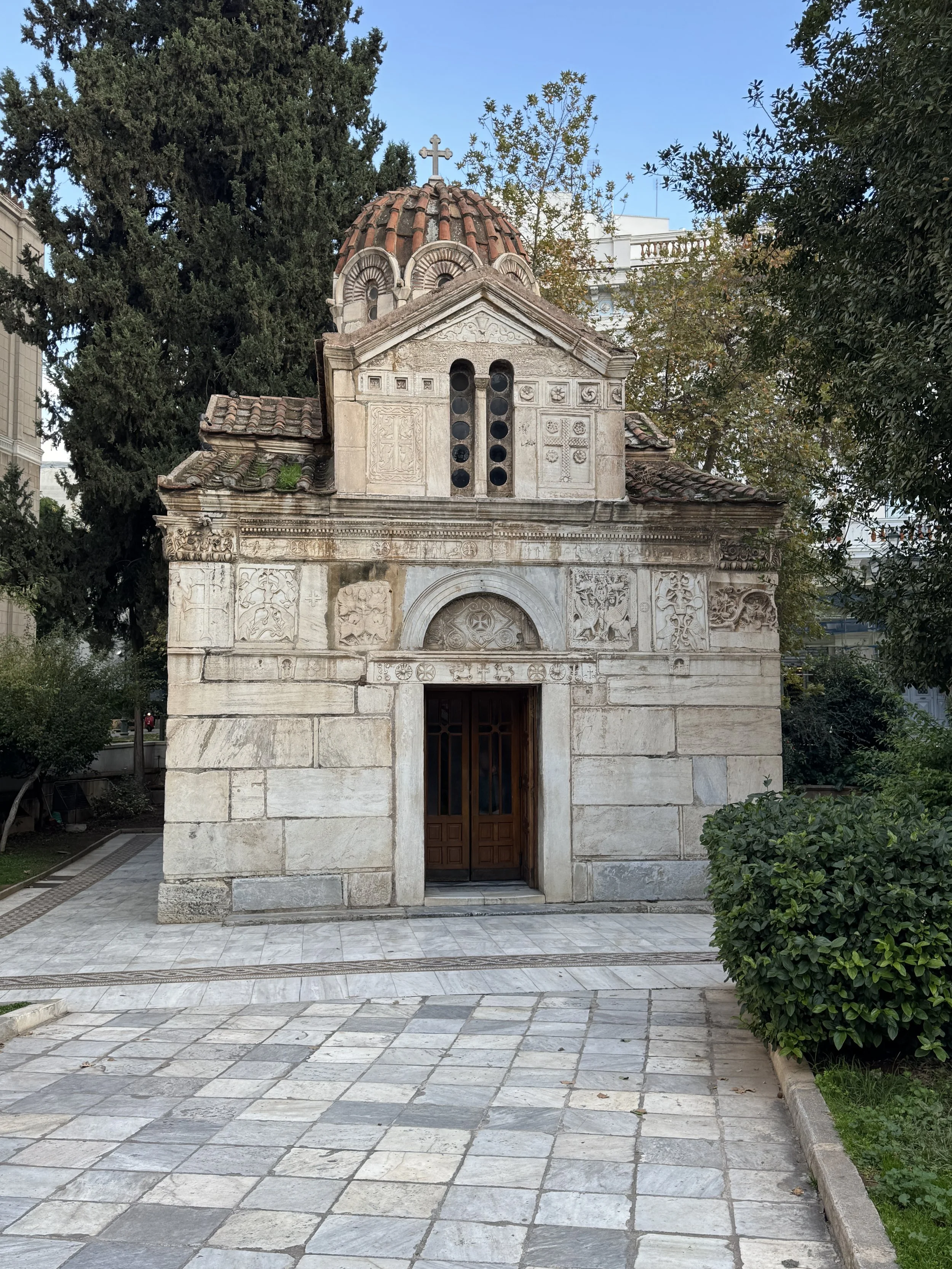
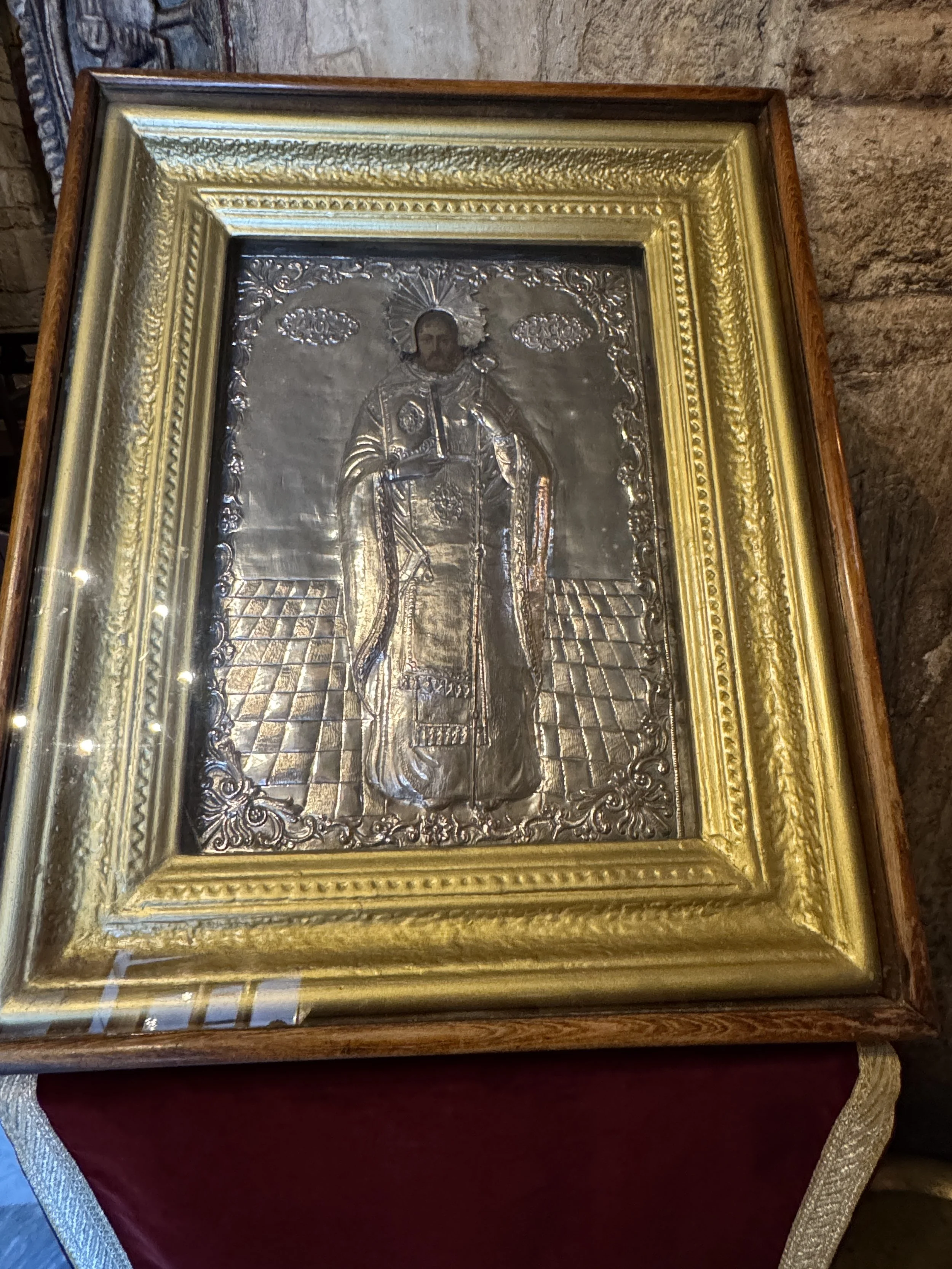
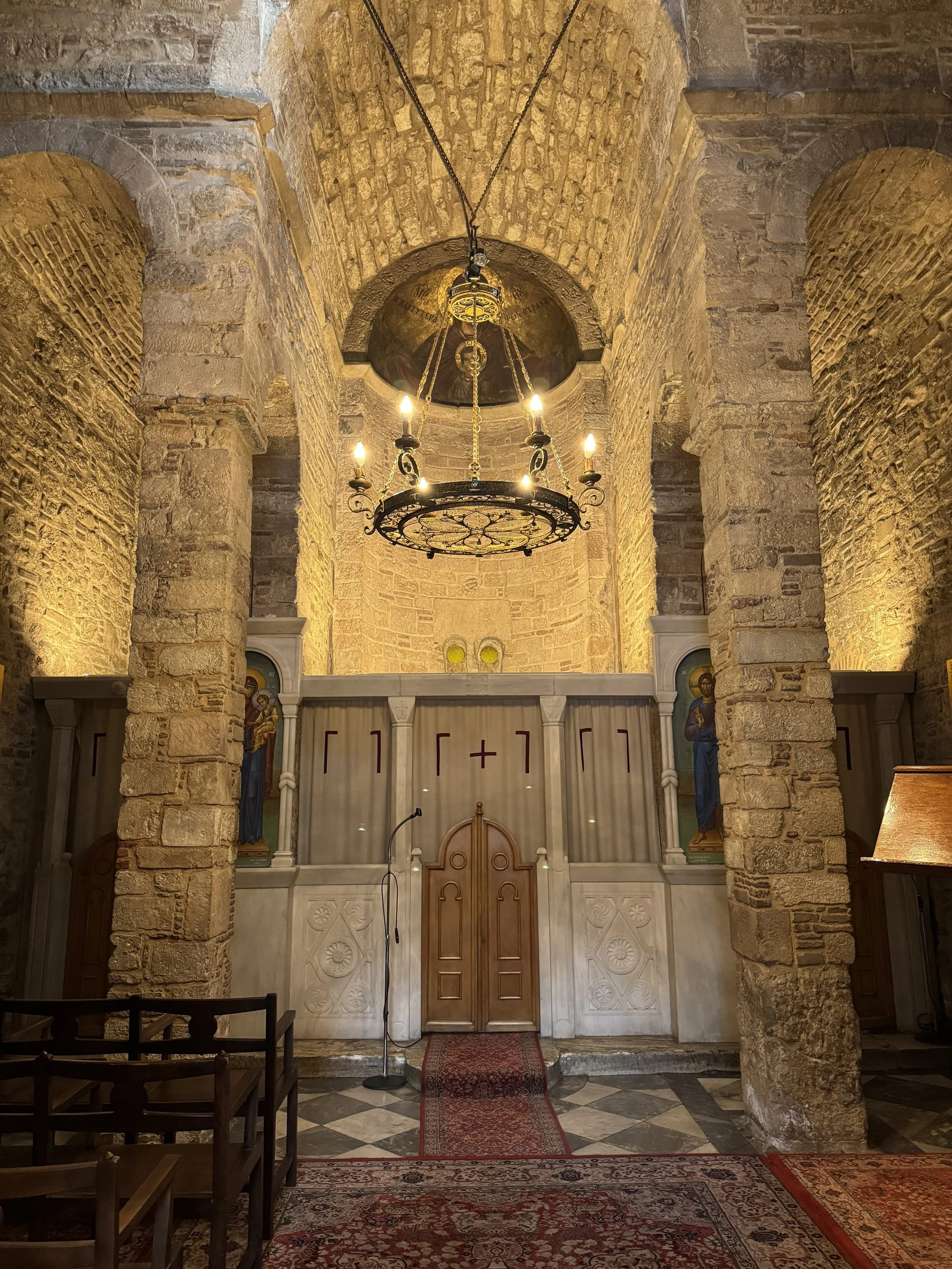
From there we headed toward Church Panagia Gorgoepikoos, also known as the Little Metropolitan Church.
It was constructed around 1150–1200 AD and dedicated to the Virgin Mary as “Gorgoepikoos,” meaning “She Who Responds Quickly” to prayers.
During Byzantine times it served as Athens’ main cathedral, long before the large modern cathedral existed.
What makes it especially interesting is that the entire church was built from reused stones (spolia) taken from:
ancient Greek temples
Roman monuments
early Christian structures
More than 90 carved reliefs are embedded in the exterior walls showing:
pagan gods
zodiac signs
animals
Christian symbols
Athens’ Grand Cathedral
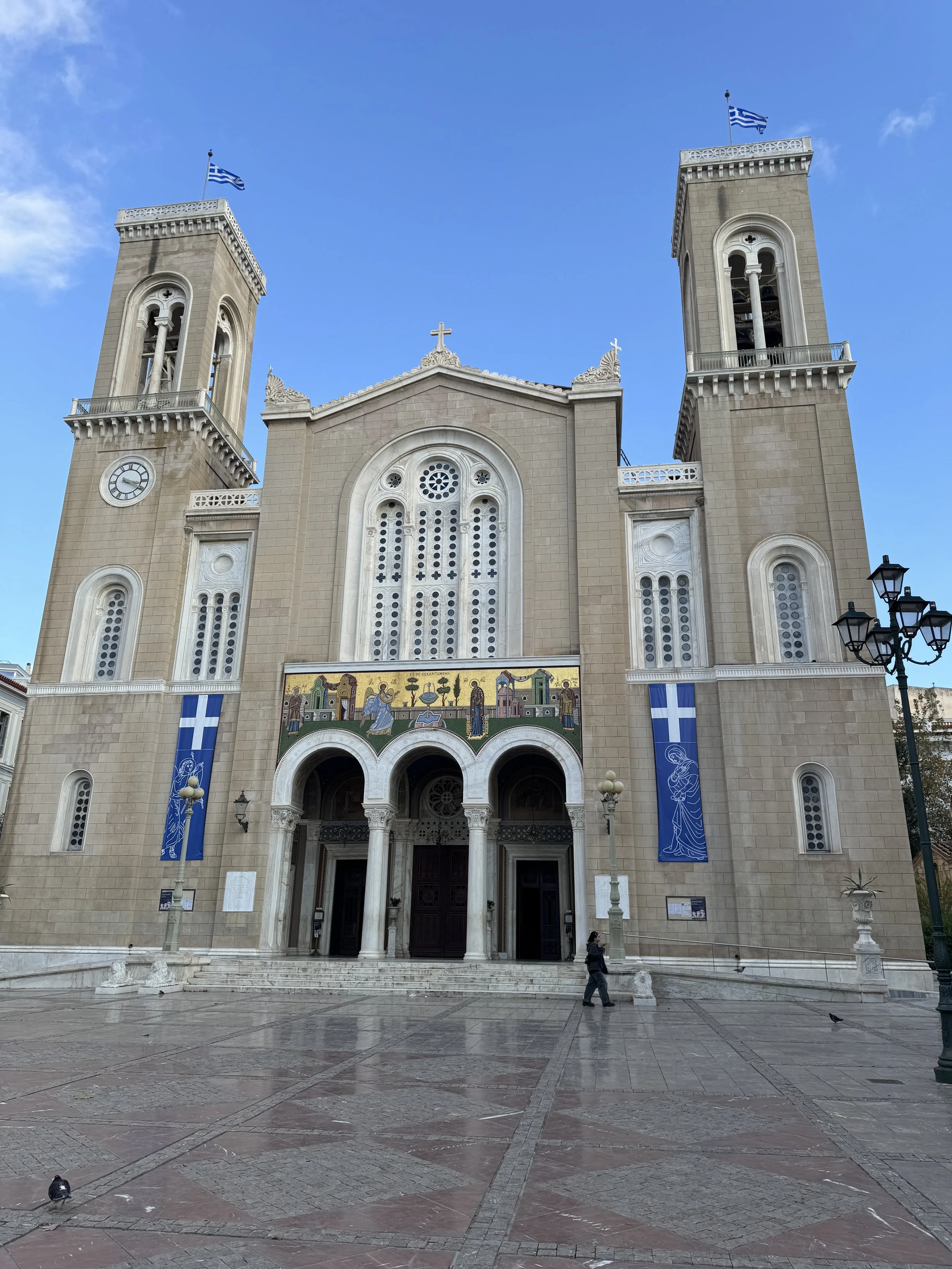
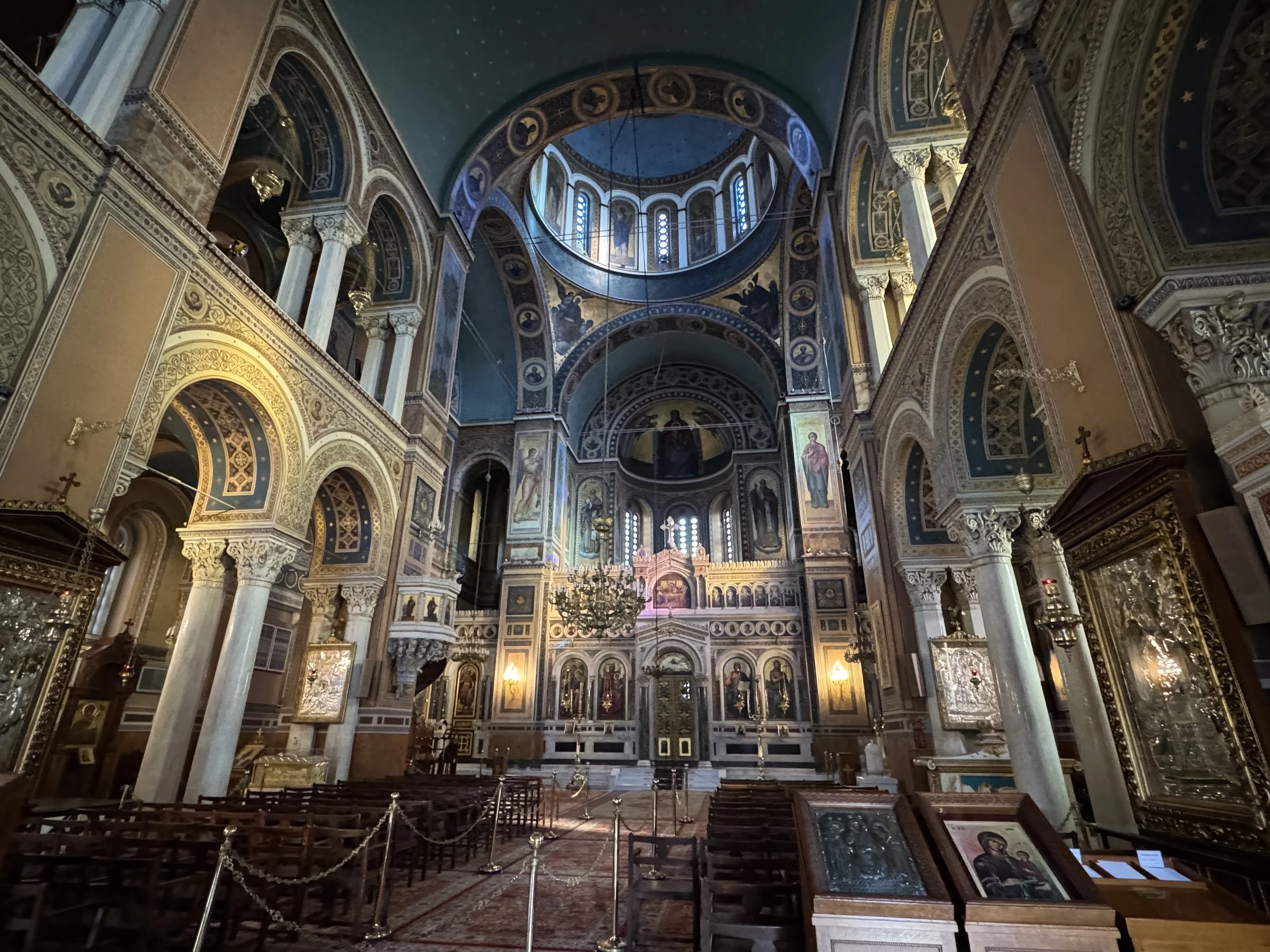
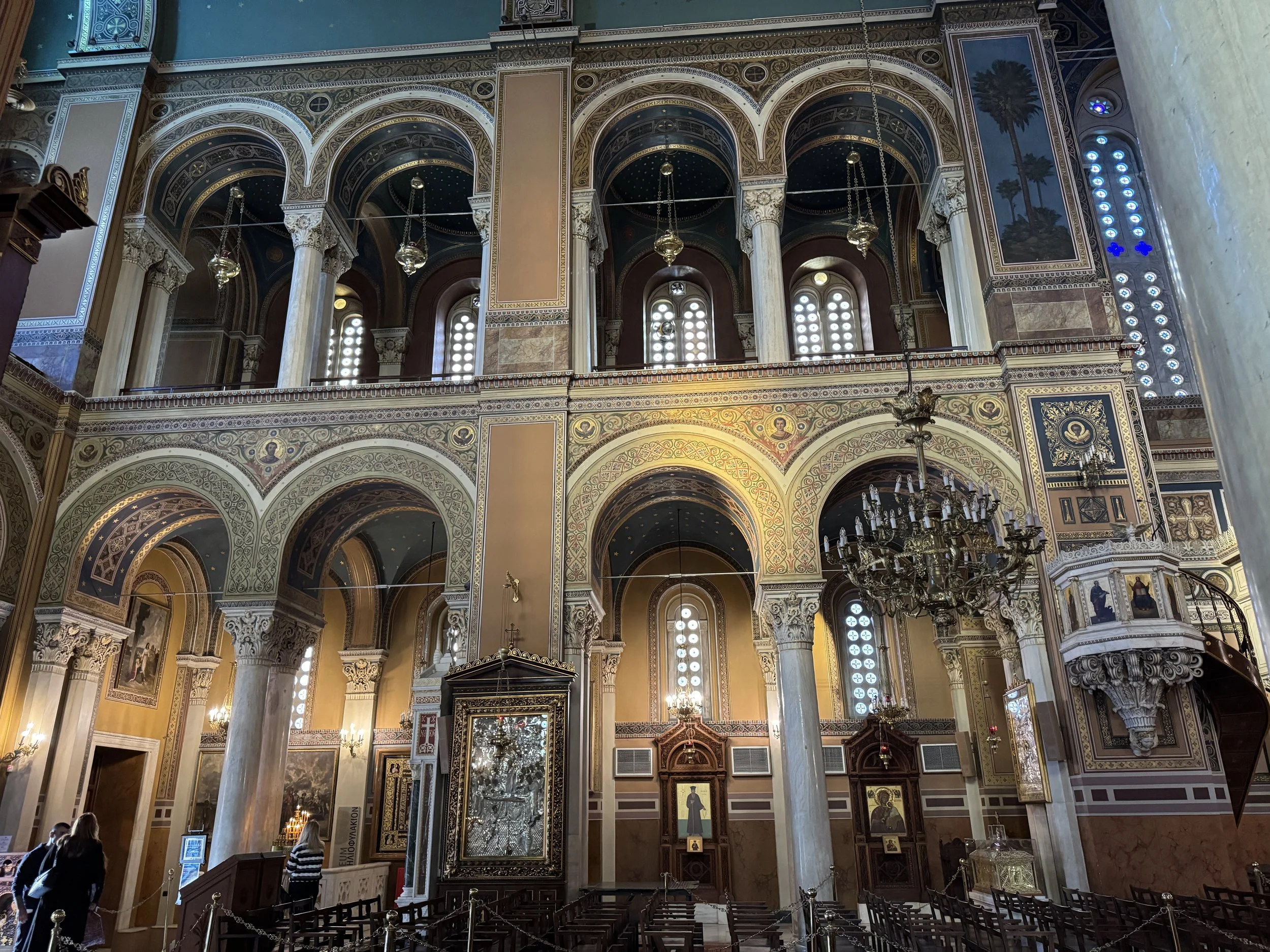
Right next door is the Metropolitan Cathedral of Athens, constructed in 1842.
Like the smaller church beside it, the cathedral was built using marble and stones taken from over 70 ancient Byzantine and classical ruins around Athens.
This symbolically ties together:
Ancient Greece
Byzantine Christianity
Modern Greece
into one national monument.
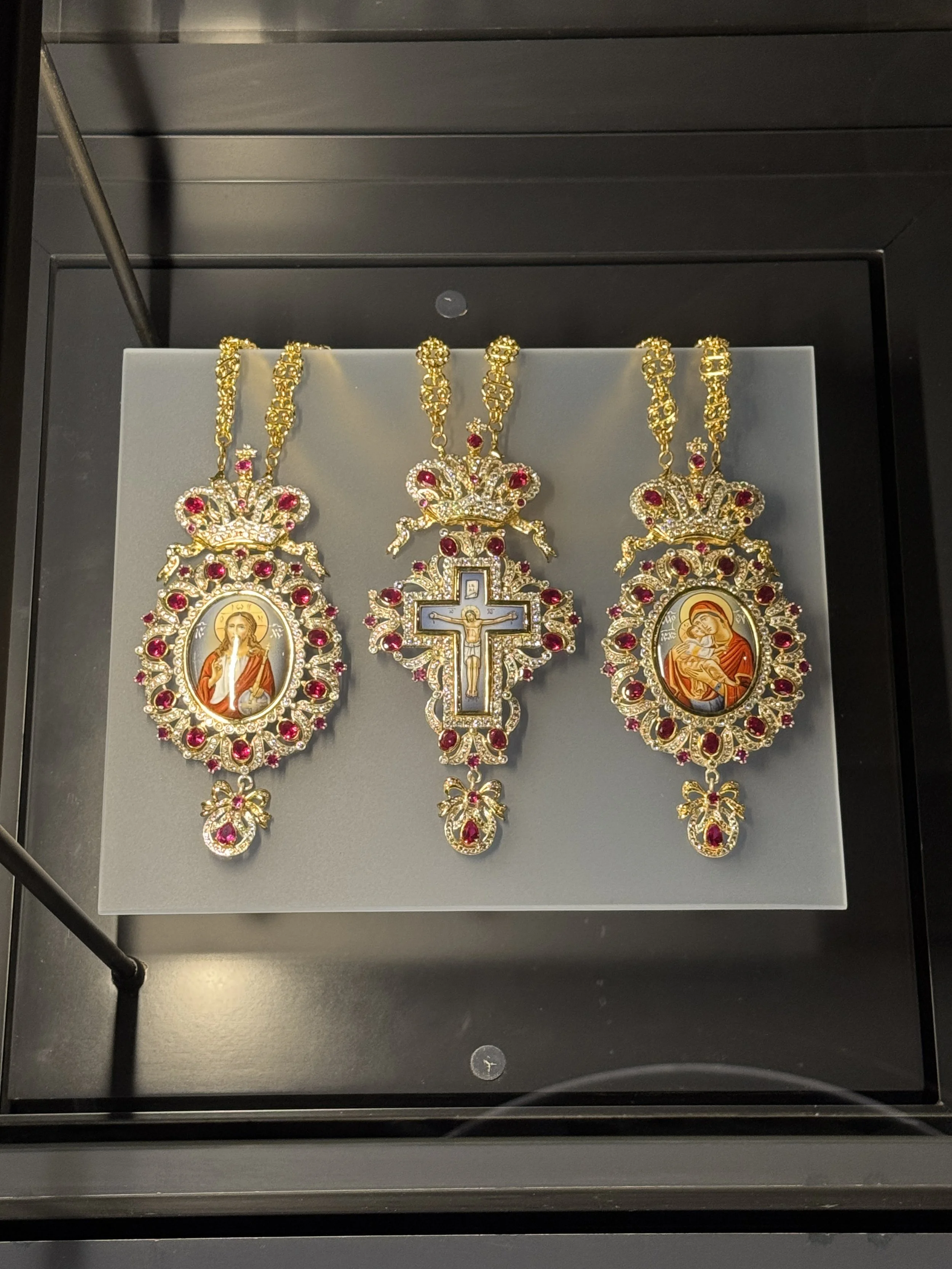
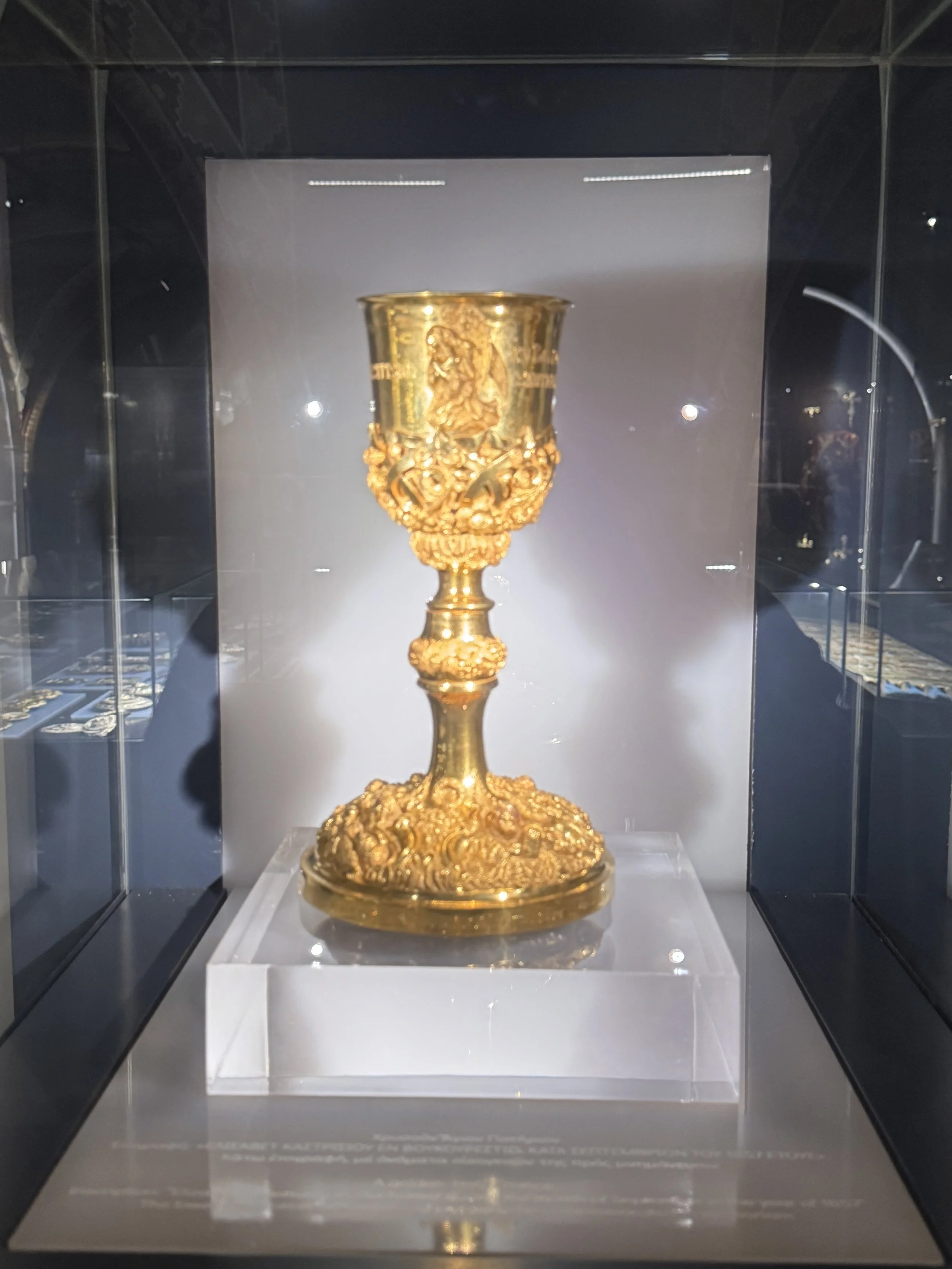
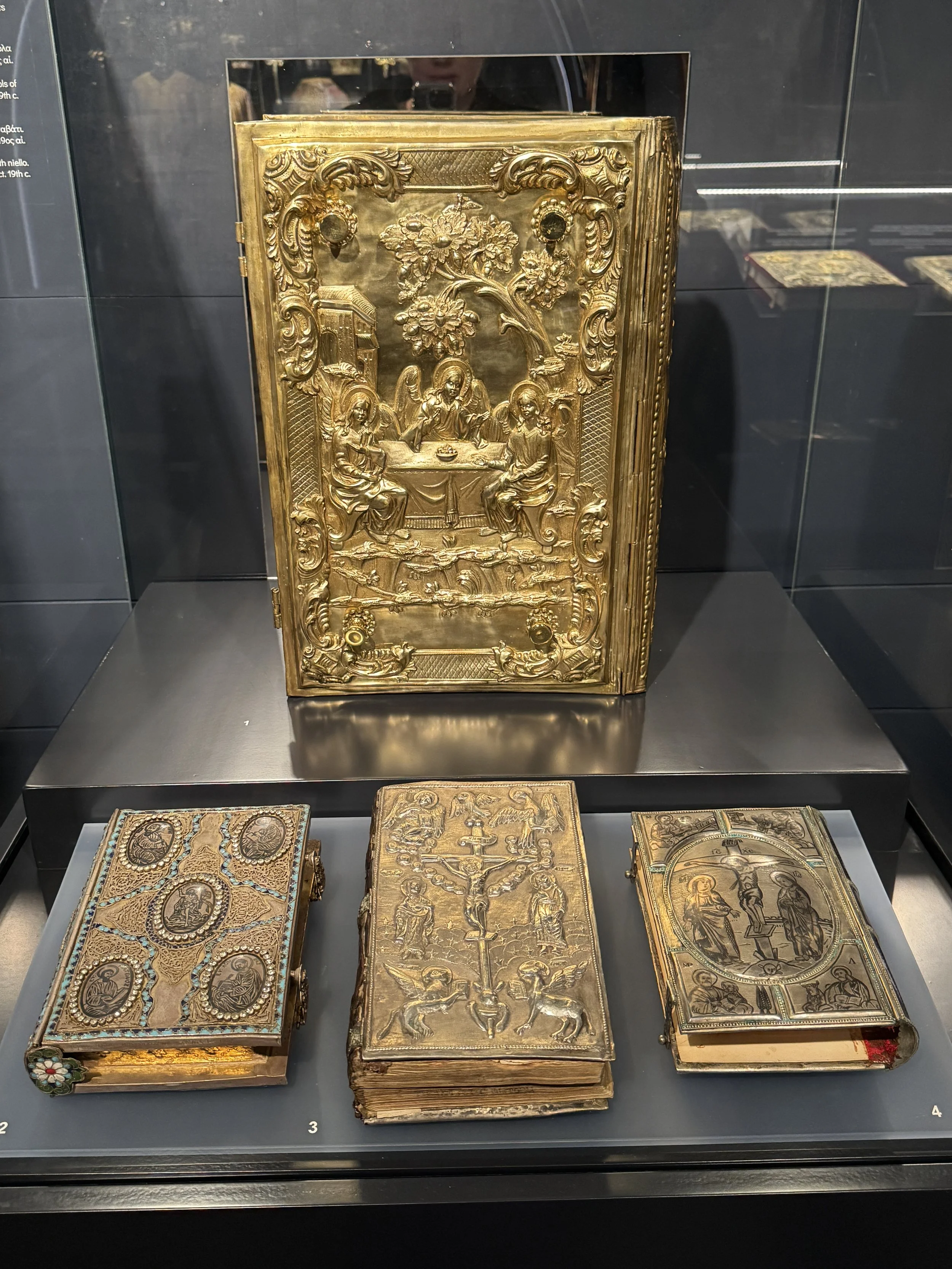
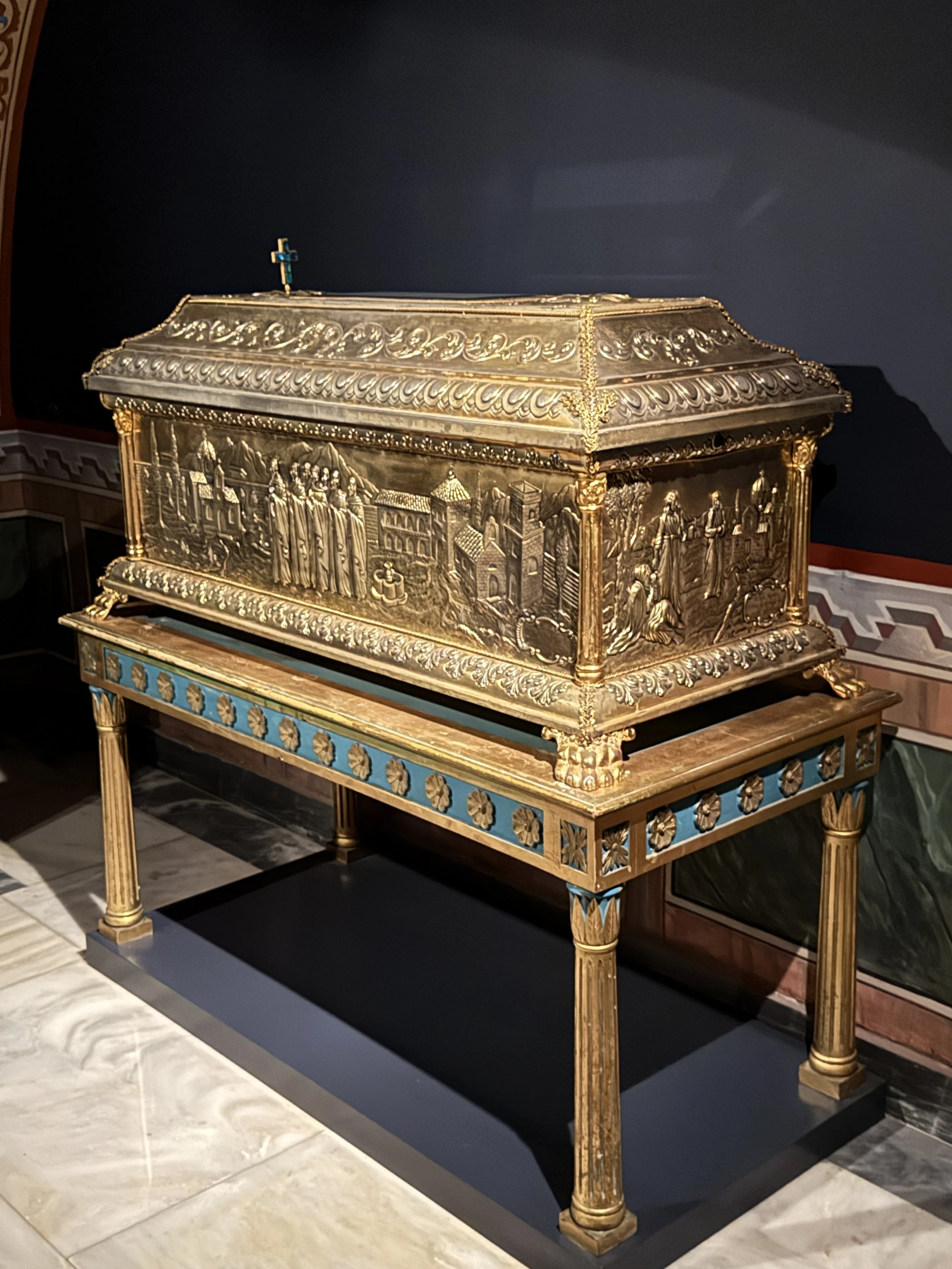
Inside we met a very nice man selling admission (€3) to the Ecclesiastical Treasury & Reliquary Museum beneath the cathedral.
The museum is essentially the treasure vault of the Archdiocese, featuring:
jeweled crosses and crowns
gold and silver chalices
bishop and patriarch vestments
reliquaries containing saints’ remains
ornate Gospel books and icons
gifts donated by royalty, wealthy patrons, and clergy
It was definitely worth the admission, especially since the money is donated back to the church.
An 11th-Century Church in the Middle of a Shopping Street
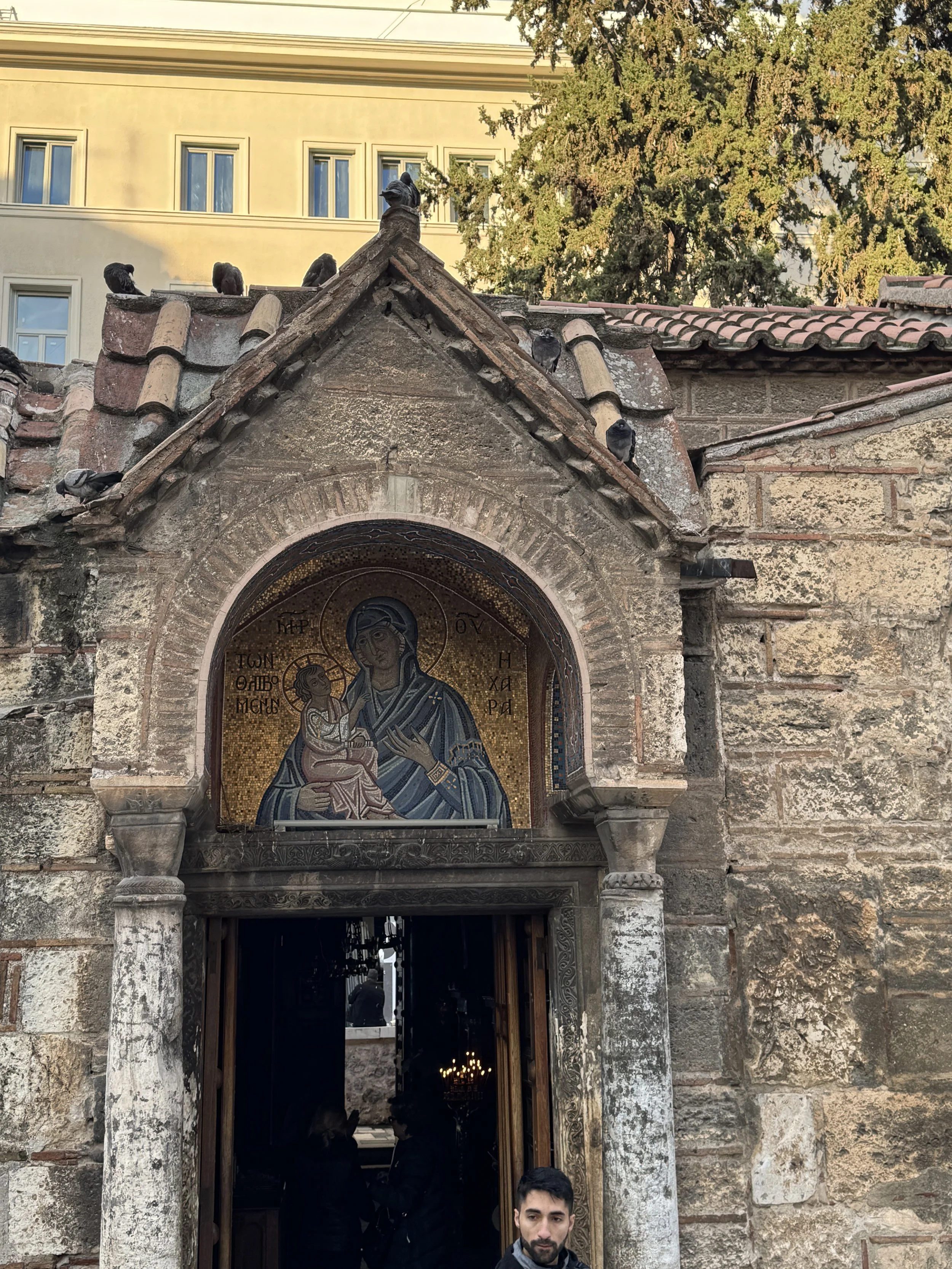
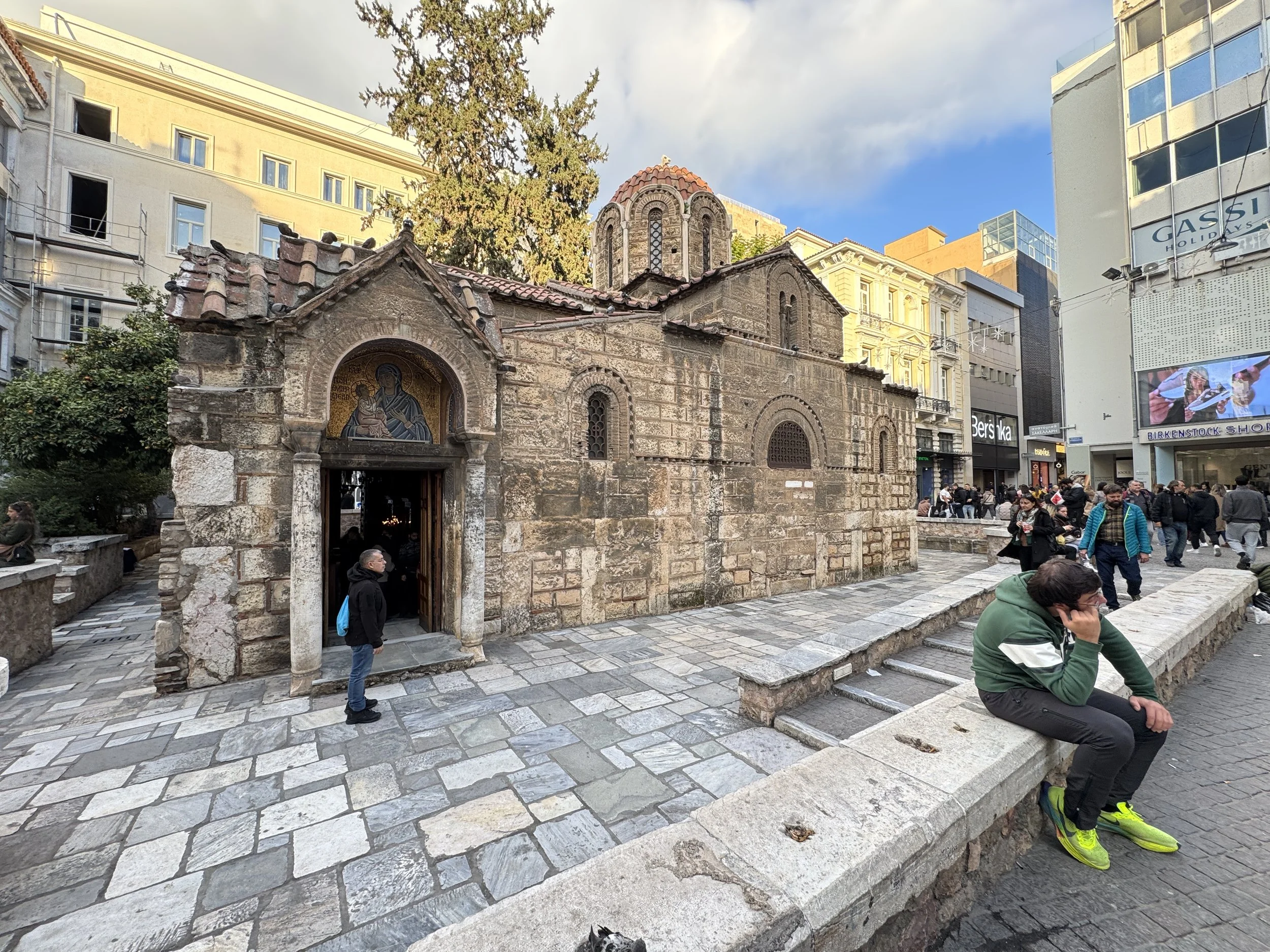
While walking back to the hotel we passed Panagia Kapnikarea, a beautiful 11th-century Byzantine church (around 1050 AD) located directly on busy Ermou Street.
The church survived:
the Ottoman period
modern redevelopment
even planned demolition in the 1800s
It was ultimately saved by strong public and royal support, and today it remains one of the oldest churches in Athens.
Unexpected Ruins at Kotzia Square
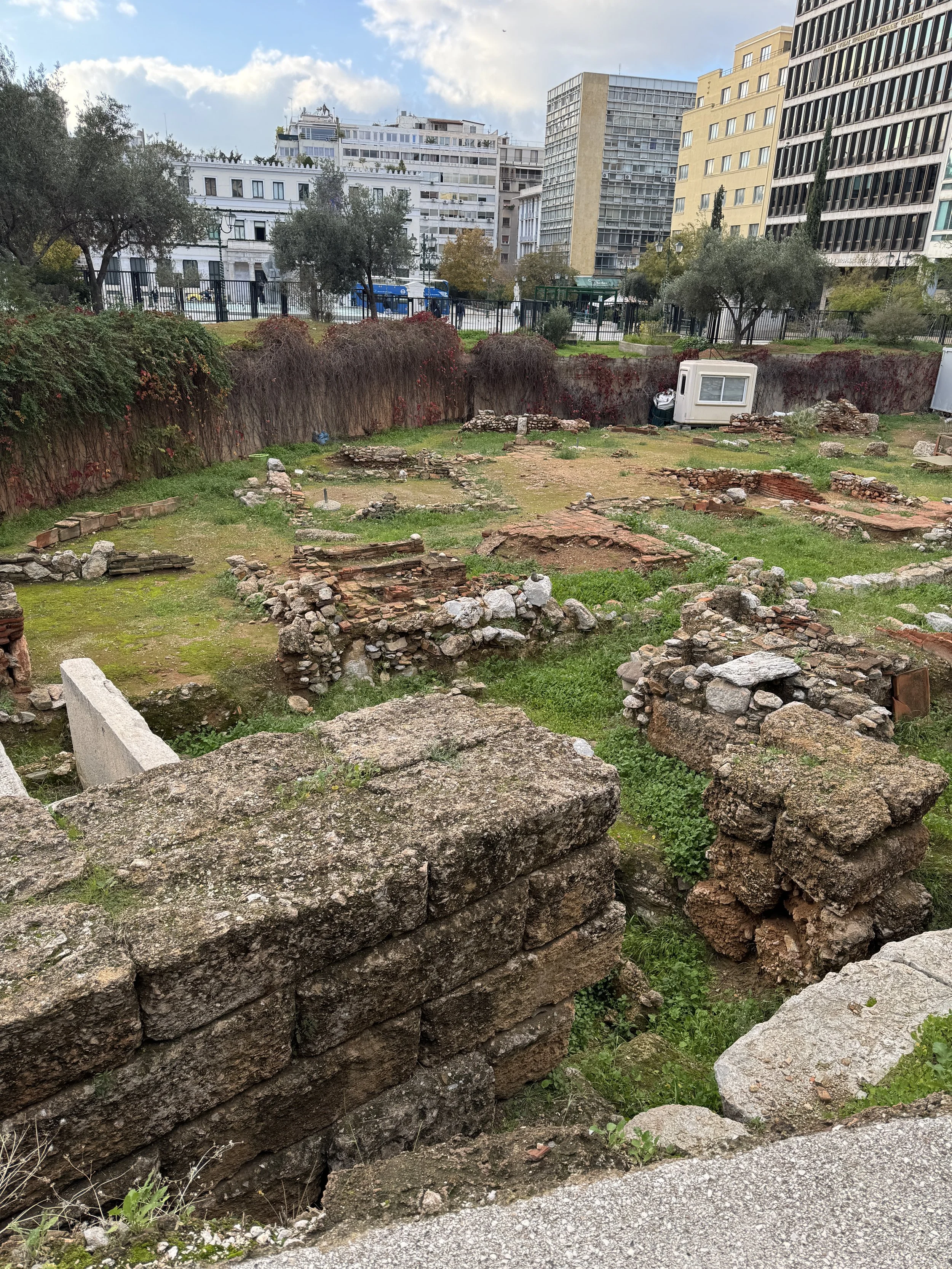
Continuing our walk we came across a field with scattered ruins.
A sign explained that it was the Archaeological Site at Kotzia Square, located in front of Athens City Hall.
Excavations here uncovered remains from the Classical, Roman, and Byzantine periods, including sections of:
ancient city walls
buildings
streets
defensive infrastructure
These ruins once formed part of Athens’ northern defenses.
Dinner: A Mixed Review
We made it back to the hotel and asked for a dinner recommendation nearby. They suggested I Kriti, a traditional Greek restaurant a few blocks away.
Unfortunately we arrived around 5 p.m., and many dishes weren’t quite ready yet.
I ended up trying:
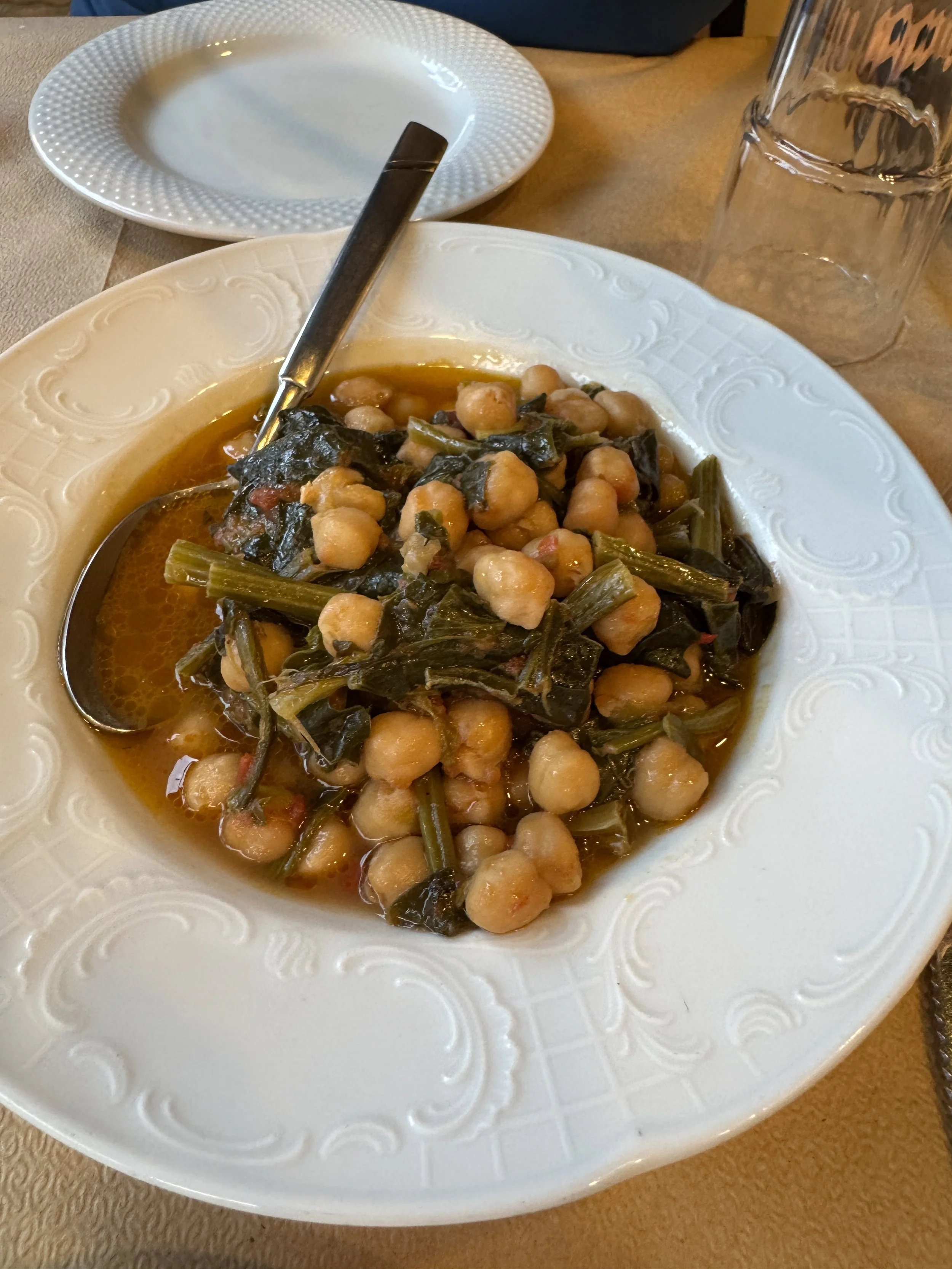
spinach and chickpeas
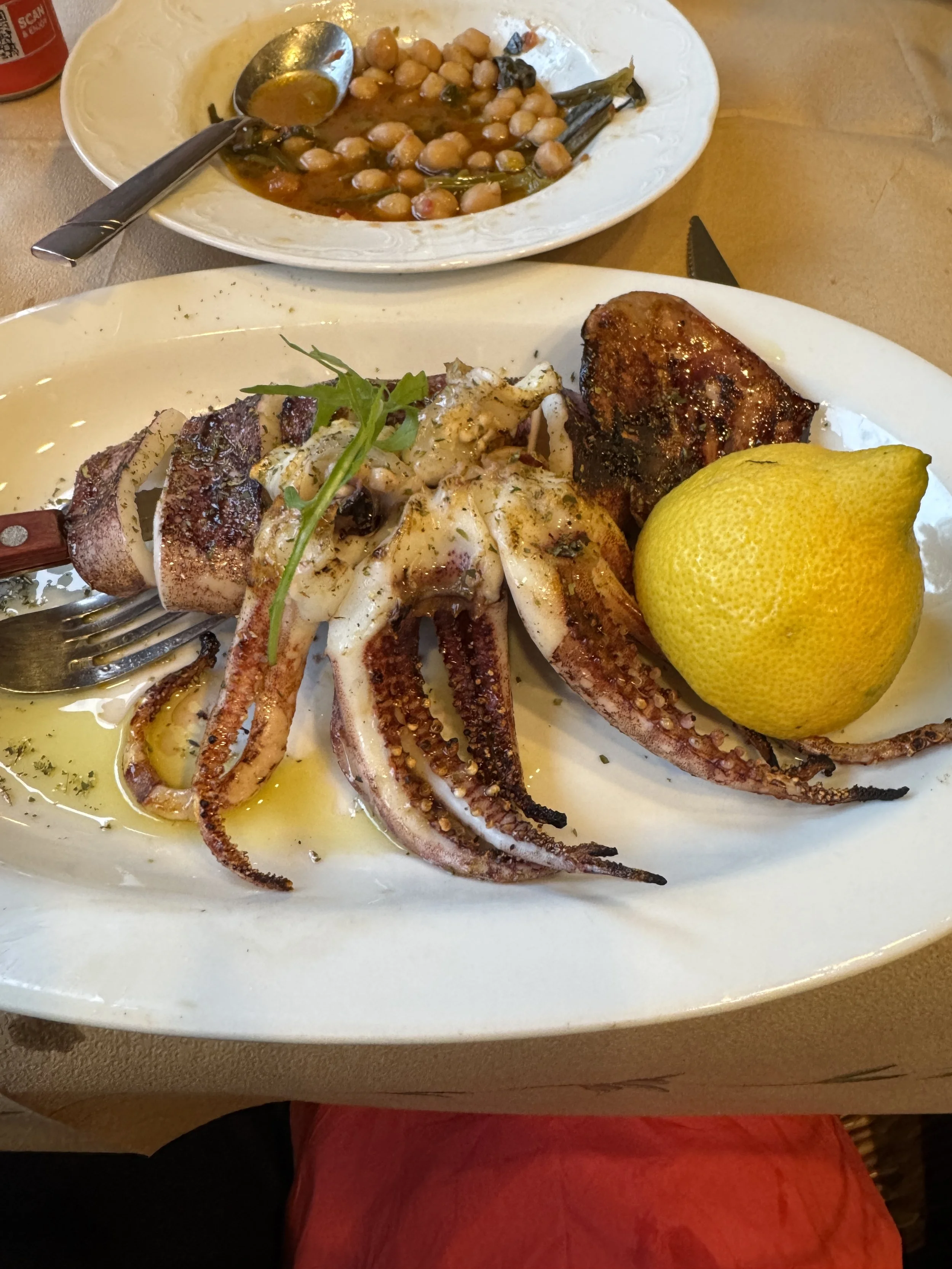
grilled squid
goat cheese pastries
Everything was okay.
I mainly wanted to try grilled squid since it’s something Greece is known for. It had great flavor, but it was a bit too chewy for me.
The spinach and chickpeas were easily my favorite dish.
The meal was relatively inexpensive, costing €31 for all three items plus soda and bottled water.
Jet Lag Wins
After dinner we headed back to the hotel.
Between the early morning wake-up, the long flights, and a full day of wandering Athens, we were completely exhausted.
We fell asleep around 7 p.m..
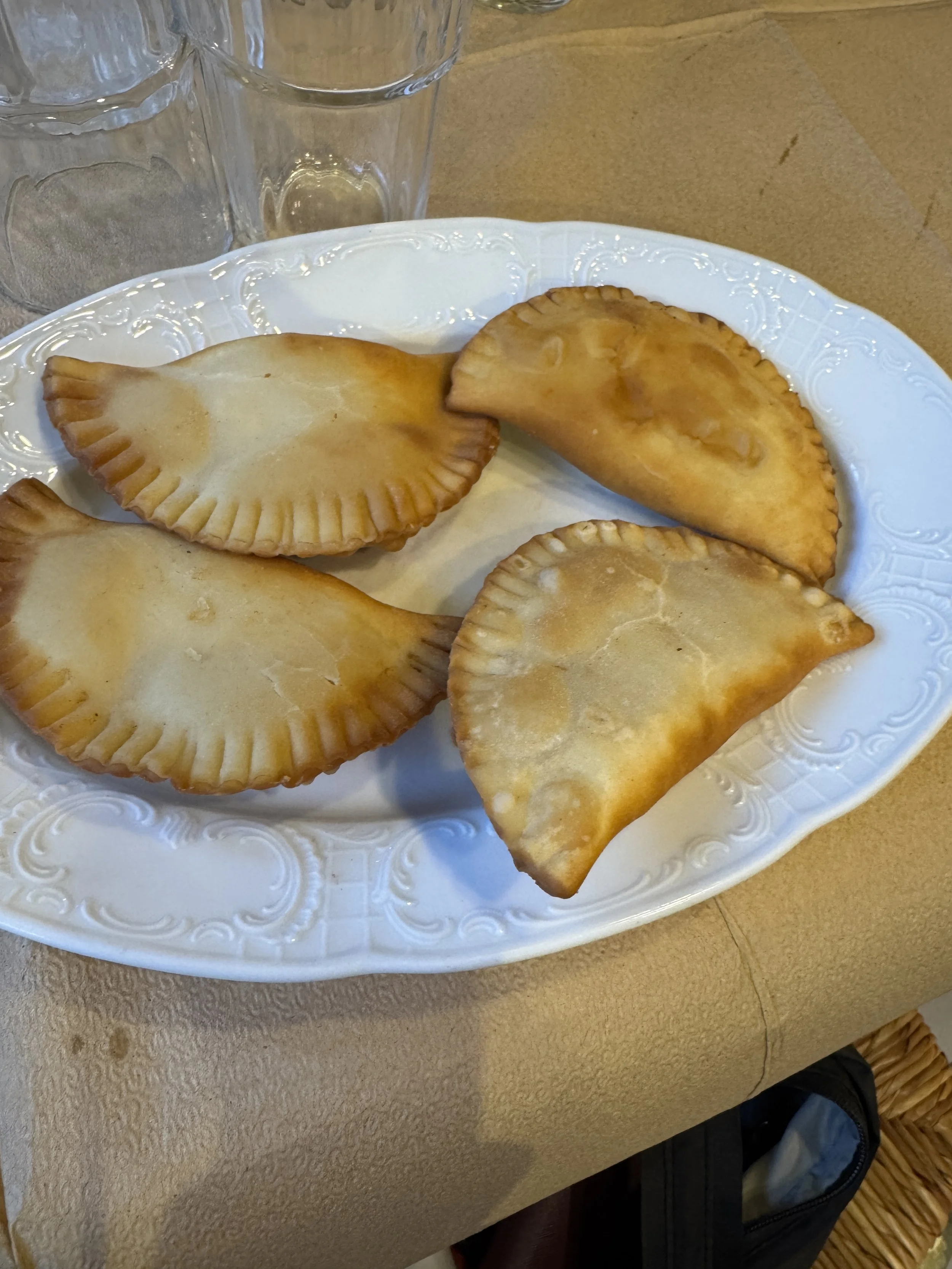
December 10: The Acropolis and Exploring Athens
Breakfast and the Climb to the Acropolis
We woke up early and had the buffet breakfast at the hotel, which consisted of cold cuts, cheese, pastries, fruit, bread, eggs, sausages, juice, and tea.
After breakfast we headed out to trek up the hill to the Acropolis.
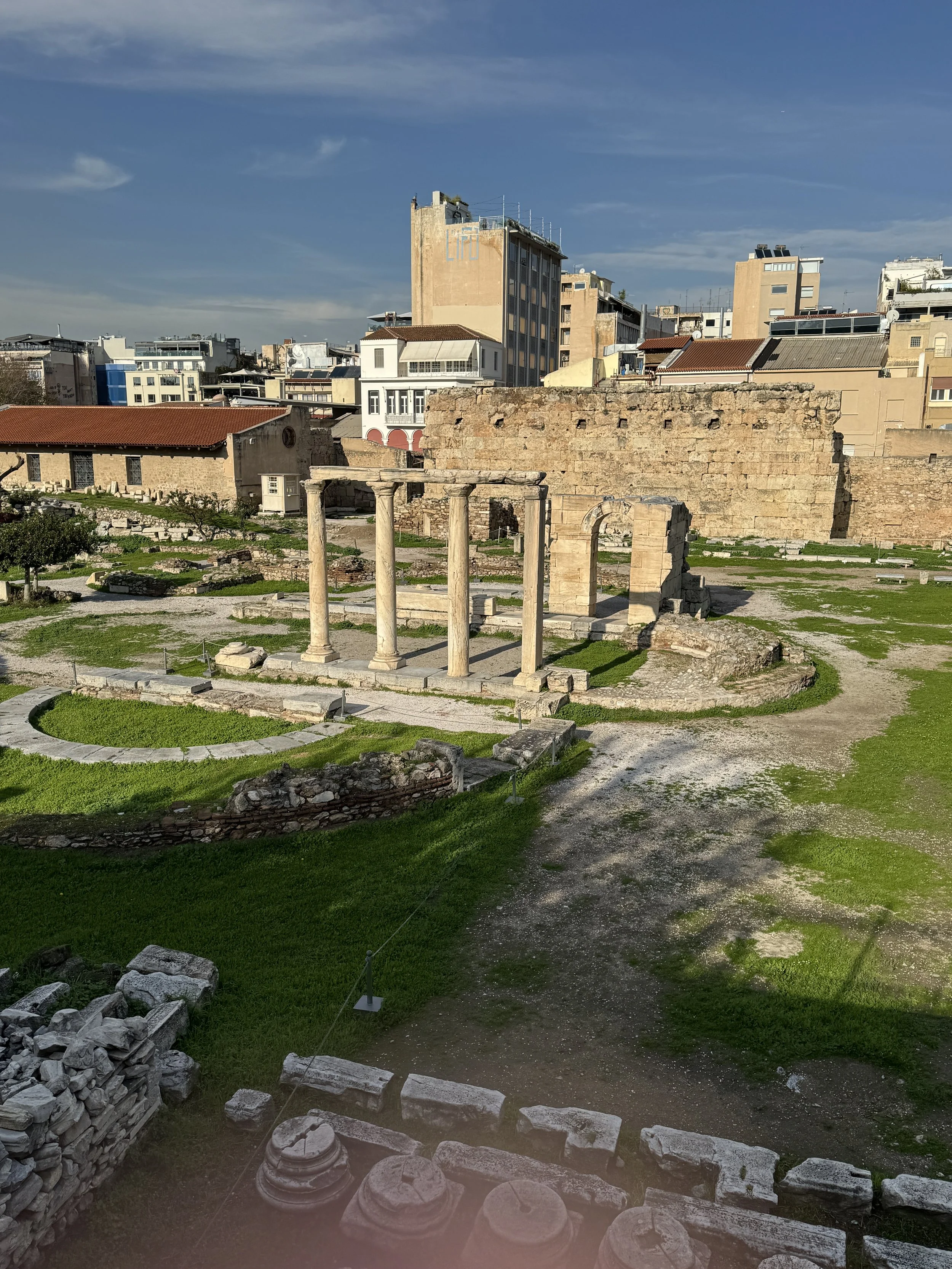
Along the way we passed Hadrian’s Library, built in 132 AD by the Roman Emperor Hadrian during his reign. It was originally opened as a library for storing manuscripts but also served as a cultural and intellectual hub, featuring reading rooms, lecture halls, courtyards, and gardens.
In 267 AD, the library suffered heavy damage during the Herulian invasion, a devastating barbarian attack on Athens. It was later partially rebuilt by the Romans. During the Byzantine period the site was repurposed several times, including being used as a church, and later during Ottoman rule a mosque was built within the ruins.
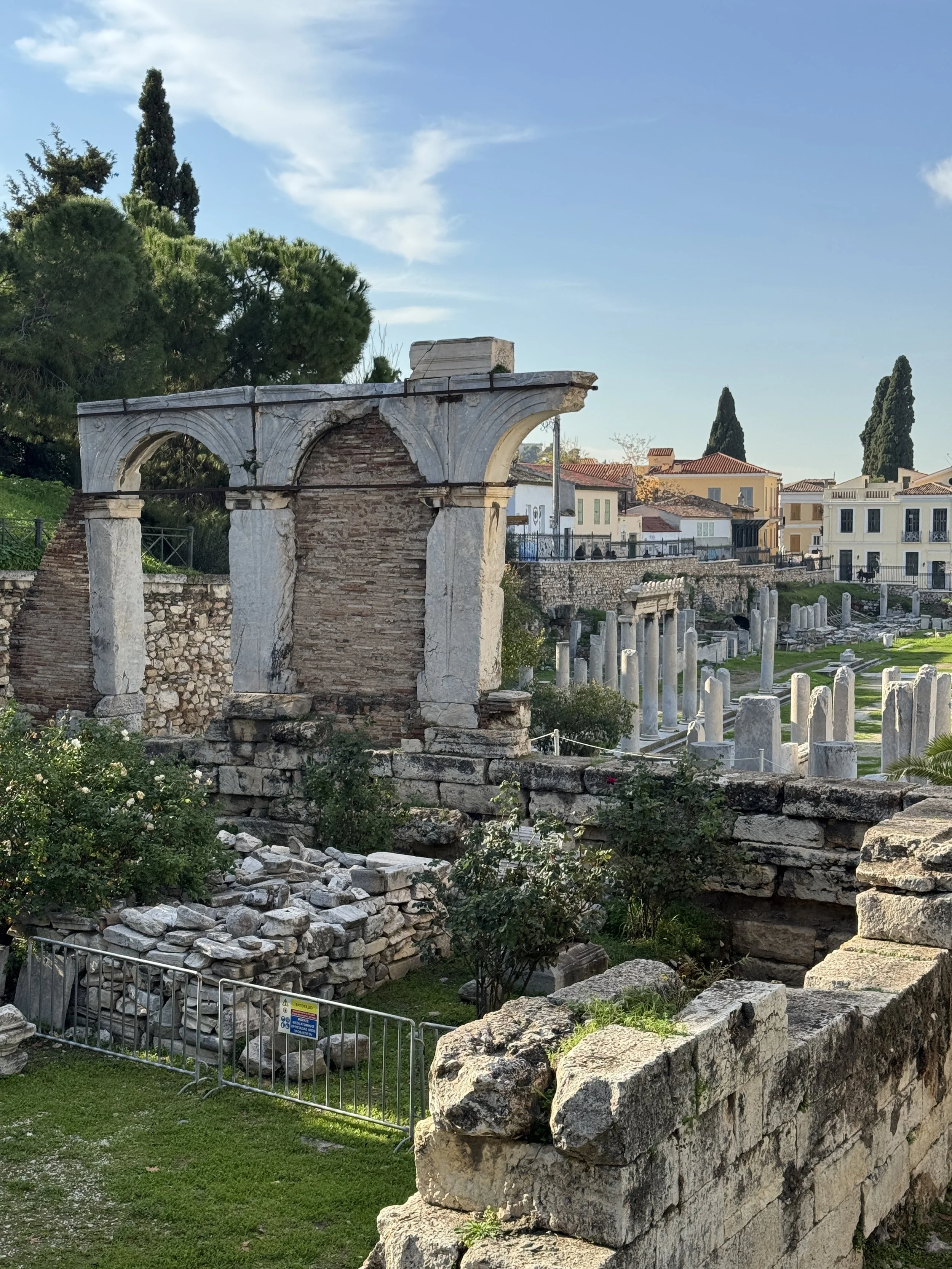
We then passed the Roman Agora, which was built between 19–11 BC with funding from Julius Caesar and Augustus to serve as the new commercial center of Athens during Roman rule. It replaced the older Greek Agora as the city’s main marketplace and hub for trade.
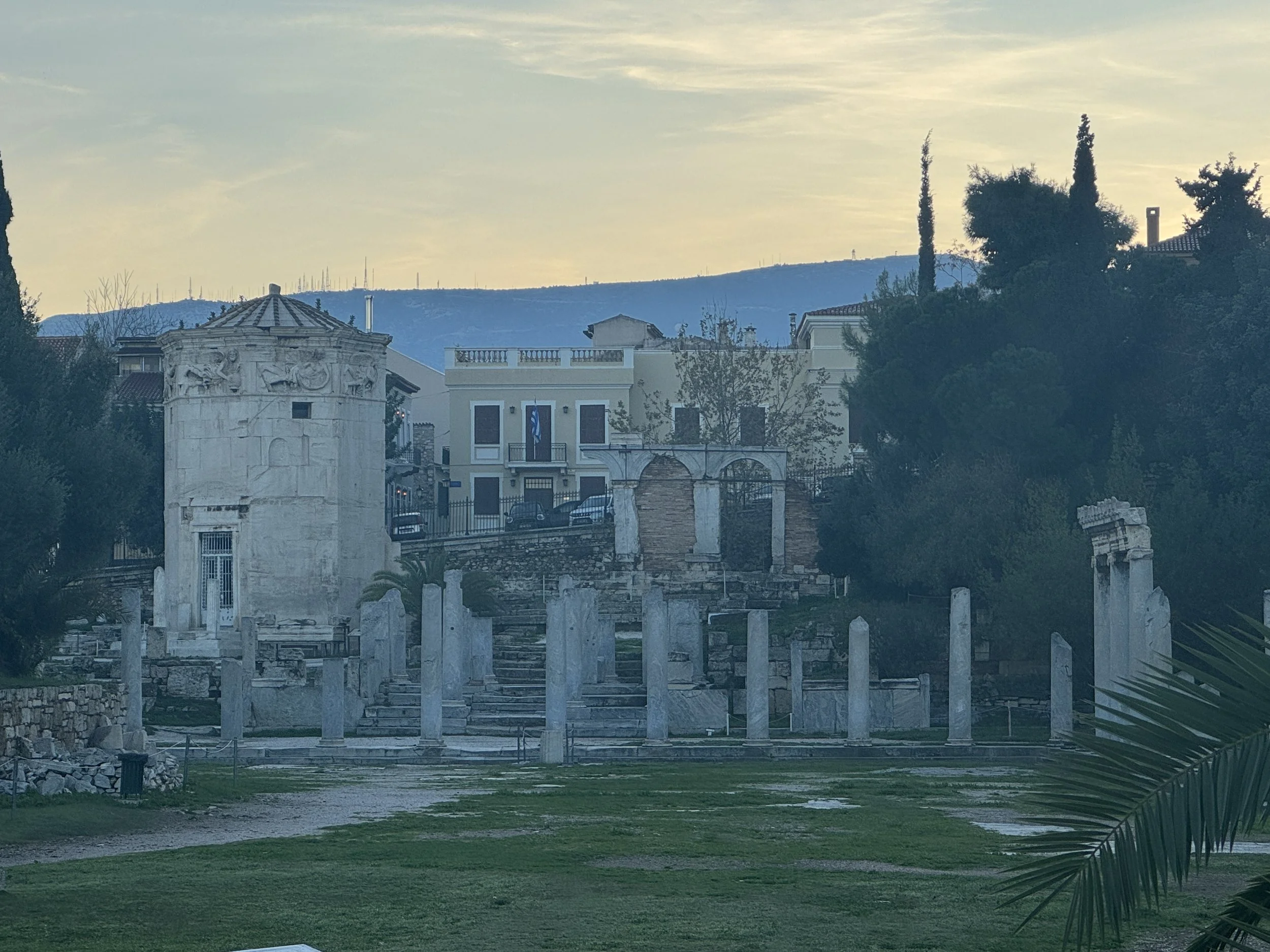
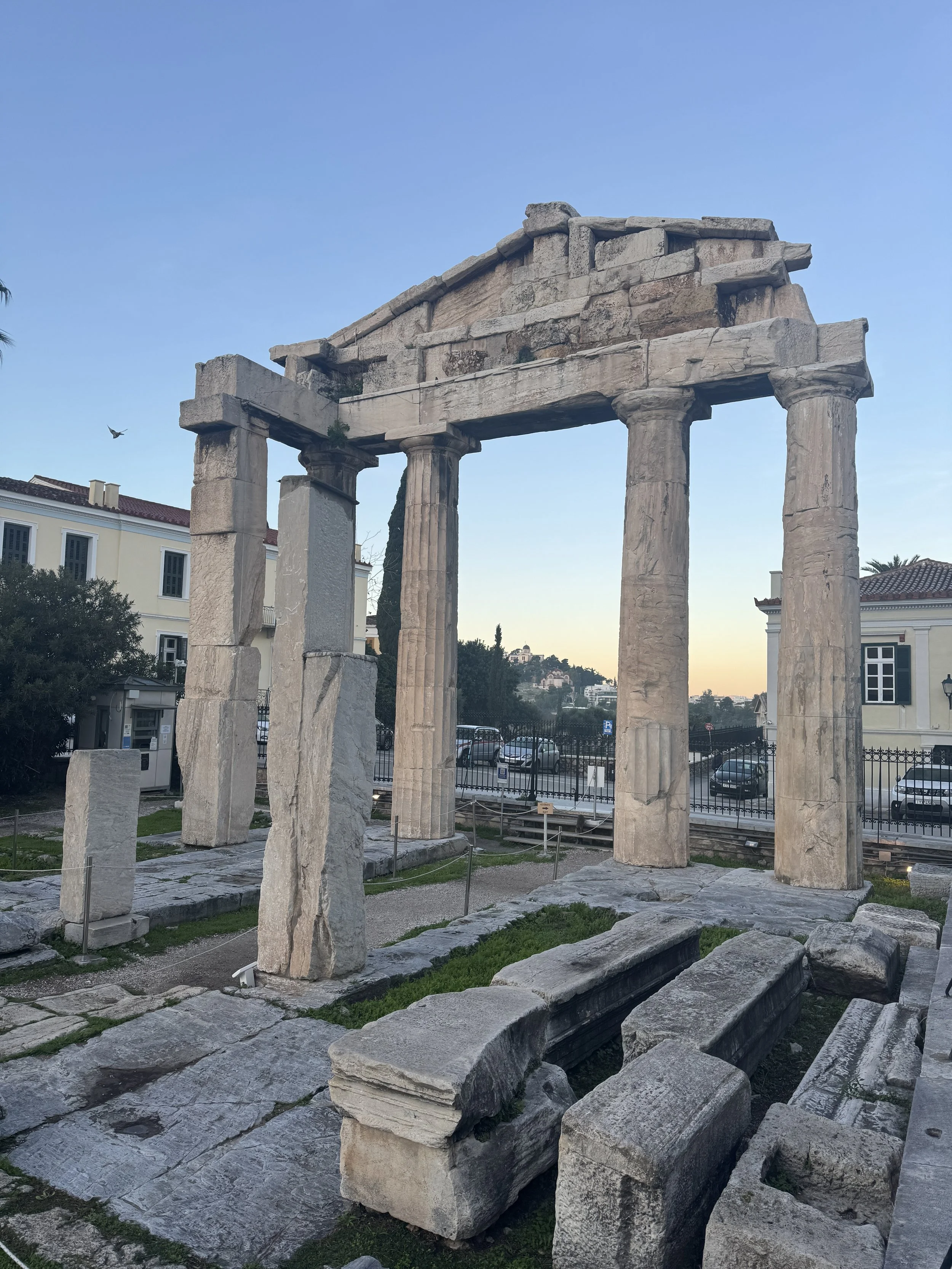
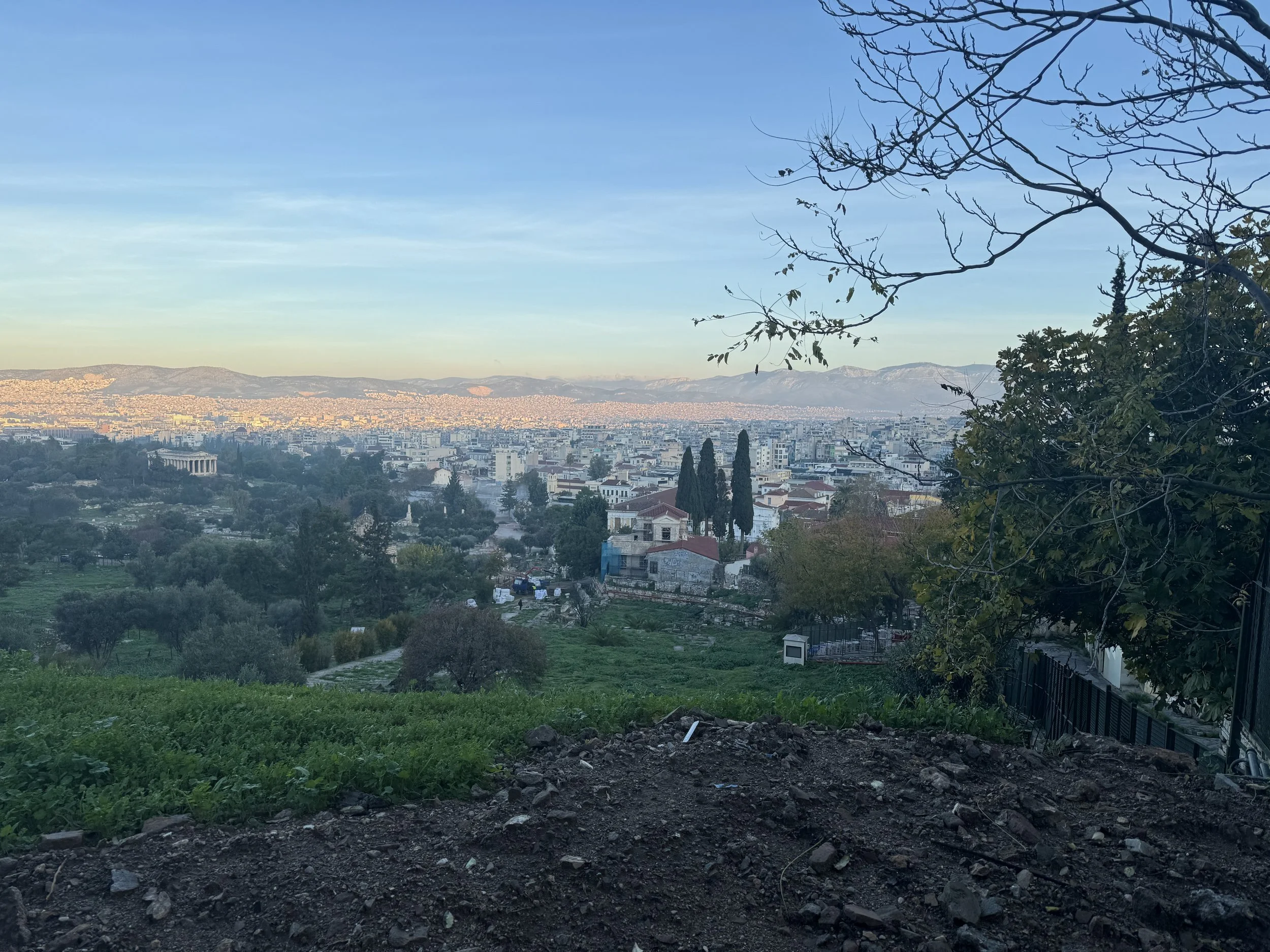
The walk up the hill is definitely uphill, but it offers some pretty impressive views of the city along the way.
Entering the Acropolis
We pre-purchased tickets, which meant we didn’t have to wait in line at the Acropolis.
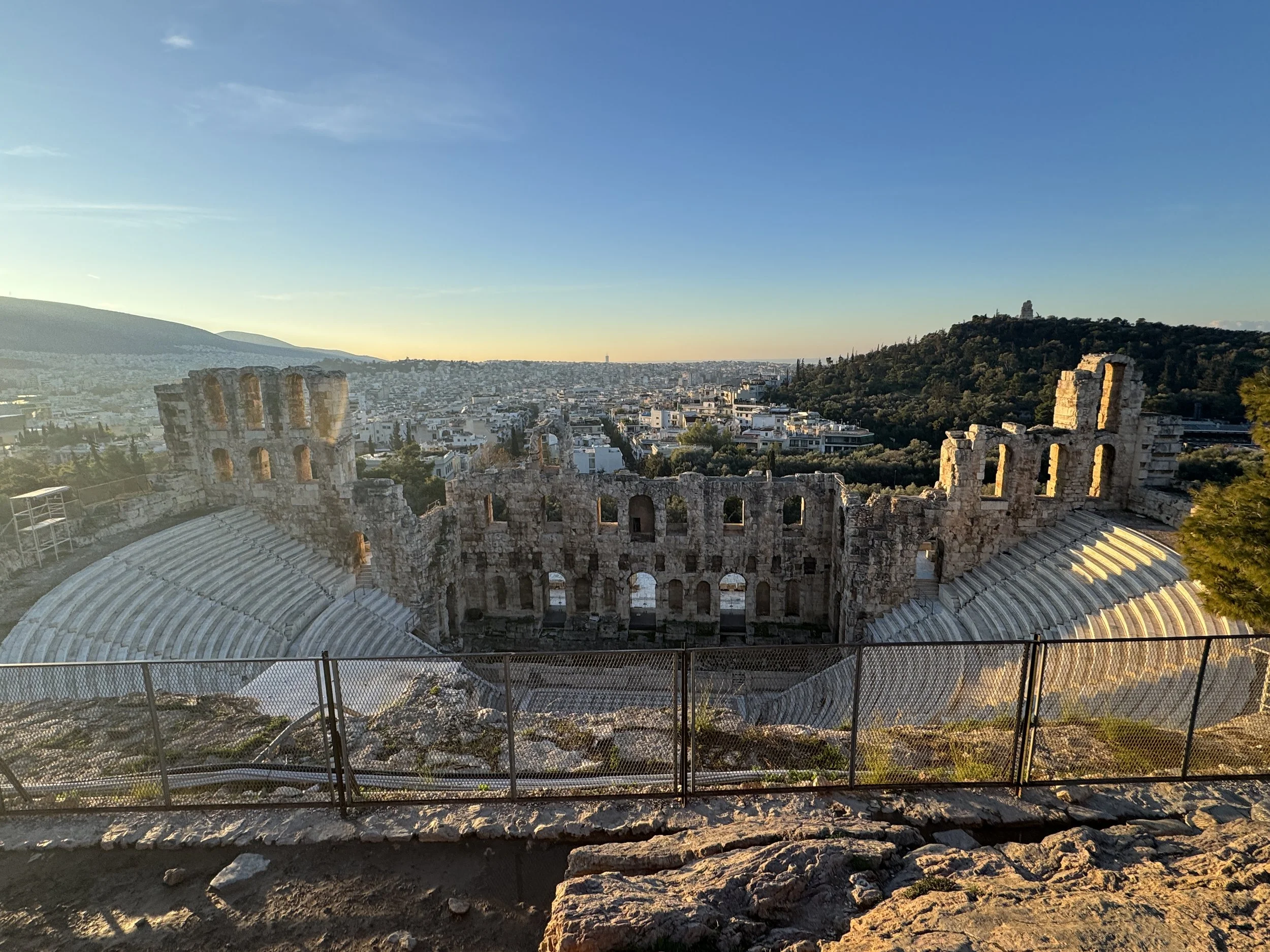
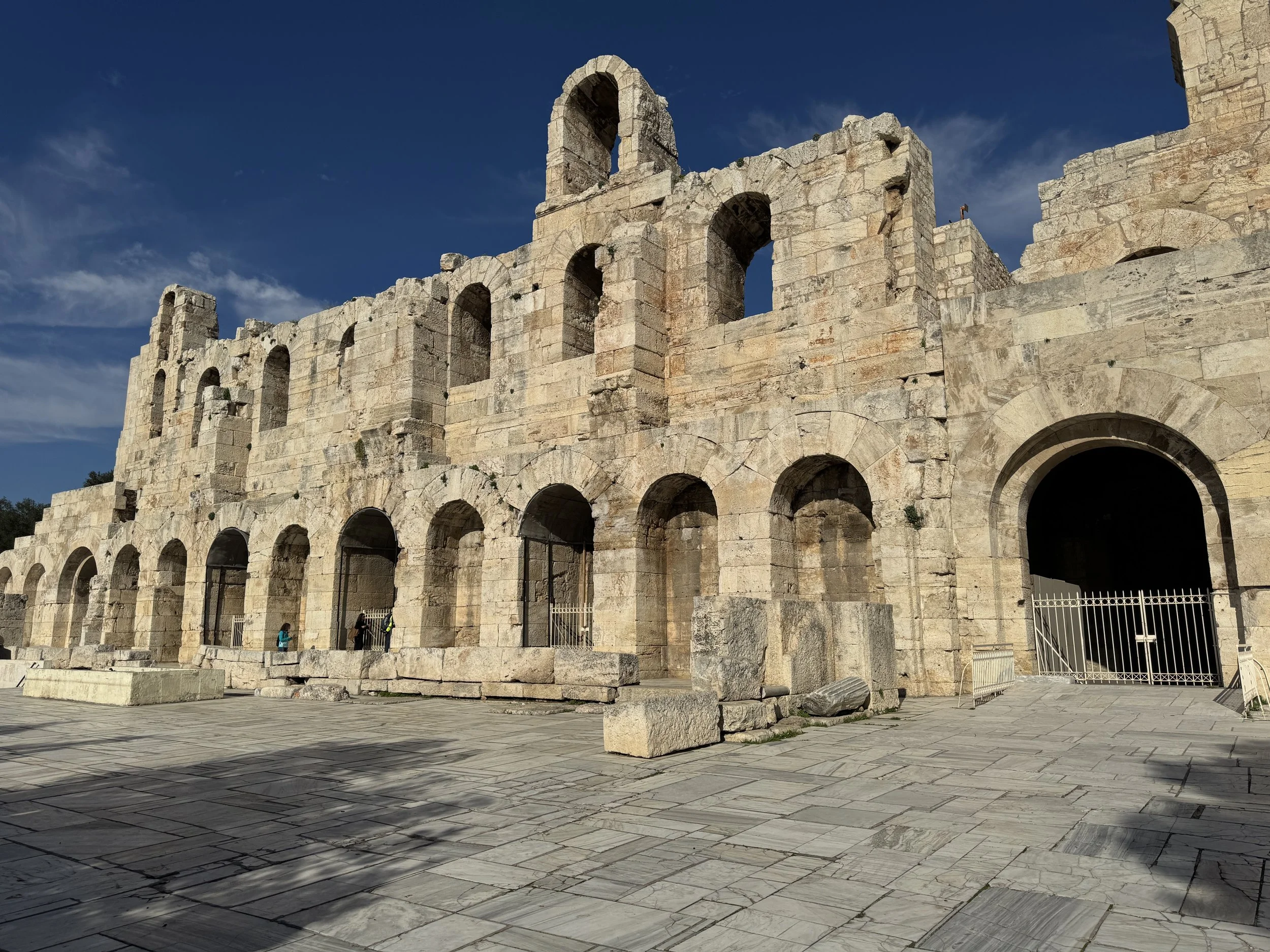
Upon entering the main gate we saw the Odeon of Herodes Atticus, built in 161 AD by the wealthy Athenian benefactor Herodes Atticus in memory of his wife, Aspasia Annia Regilla.
In 267 AD, the building was destroyed during the Herulian invasion of Athens and remained in ruins for centuries. It was restored in the 1950s using Pentelic marble and reopened for modern performances.
Next we came across the Propylaea of Athens, the monumental gateway to the Acropolis. It was constructed between 437–432 BC during the Golden Age of Athens under Pericles and is made entirely of marble.
Over the centuries the Propylaea was reused for several purposes, including a Byzantine residence, a Frankish palace, and later an Ottoman gunpowder store. Unfortunately the gunpowder exploded in 1656, causing severe damage.
The Parthenon and the Sacred Hill
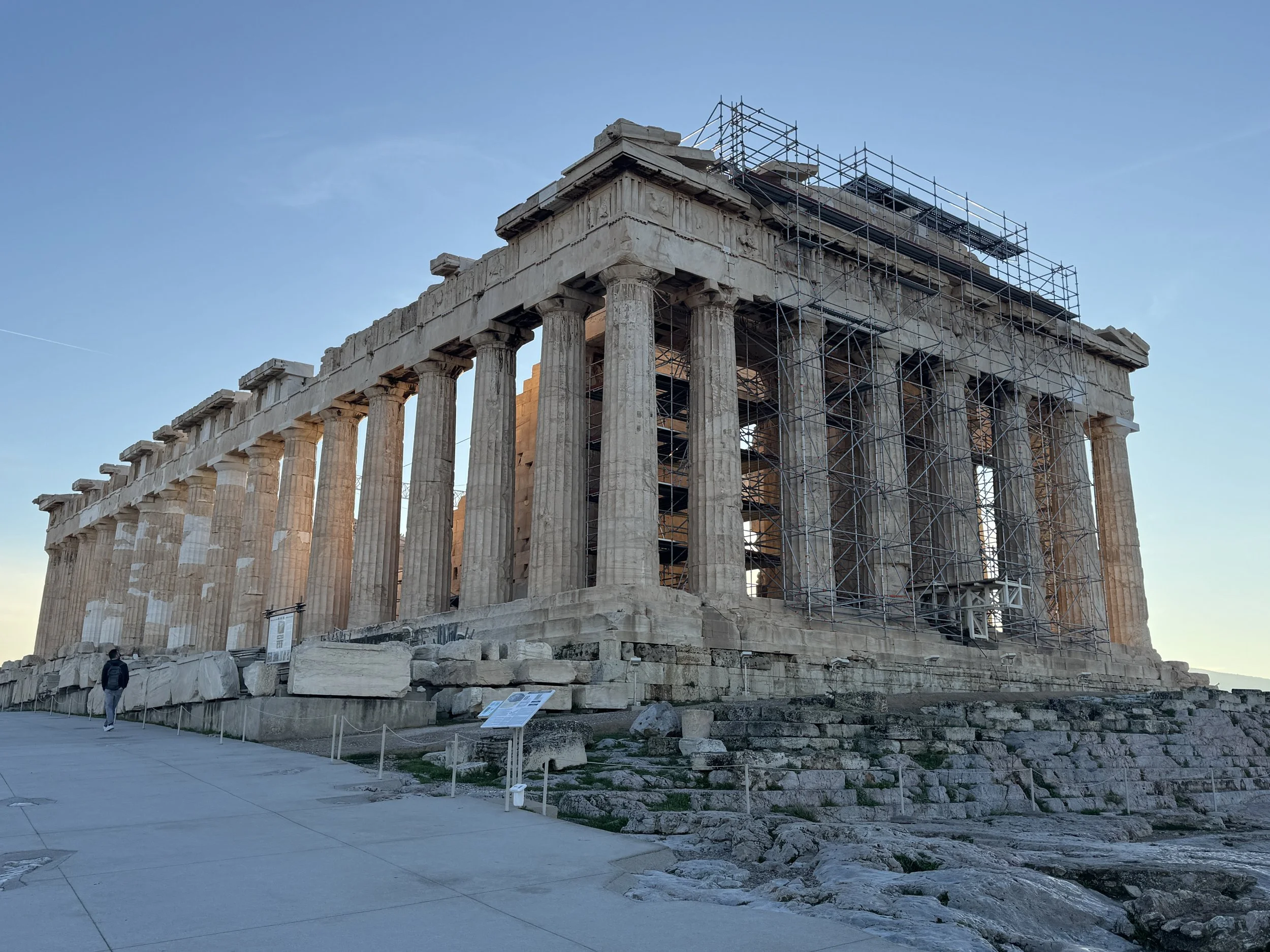
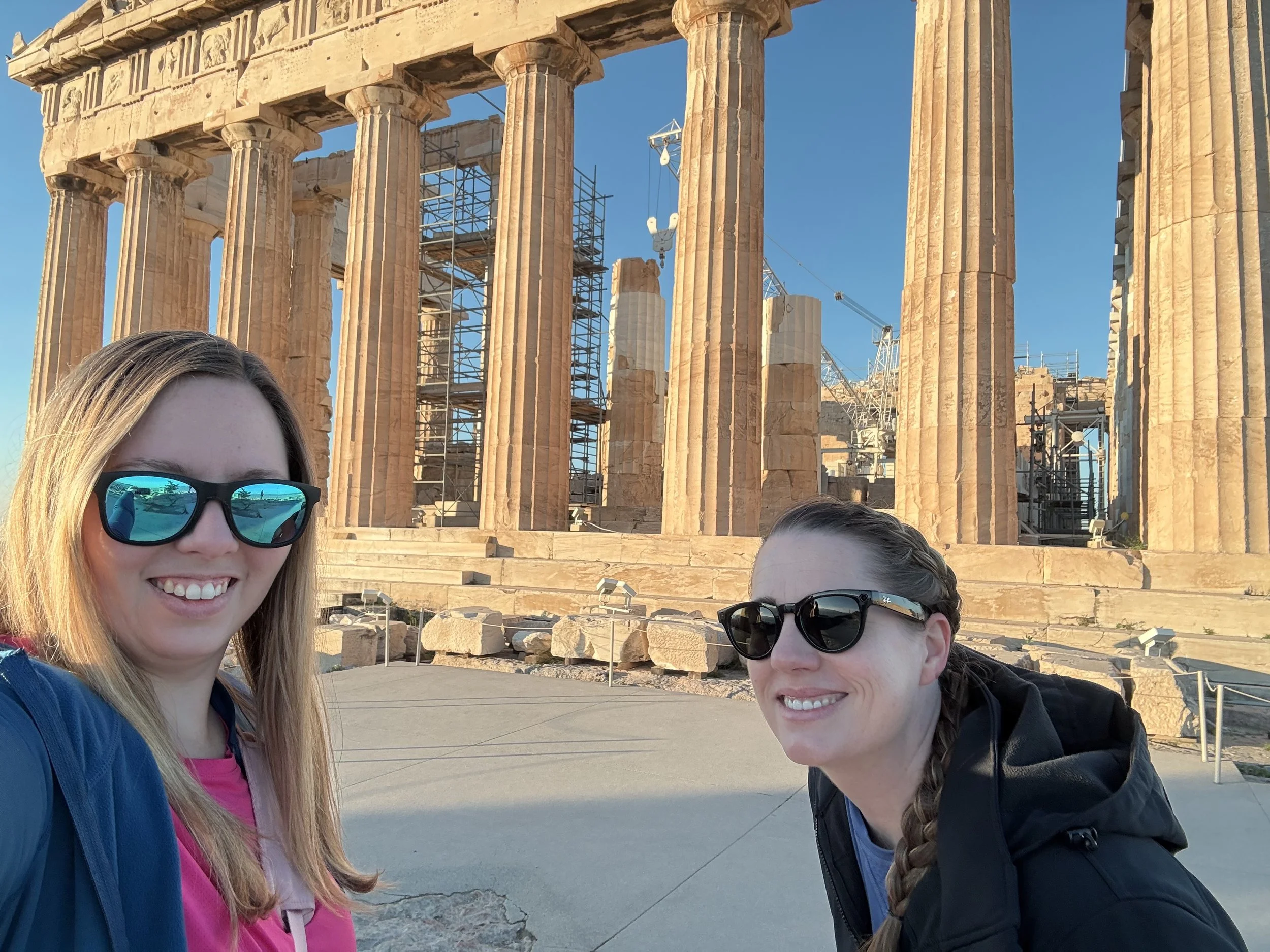
At the top sits the Parthenon, built between 447–432 BC during the Golden Age of Athens under the leadership of Pericles.
Like much of the Acropolis, it is constructed from marble. Over the centuries the Parthenon has served many purposes. It was converted into a Christian church, later into a mosque, and suffered catastrophic damage in 1687 when an Ottoman gunpowder store inside was hit during a Venetian bombardment.
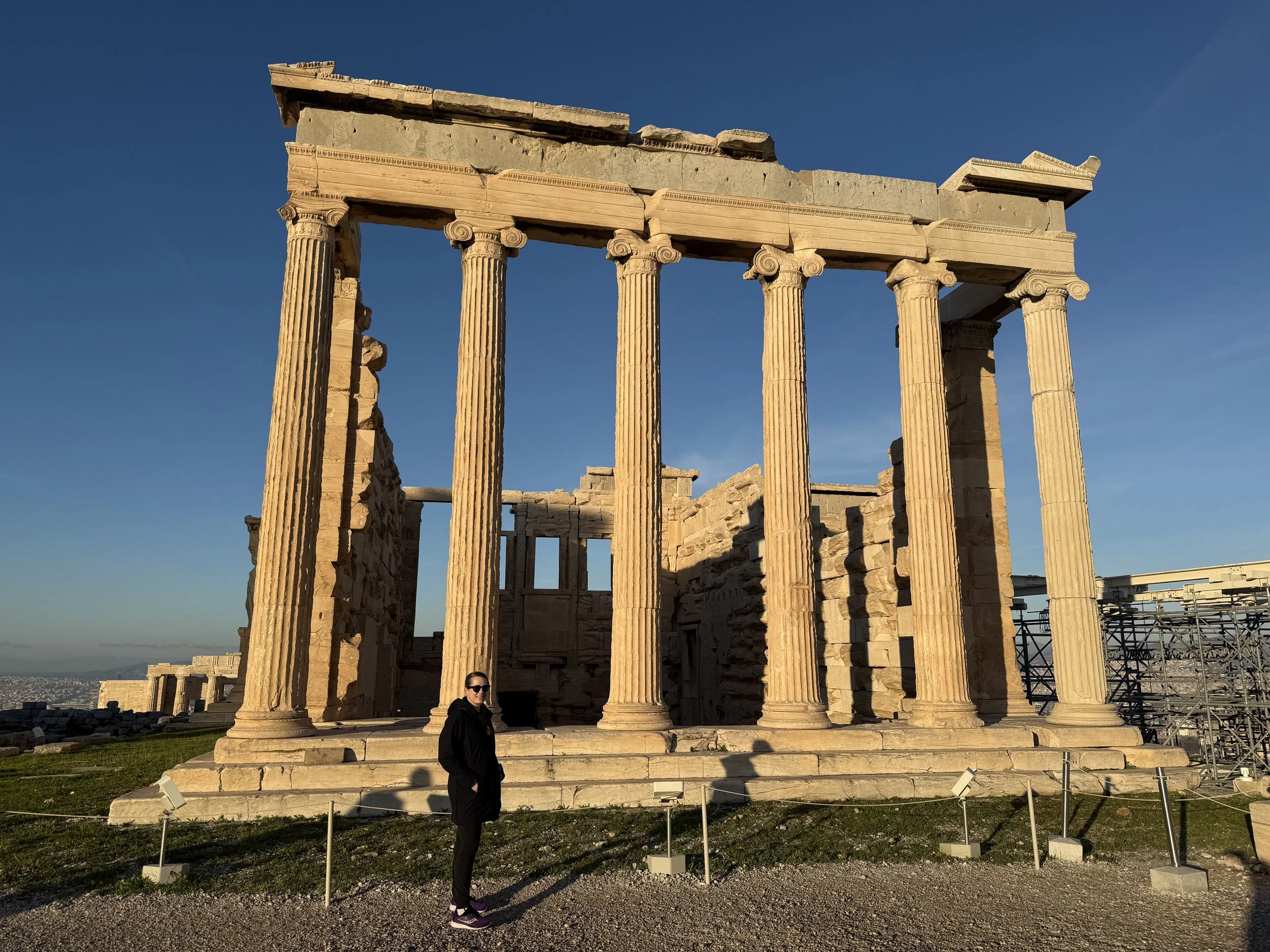
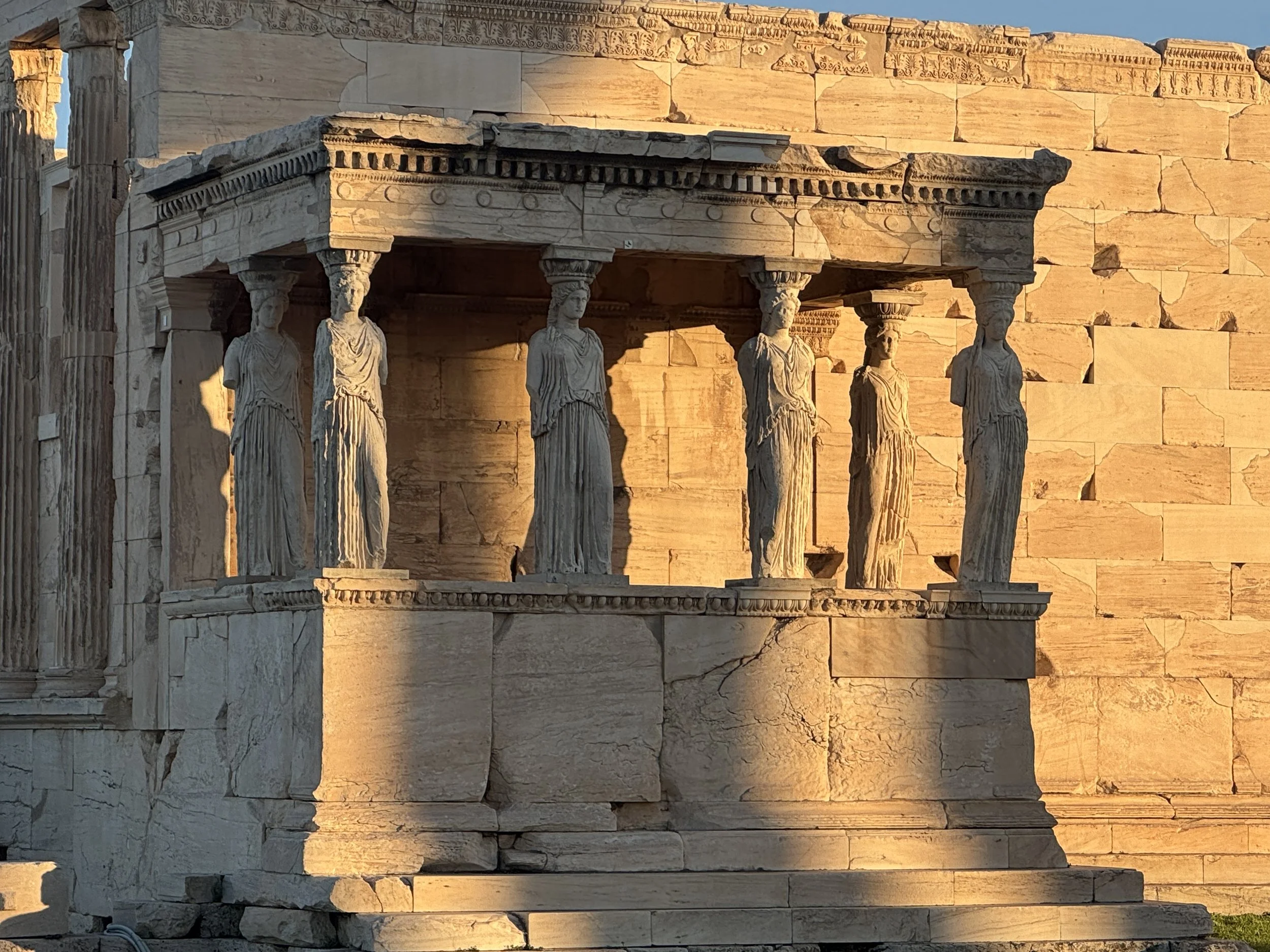
Nearby is the Erechtheion, built between 421–406 BC on the north side of the Acropolis during the Peloponnesian War.
It was designed to house multiple sacred sites connected to Athens’ earliest myths and religious traditions, including those tied to Athena and Poseidon. Over time it was used as a Christian church, a residence, and later even a harem during Ottoman rule.
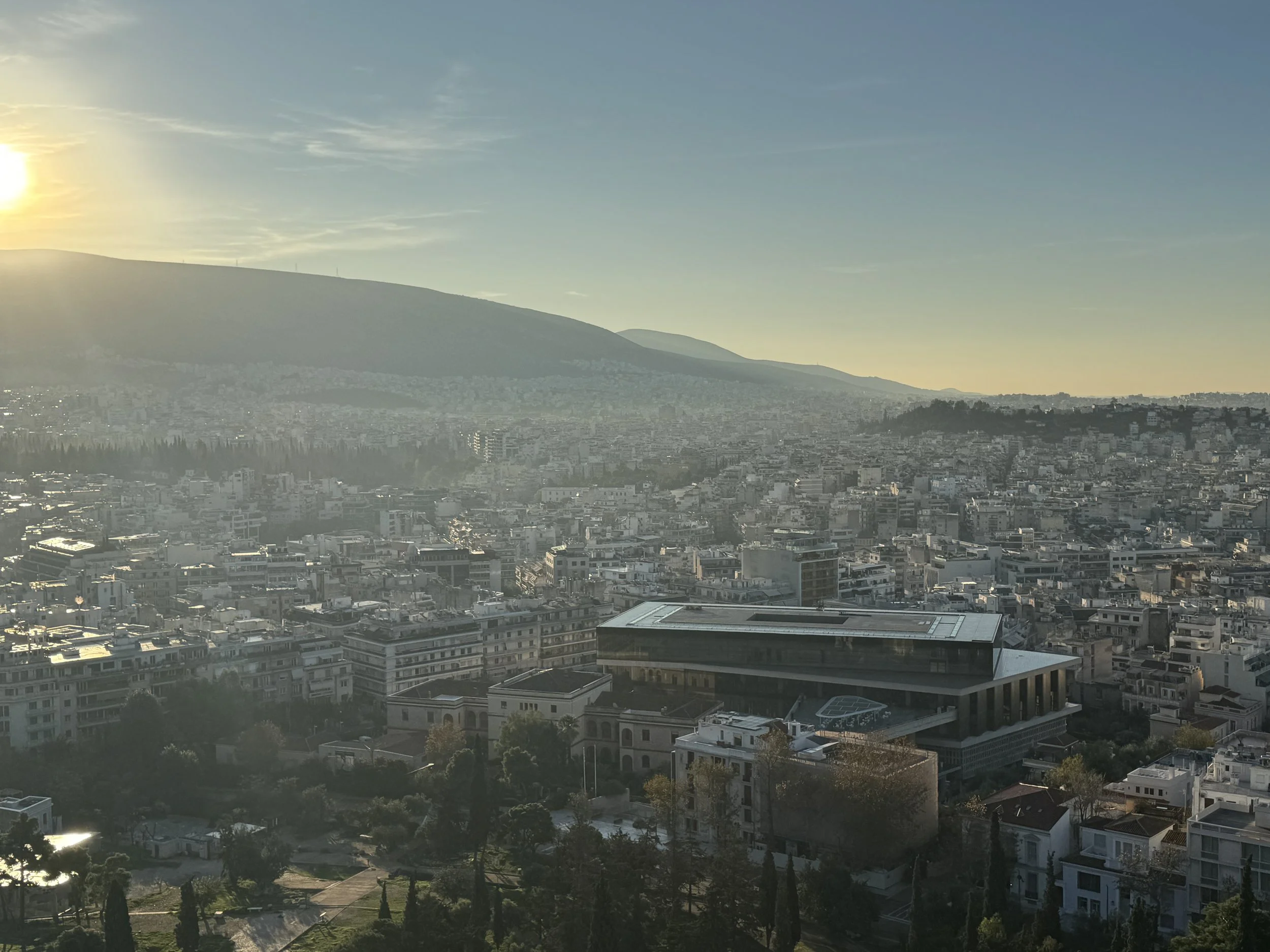
From the top you get great aerial views of Athens, which makes the climb even sweeter.
The World’s Oldest Theater
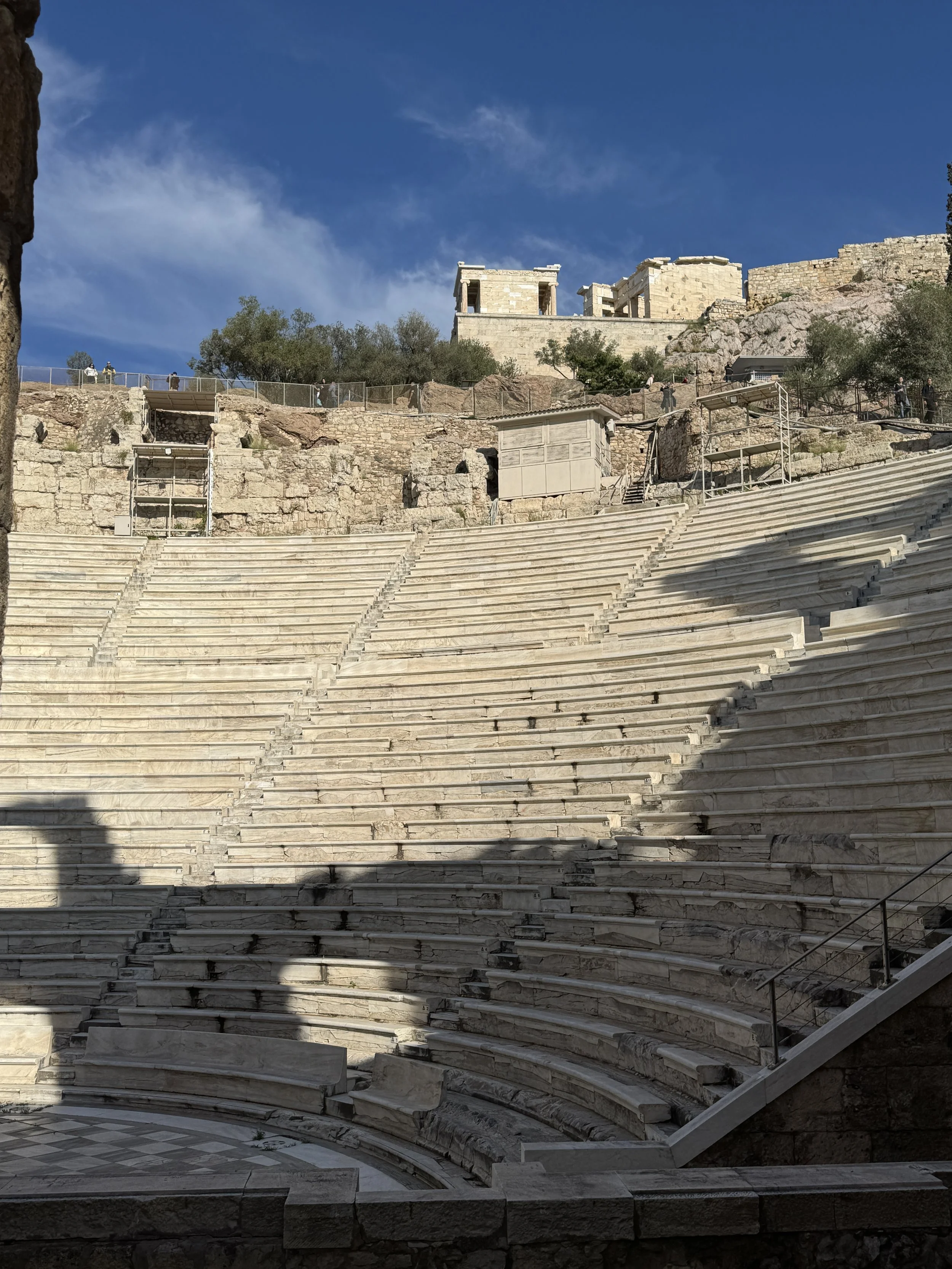
From there you follow a path down the Acropolis toward the Theatre of Dionysus, considered the world’s oldest known theater.
It originated in the 6th century BC as a simple open-air space dedicated to Dionysus, the god of wine and drama. By the 5th century BC, it had become the birthplace of Greek tragedy and comedy.
As you continue down the path you can exit through a different gate than the one you entered.
Coffee and Re-Planning the Day
At this point we had kind of run out of the places we had preselected, so we stopped at a little coffee shop called 3 Monkeys.
Here I tried Greek coffee with ice cream. It was very strong at first, but once the ice cream melted it became sweeter and easier to drink.
While sitting there we plotted out our next stops and decided to visit the Acropolis Museum, which had very high reviews and was just a few minutes away.
The Acropolis Museum (and the Real Star Below It)
Admission to the museum was €20.
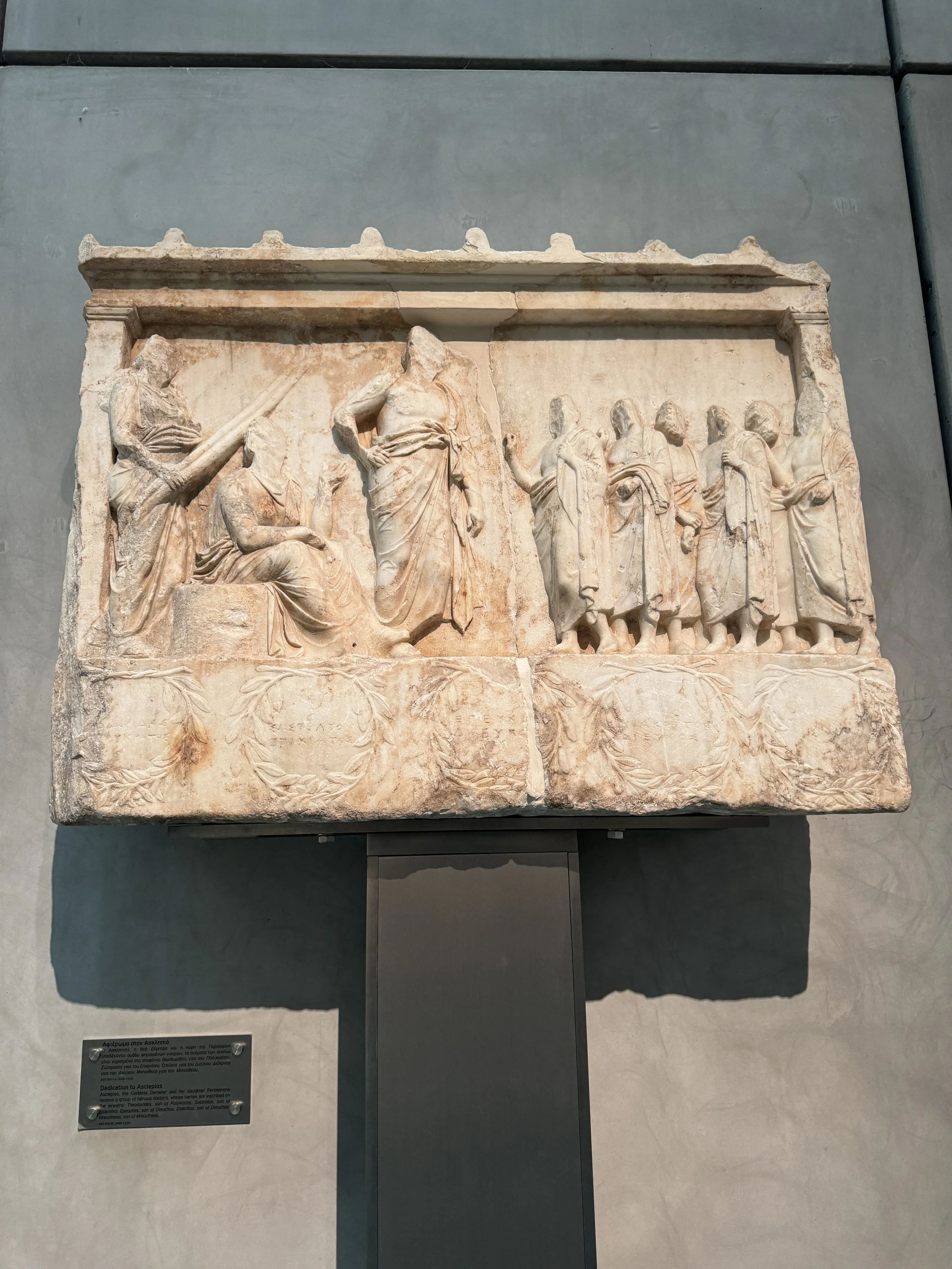
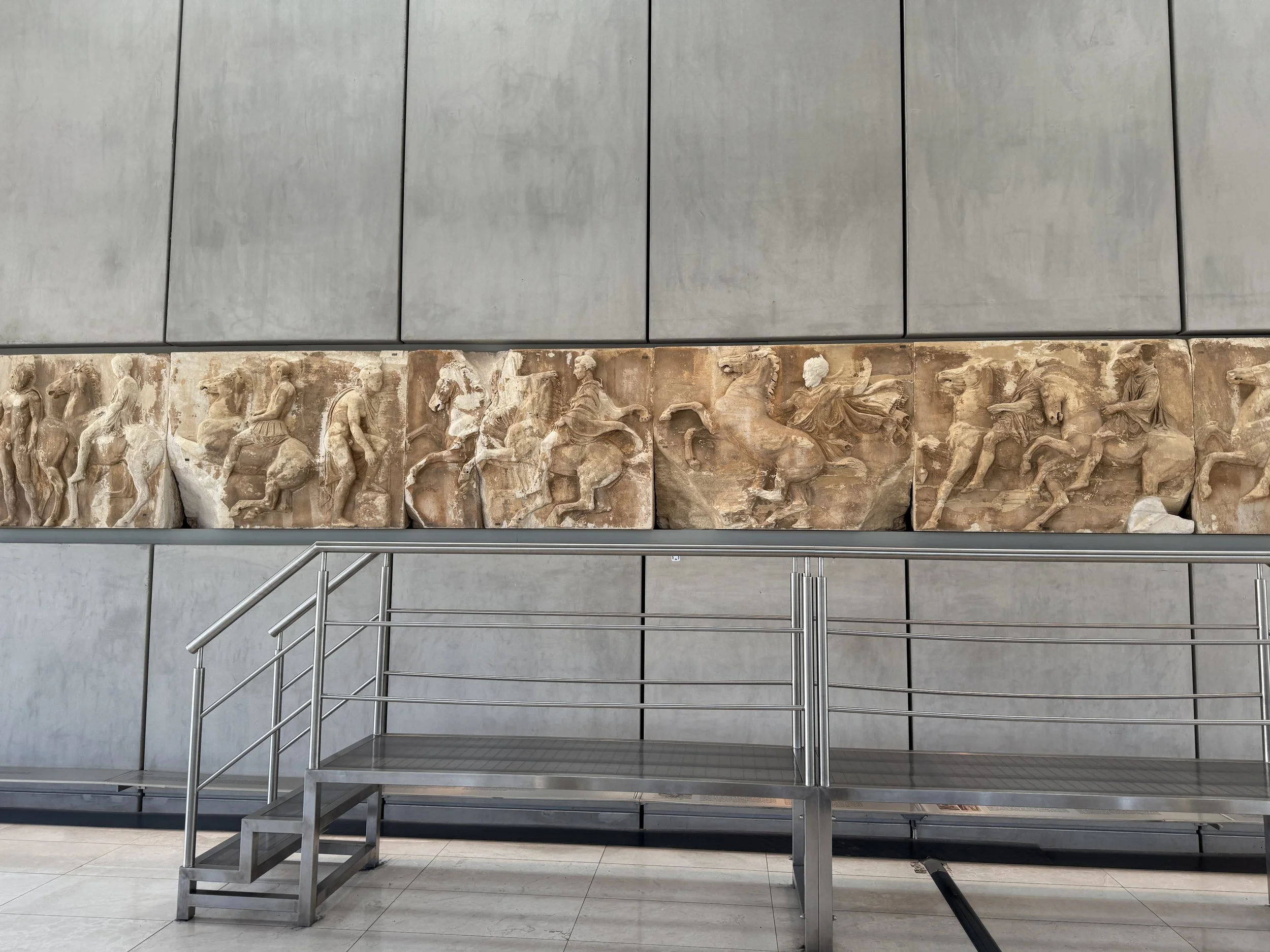
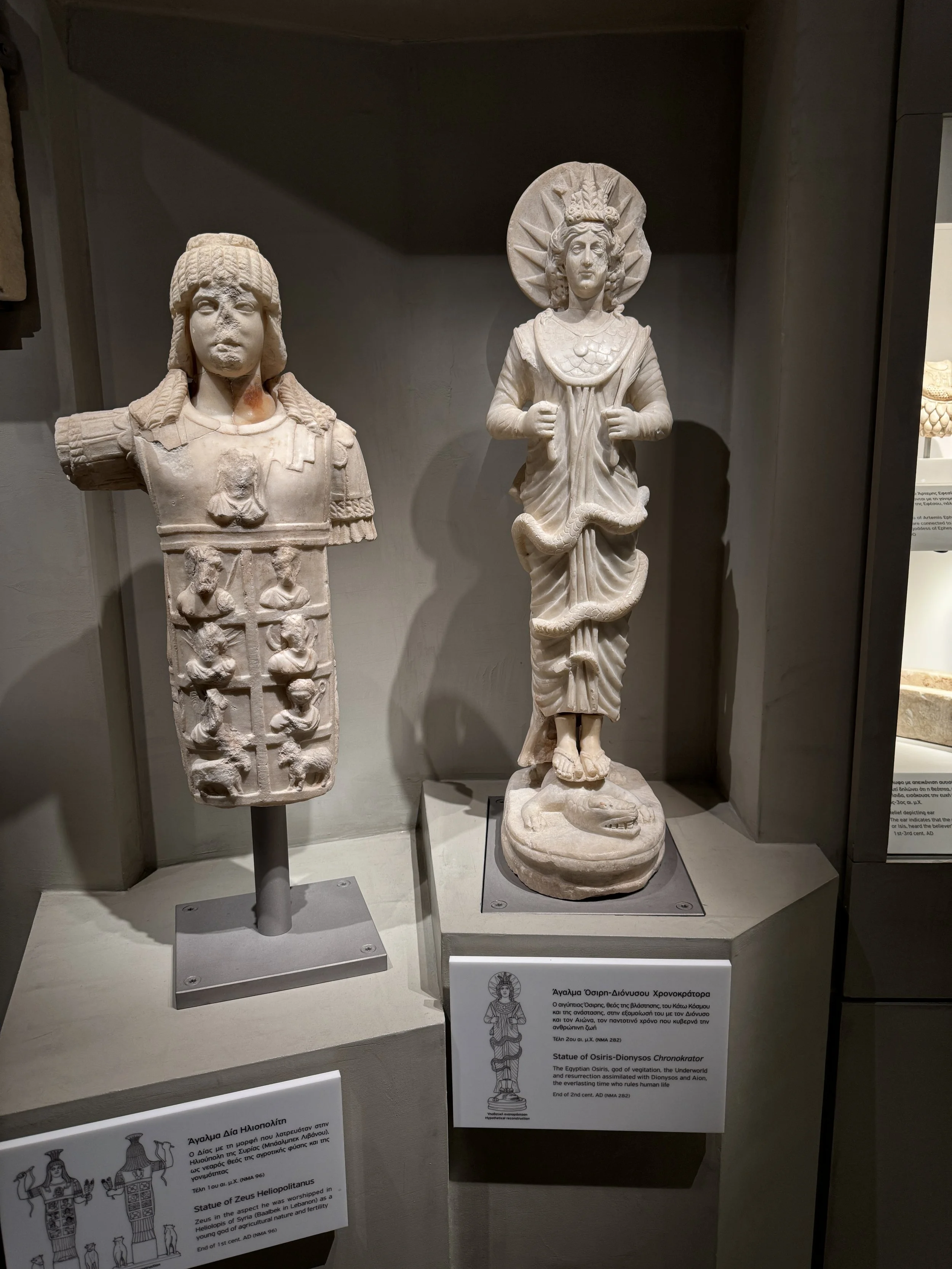
The interior of the museum was honestly just meh. A lot of the displays are only partially complete or consist of replicas with one authentic piece. They did have some intact pottery and quite a few sculpture heads, but overall the exhibits weren’t that exciting.
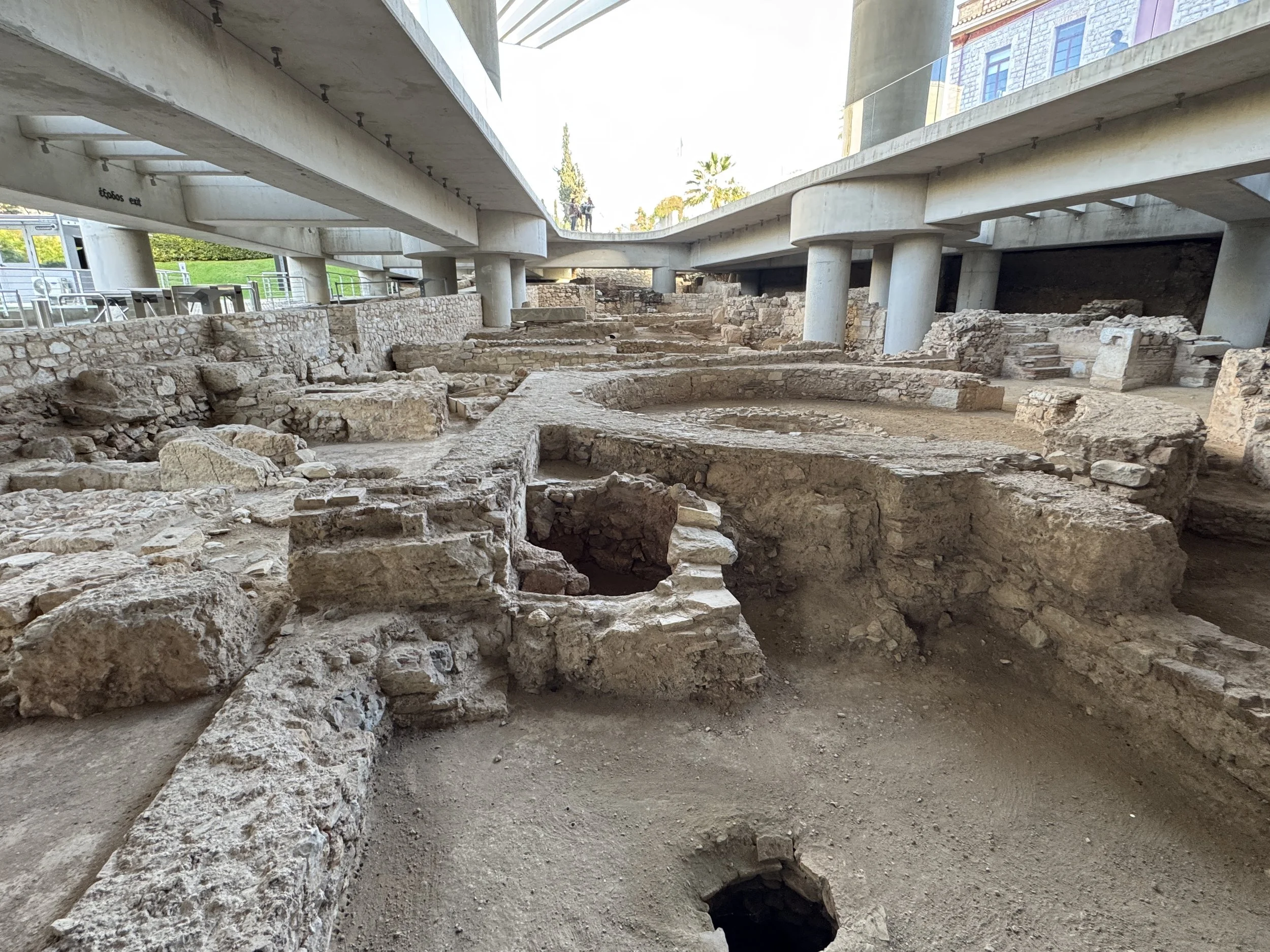
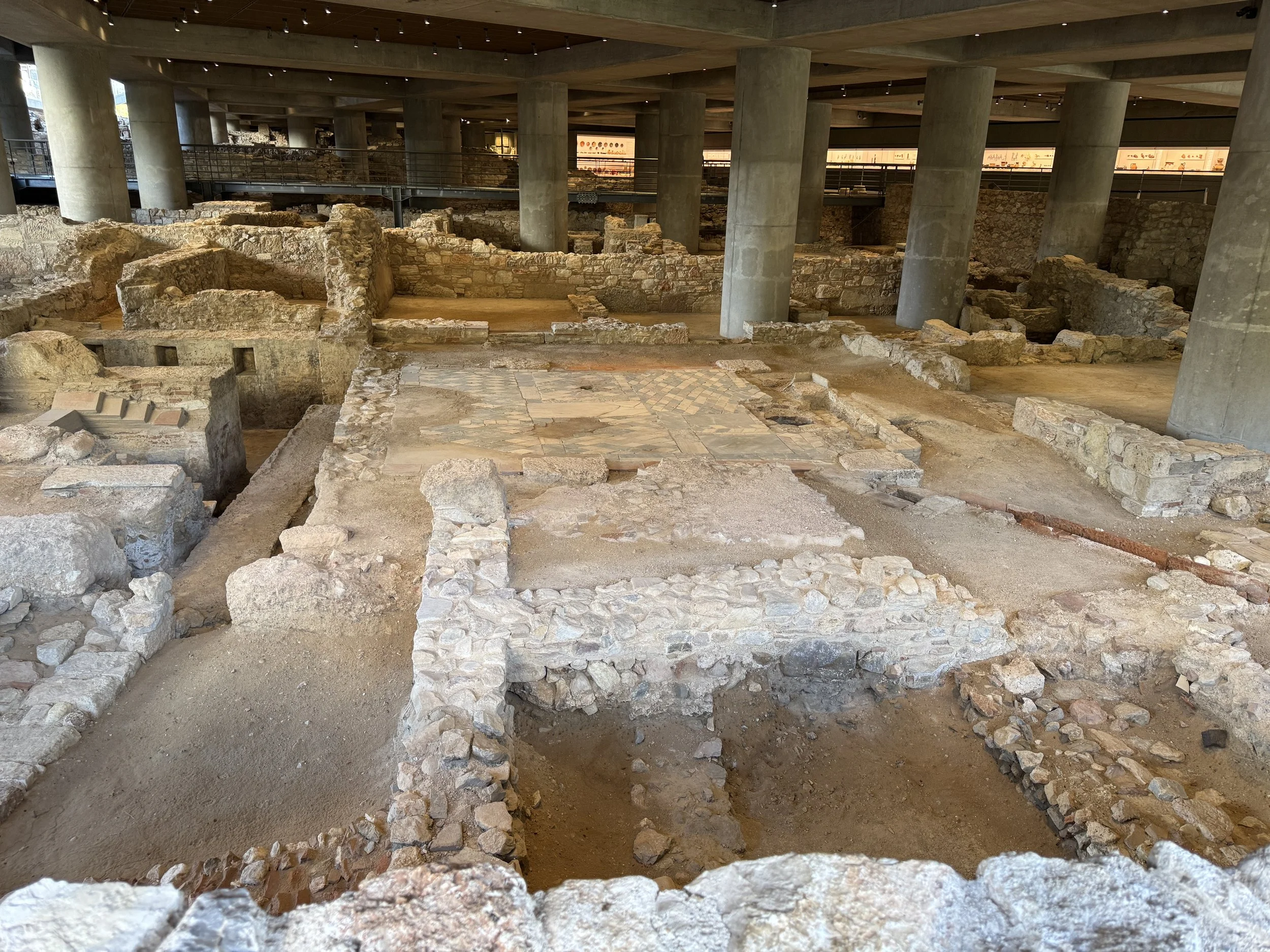
What makes this museum special, however, is that it’s built directly over an excavation site.
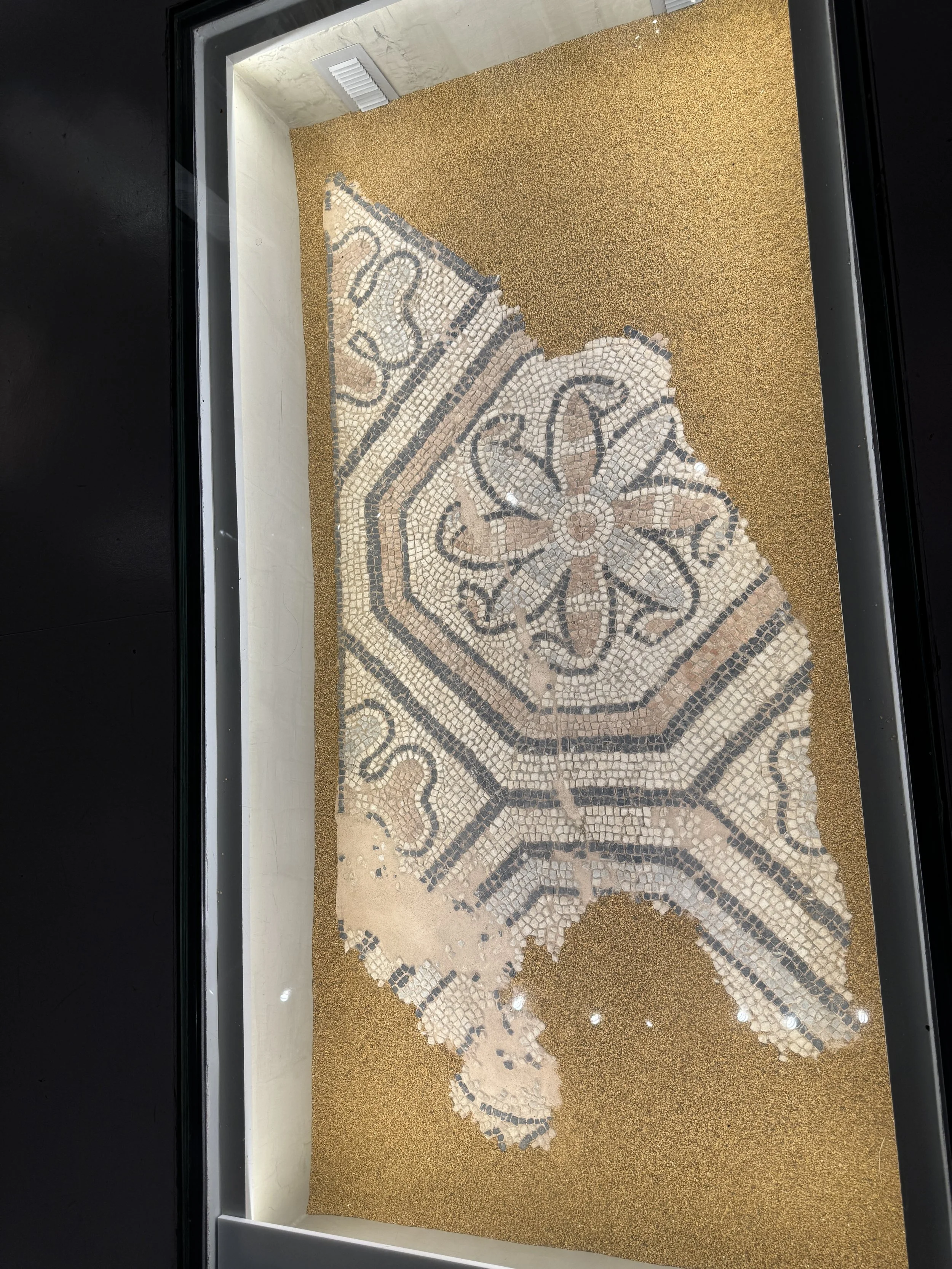
Below the museum is a well-preserved ancient Athenian neighborhood that dates from the Classical period (5th century BC) through Roman and Byzantine times.
Visible through the museum’s glass floors and walkways, the site includes the remains of:
ancient homes and villas
bath complexes
streets and drainage systems
workshops and courtyards
Part of the admission lets you go below the museum for a closer look, and honestly this was way cooler than the museum itself.
Socrates’ Prison and a Miraculous Church
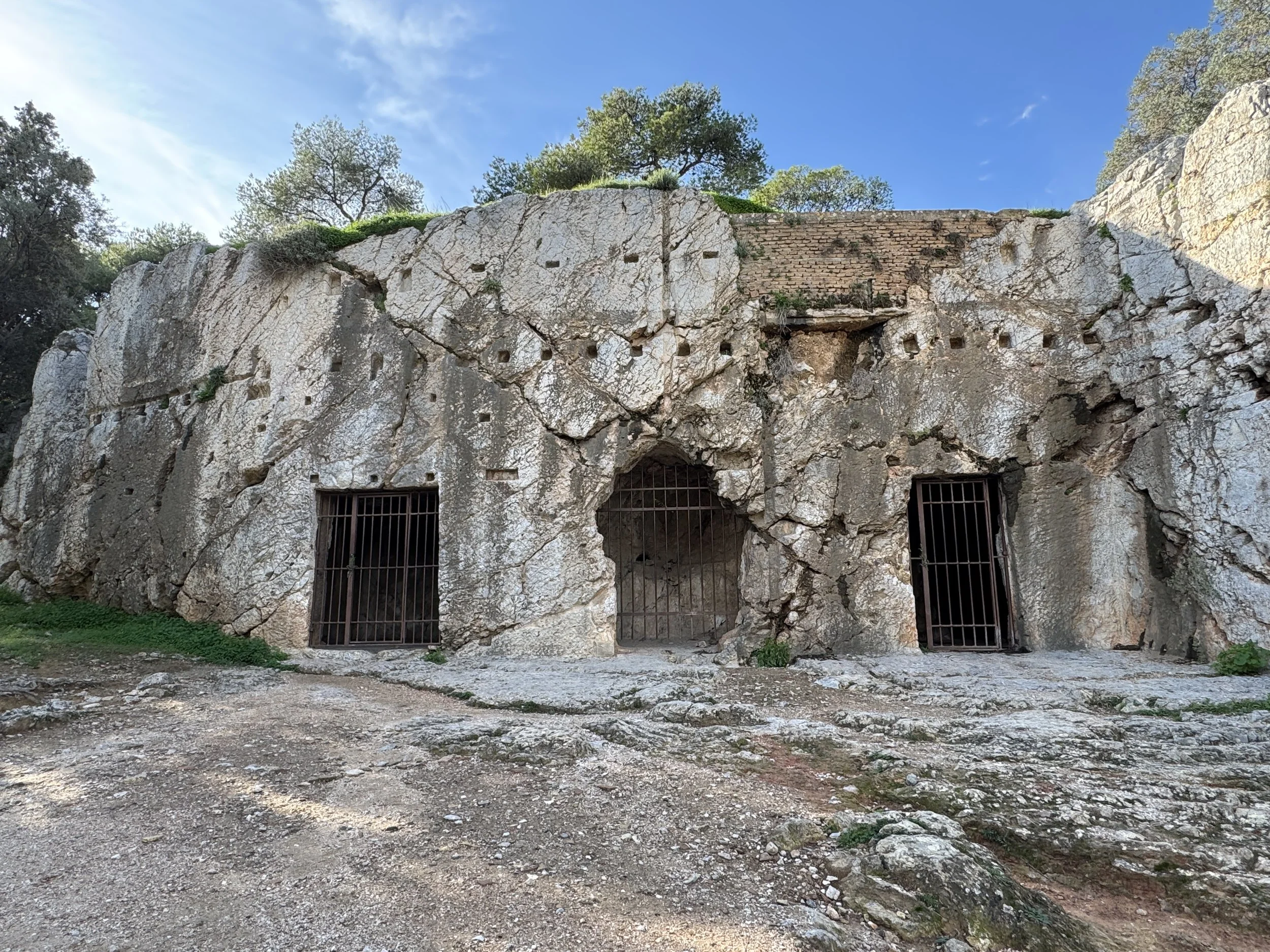
After leaving the museum we headed toward the Prison of Socrates.
On the way we passed the Odeon of Herodes Atticus again, this time from the ground level, which is free to see.
The pathway leading to the prison is mostly pedestrian-only and lined with street performers and crowds.
The Prison of Socrates consists of a series of rock-cut chambers on Philopappos Hill. According to tradition, this is where Socrates spent his final days discussing philosophy before drinking hemlock, as recorded by Plato.
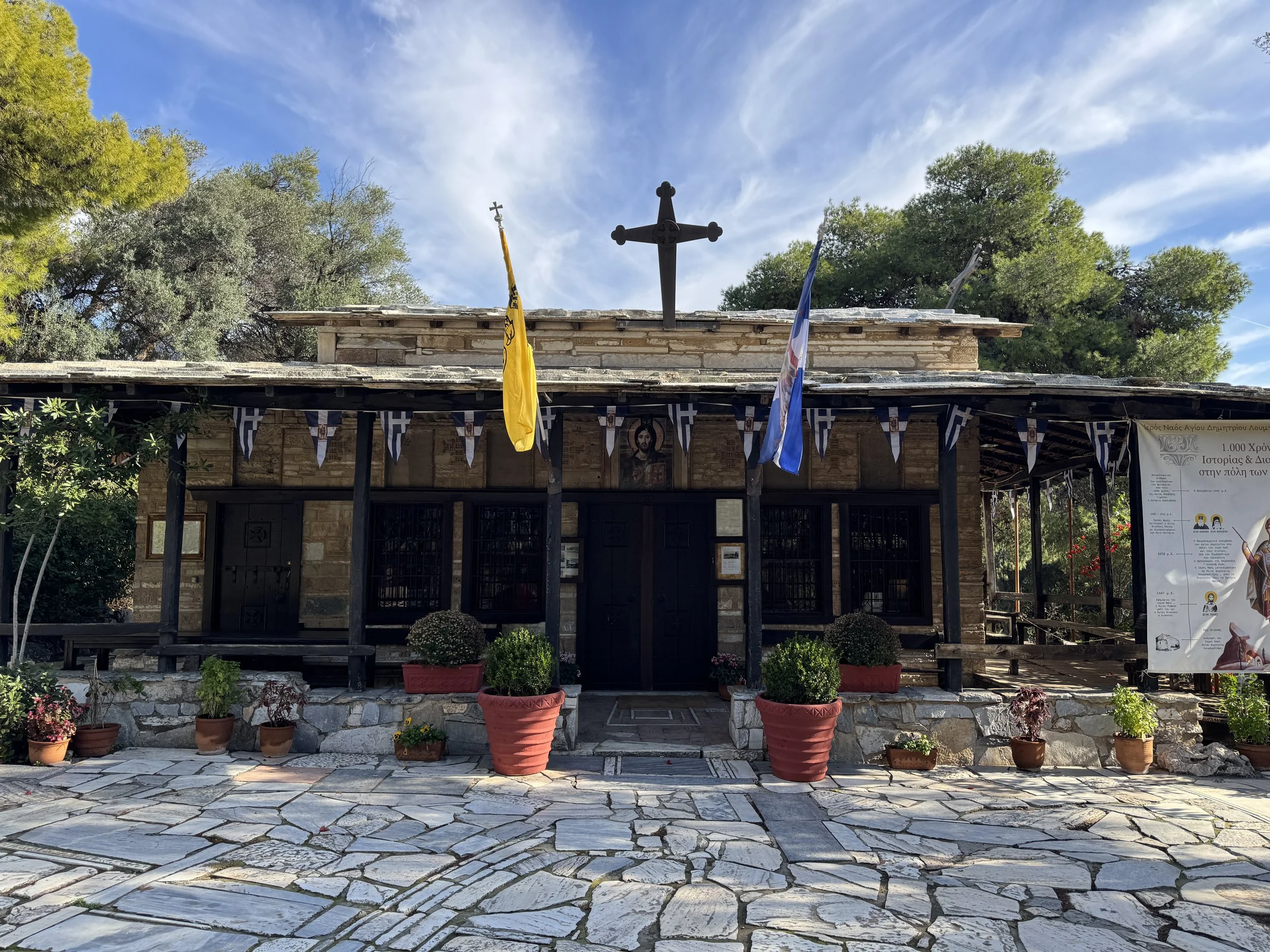
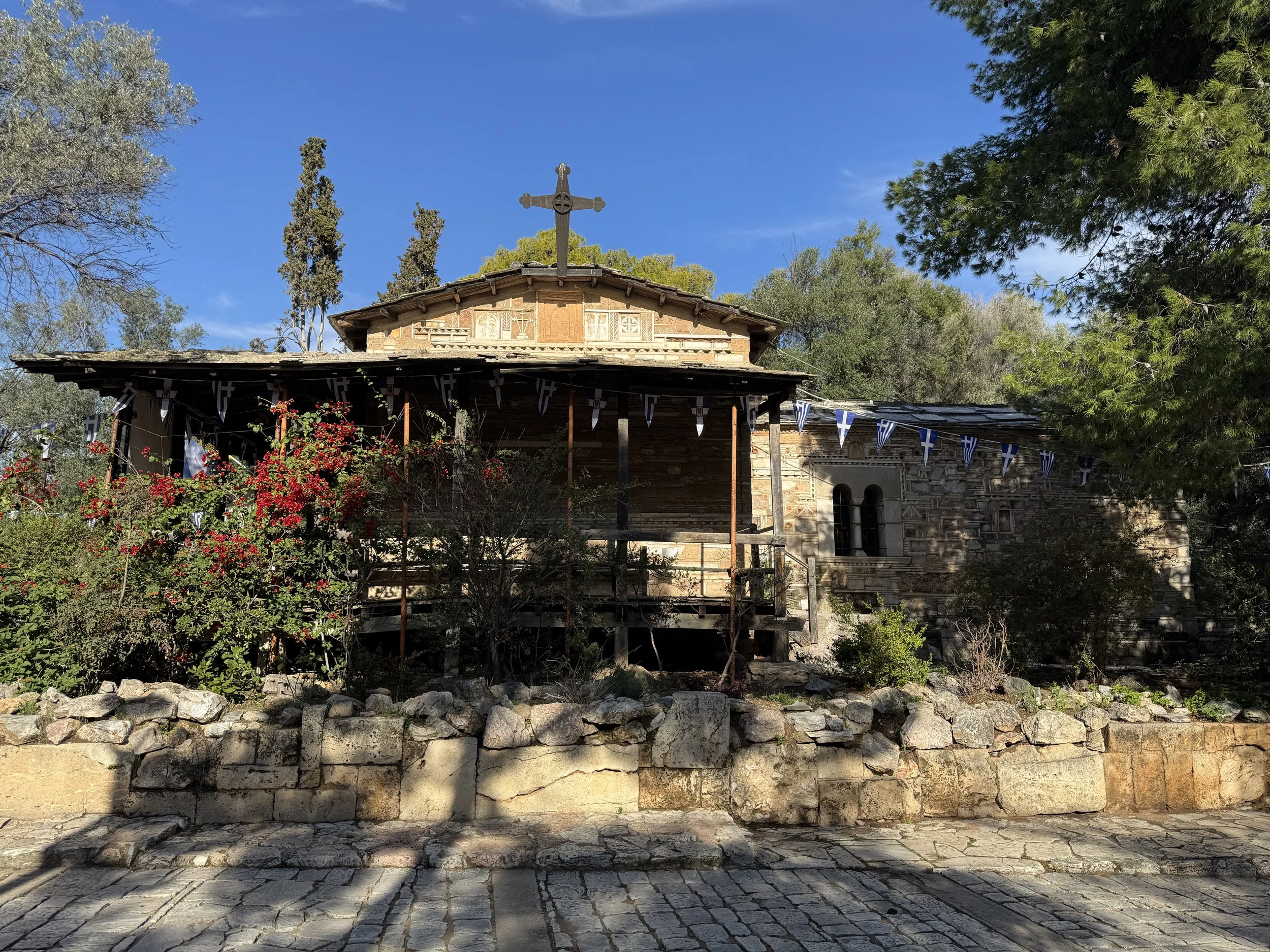
Along this same path is the Church of Agios Dimitrios Loubardiaris.
The church dates to the 16th century, though it is believed to have been built on the site of an earlier Byzantine church. Its unusual name, “Loubardiaris” (The Bombardier), comes from a legend during the Ottoman period.
According to the story, as the Turks prepared to fire a cannon (“loubarda”) at the church, a sudden lightning strike hit the gunpowder, killing the attackers and saving the church. Locals believed Saint Demetrios performed a miracle, giving the church its distinctive name.
Philopappos Monument and Acropolis Views
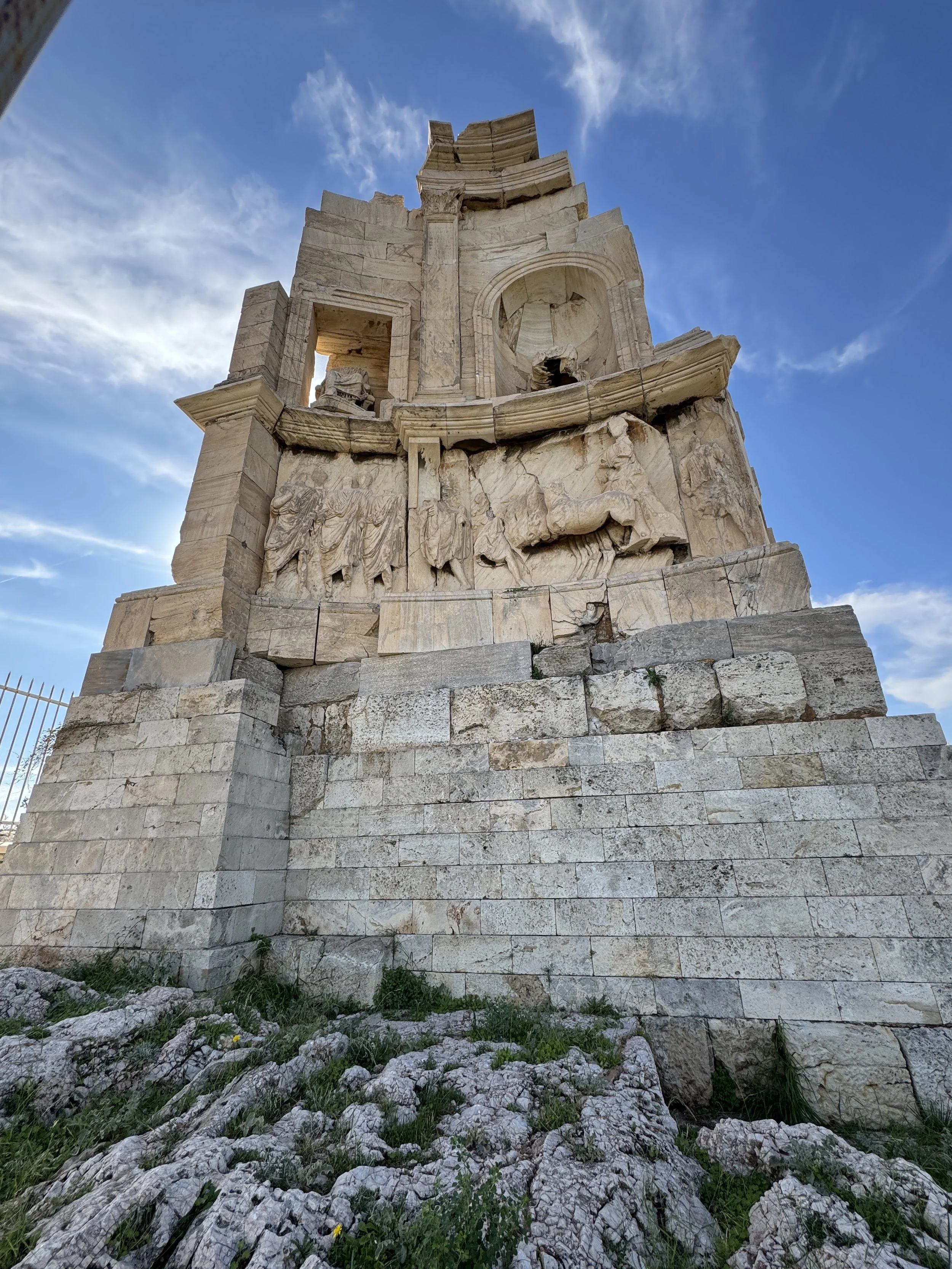
Continuing along the same path takes you up a hill to the Philopappos Monument.
It was built in the 2nd century AD (around 114–116 AD) in honor of Gaius Julius Antiochus Epiphanes Philopappos, a prince from the former Kingdom of Commagene (modern-day Turkey) who later became a prominent Roman citizen and benefactor of Athens.
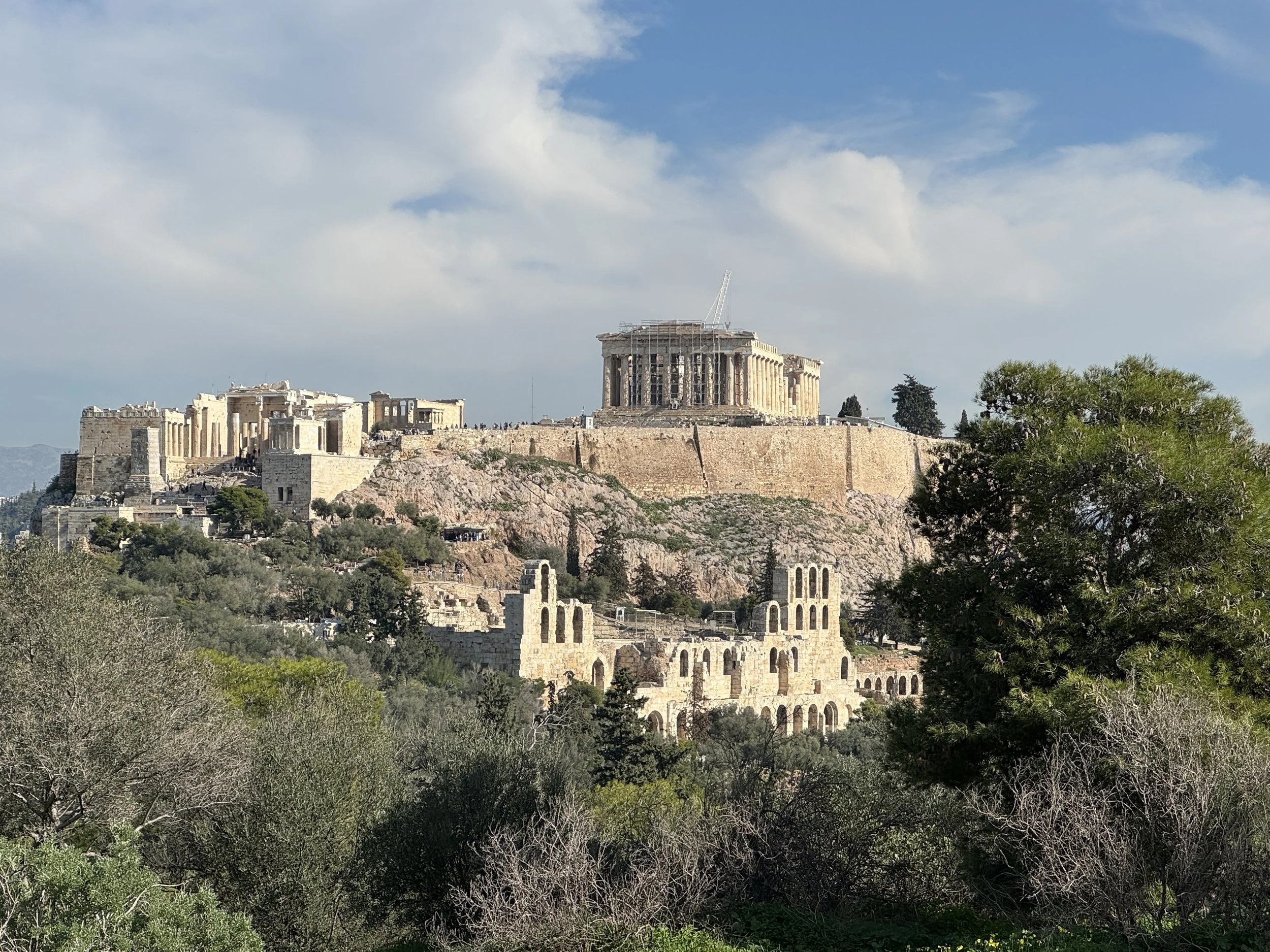
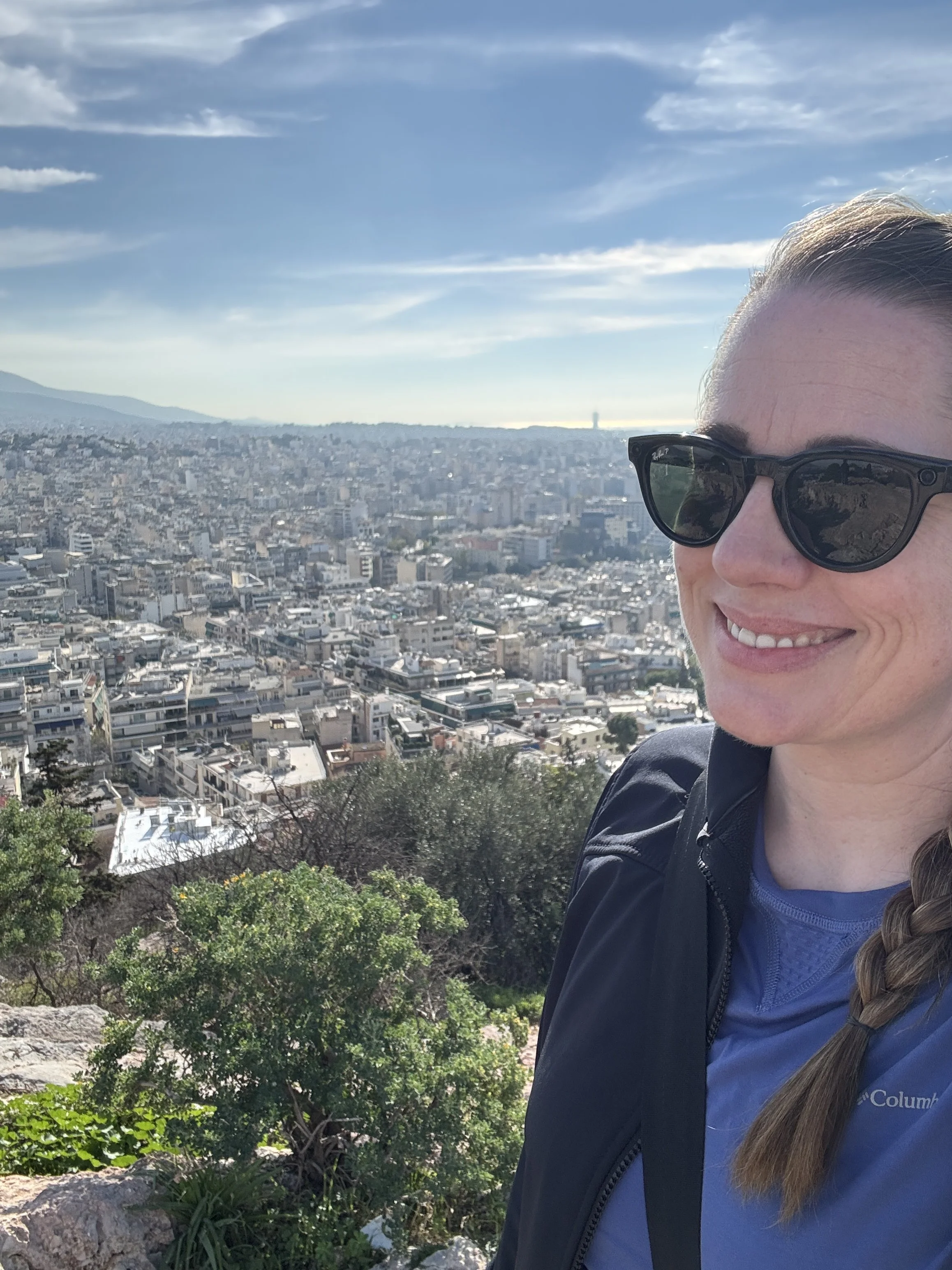
From here you get aerial views of Athens and fantastic views of the Acropolis across the way.
Lunch with Begging Birds
We made our way back down to street level and stopped for lunch at Plakiotissa Taverna.
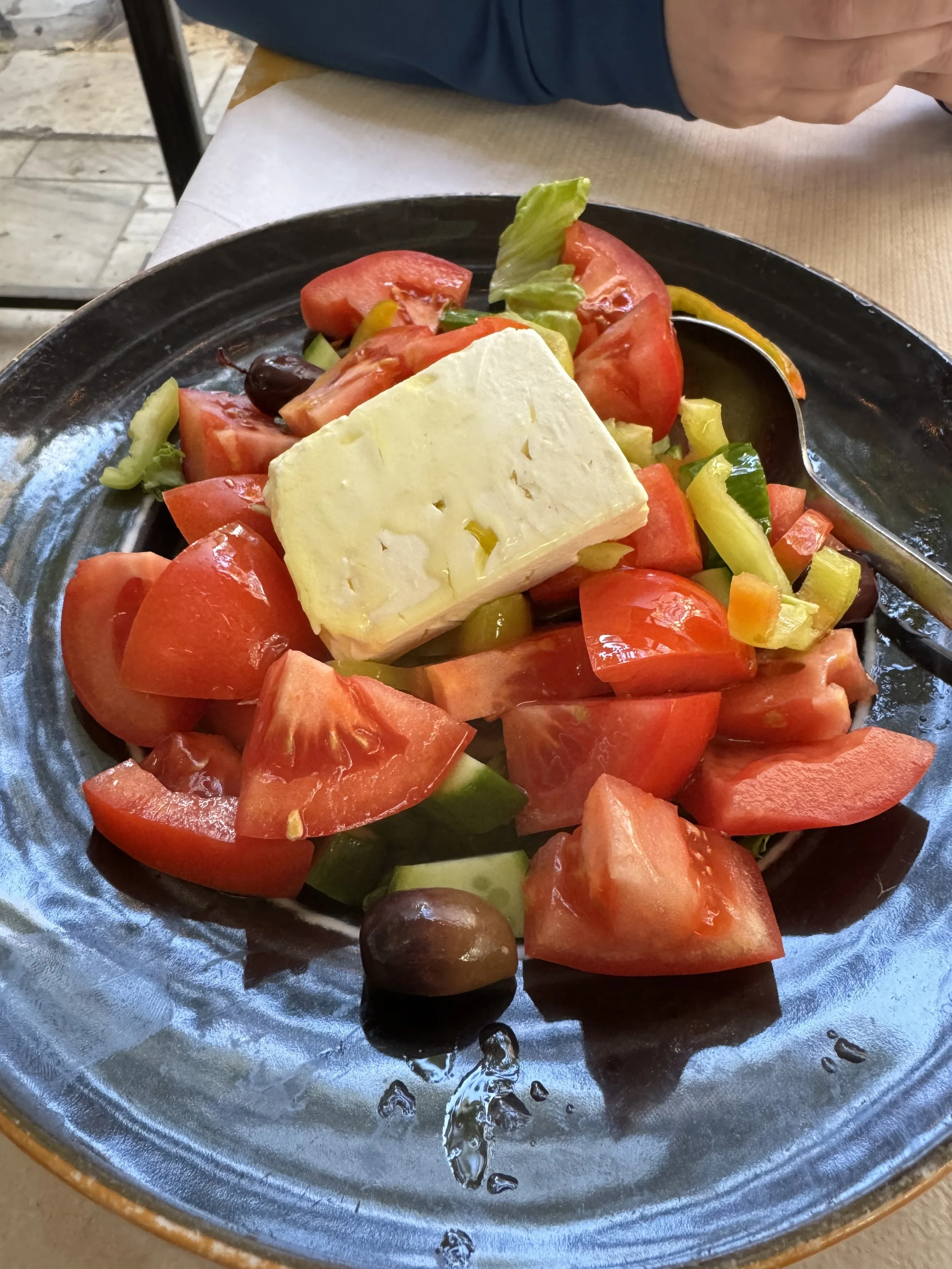
I ordered a Greek salad and moussaka.
The salad was excellent, but the moussaka was just fair.
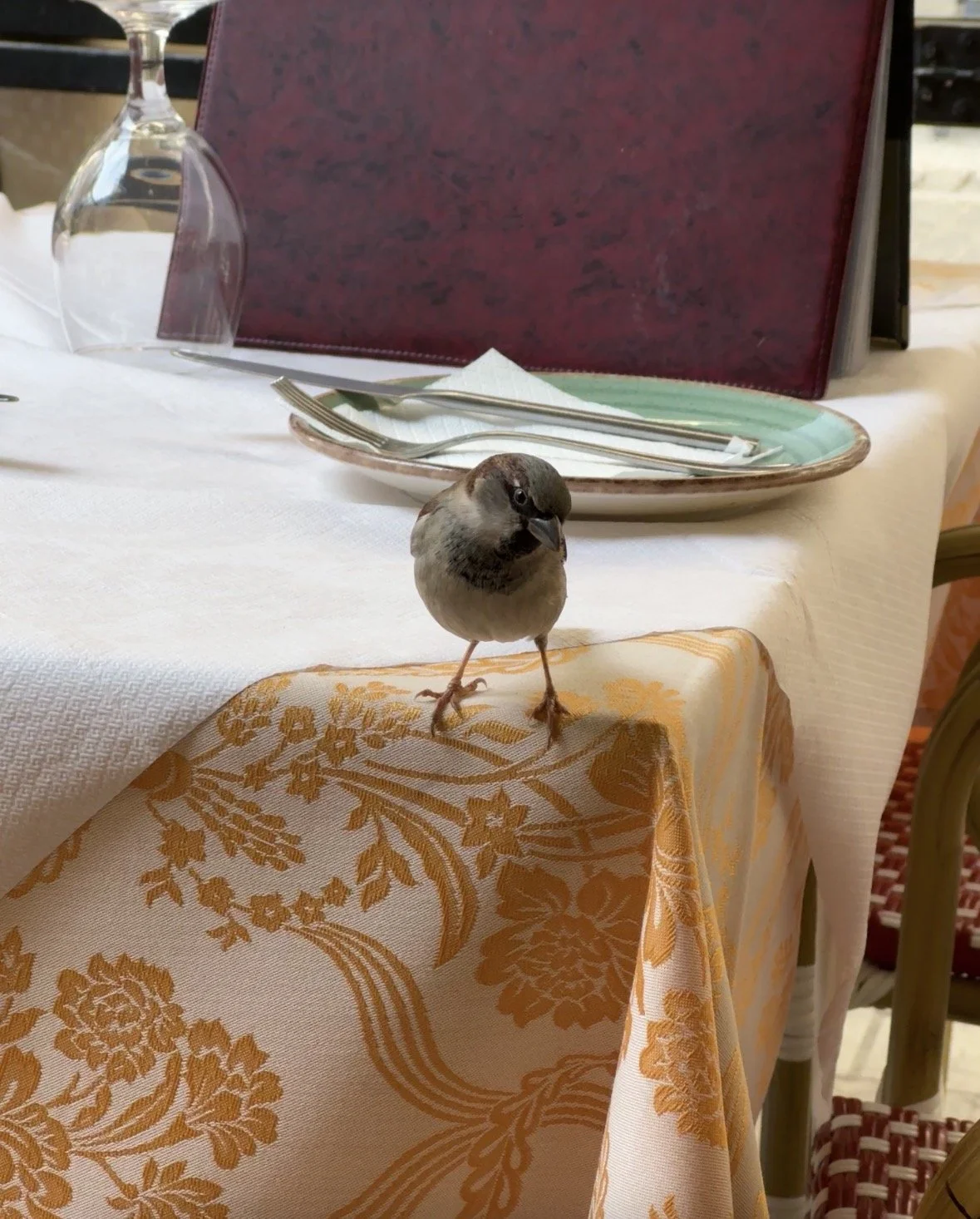
The outdoor seating area felt a little claustrophobic with too many tables packed together, but they had birds wandering around with what I can only describe as puppy-dog eyes.
I have never experienced birds begging for food in such a convincing manner.
Ancient Monuments and Byzantine Churches
After lunch we continued to some of the remaining spots we had marked on our map.
The Choragic Monument of Lysicrates was built in 334 BC to commemorate a victory in a theatrical competition during the festivals of Dionysus. It was dedicated by Lysicrates, a wealthy citizen who sponsored the winning chorus.
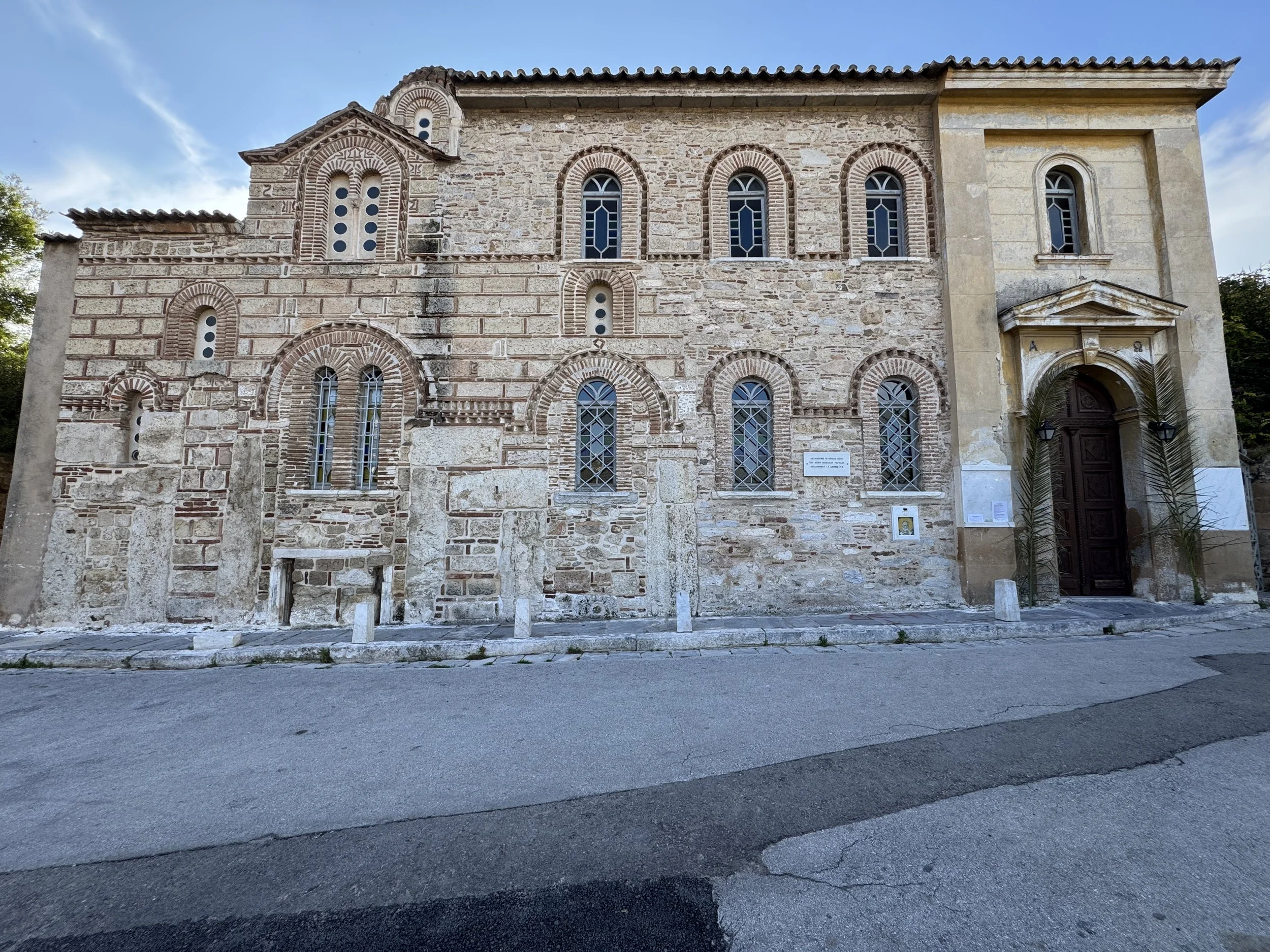
Next we visited the Church of the Transfiguration of the Saviour, which dates back to the 11th century, making it one of the largest and most important Byzantine churches in Athens.
It was originally part of a Byzantine monastery founded by a noble Athenian family named Lykodimos, from whom the church takes its historic name.
In the 19th century, it was restored with the support of the Russian Empire and became the official Russian Orthodox Church of Athens, which is why it’s commonly known today as the Russian Church.
Wandering Through Athens’ Most Charming Streets
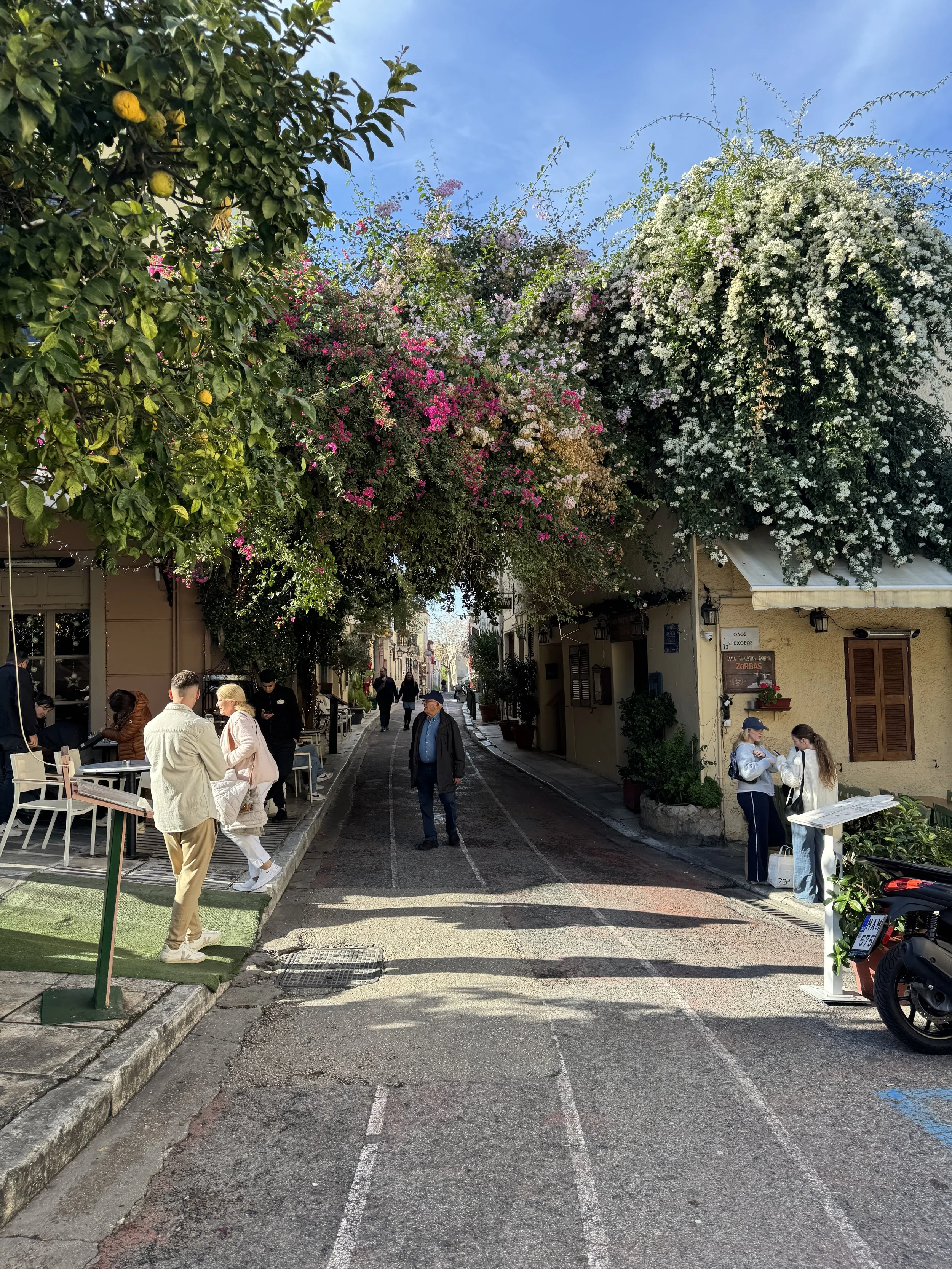
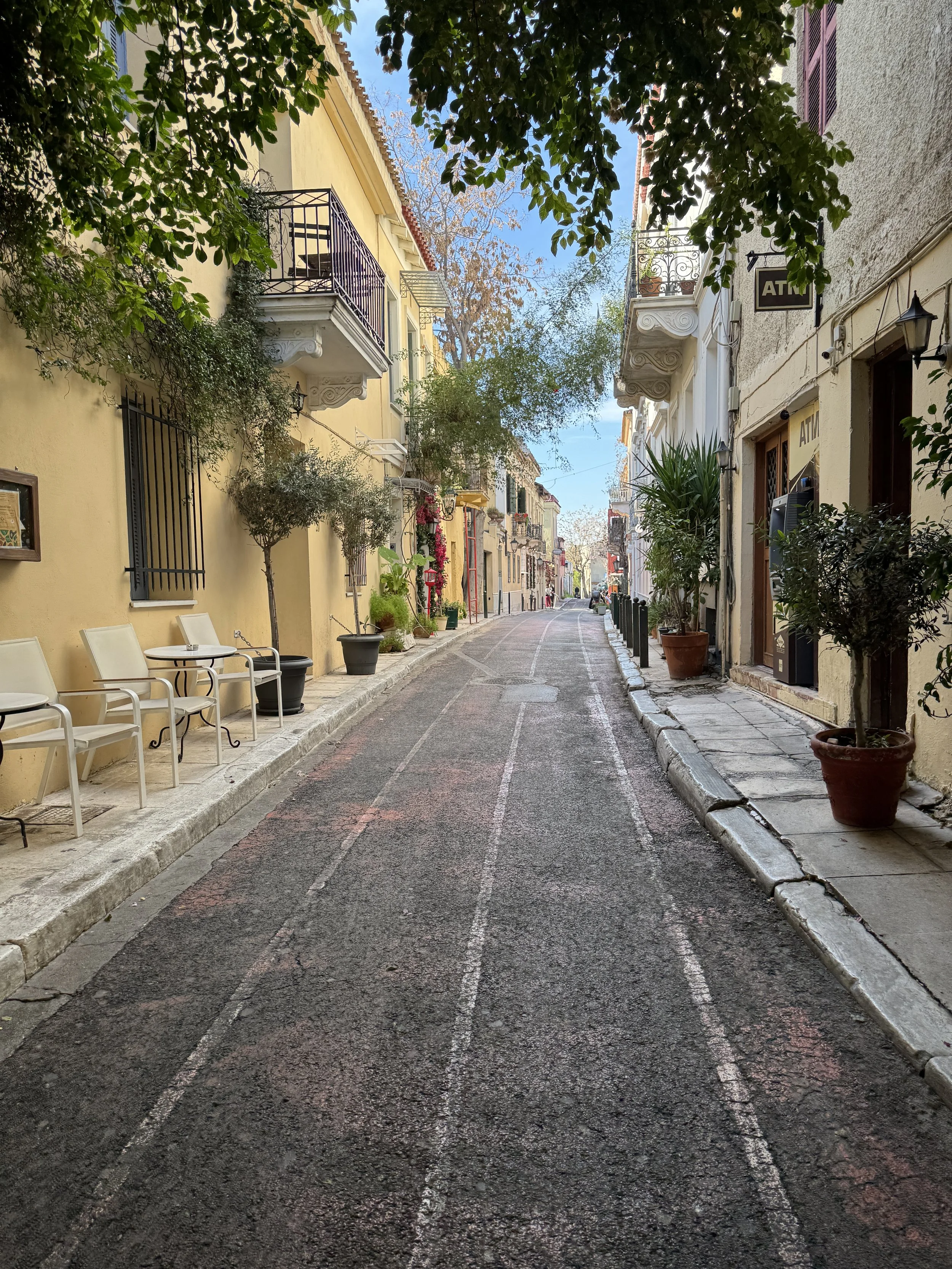
We then headed down Lysiou Street, which was lined with cute restaurants and small shops.
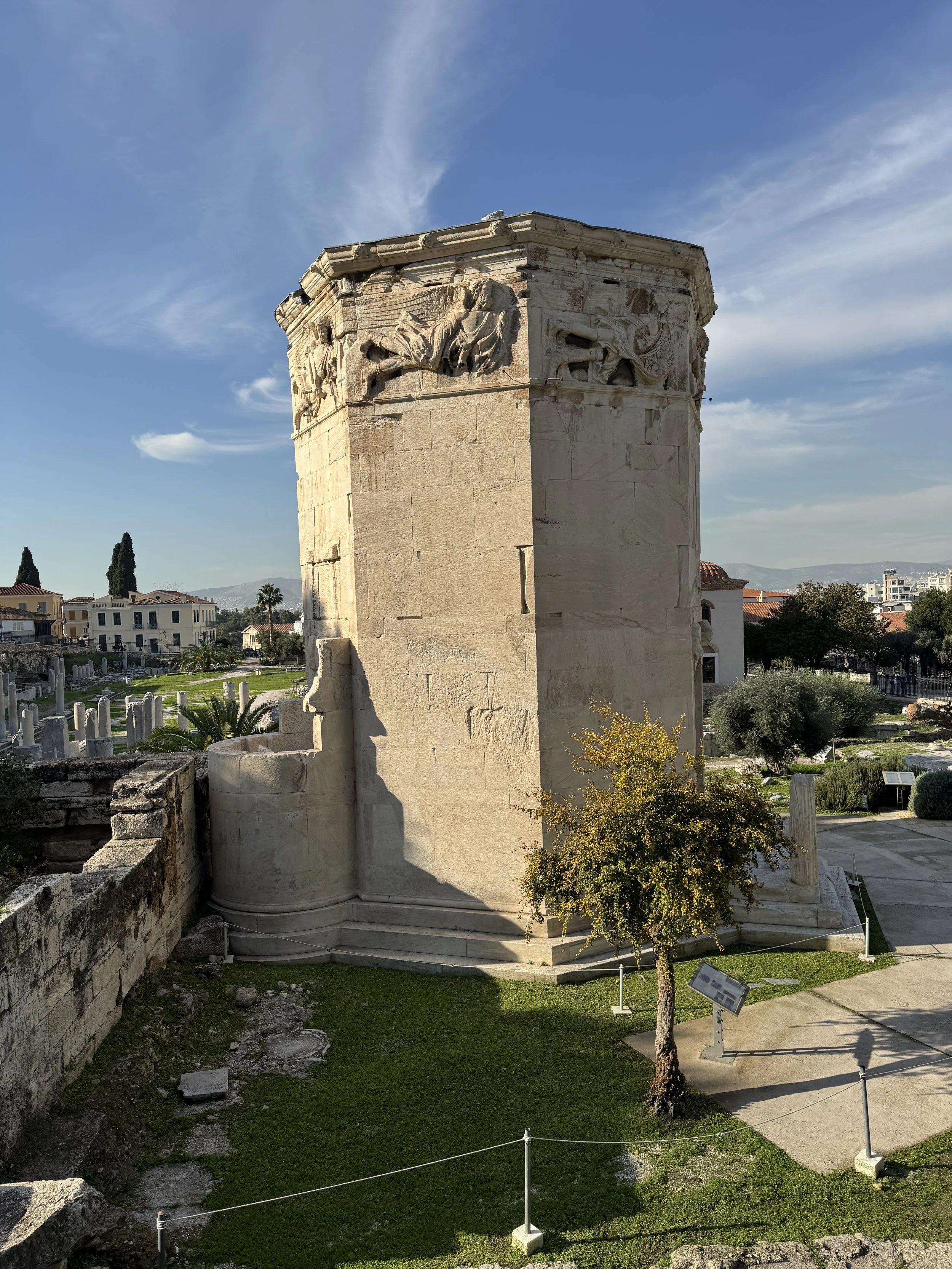
Next we visited the Tower of the Winds, built in the 1st century BC by the astronomer Andronikos of Kyrrhos.
Located in the Roman Agora, it functioned as an advanced ancient timekeeping station, combining:
a water clock
sundials
a wind vane
At the top are eight wind gods, each representing a different wind direction.
Over the centuries the tower was reused as a Christian chapel and later during Ottoman times as a dervish lodge.
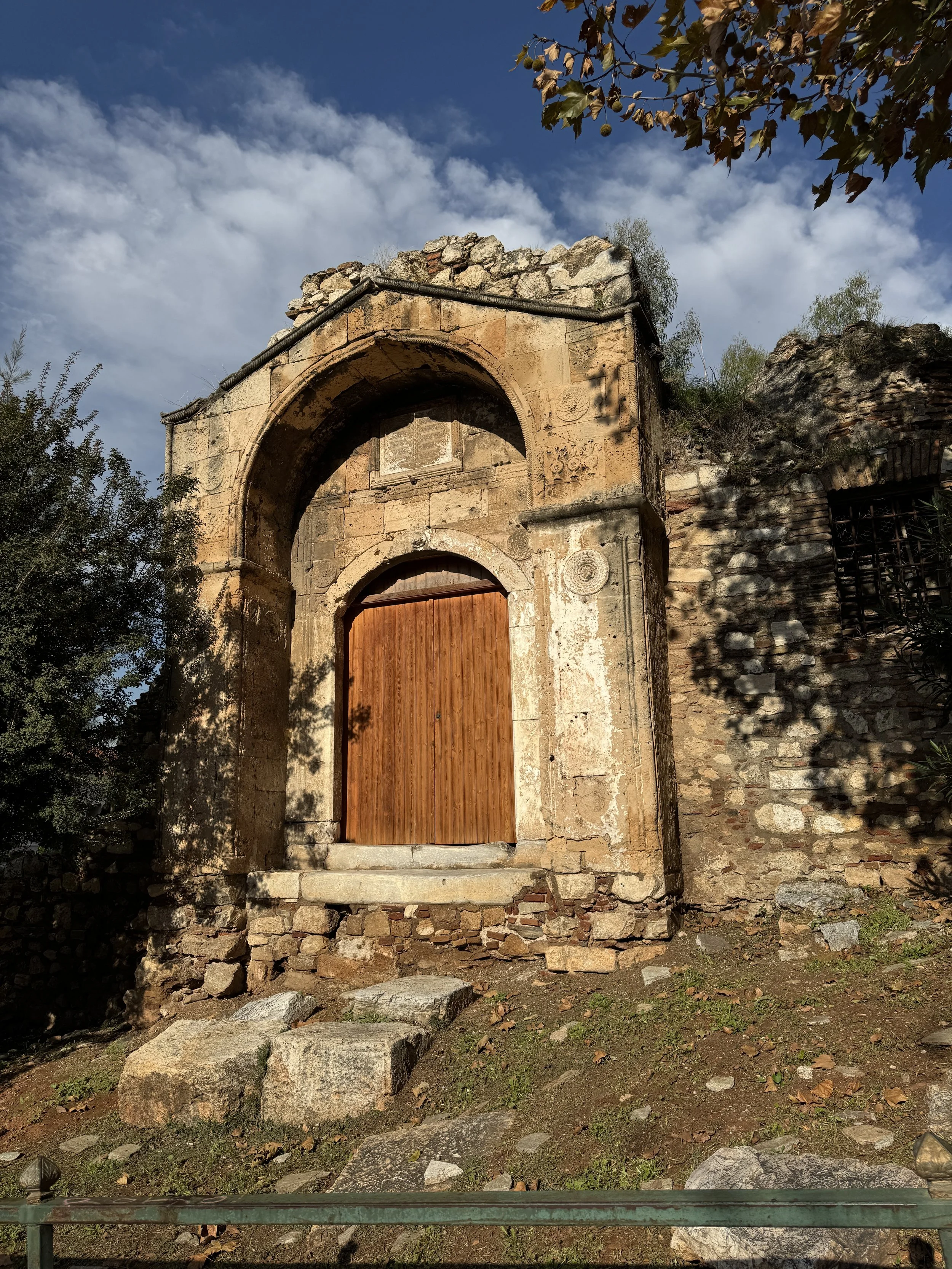
Right across the street stands the Old Madrasa Gate, the last surviving remnant of an 18th-century Ottoman Islamic school built in 1721 near the Roman Agora.
Gelato, Markets, and Unexpected Surprises
We passed Hadrian’s Library again and snapped a few more photos from this direction, which led us to another cute street called Adrianou.
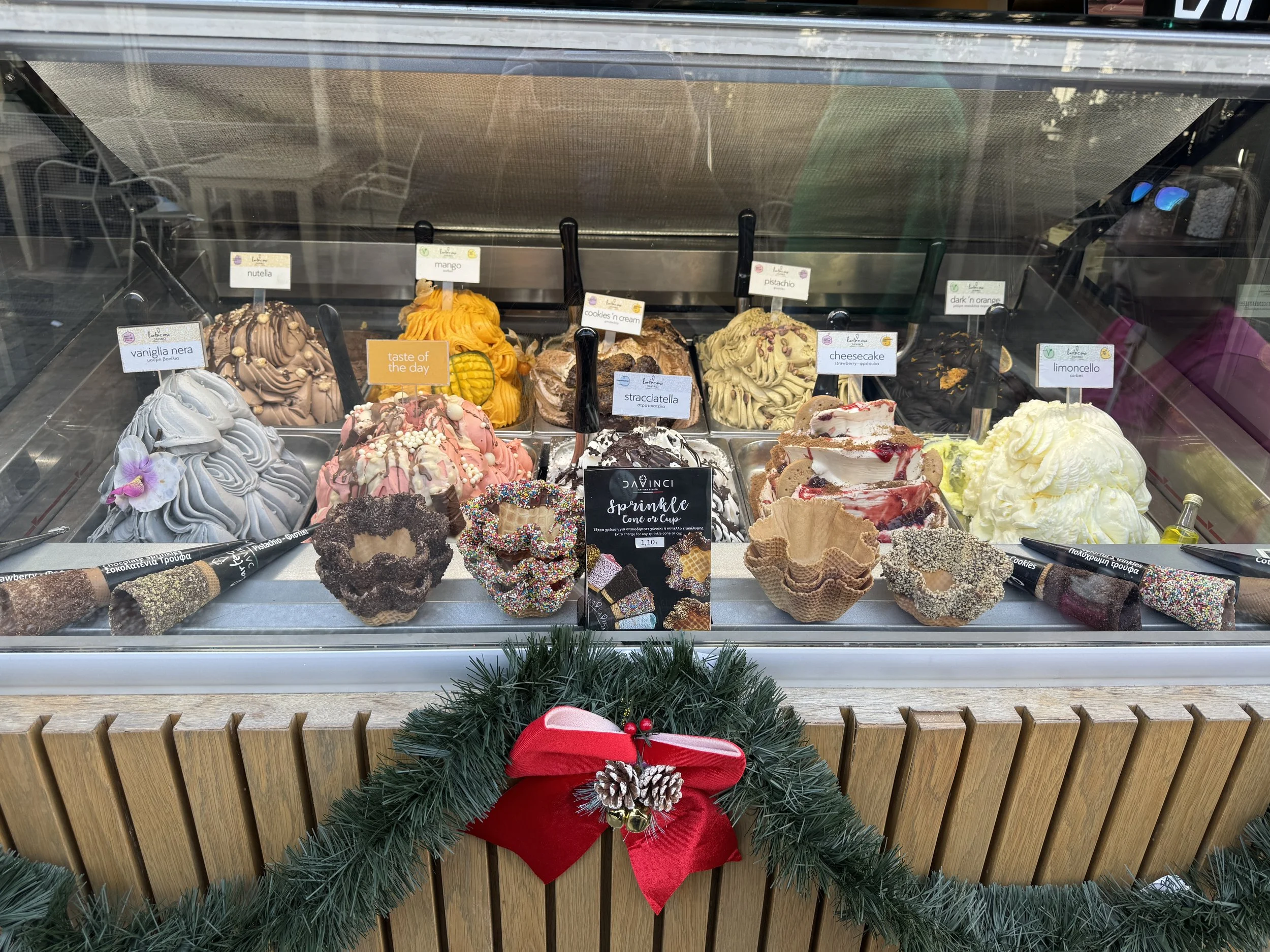
We made a pit stop at Lartecono Davinci Gelato, which was to die for and absolutely worth the stop.
From there we walked to Monastiraki Square, where a large flea market and souvenir shops fill the area. Most of the shops sell similar items, but a few were unique.
We weren’t really in the mood to shop, so we mostly window shopped and people-watched.
Graffiti, Cafés, and… a Sex Vending Machine
Next we wandered up into Psyrri, an area known for its graffiti art and cute cafés.
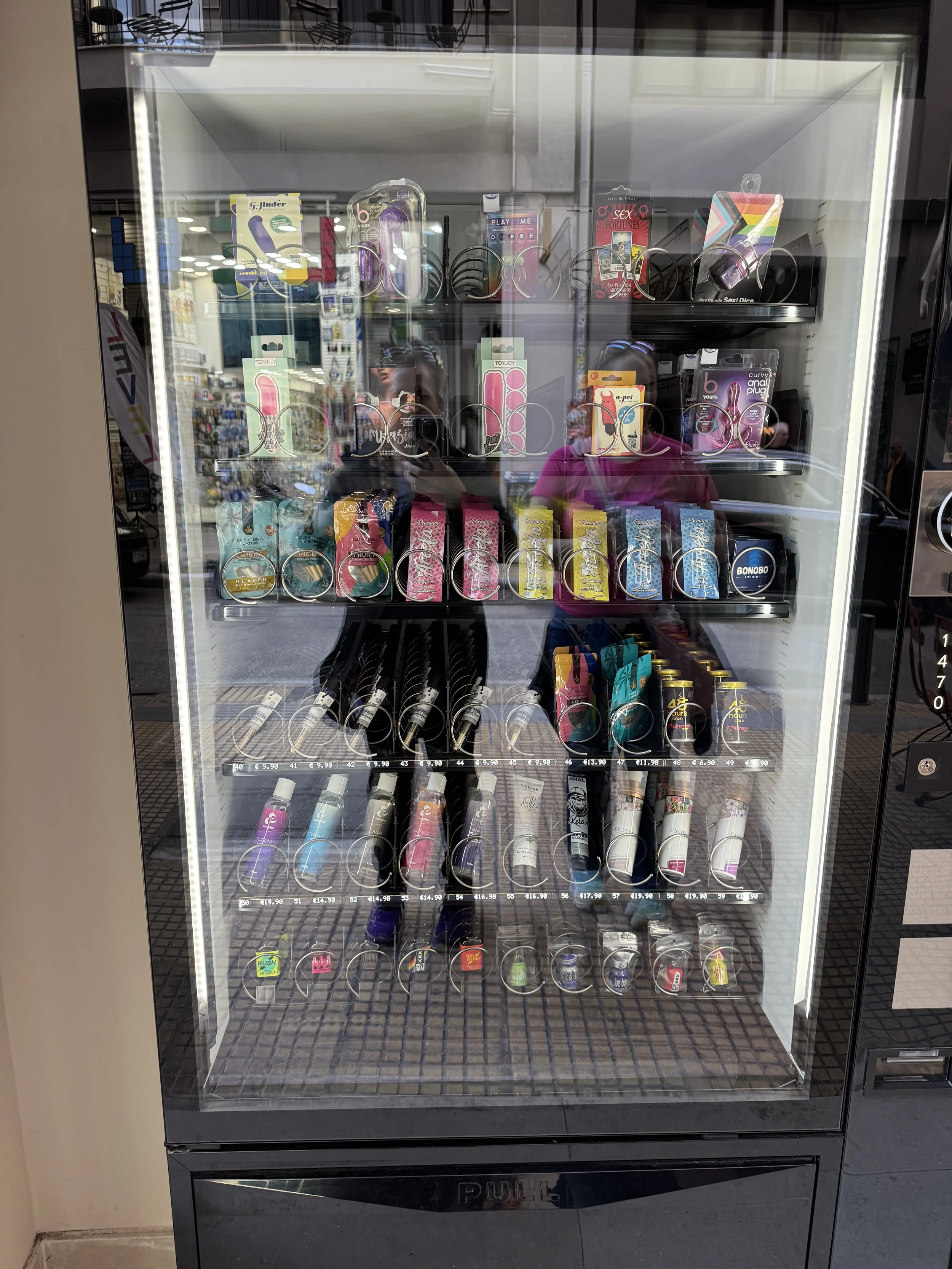
It also had something slightly unexpected: a sex vending machine stocked with vibrators, lube, condoms, and pretty much anything you might want in the bedroom.
Athens definitely keeps things interesting.
The Most Over-the-Top Christmas Block
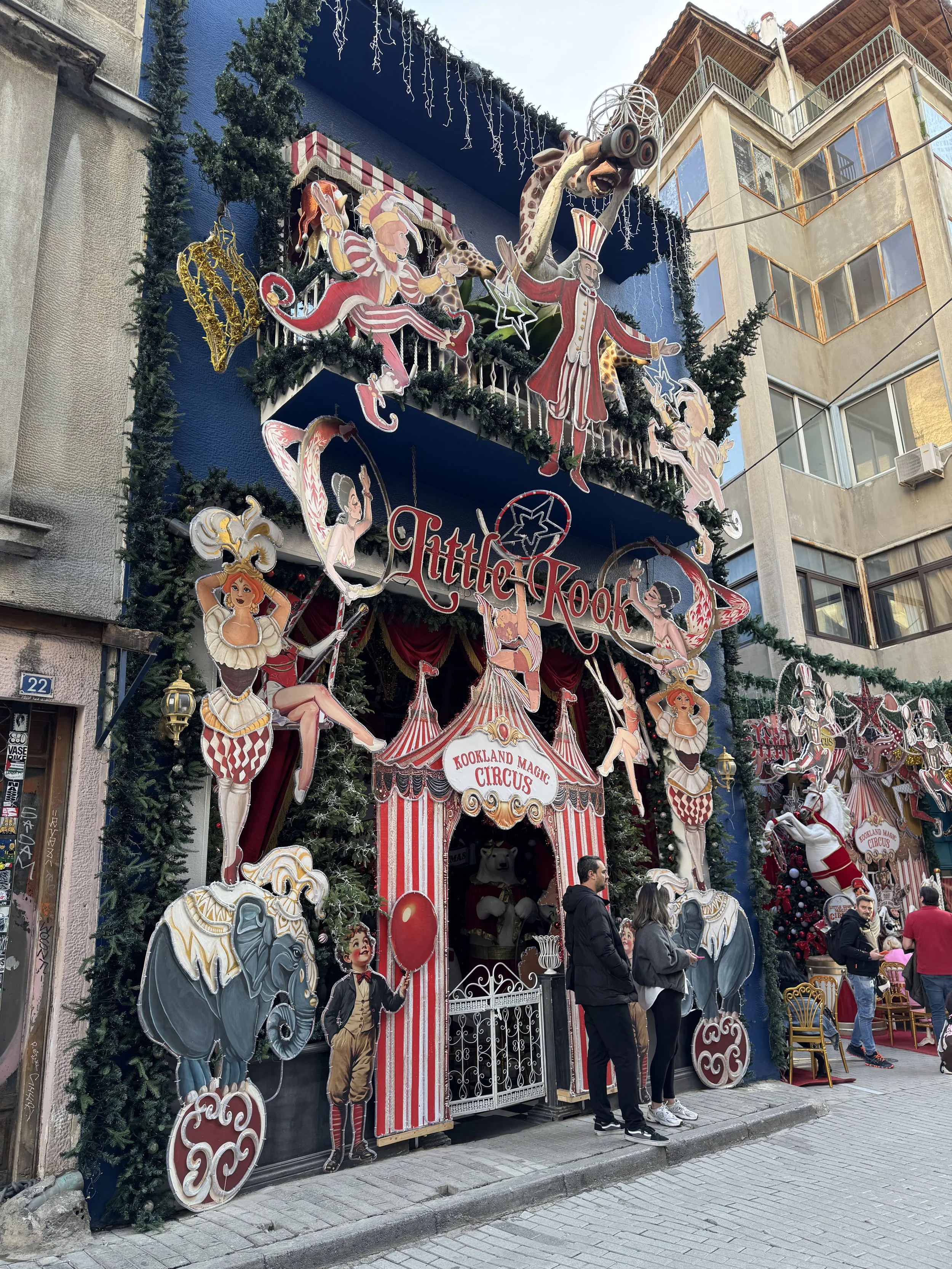
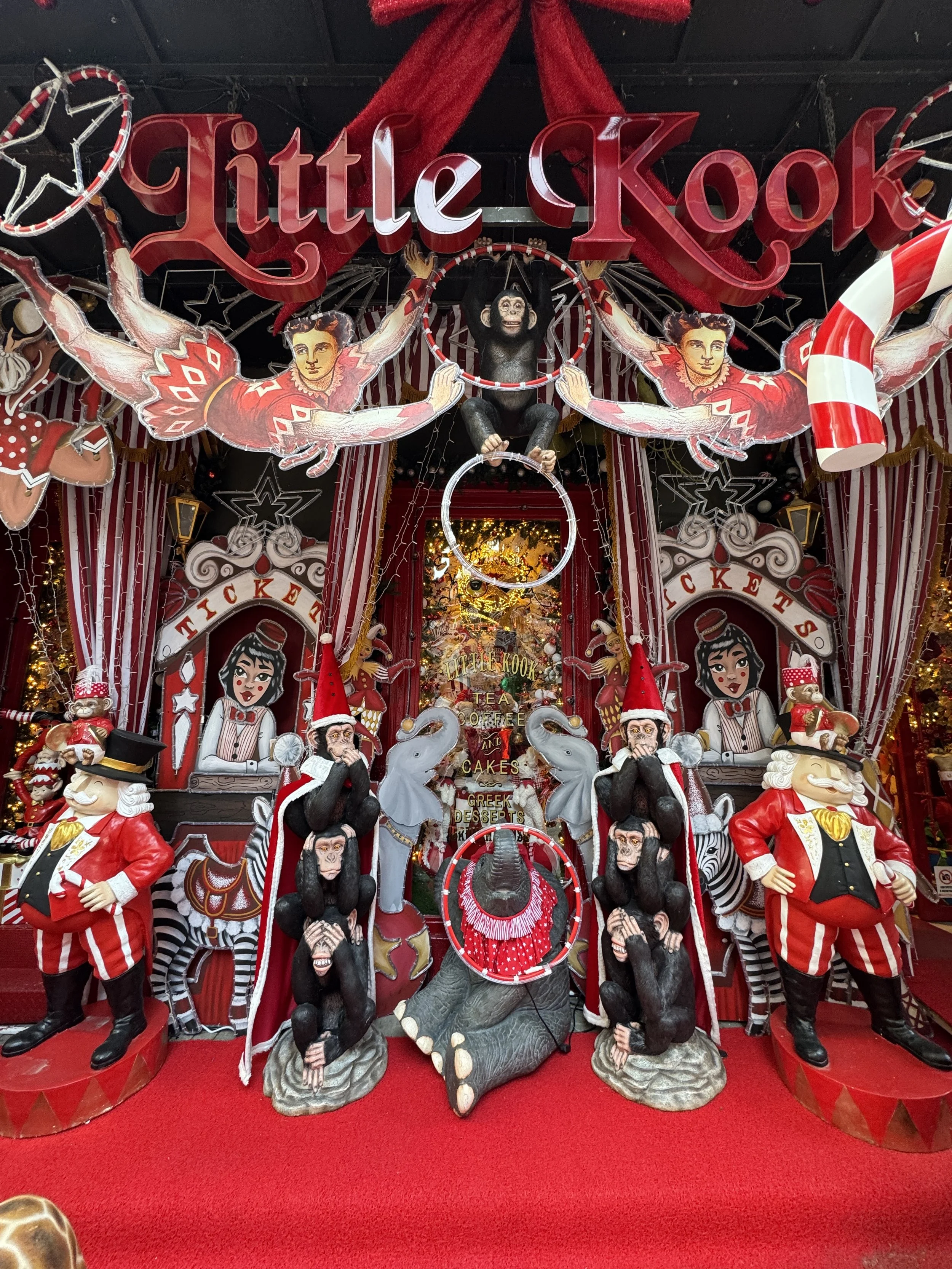
While wandering we stumbled across Little Kook, which looked like an entire Christmas-themed block.
It’s essentially a Christmas café filled with decorations, drinks, and sweet treats, and it was completely over-the-top festive.
We spent some time enjoying the décor before heading back to the hotel to rest before dinner.
Dinner at Restaurant Fish
For dinner we walked about 10 minutes to Restaurant Fish.
The place was busy with only one table open, though to be fair it’s not a very large restaurant.
As the name suggests, the menu focuses heavily on seafood.
I ordered the seafood risotto, which came with shrimp, mussels, and squid, and it was quite good.
What surprised us most was the price.
It was incredibly cheap, costing about €11 per person including a soda and seafood dish.
December 11: Crete, Minoan Palaces, and Olive Oil
Early Morning Flight to Crete
We woke up, got packed, and our driver arrived just before 7 a.m. to take us to the airport.
The airport was efficient and we made it through security quickly. Since we were flying domestically, we didn’t need to go through immigration.
The airport had a really nice setup with several places to order pastries, breakfast, drinks, and snacks, along with plenty of seating.
I picked a breakfast place where for €14 you got eggs two ways, beans, mixed vegetables, sausage, bacon, and a fried cheesy ball.
Soon after we boarded our 40-minute flight to Crete. When we landed we stepped out onto the tarmac and hopped on a bus, which drove us about 150 meters to the airport terminal.
Our bags were already waiting when we arrived inside.
Picking Up the Rental Car
We proceeded to Right Car to pick up our rental.
This one was a budget rental, which meant we had to walk about five minutes outside the airport to the booth.
The car itself was fairly new and had Apple CarPlay, which was a nice bonus.
An Unexpectedly Great Lunch Stop
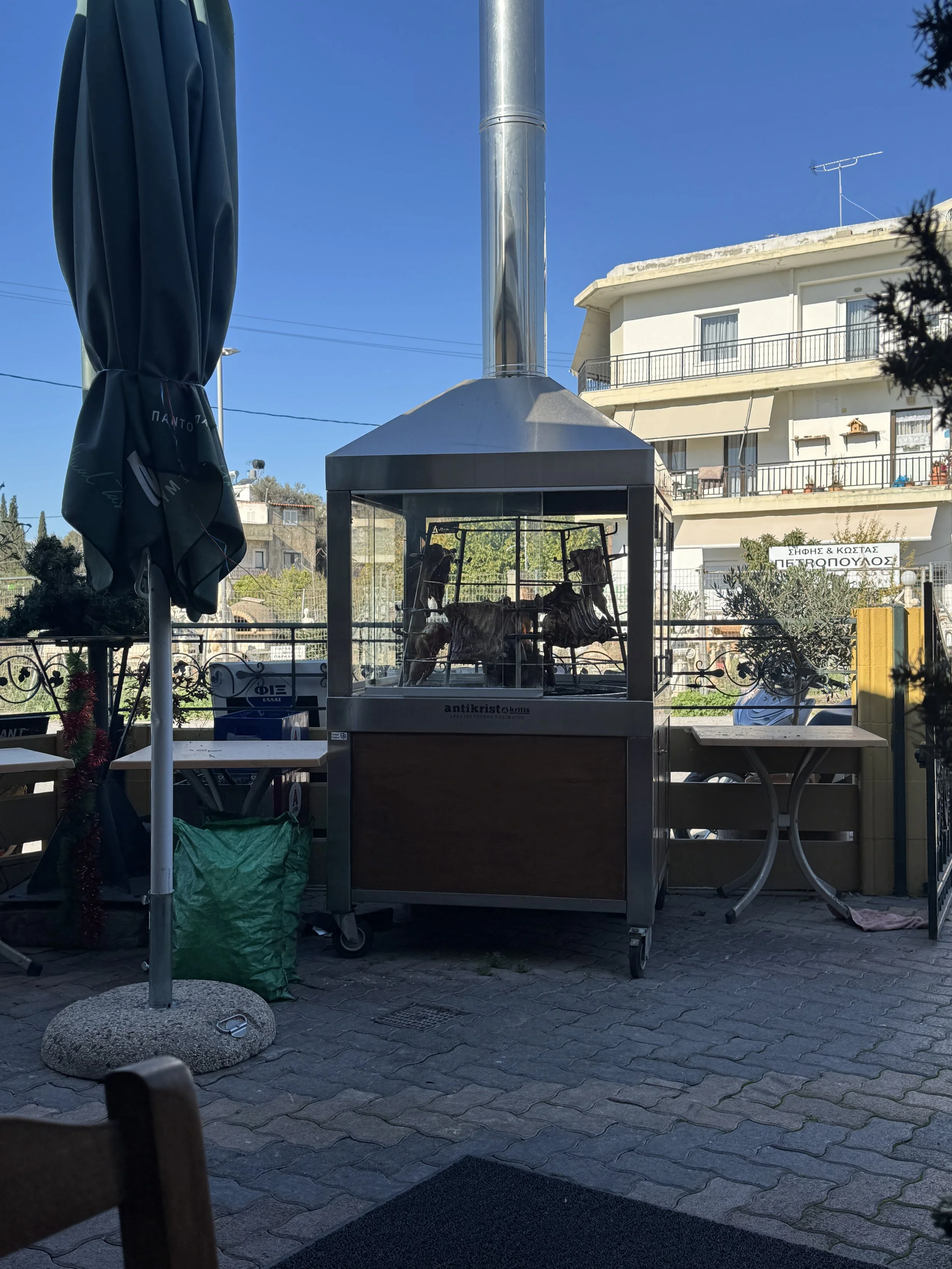
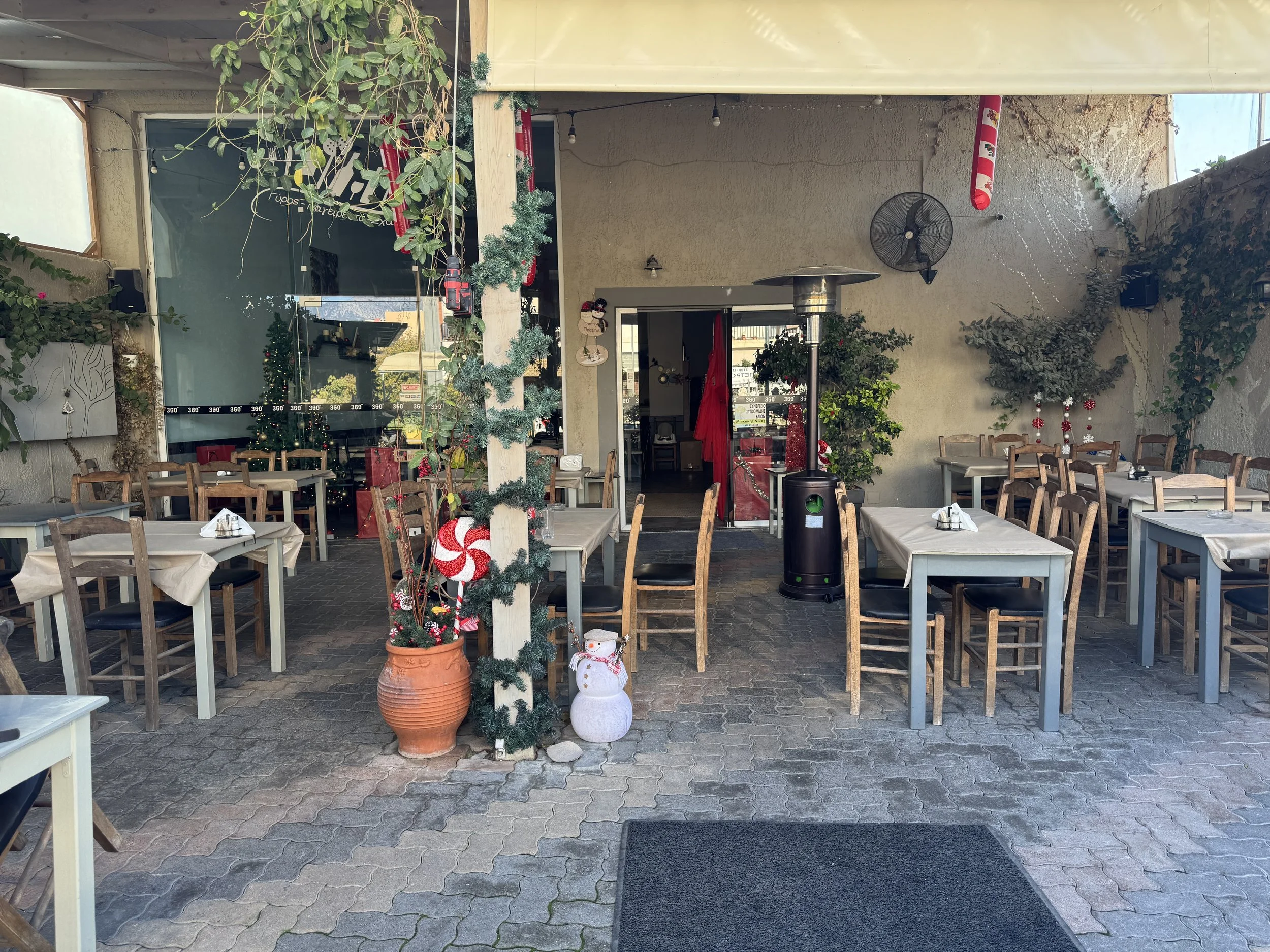
Before heading to the archaeological sites we stopped at Εστιατόριο 360 Mires Restaurant.
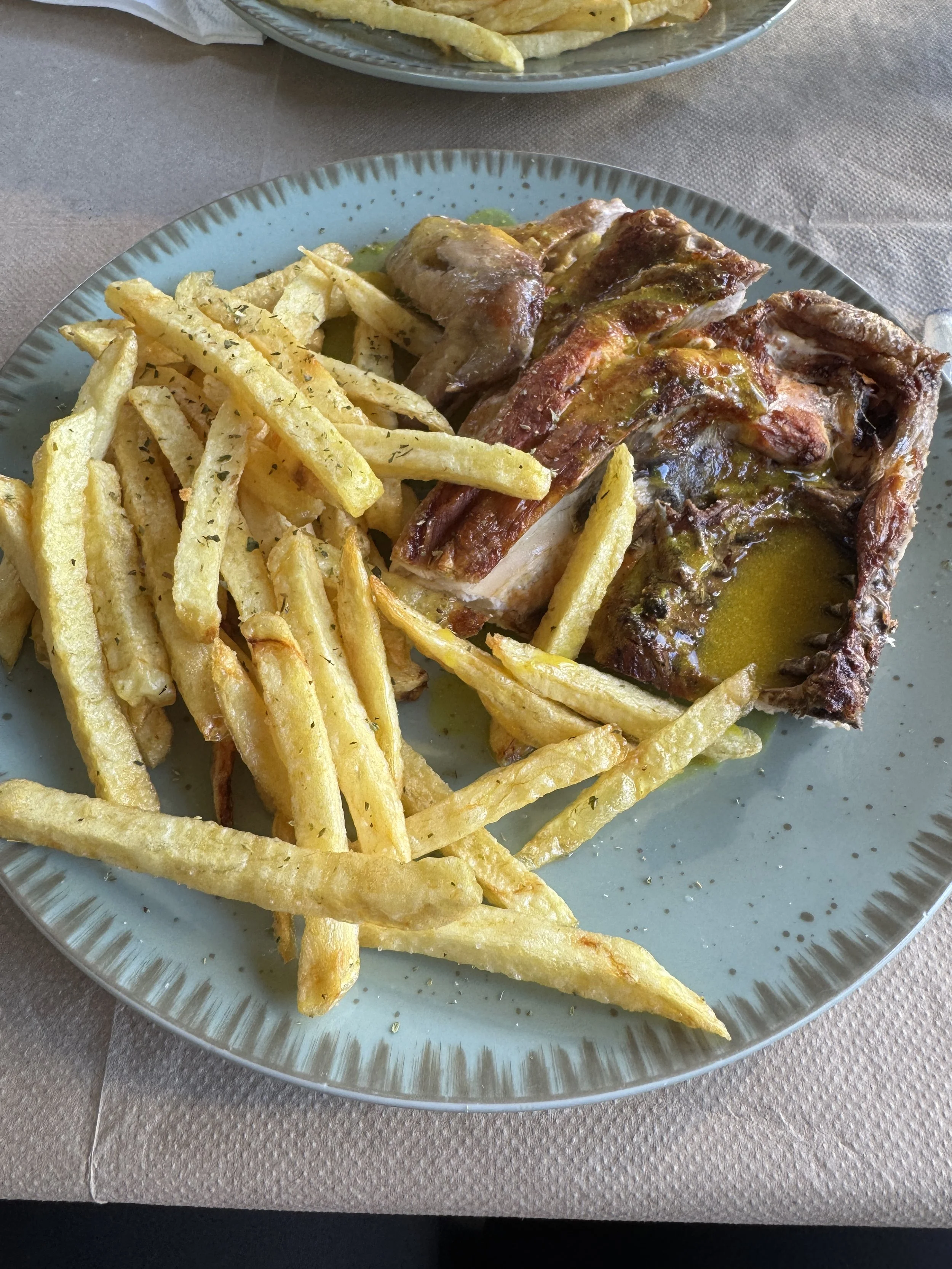
We ordered a wood-fired chicken served with a delightful butter sauce and fries.
It was delicious and surprisingly inexpensive at about €11 with a drink. Definitely worth the stop.
The Minoan Palace of Phaistos
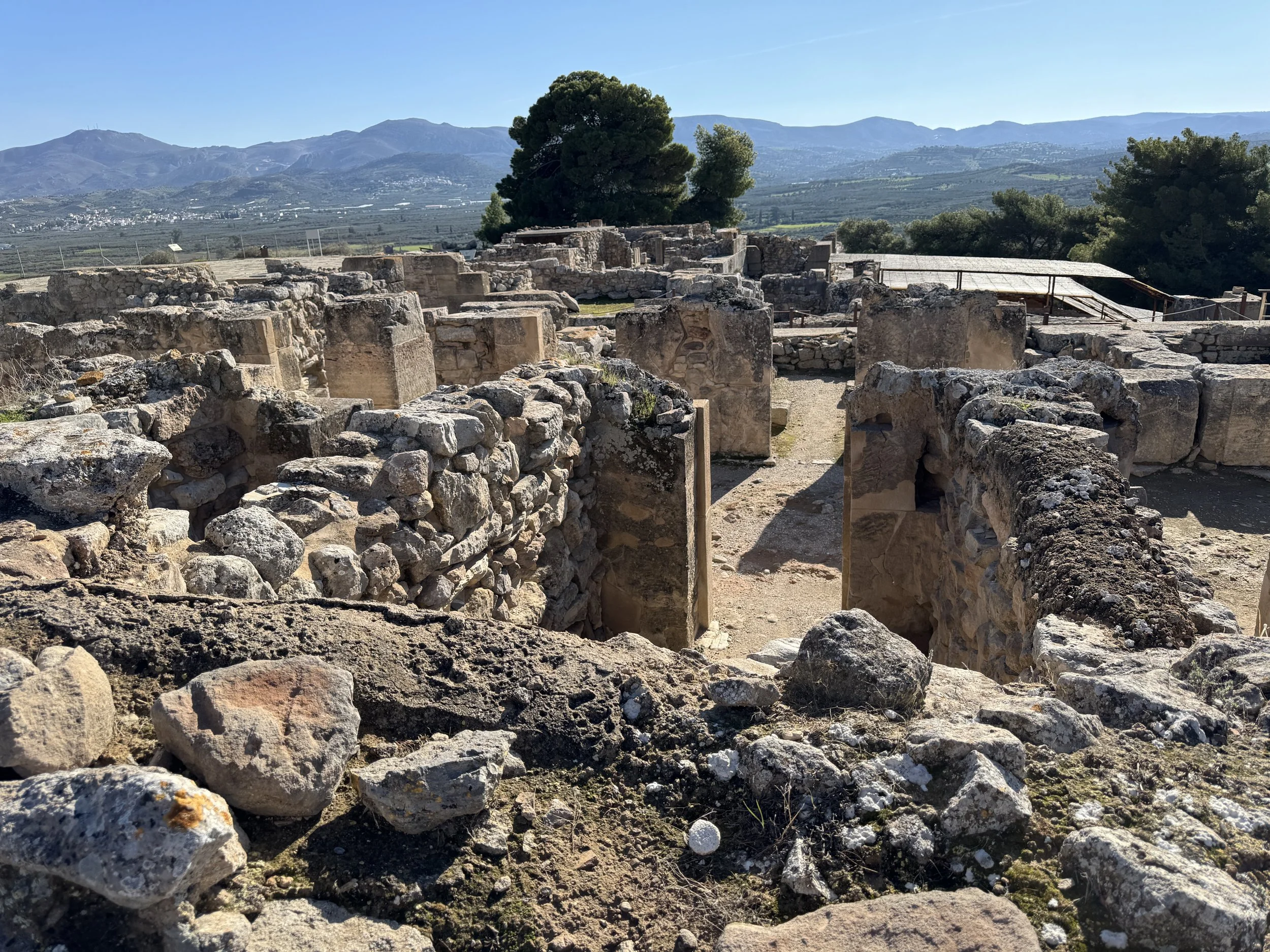
Our next stop was the Minoan Palace of Phaistos.
There’s a parking lot just outside the site, and the actual entrance is somewhat hidden. You have to walk across a bridge to reach it.
Admission was €15.
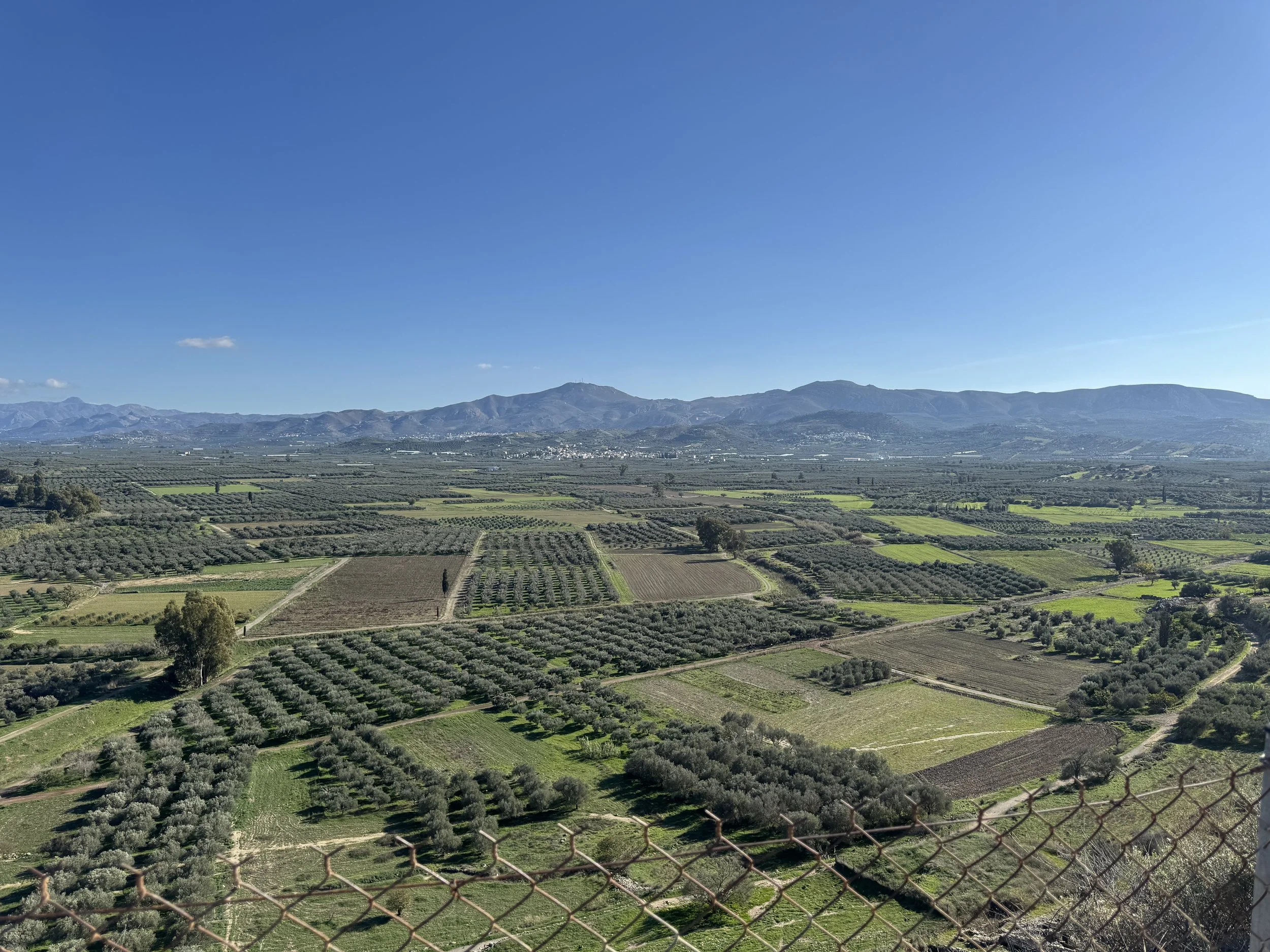
The Minoan Palace of Phaistos was one of the most influential centers of Bronze Age Crete, serving as the main political and economic hub for the fertile Mesara Plain in the island’s south.
Its hilltop location offered sweeping views of farmland and trade routes, making it a powerful regional seat.
The first palace was constructed around 1900 BC, featuring storage wings, ceremonial areas, workshops, and the grand staircases typical of Minoan design. This early complex was destroyed—most likely by an earthquake—around 1700 BC.
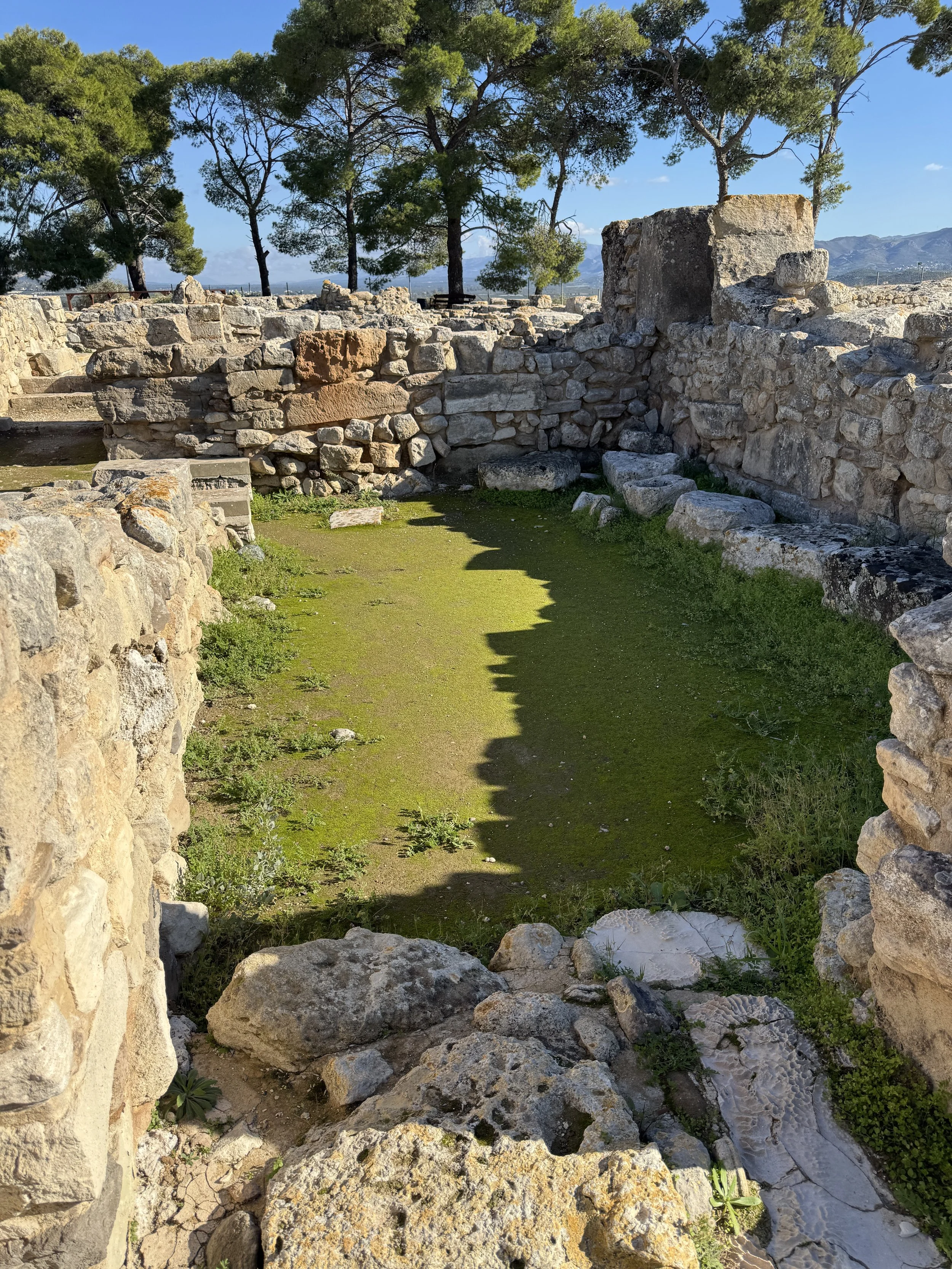
A second palace was then built in its place, larger and more refined. Most of the structures visible today date from this rebuilding phase. Visitors can still see the central courtyard, monumental staircases, storerooms, and residential quarters that once formed the heart of Phaistos’ administrative and religious life.
Many archaeologists consider it one of the most elegant examples of Minoan architecture.
Like other Minoan palaces, Phaistos declined around 1450 BC, a time marked by natural disasters and the expanding influence of the Mycenaeans. The site was never rebuilt, leaving its foundations preserved in a remarkably authentic state.
Phaistos is also famous for the discovery of the Phaistos Disc, a clay tablet stamped with mysterious spiral symbols that remain undeciphered. Although the disc was found here, it is now displayed in the Heraklion Archaeological Museum.
Today, the ruins of Phaistos offer a quieter, more atmospheric alternative to Knossos, giving visitors the chance to experience Minoan history in a more genuine setting.
Knossos Palace (and the Worst Guide of the Trip)
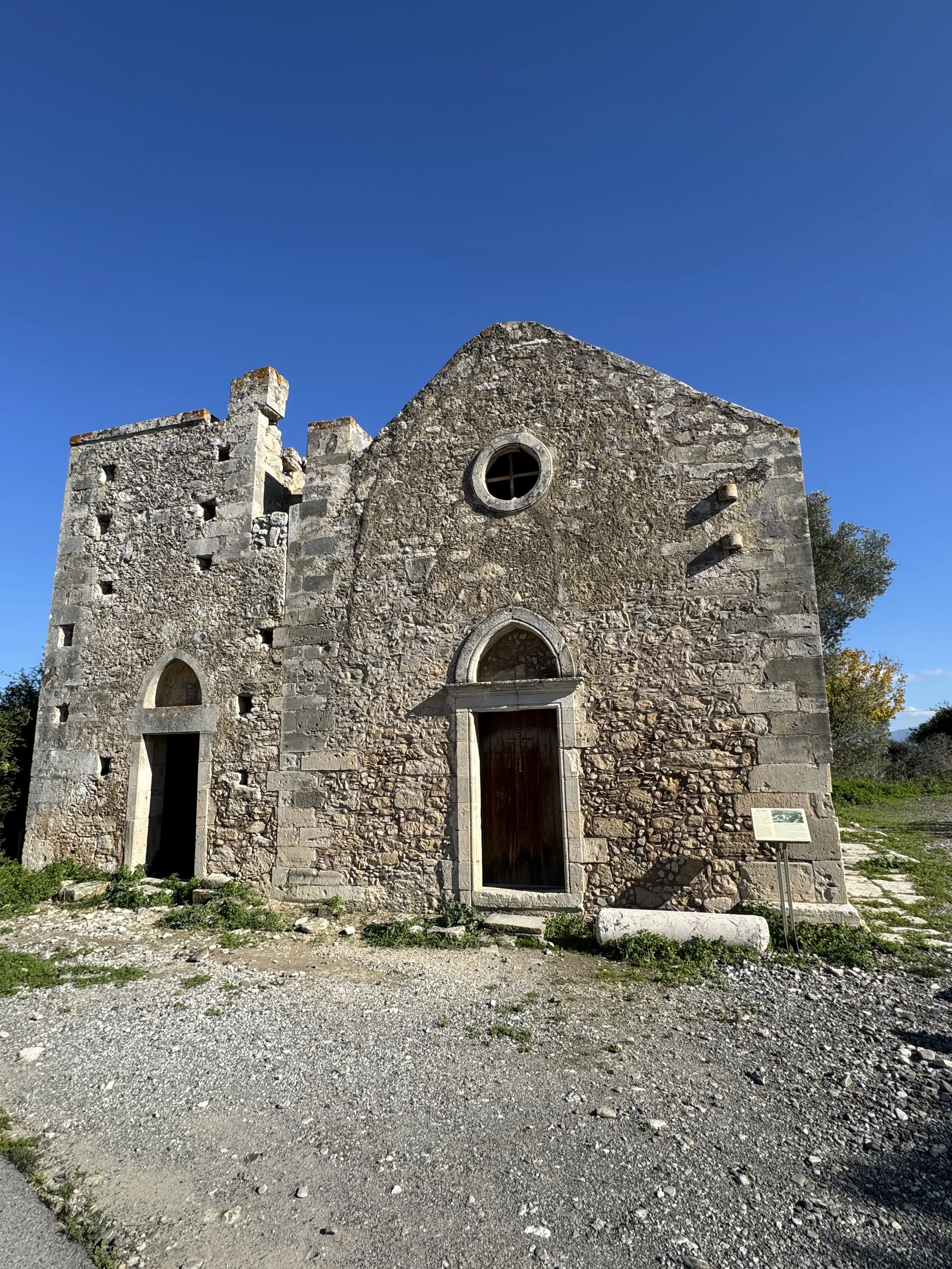
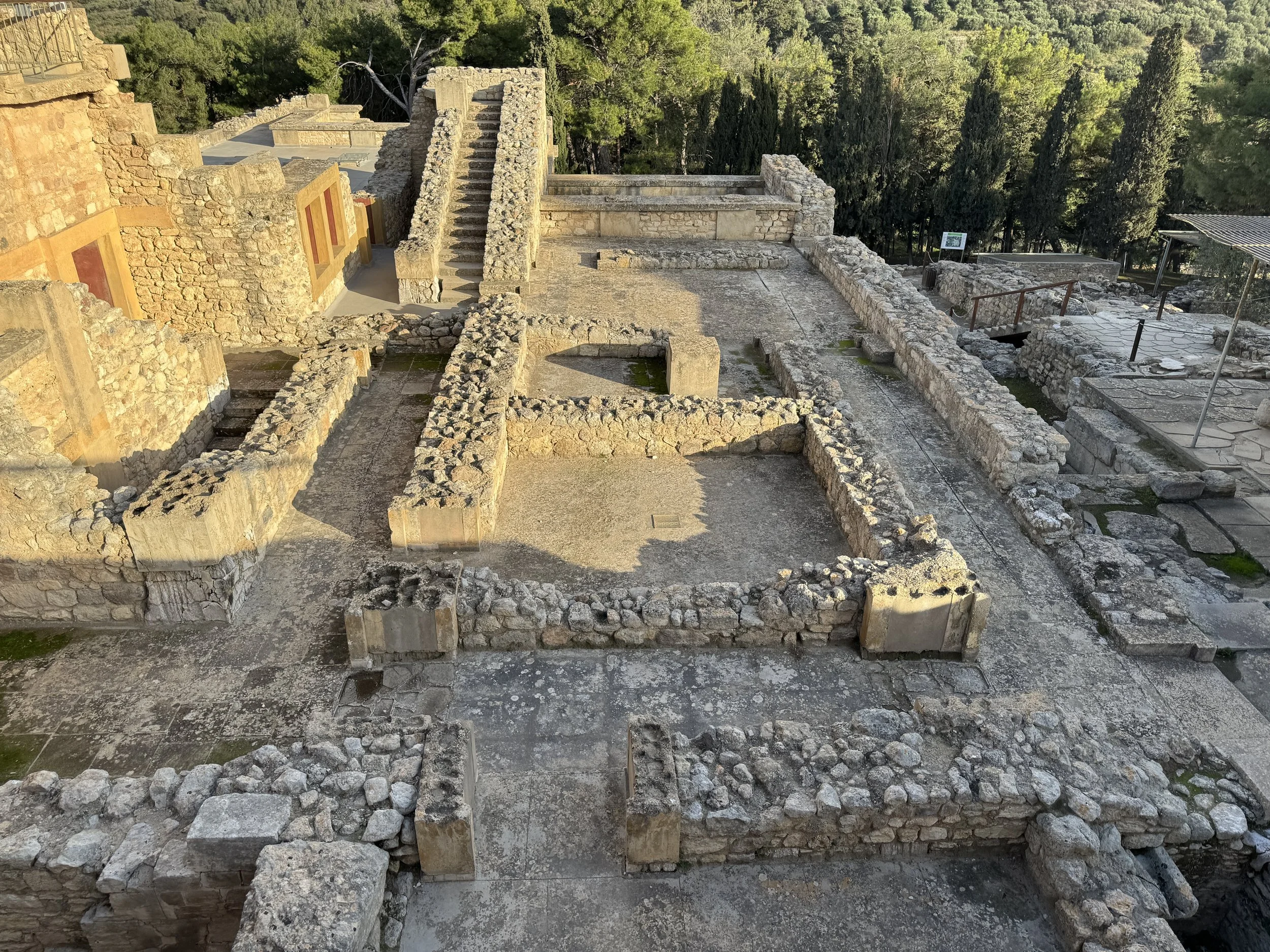
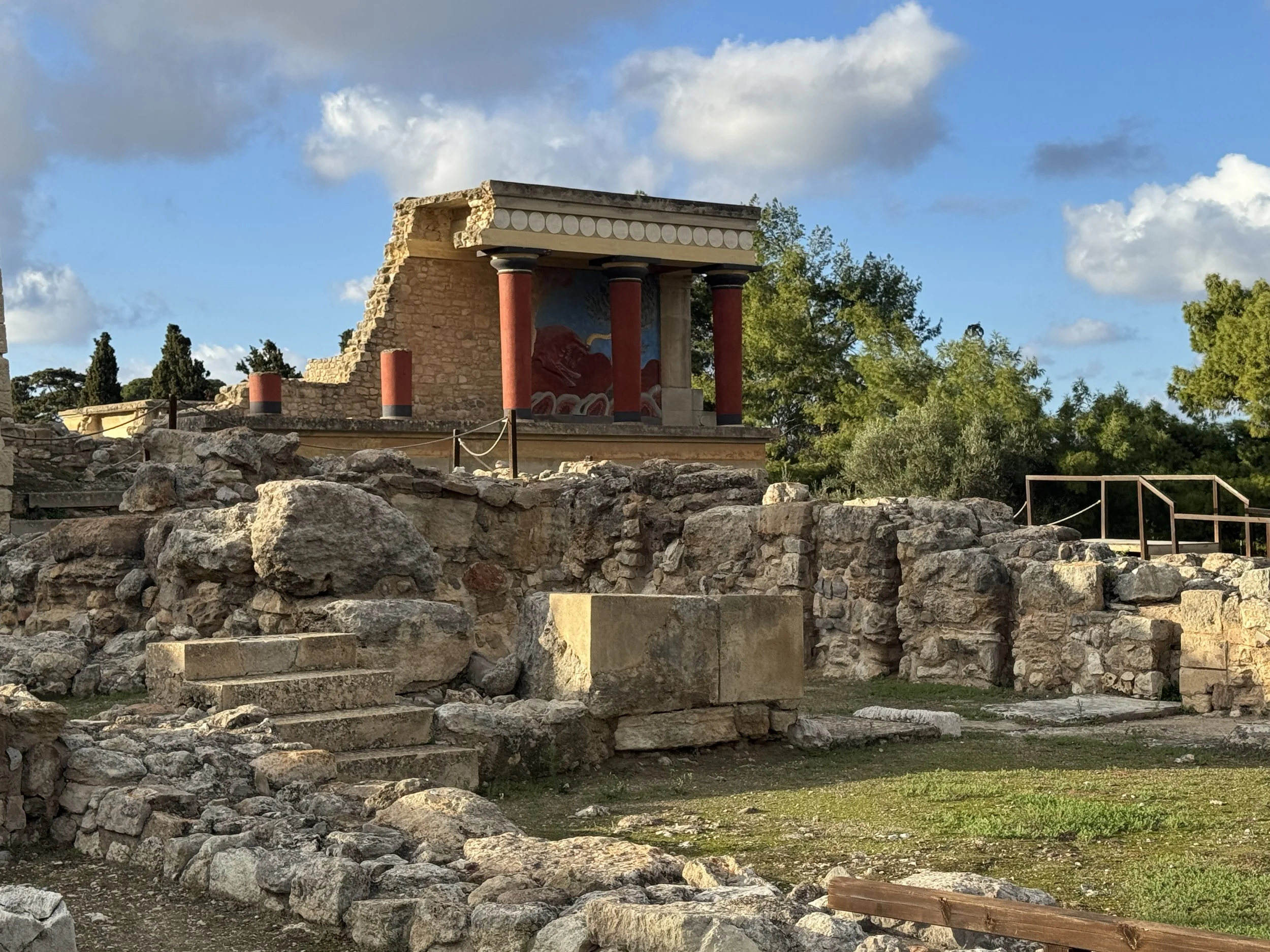
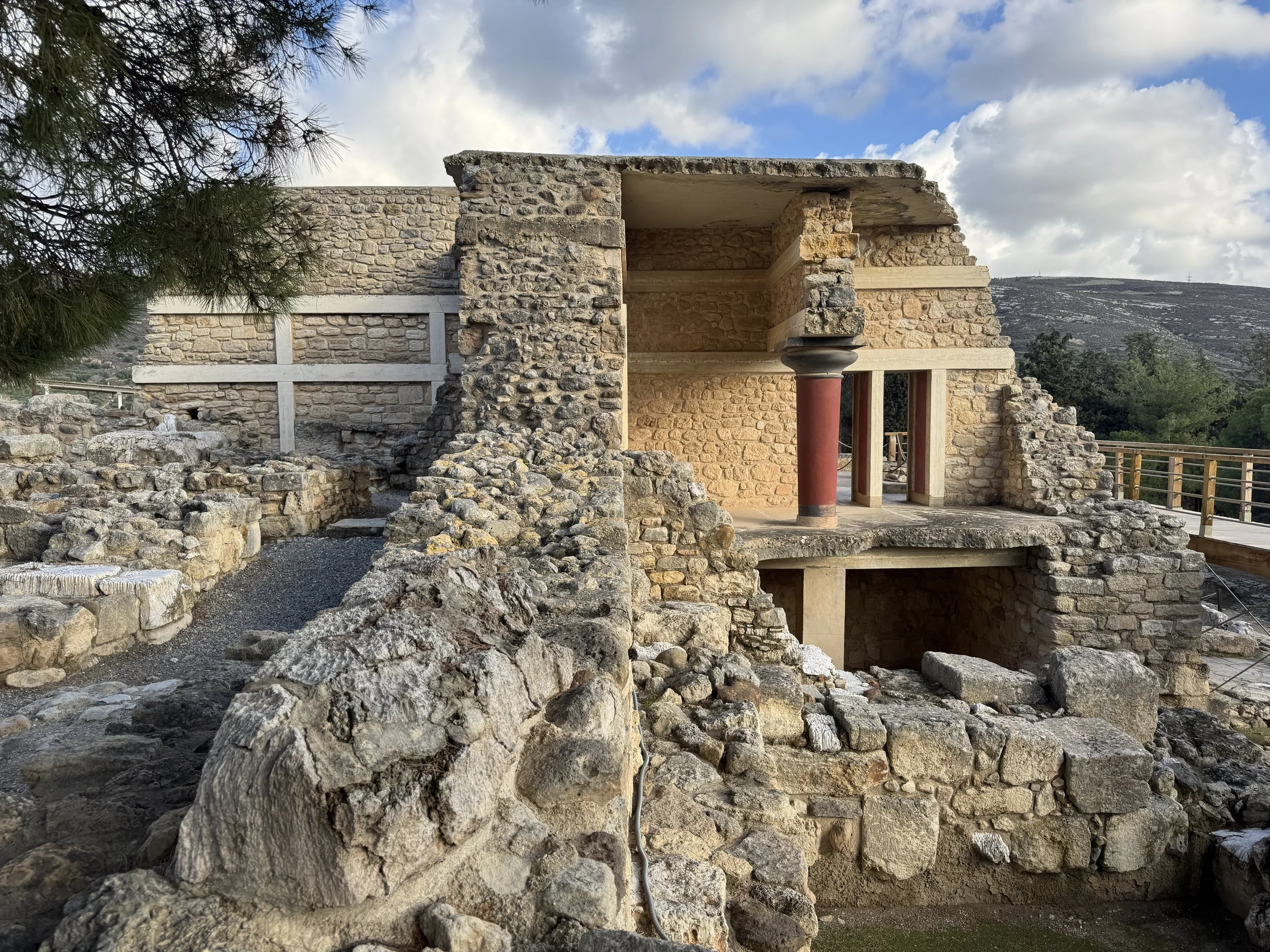
From there we headed back toward Heraklion and stopped at Knossos Palace.
This site has a much larger parking lot about 60 meters from the entrance. Admission is €20, and there are guides offering tours outside.
One guide approached asking €50, then another came over offering €20, so we decided to go with him.
That was the first mistake of the trip.
I think he may have been a bit forgetful because he kept repeating the same things. He also spent a lot of time talking about the meaning of words and politics, particularly going on about the burning of libraries and restricted access to books, which had very little to do with the site.
It wasn’t the most enjoyable experience.
Eventually we ditched him and went back to check out a few things we had skipped.
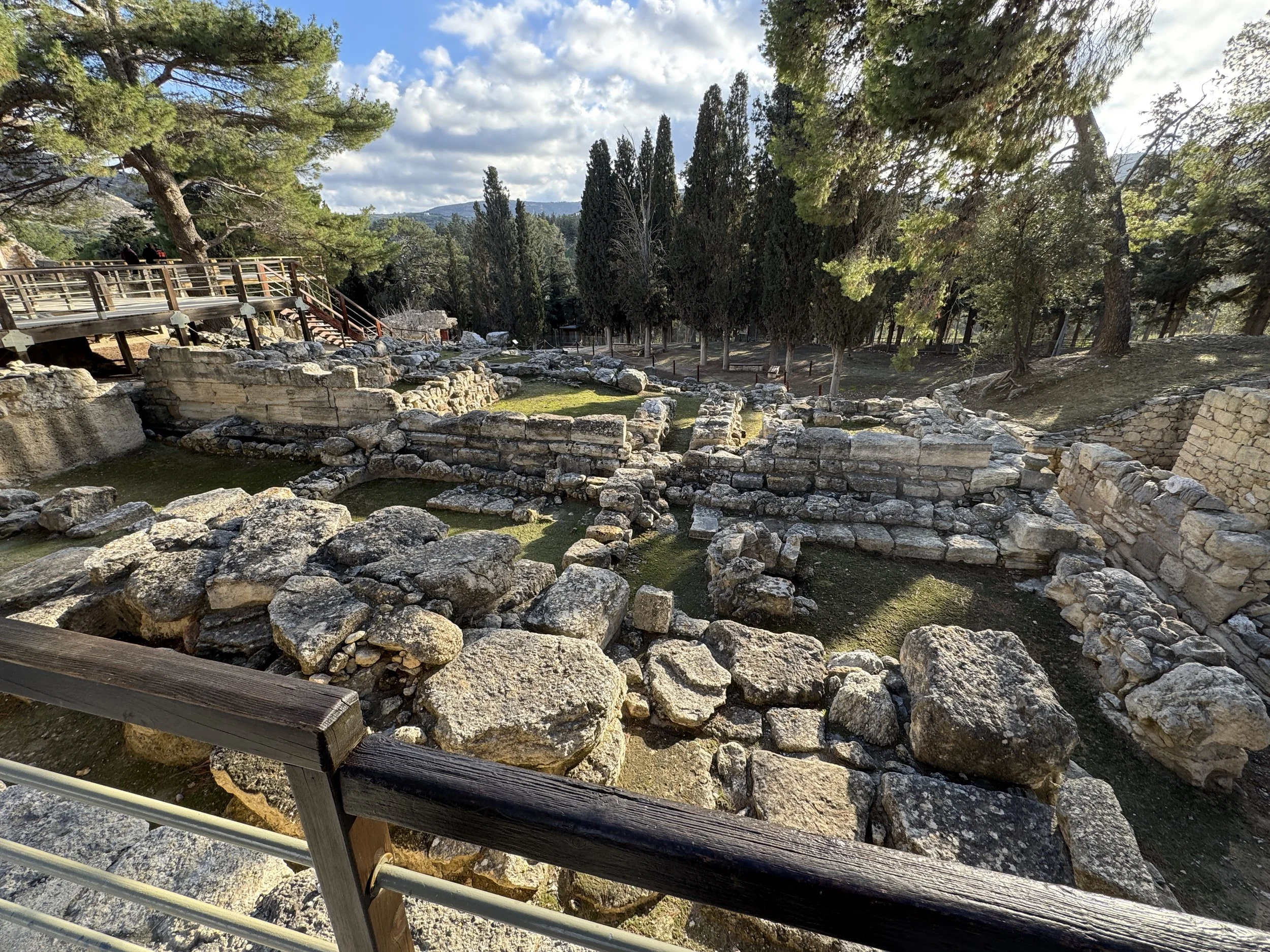
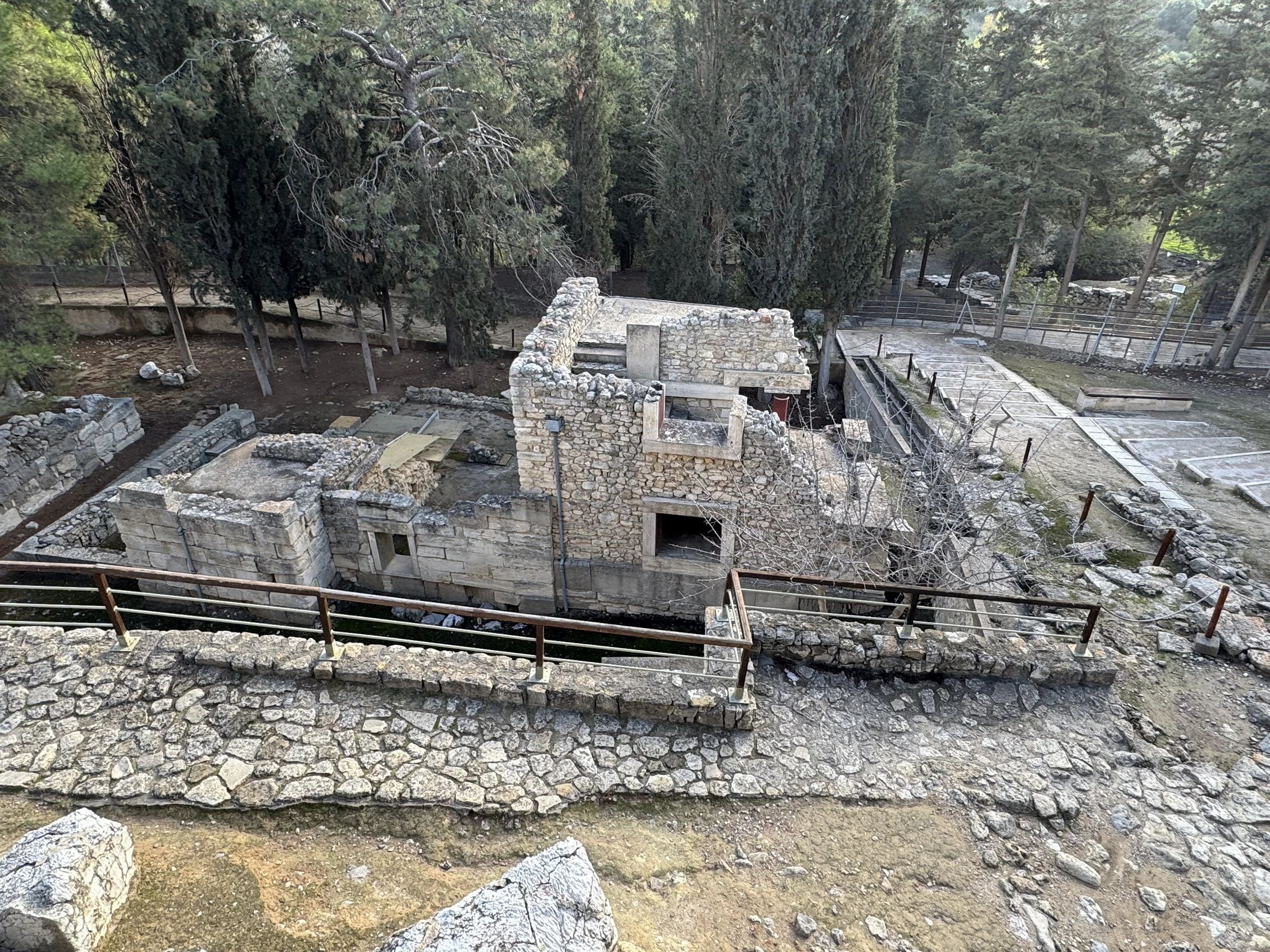
Here’s the general gist of the site:
The Palace of Knossos was the political and ceremonial center of Minoan Crete and is often associated with myths like the Labyrinth and the Minotaur.
The first palace was built around 1900 BC, featuring multi-story buildings, workshops, storerooms, and advanced drainage systems. After an earthquake destroyed it, a larger second palace was constructed around 1700 BC, and much of what visitors see today comes from this rebuilding phase.
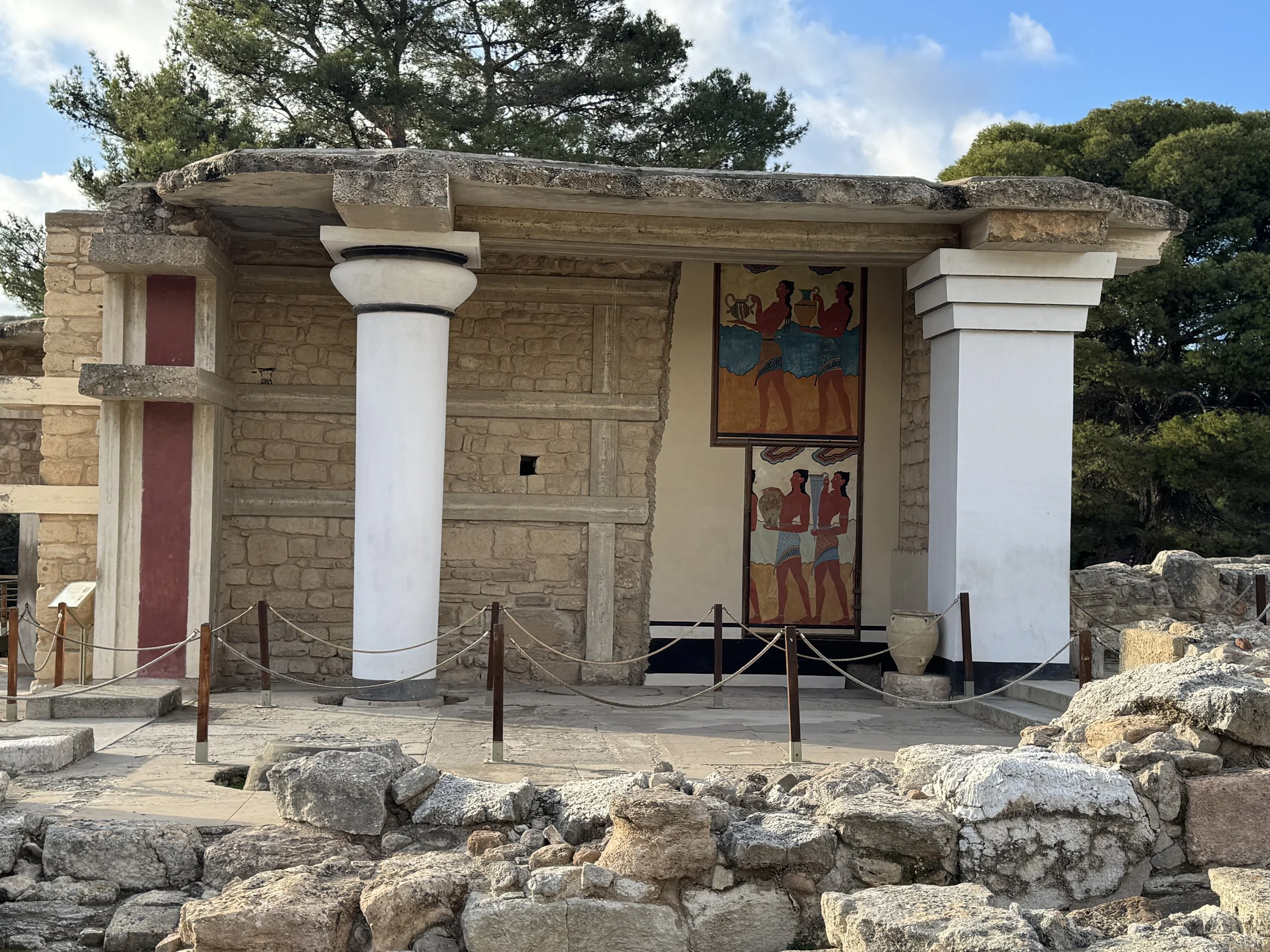
At its height, Knossos was a vibrant hub of administration, trade, and ritual life. Colorful frescoes once decorated the corridors, and the palace’s maze-like design likely inspired later Greek legends.
Around 1450 BC, the complex was heavily damaged—possibly due to natural disasters or regional upheaval—and eventually came under limited Mycenaean control before being abandoned.
The site was excavated in the early 20th century by Sir Arthur Evans, who partially reconstructed sections of the palace to help visitors imagine its former grandeur.
Today it remains Crete’s most iconic archaeological site and an important window into the world of the Minoans.
Olive Oil, Honey, and the Best Surprise of the Day
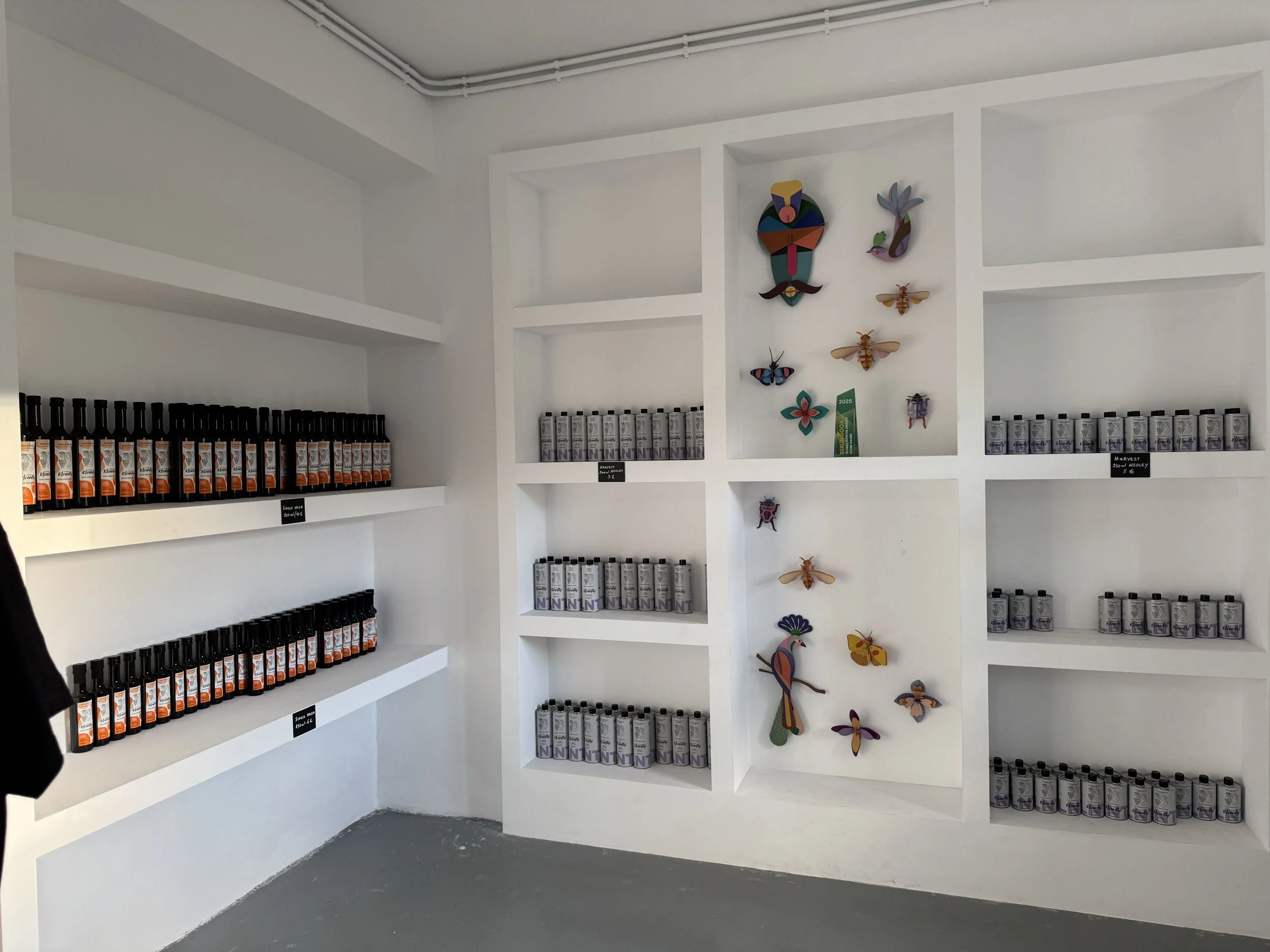
Our final stop of the day was Kleanthi Olive Farm, a family-run olive grove and olive oil producer near Skalani, Heraklion.
The farm blends traditional cultivation methods with sustainable modern practices to produce high-quality extra virgin olive oils that reflect the heritage of Cretan olive culture.
The property is set among ancient olive trees, which makes the setting feel pretty special.
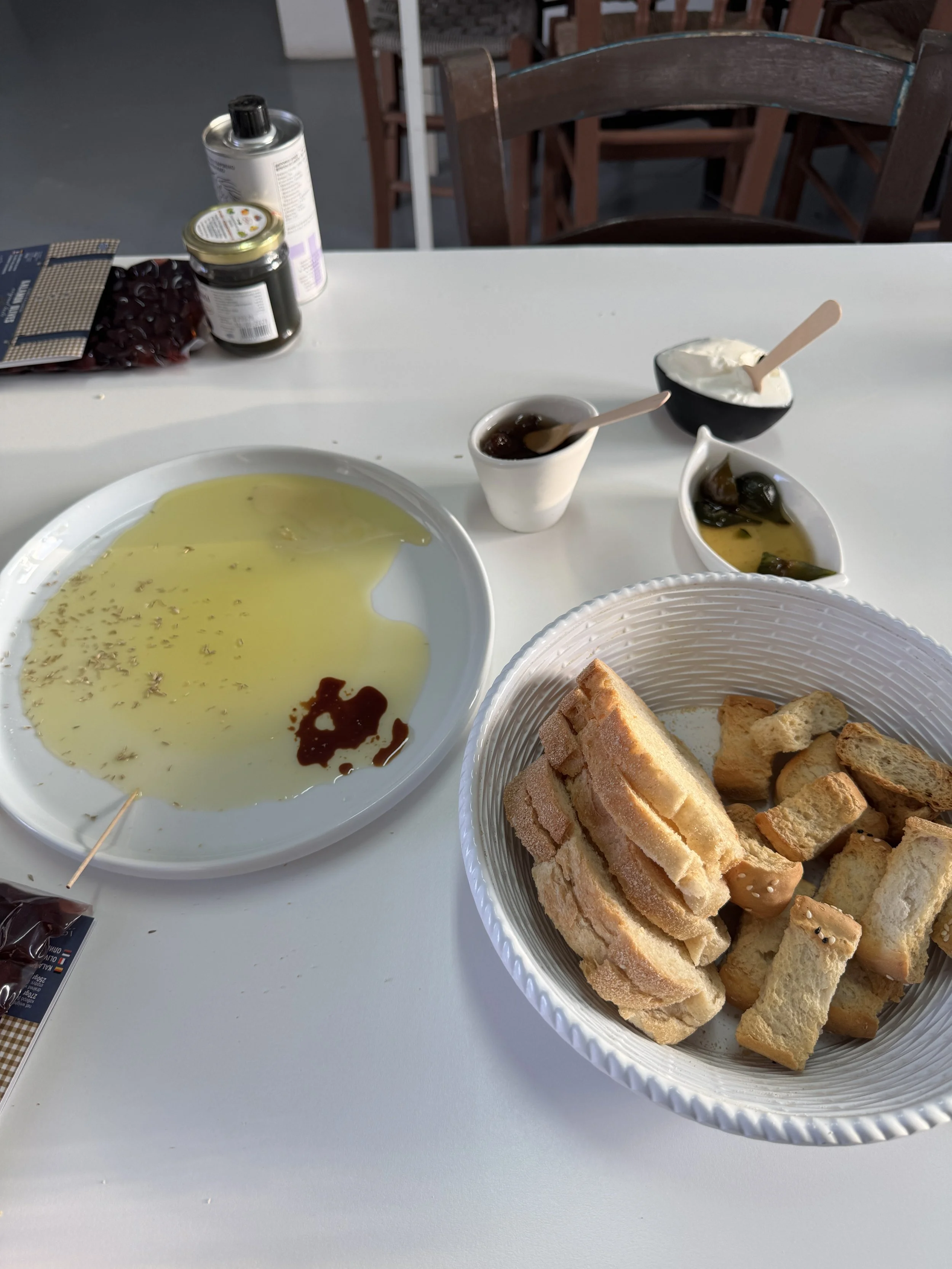
When we arrived we were greeted and offered a tasting.
They served olive oil with:
grape syrup
honey
salt and fresh dried thyme
(all separately of course)
They also gave us grapes in honey, figs in honey, and yogurt to try.
That grape syrup was fire, and honestly I probably wouldn’t have bought it otherwise if I hadn’t tasted it.
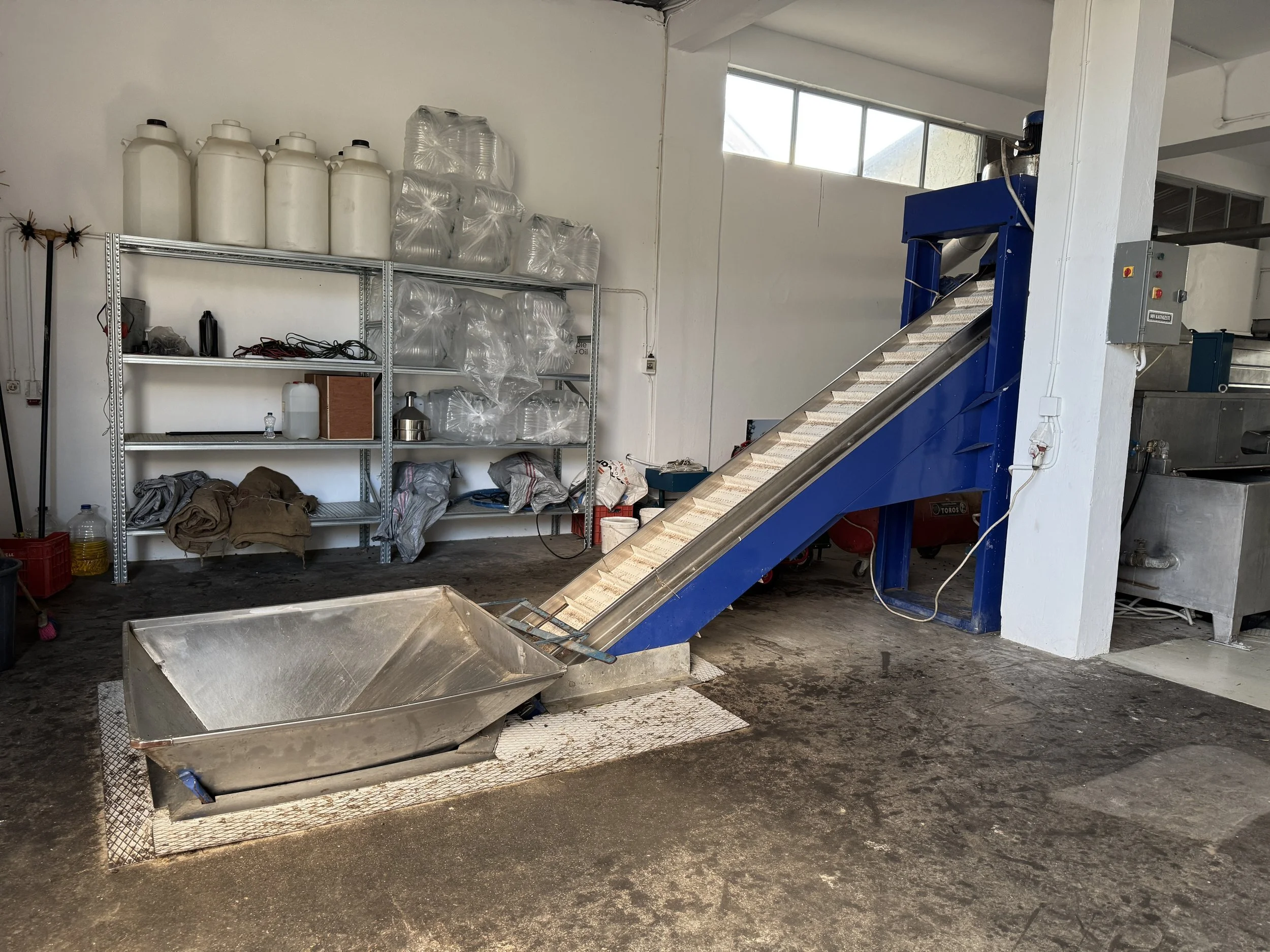
We were also given an impromptu tour of the factory, which was unexpected but really educational. It definitely helped make up for the guide at Knossos.
Checking Into Candia Studios
Afterward we headed to our hotel, Candia Studios.
It was easy to find and had parking, although getting into the space was tricky because parking in Greece can be a bit precarious.
The property doesn’t have a reception desk and instead sends instructions by email. Unfortunately I never received them.
Luckily they had a phone number listed, and when I called someone answered immediately and seemed to be expecting my call, since they didn’t have my contact information. (I had booked through my credit card travel portal.)
She sent me the instructions and we were able to get inside.
The room was spacious but not luxurious. It was clean and had a small kitchenette, and we ended up having the entire second floor to ourselves.
It’s also pretty cute, and honestly I really liked it. It was reasonably priced and met our needs perfectly.
The Best Dinner of the Trip
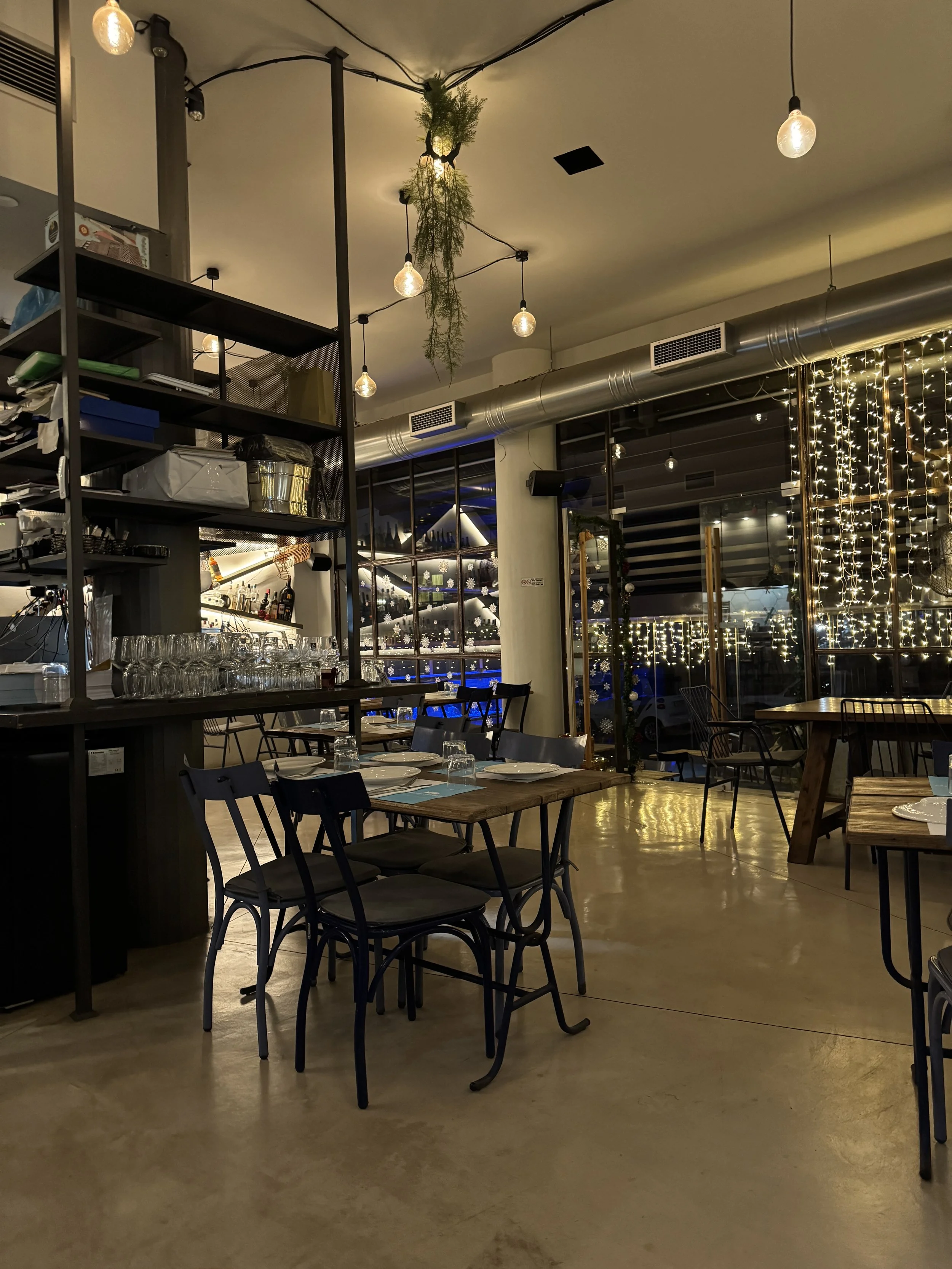
We went out for dinner on a 10-minute walk to 44 Kouzina (although the sign on the door had a different name).
The restaurant is known for seafood and fish.
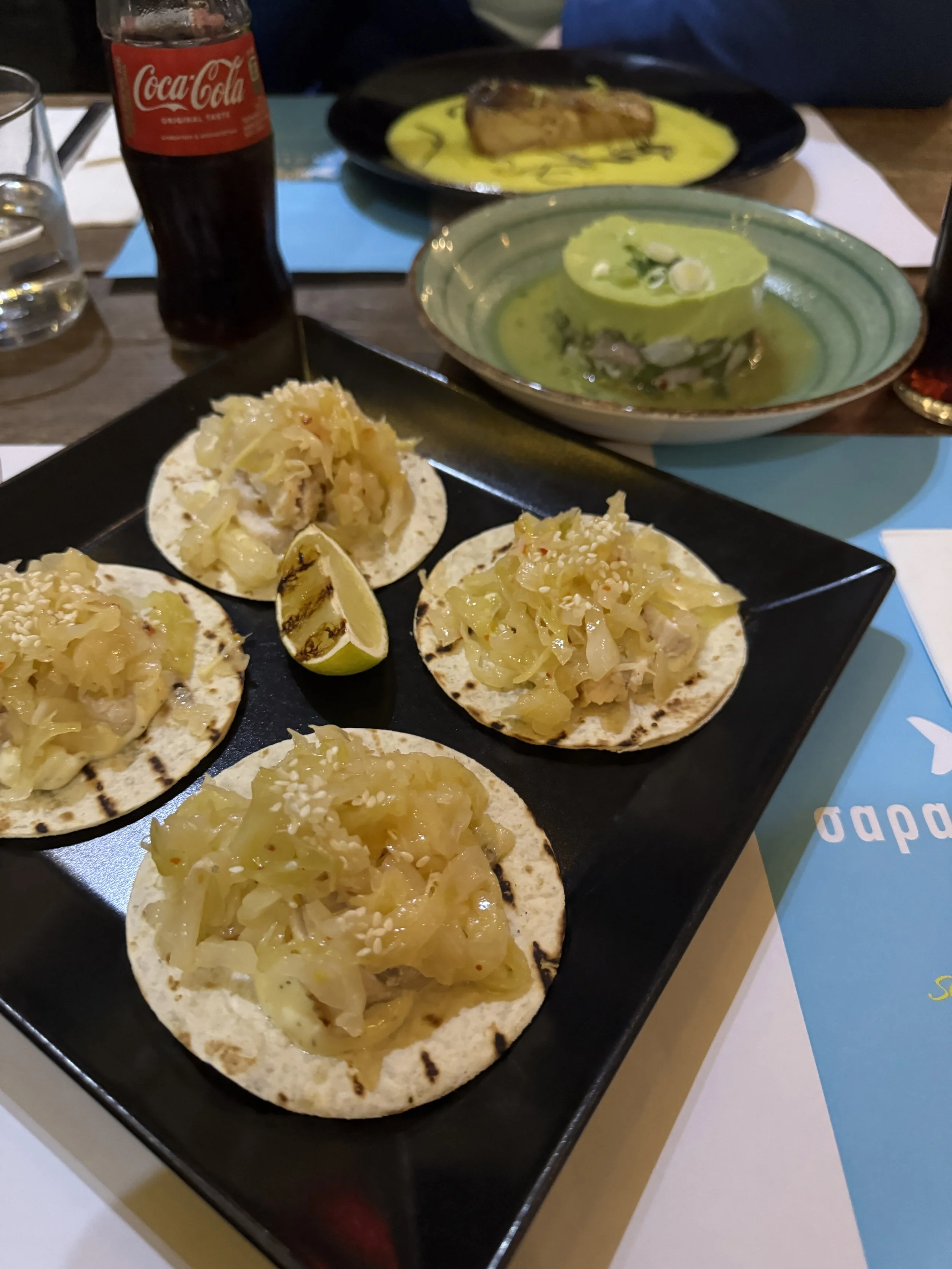
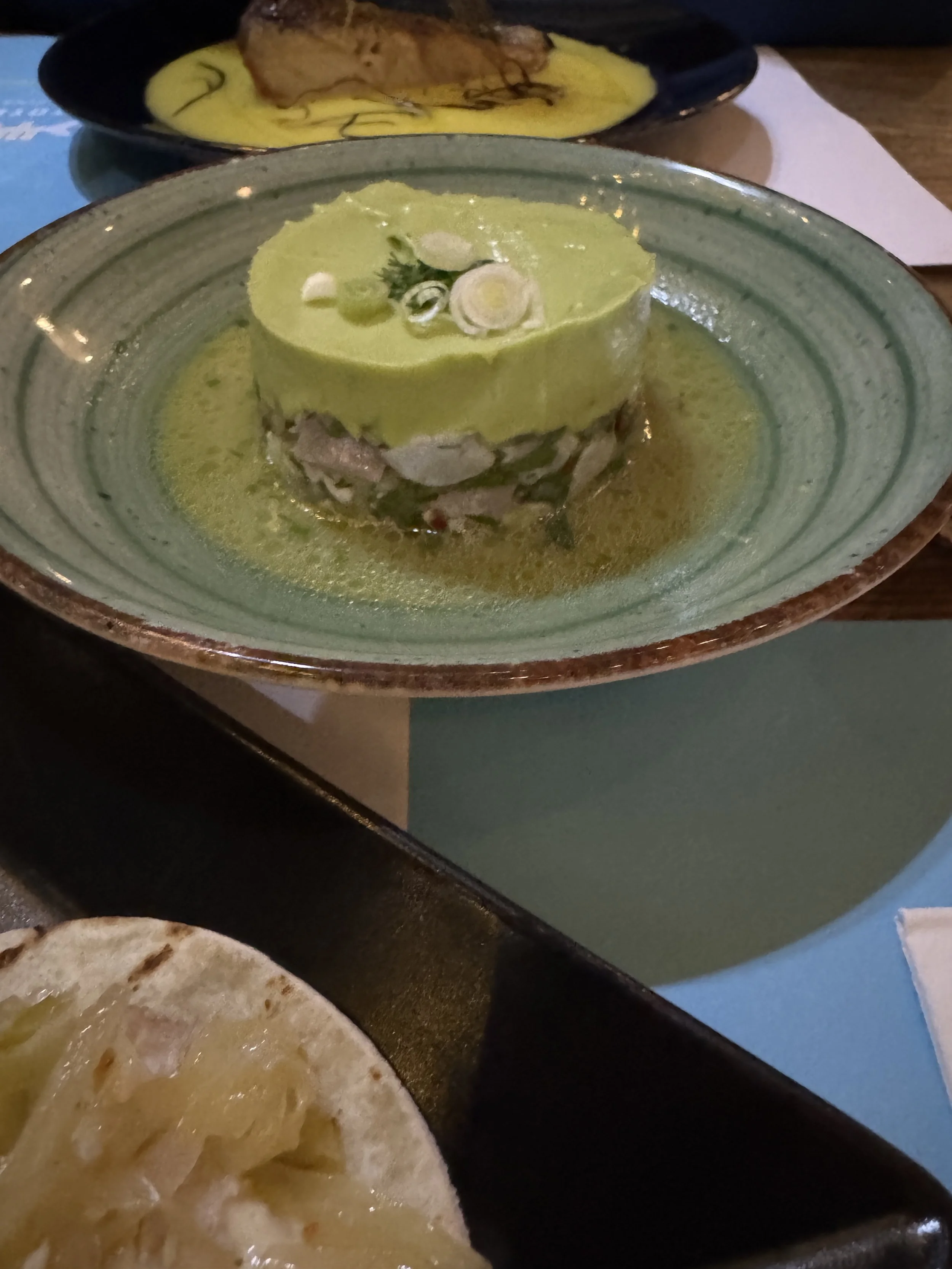
I ordered fish ceviche with avocado mousse and swordfish tacos, and both were absolutely delicious. It ended up being my favorite meal of the entire trip.
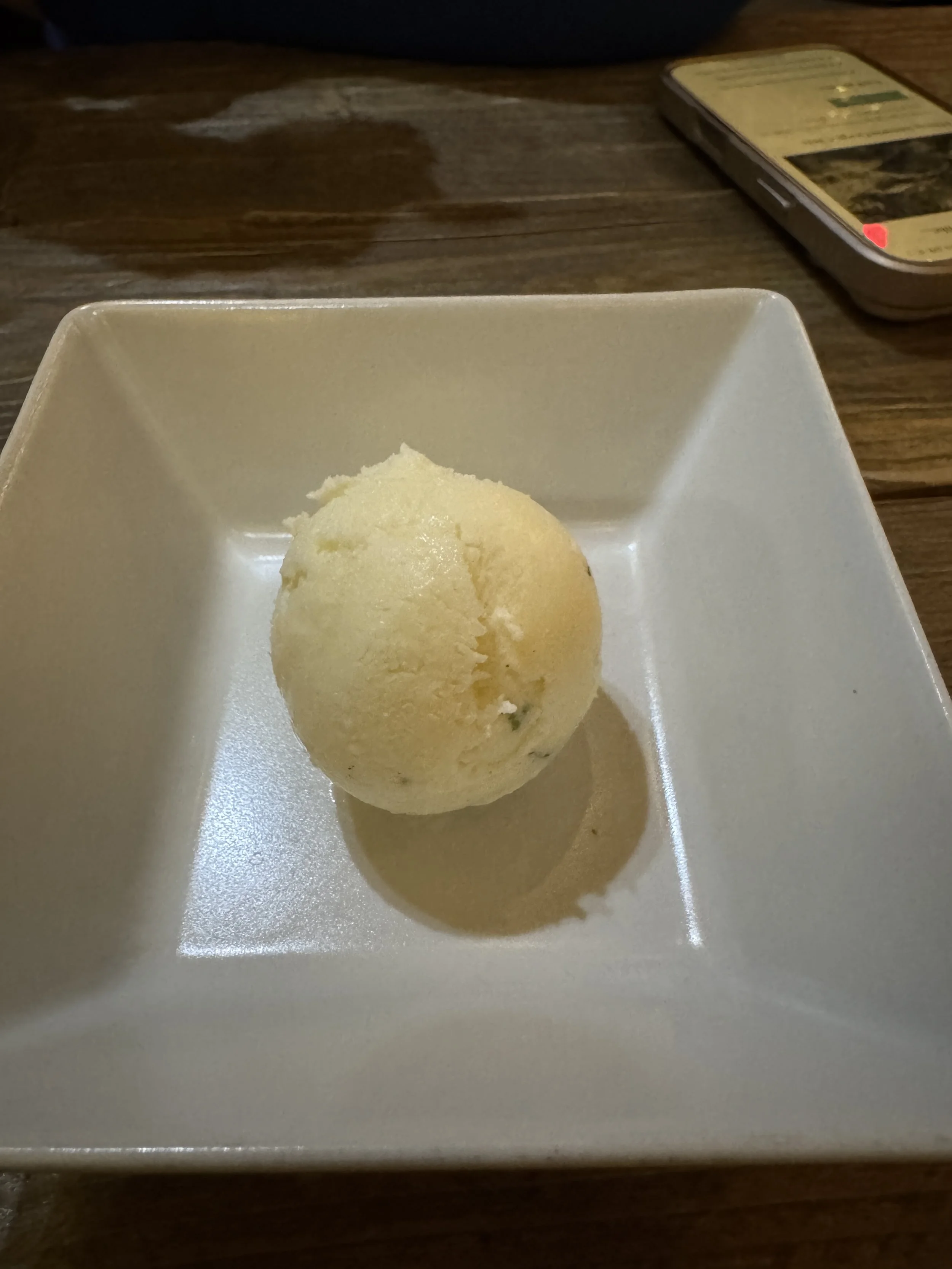
They also served a homemade yogurt-flavored ice cream with mint at the end, which was tangy, sweet, and something I had never tried before.
The restaurant itself was nice, and the waitress was very personable, offering suggestions of things to do in the area.
If you’re staying nearby, it’s definitely worth trying.
After dinner we walked back to the hotel, planned out the next day, and went to bed.
December 12: Chania and Rethymno
An Early Start and a Drive to Chania
We got on the road at 6 a.m. and drove to Chania. We parked in the Municipal Parking lot and paid the fee through the parking app.
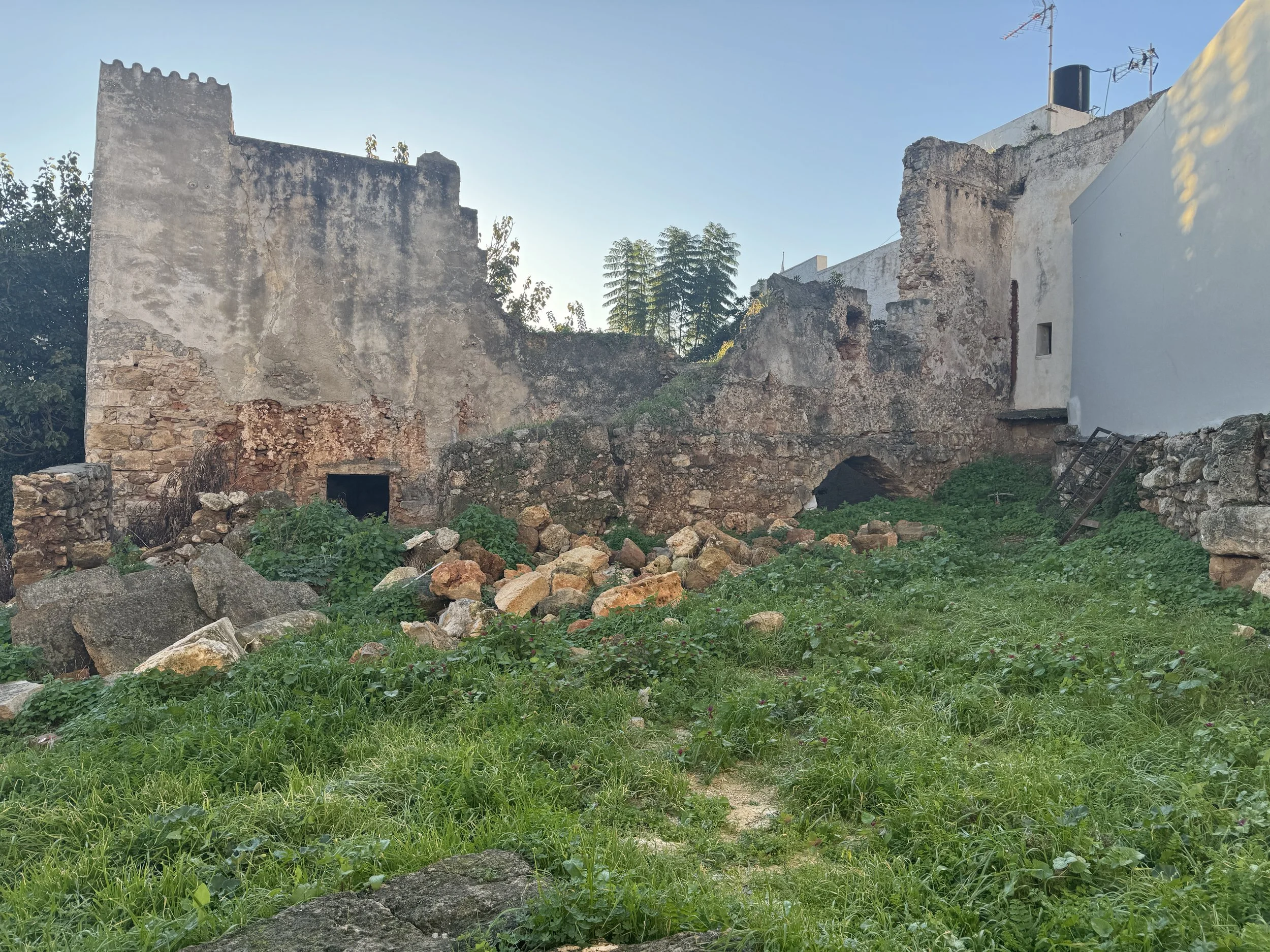
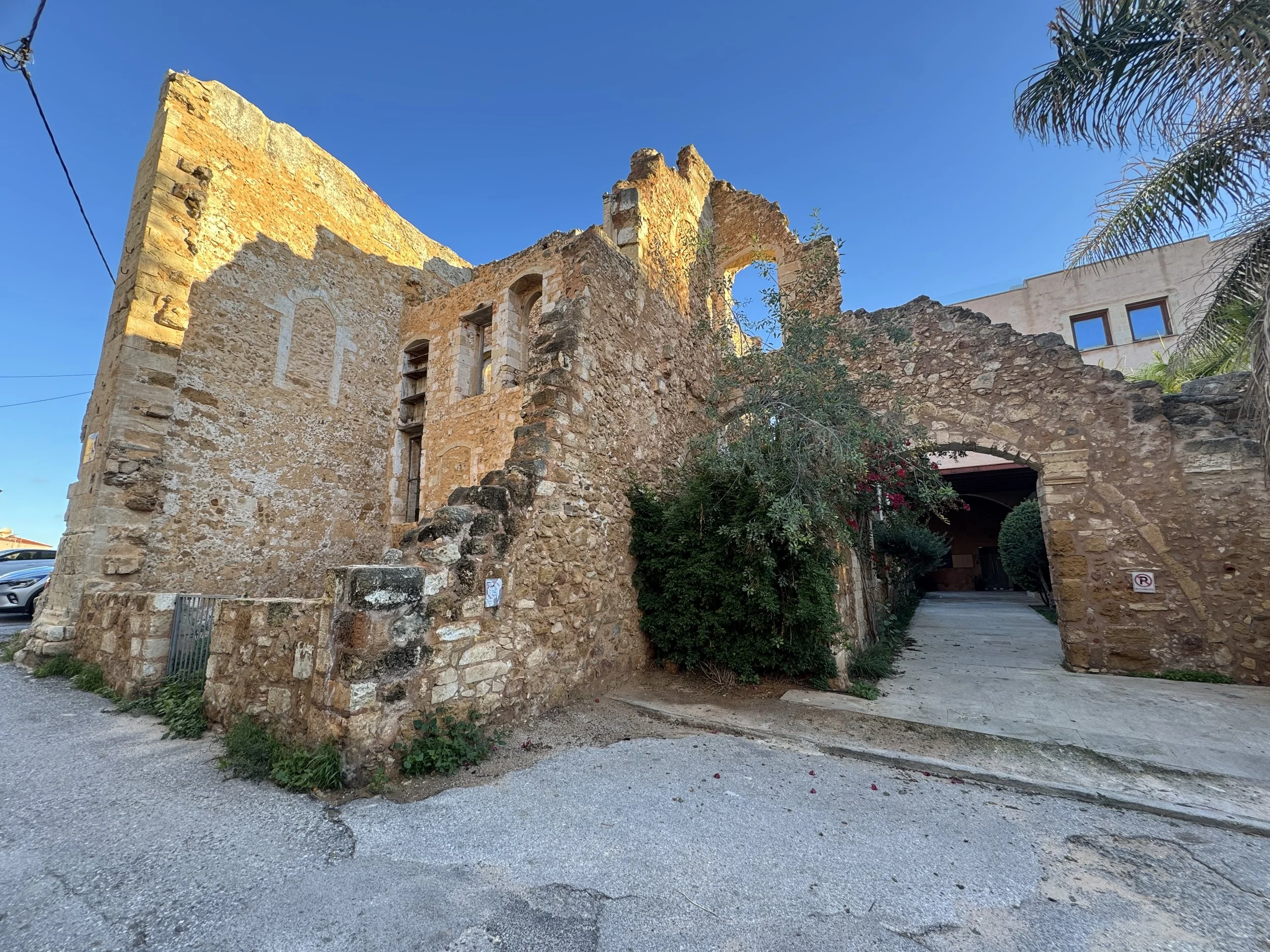
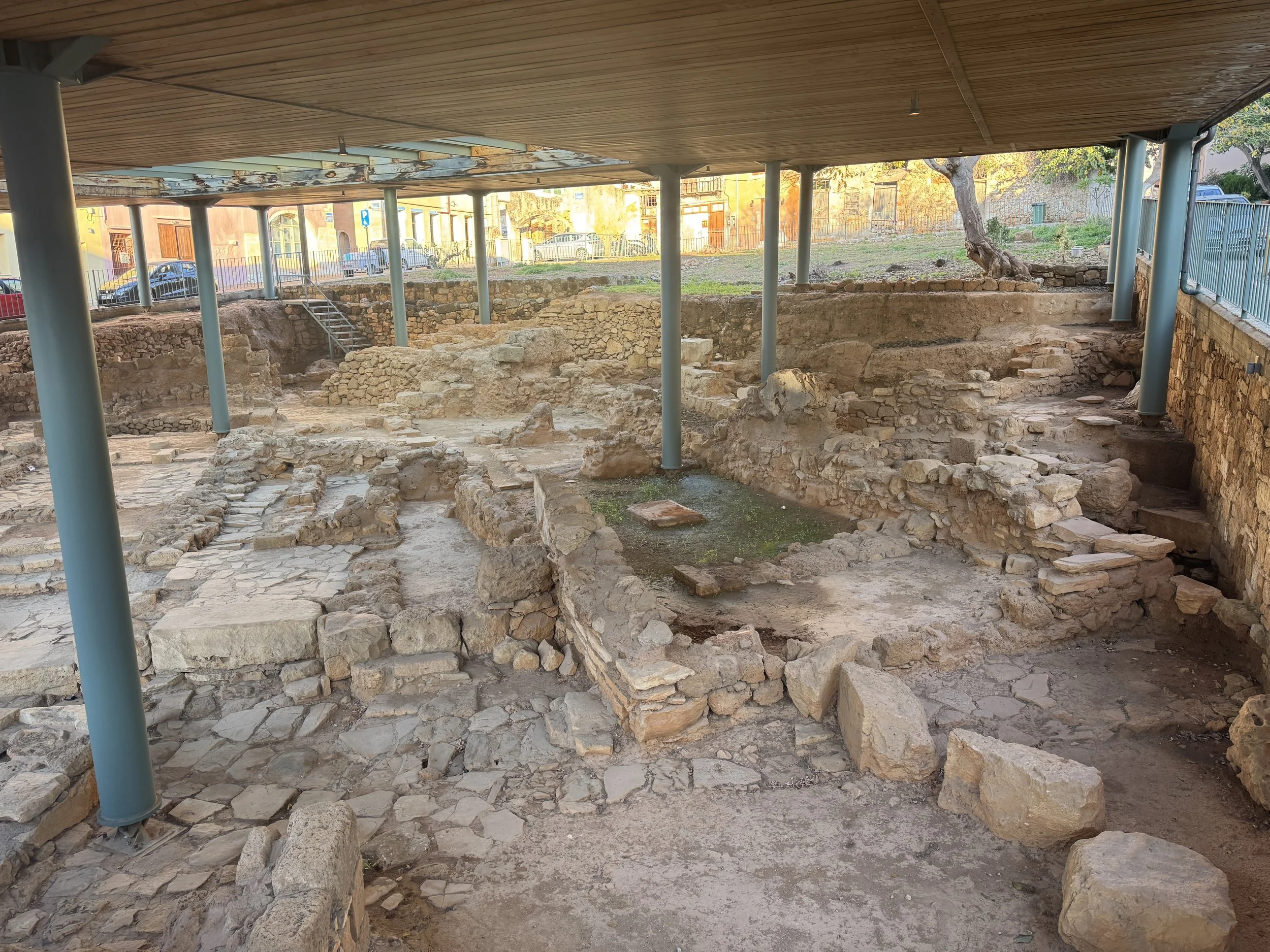
From there, we walked to Mathioudaki Excavation, a small Minoan burial site dating to the Early to Middle Minoan period (c. 3000–1600 BCE). The excavation uncovered tombs and pottery, offering insight into early funerary practices in western Crete and everyday life beyond the major palatial centers.
A block or two away is the Archaeological Ruins of Minoan Kydonia, which mark the remains of an important Minoan settlement that was continuously inhabited from the Early Bronze Age through Classical times. Built beneath modern Chania, the site reveals houses, workshops, and storage areas, showing Kydonia’s role as a long-lived urban center and key hub in western Crete rather than a single palatial complex.
Breakfast by the Old Venetian Port
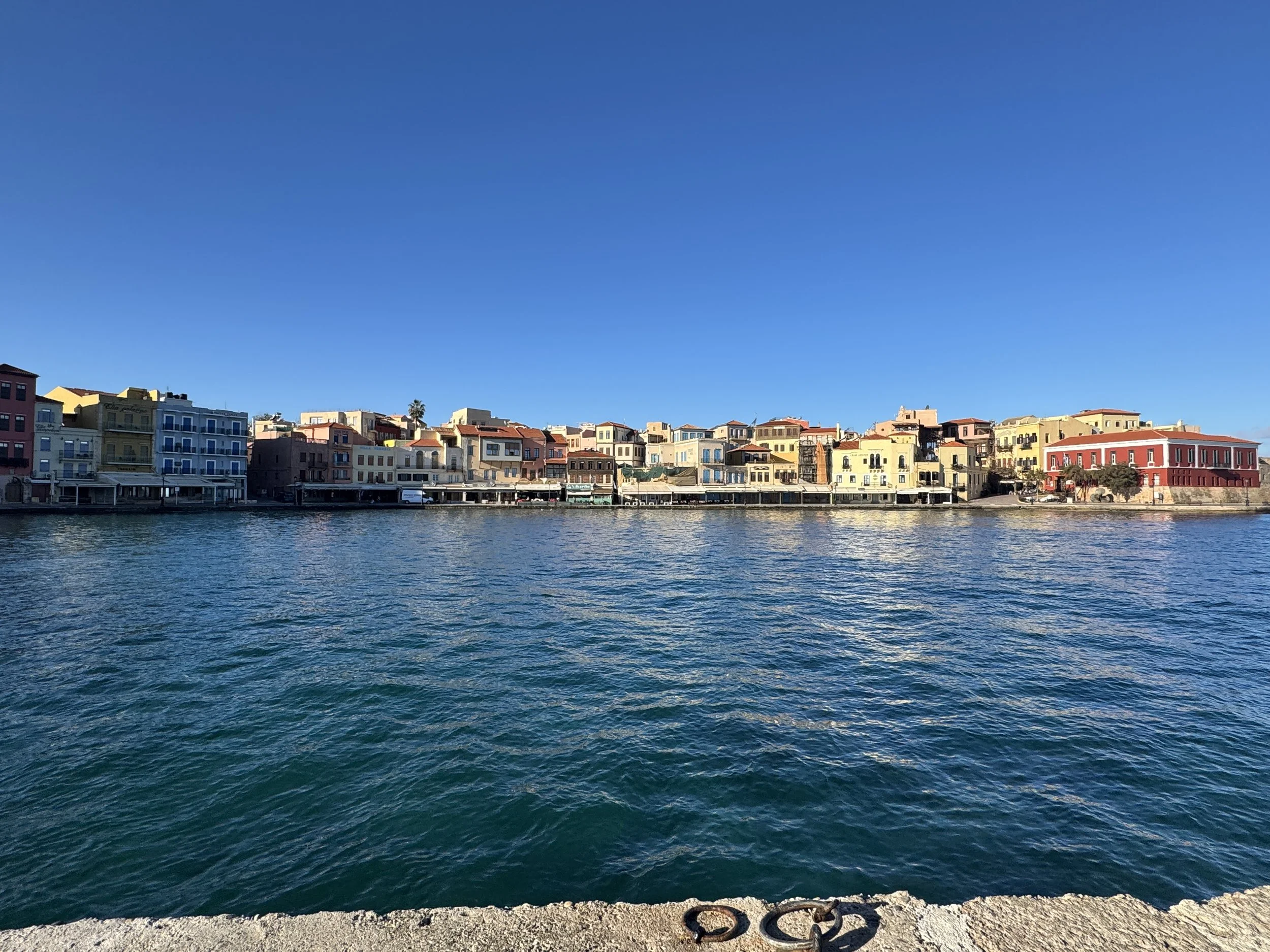
From there we wandered to the Old Venetian Port
(Παλαιό Ενετικό Λιμάνι Χανίων), which was built by the Venetians in the 14th century as a fortified harbor to protect trade routes in the eastern Mediterranean. Later shaped by Ottoman and modern influences, the harbor remains one of Chania’s most enduring landmarks, blending maritime defense with centuries of layered history.
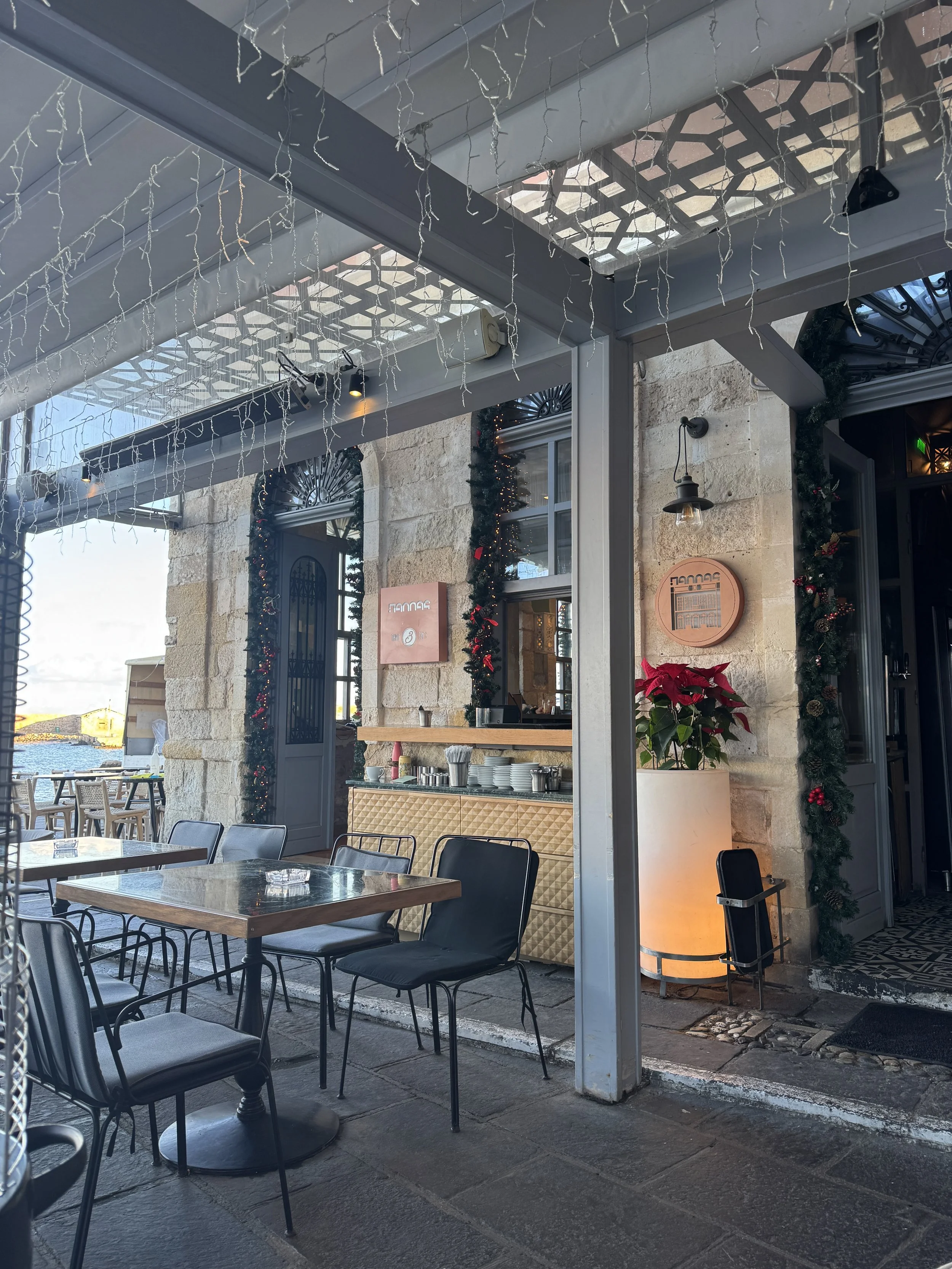
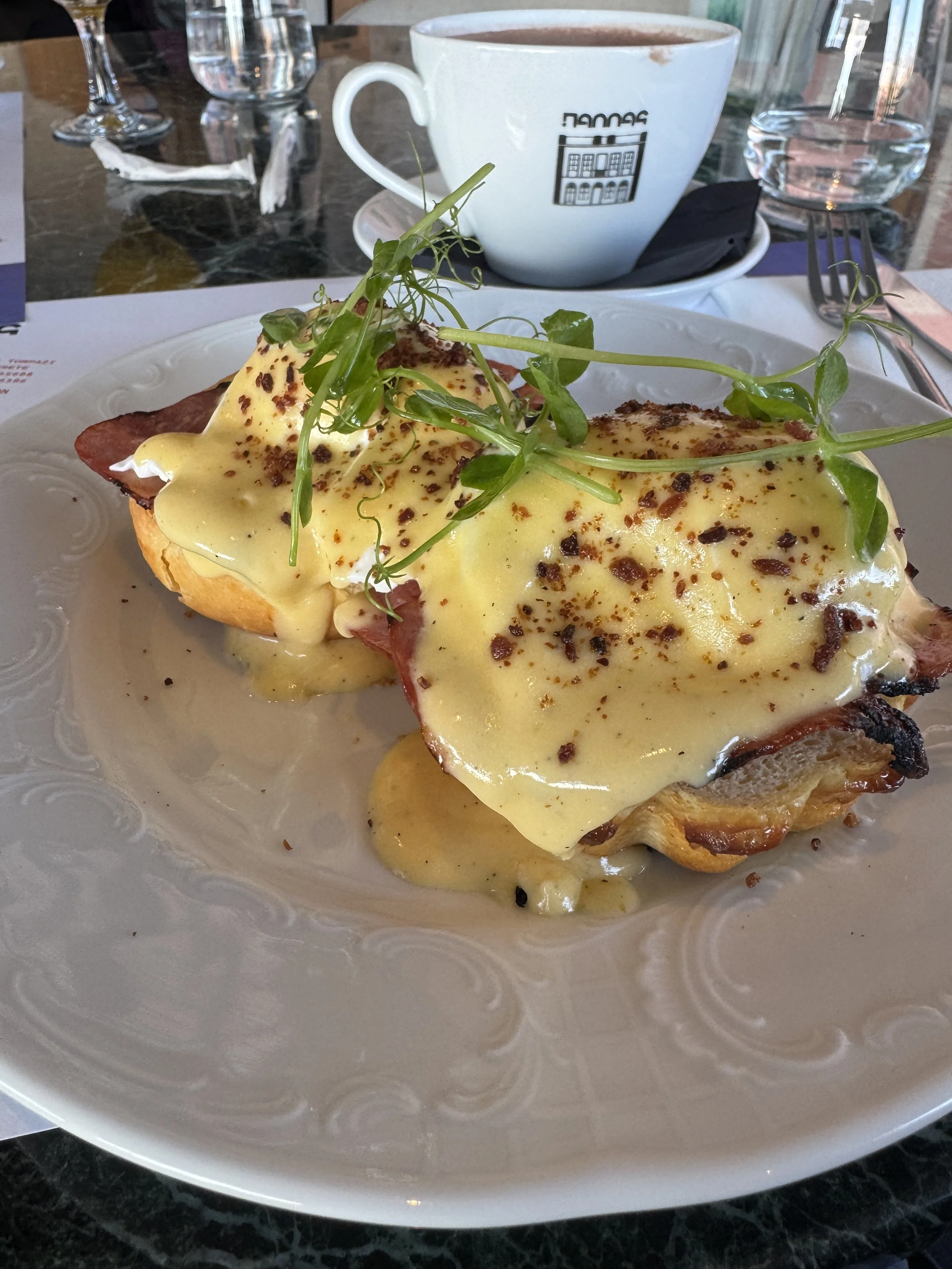
We found a cute restaurant right on the water called Palla.
I had eggs Benedict on a mini brioche bun with bacon on top, along with a cinnamon roll and a salted caramel hot chocolate.
It was all perfect. The cinnamon roll wasn’t overly sweet, and the icing was more tangy than sugary, but still really good.
Mosques, Christmas Decor, and the Chania Lighthouse
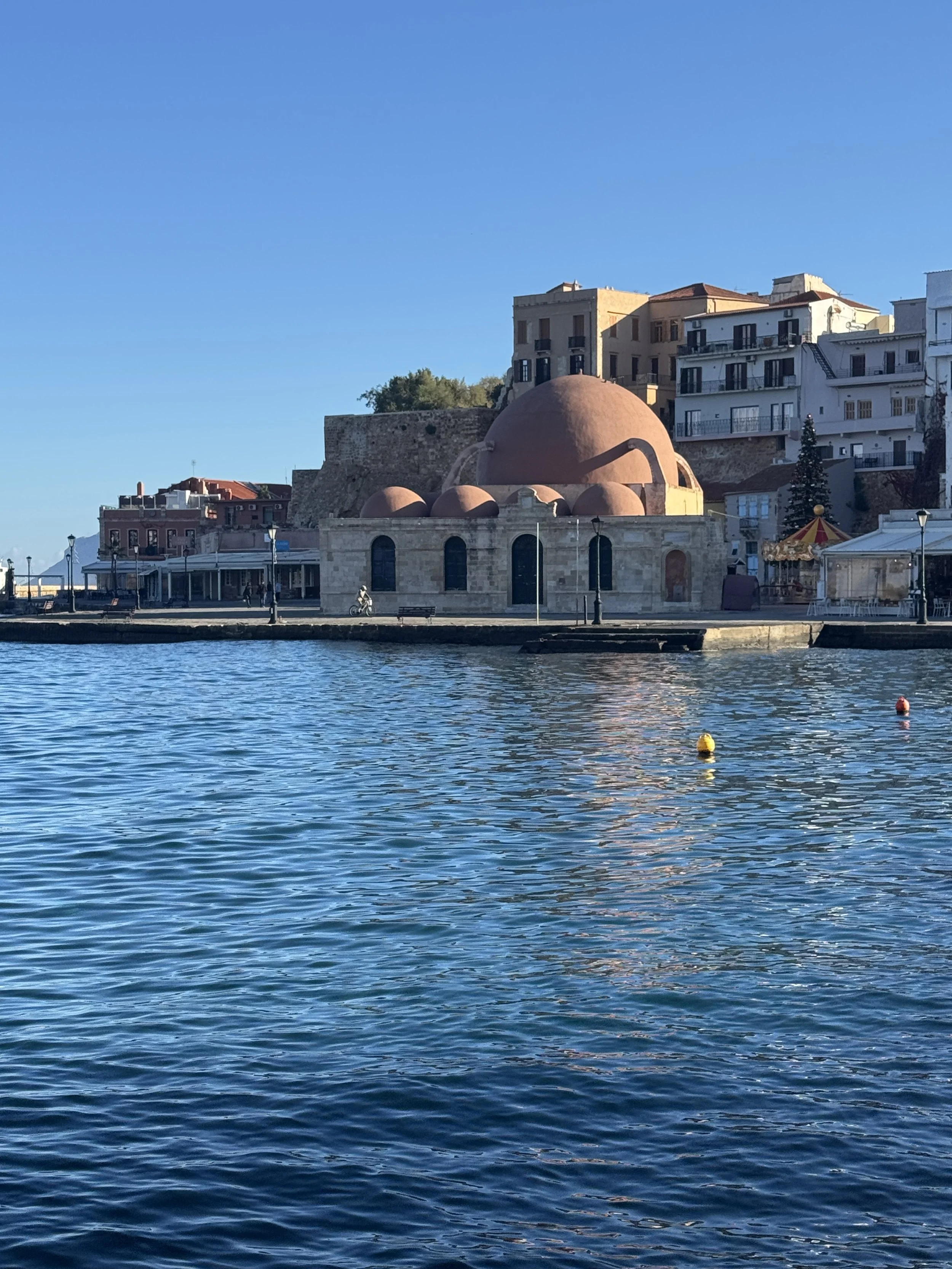
We headed toward Küçük Hasan Mosque
(Τζαμί Κιουτσούκ Χασάν Πασά), which was built in the 17th century during Ottoman rule and stands as one of Chania’s oldest surviving mosques. Located at the entrance of the Old Venetian Harbor, it reflects the city’s Ottoman past and later served various secular roles after Crete’s transition to Greek rule.
Oddly enough, it had a Christmas tree and a manger scene next to and in front of it.
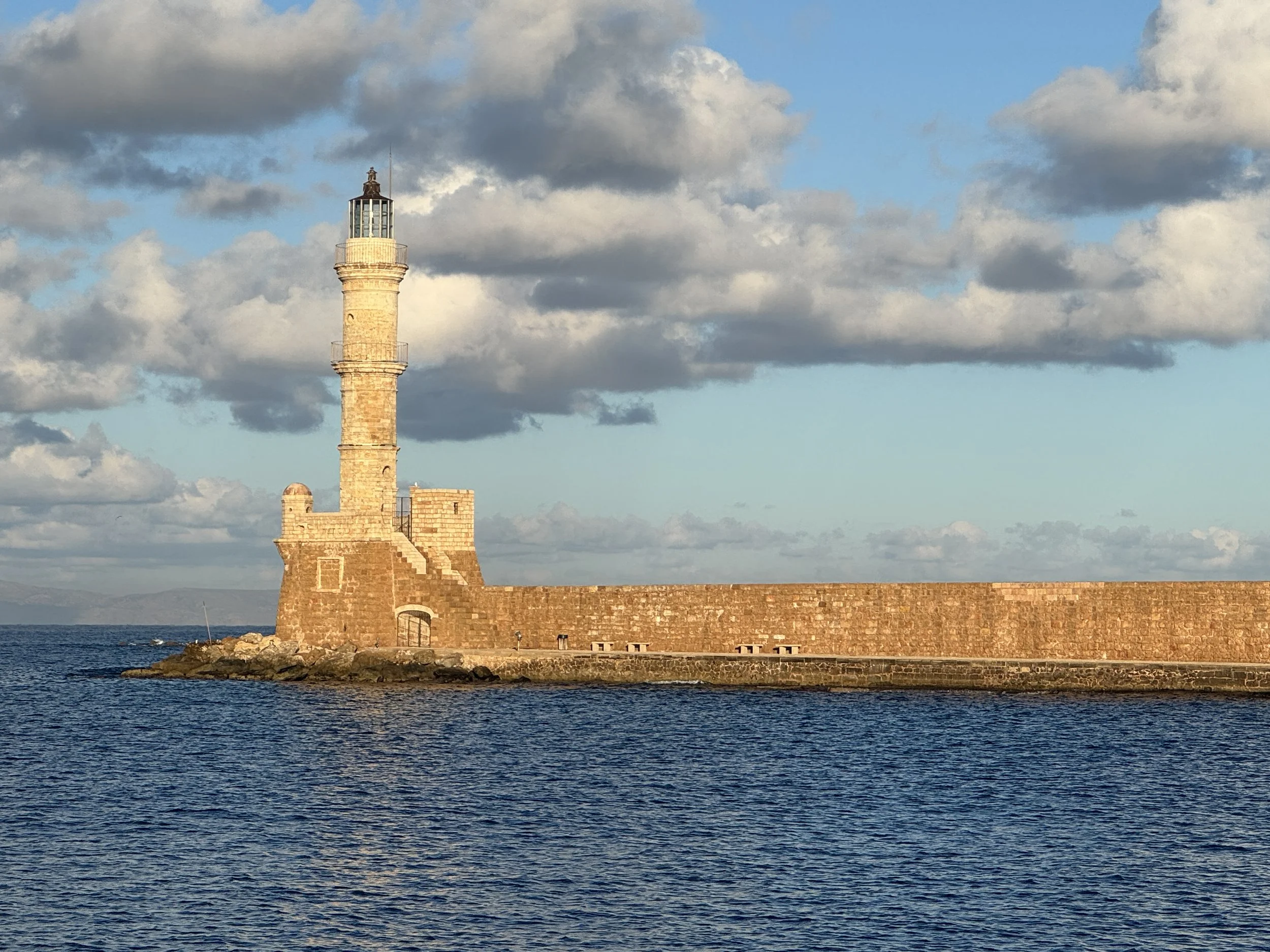
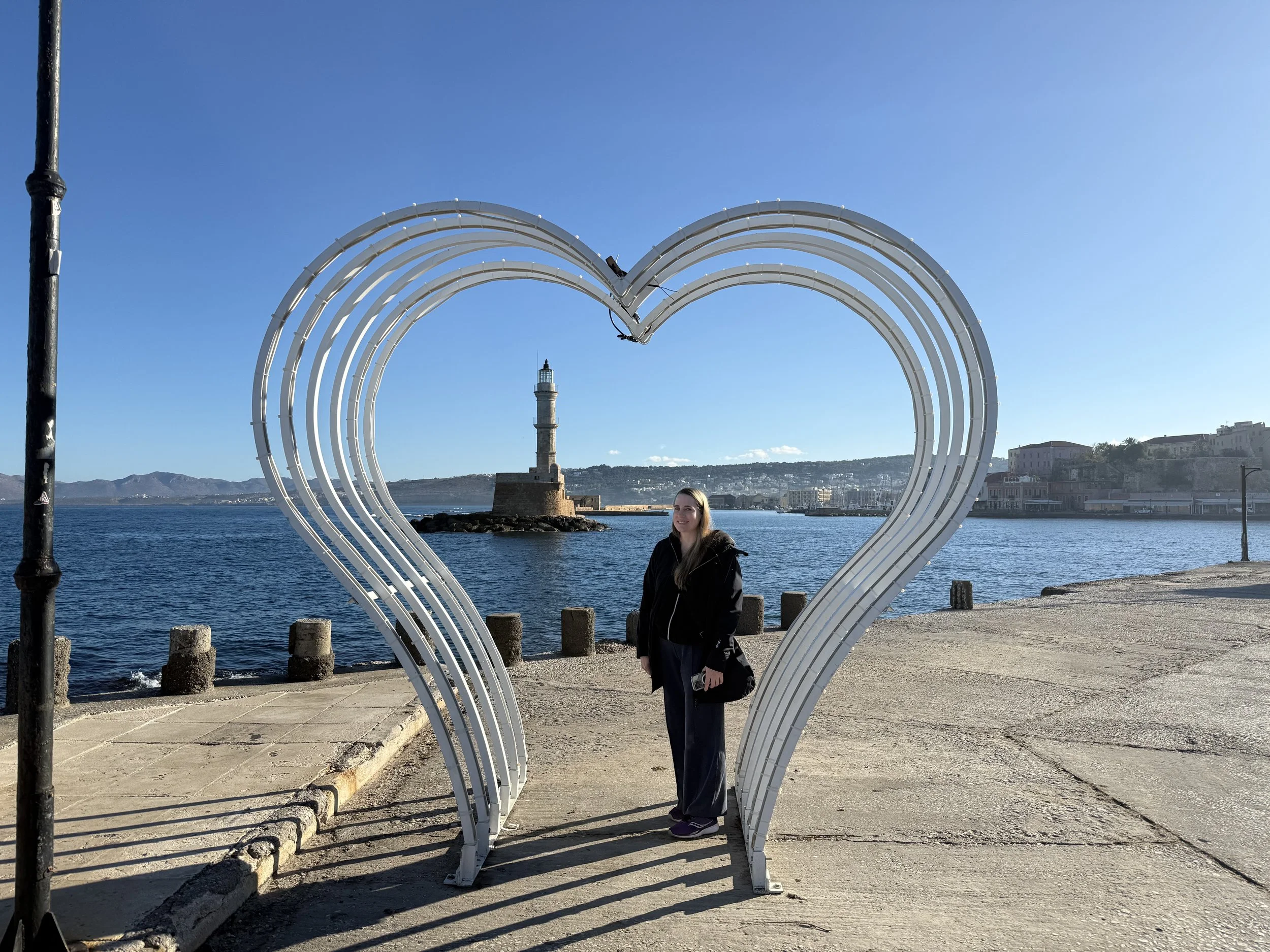
We continued walking along the Venetian Port, taking in the area and snapping photos of the Chania Lighthouse. It was originally built by the Venetians in the late 16th century to guide ships into the harbor and was later rebuilt by the Egyptians in the 19th century. Its distinctive minaret-like design reflects Chania’s layered history and makes it one of the oldest continuously used lighthouses in the Mediterranean.
Leather Street and One Last Stop in Chania
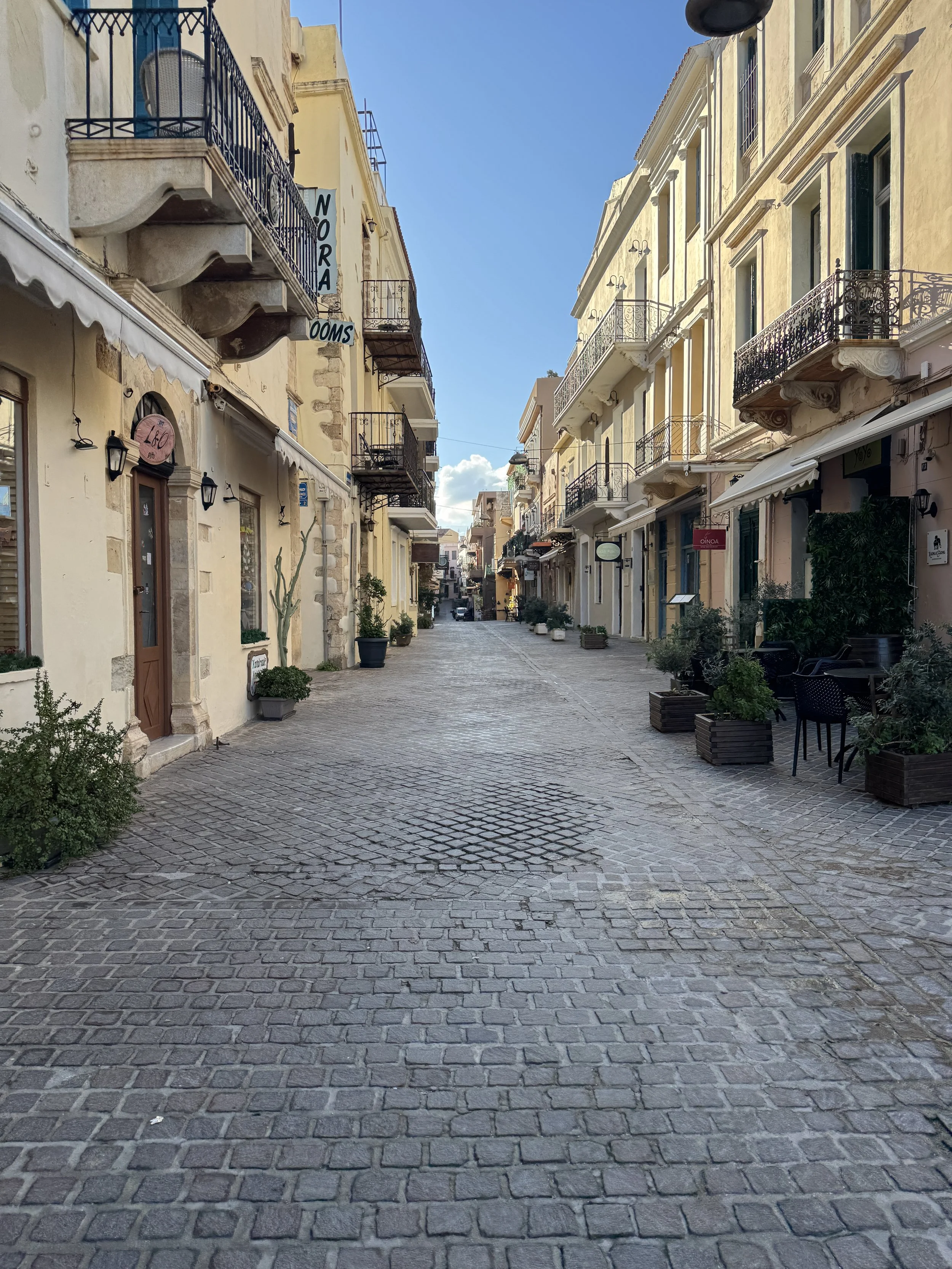
We then walked up Skridlof Street, which is known for its leather goods, and the whole street had a faint smell of leather. The shops sold shoes, jackets, bags, slippers, wallets, gloves, and pretty much anything else you could want made of leather.
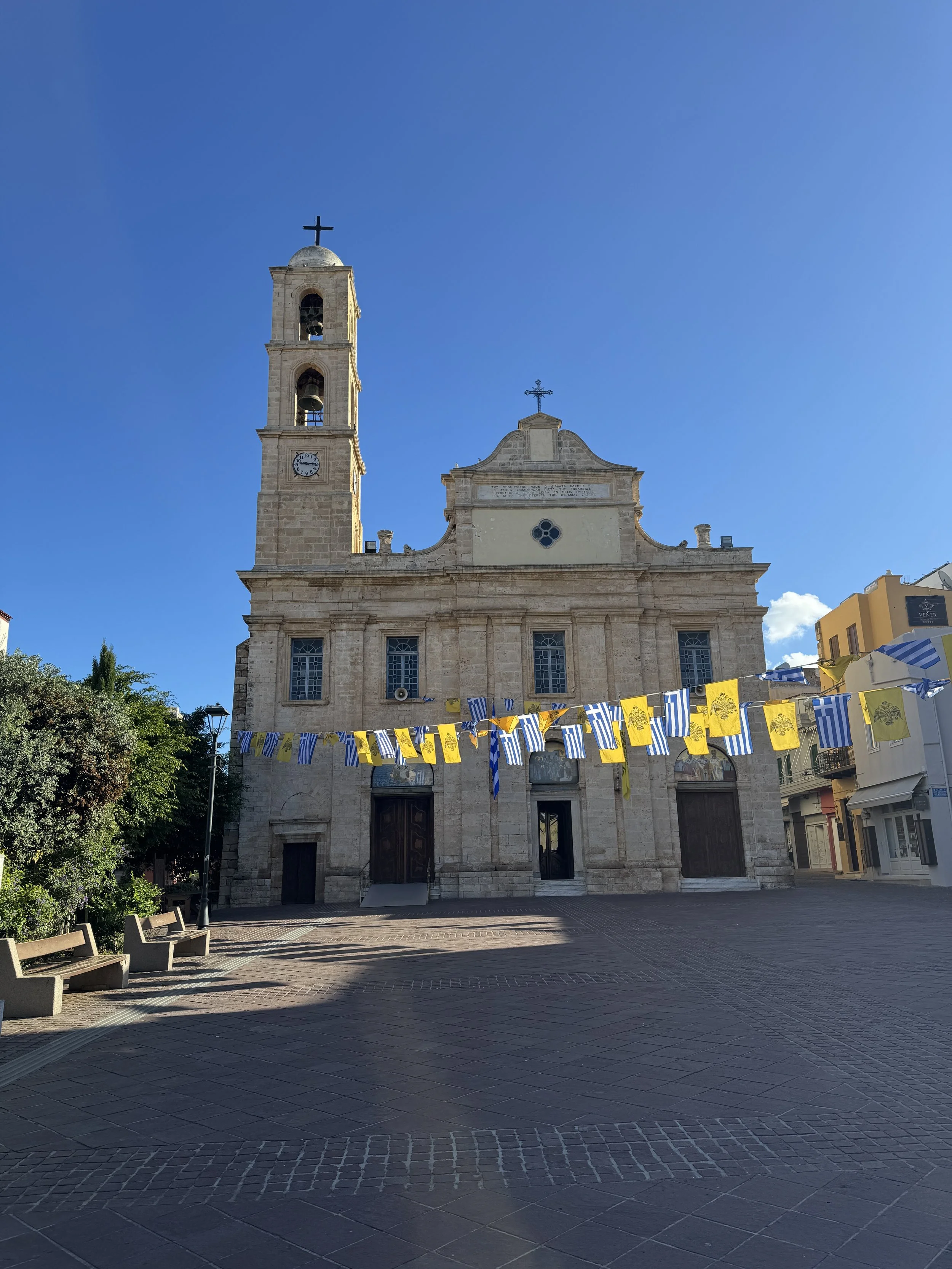
We also passed the Cathedral of Eisodion of the Theotokos, a 19th-century Orthodox cathedral built on the site of earlier religious structures, including a former Venetian church and an Ottoman-era mosque. Today it serves as Chania’s main cathedral, reflecting the city’s layered Venetian, Ottoman, and modern Greek history.
That more or less rounded out our time in Chania, and we headed back to the car to leave town.
The Pottery Stop That Wasn’t
We attempted to stop at Manousos Ceramics
(Εργαστήρι Κεραμικής Μανούσος Χαλκιαδάκης), a family-run Cretan pottery workshop producing handmade ceramics inspired by Minoan and traditional designs, where visitors can often watch the craft in action.
Unfortunately, getting there required a windy mountain road, and it was all for nothing because it was closed.
I’m guessing it was due to winter hours.
Arriving in Rethymno
We continued driving to Rethymno and found parking near the Fortezza Fort. It was hourly parking and paid at the end, costing about €8 for 3.5 hours.
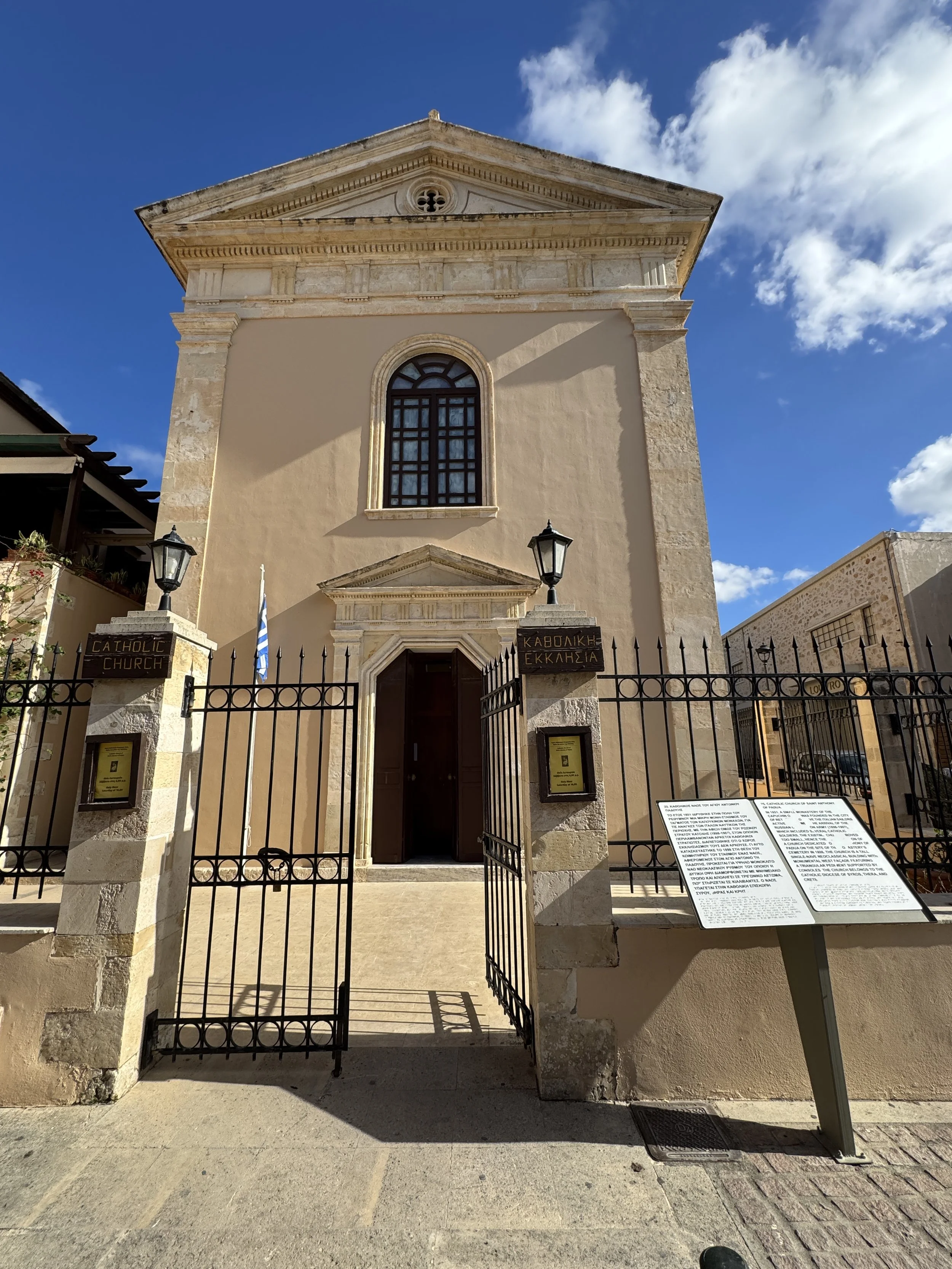
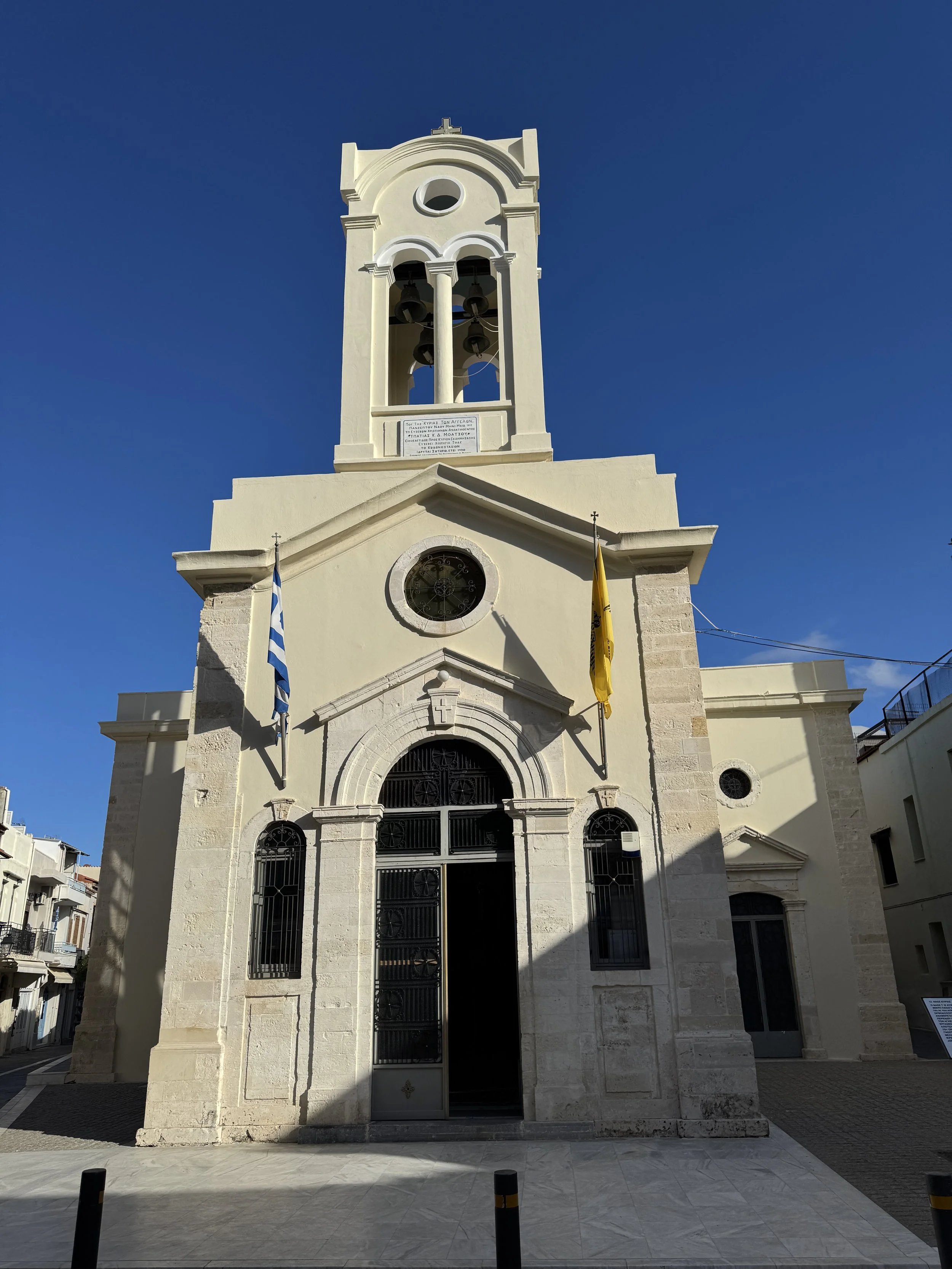
While walking toward the port, we passed the Catholic Church of Saint Anthony of Padua
(Ιερός Καθολικός Ναός Αγίου Αντωνίου της Παδούης). It was built in the late 19th century, following Crete’s transition away from Ottoman rule. The church reflects the continued presence of Western Christian traditions in the city, rooted in Rethymno’s earlier Venetian past.
Lunch at the Port
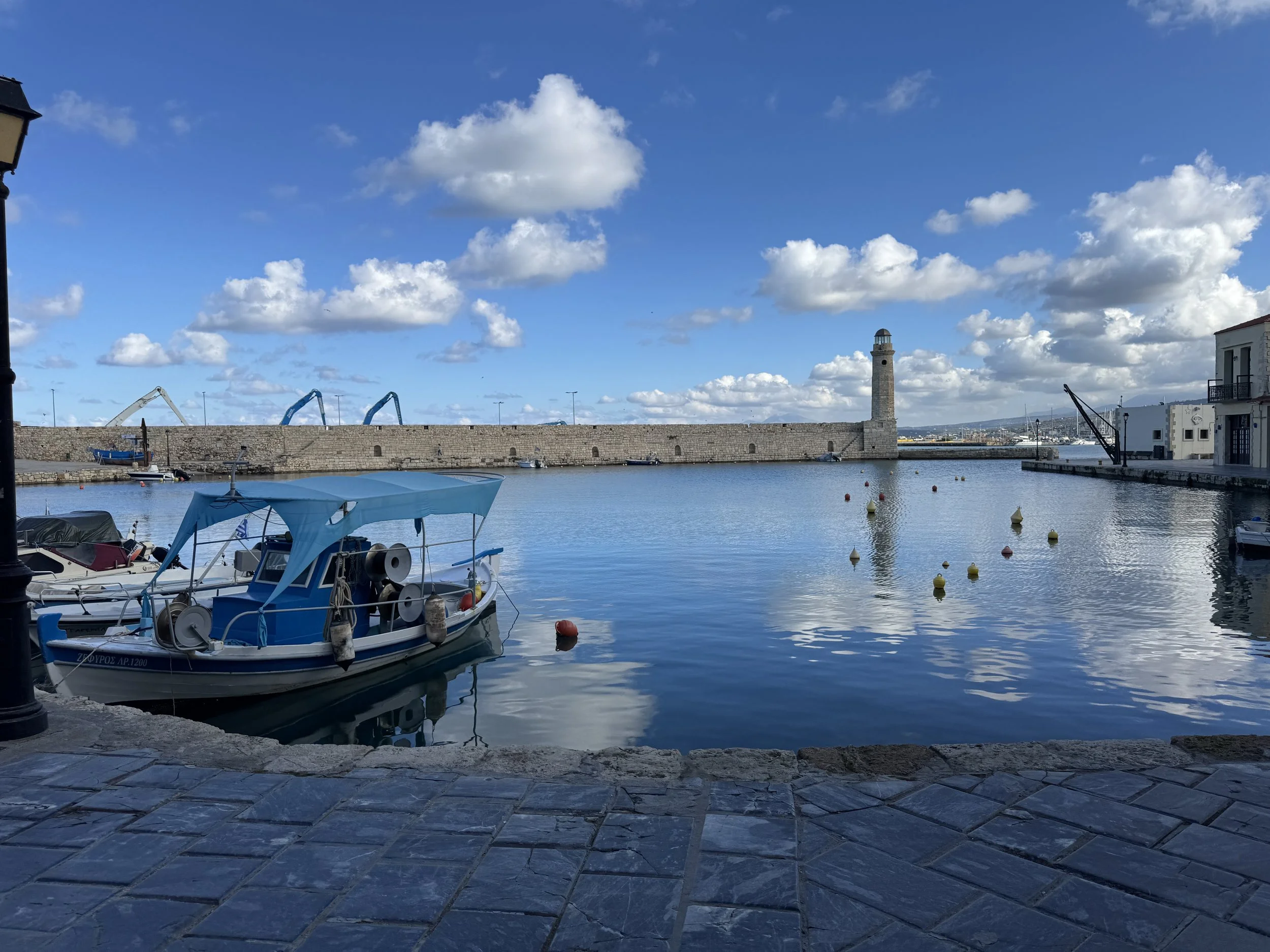
Once we reached the port, we ate at Achinos Restaurant.
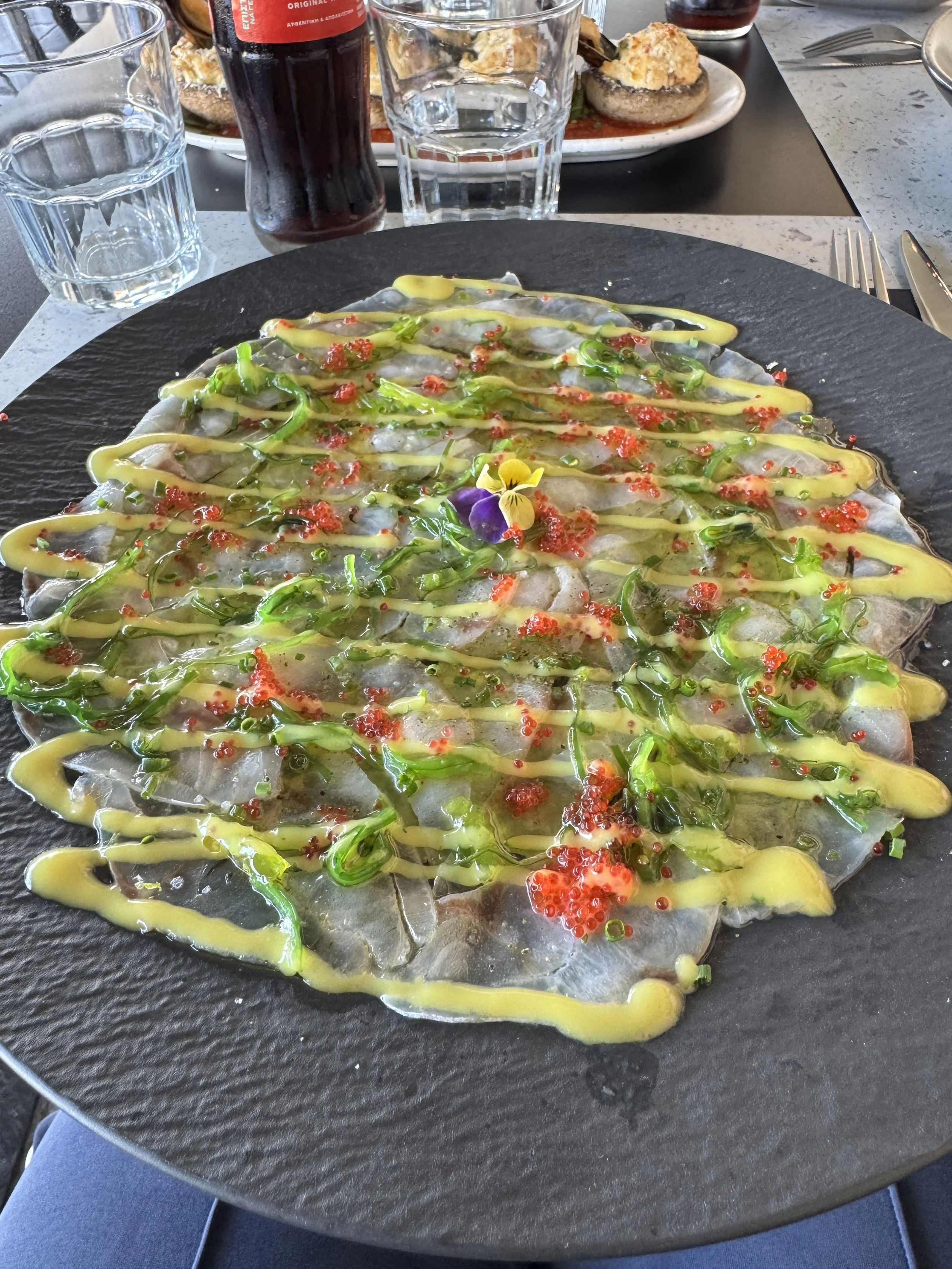
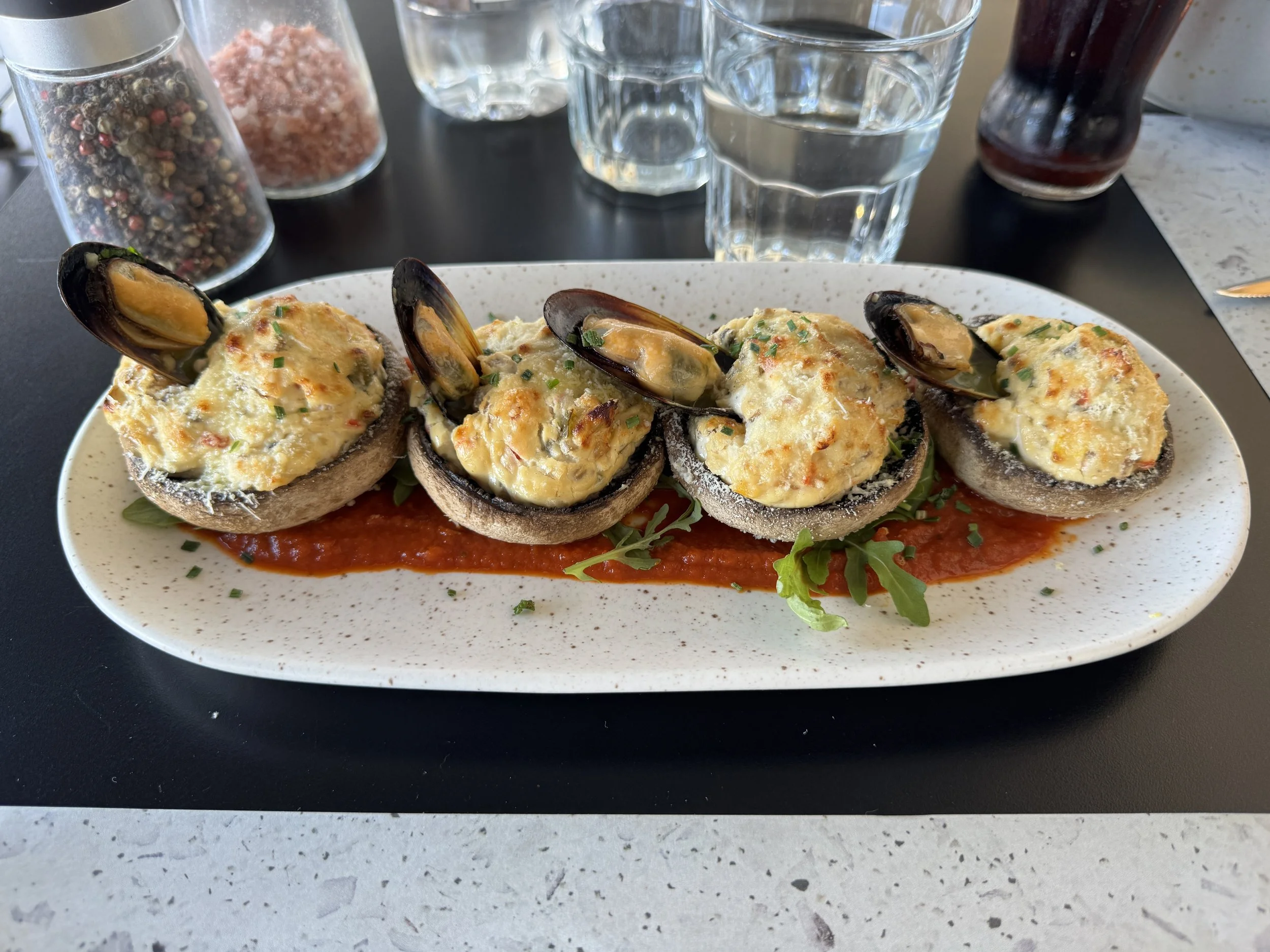
I had sea bass carpaccio and stuffed mushrooms, which were delightful, and we also got a free panna cotta for dessert, which was also very good.
We sat outside with a heater and enjoyed the view of the lighthouse and port, which definitely added to the experience.
Fountains, Mosques, and a Tiny Reminder of France
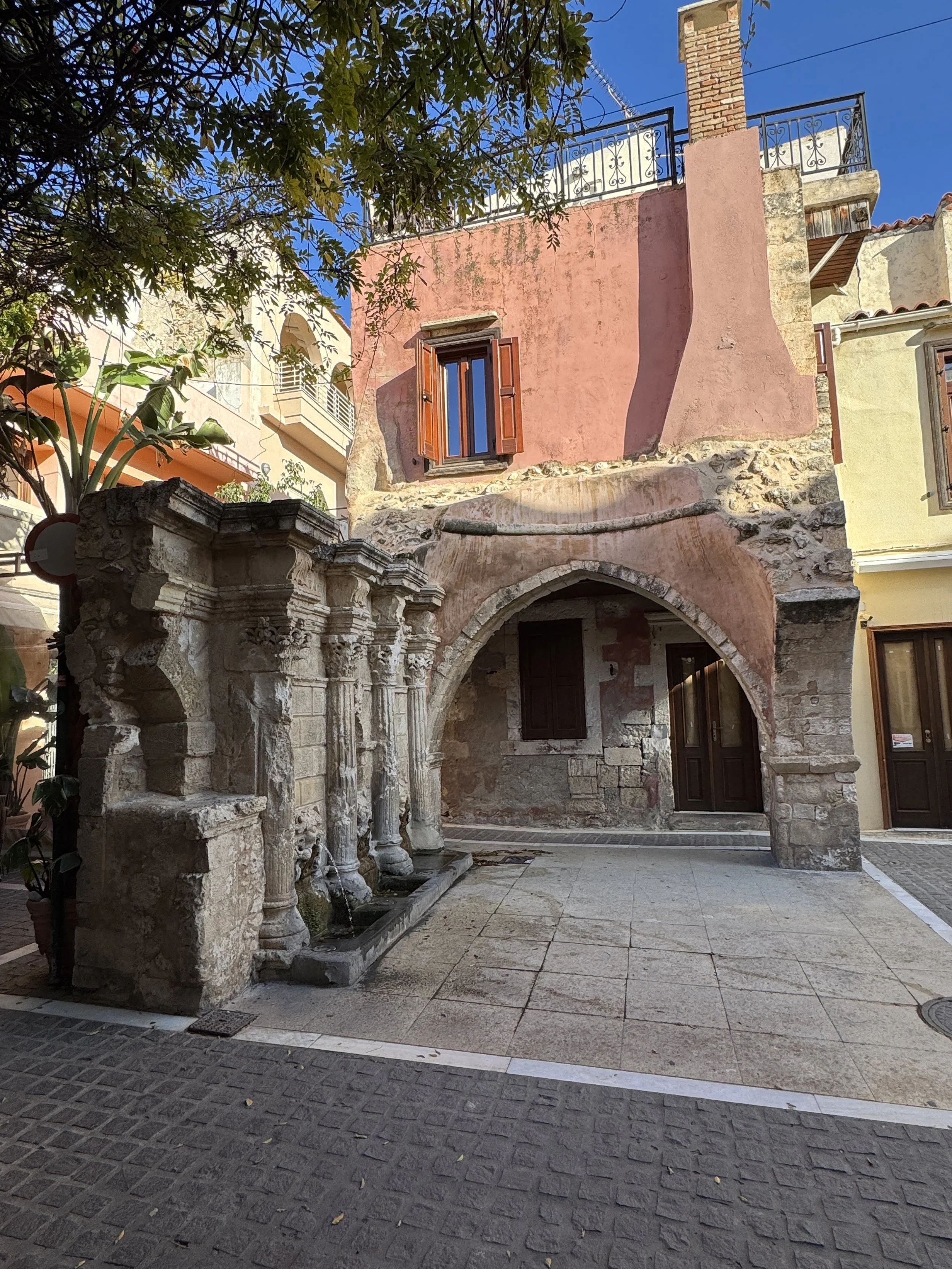
After lunch we wandered back into town and found the Rimondi Fountain
(Ενετική Κρήνη Ριμόντι), which was built in 1626 during Venetian rule as a public water source for Rethymno. Decorated with Corinthian columns and lion-head spouts, it reflects the city’s prosperity and Venetian urban planning in the late Renaissance period.
One block away was Neratze Mosque
(Νερατζέ Τζαμί), which was originally built as a Venetian Augustinian church in the late 16th century and converted into a mosque during Ottoman rule in the 17th century. Its prominent minaret reflects Rethymno’s layered Venetian and Ottoman past, and the building later served various civic uses in modern times.
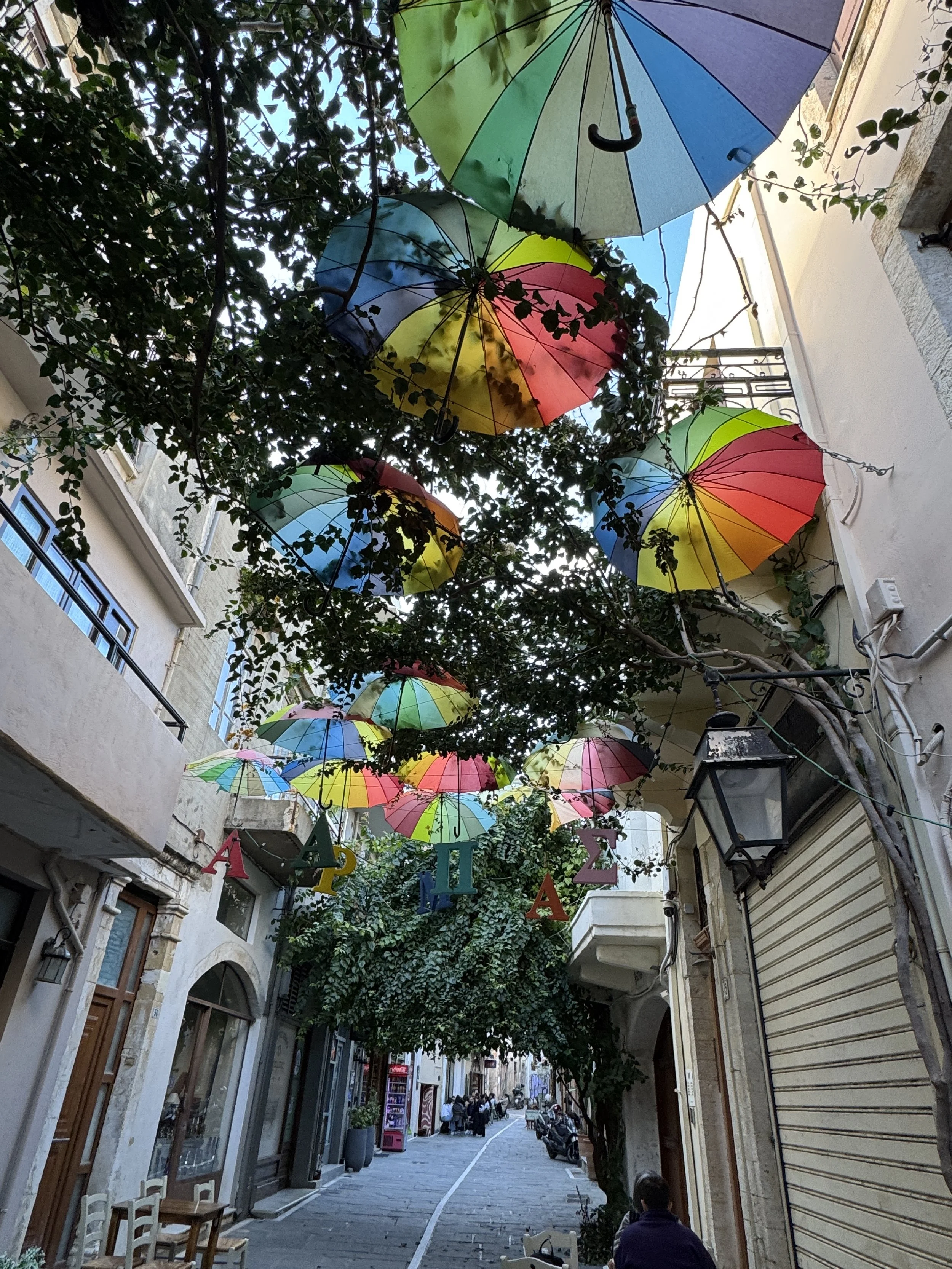
A few blocks from there was Regenschirm-Gasse Rethymno, which felt like a tiny replica of the streets of Grasse, France
(see France blog for photos and information), with umbrellas hanging down into the alley.
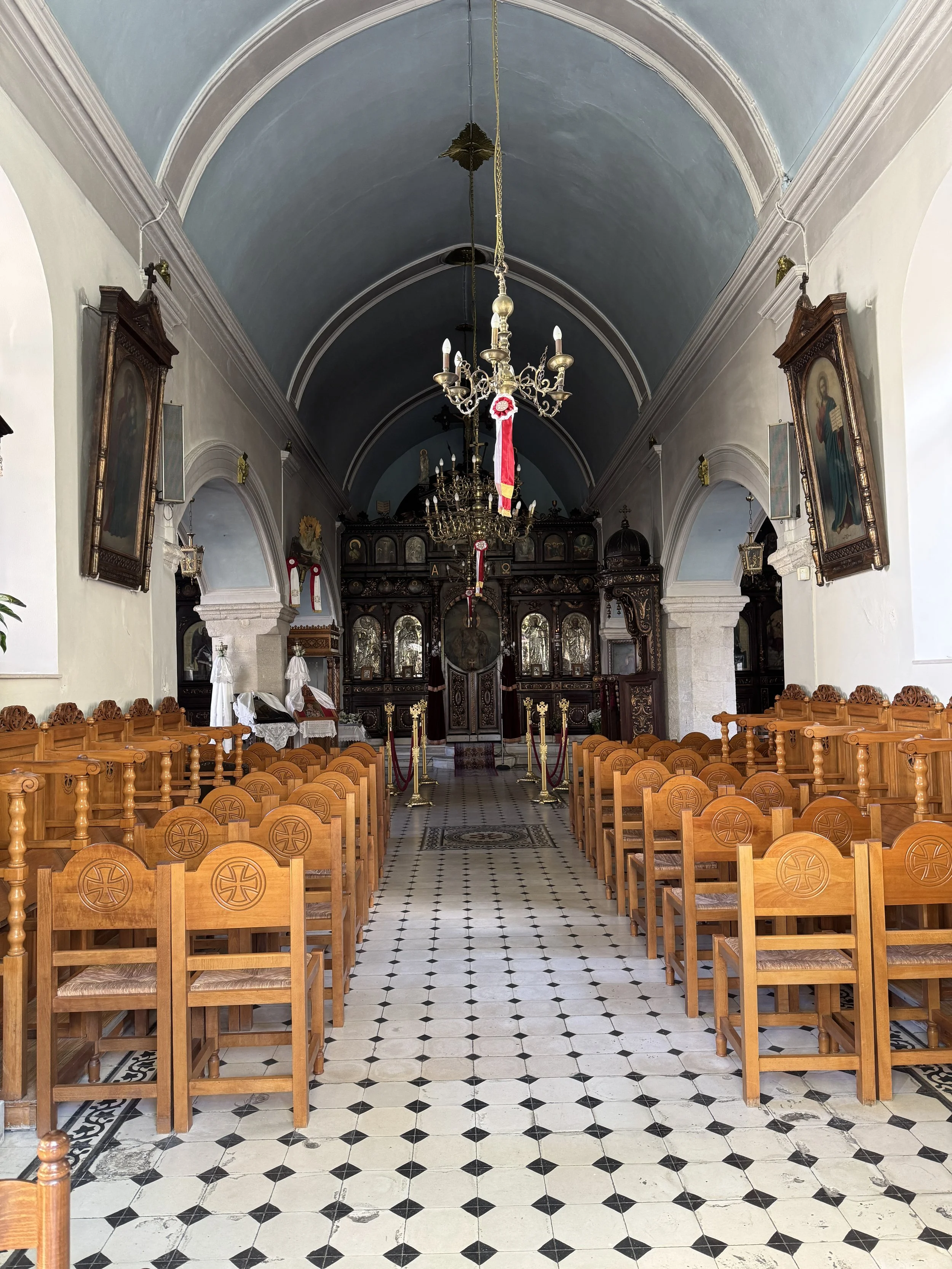
Fortezza of Rethymno: The Best Historic Site in Crete
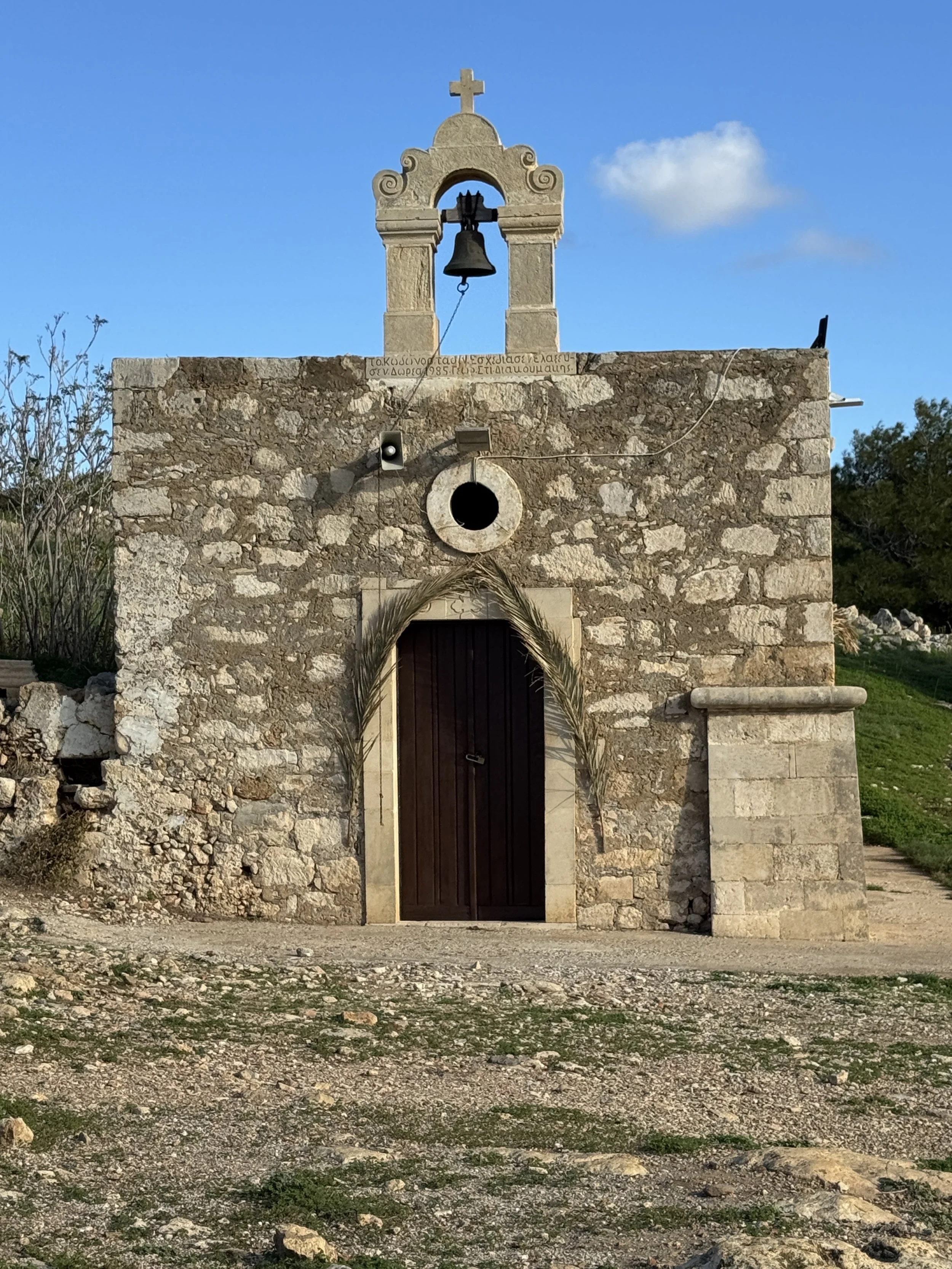
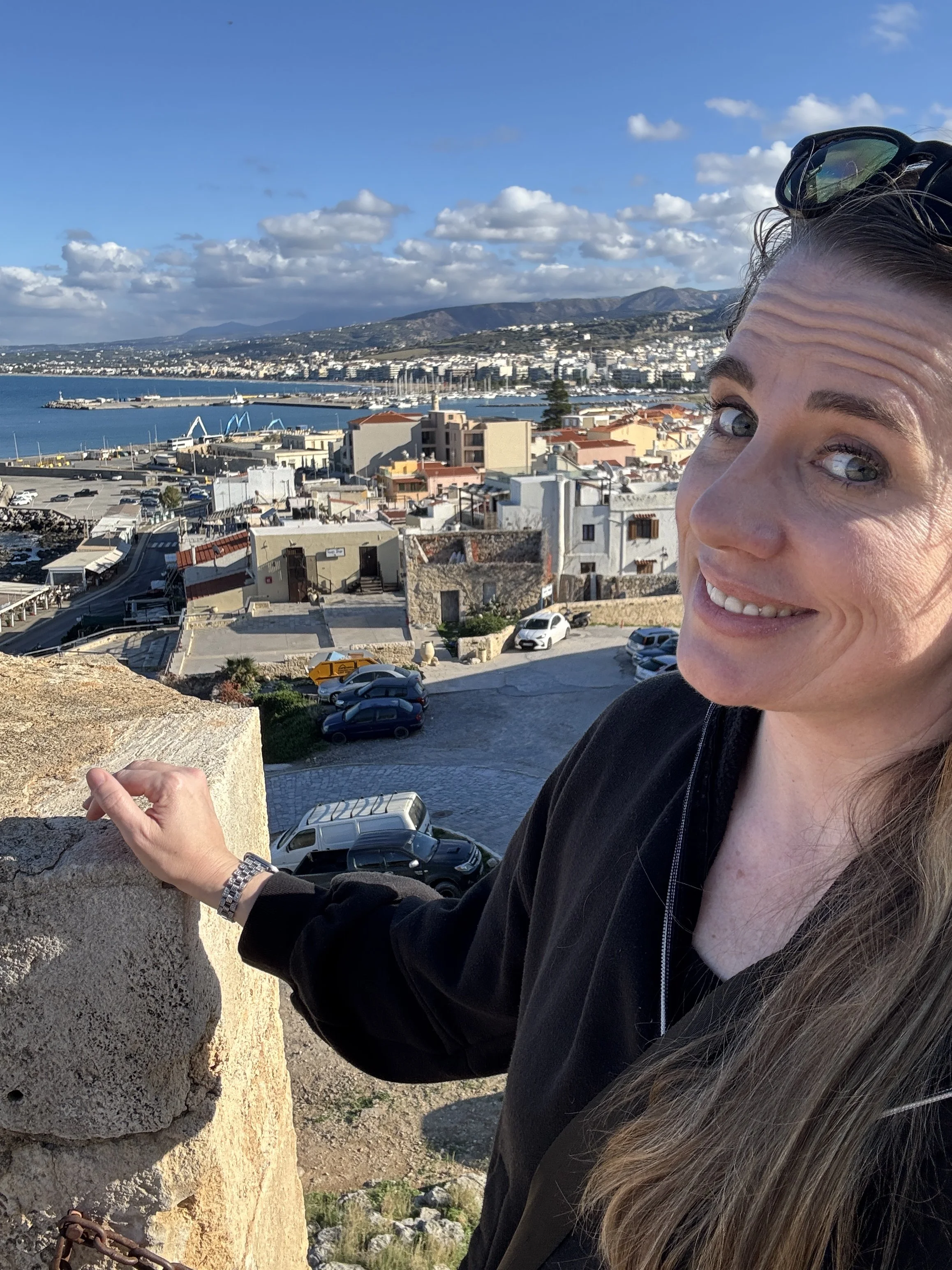
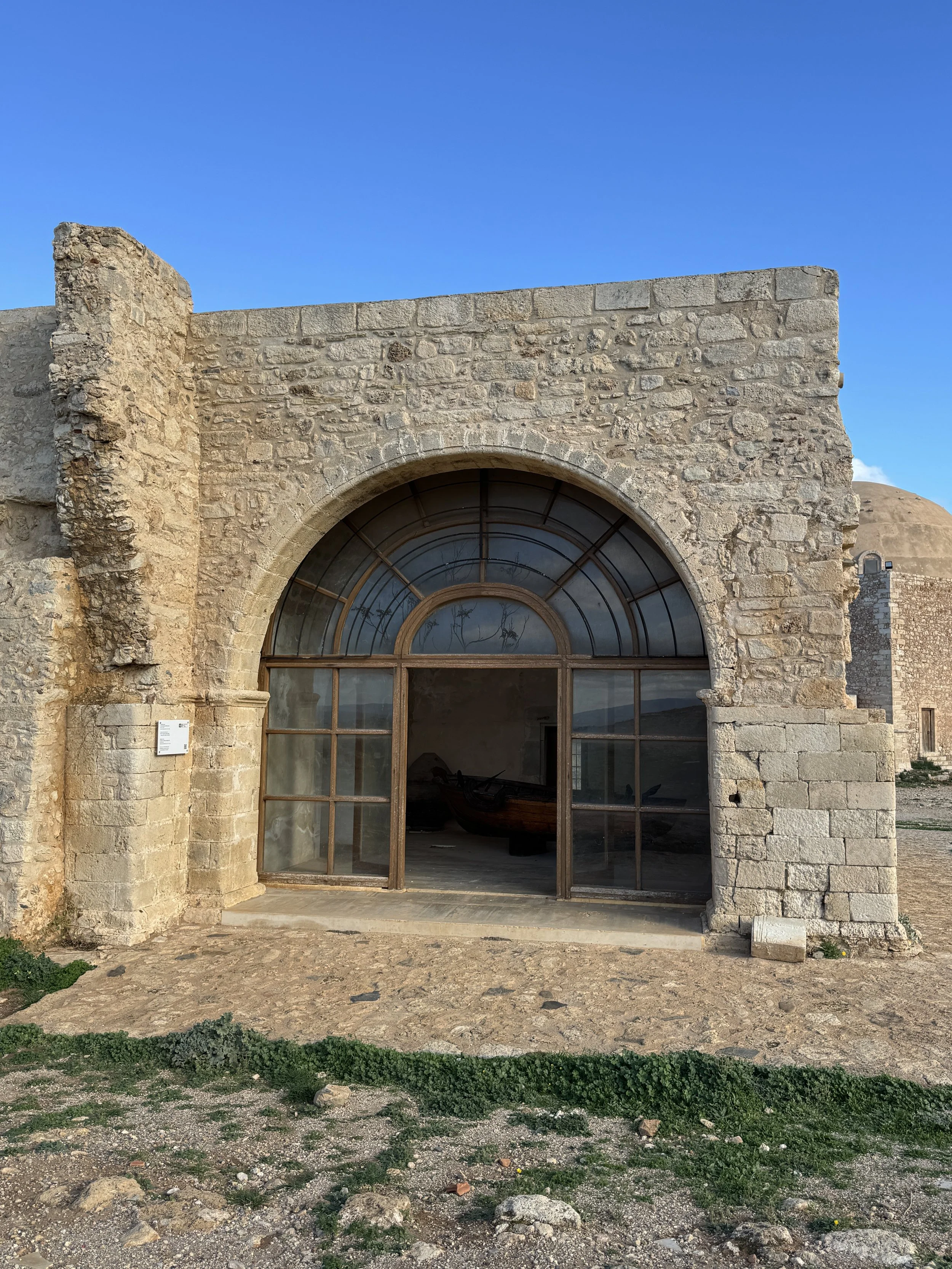
We slowly wandered back to the Fortezza of Rethymno
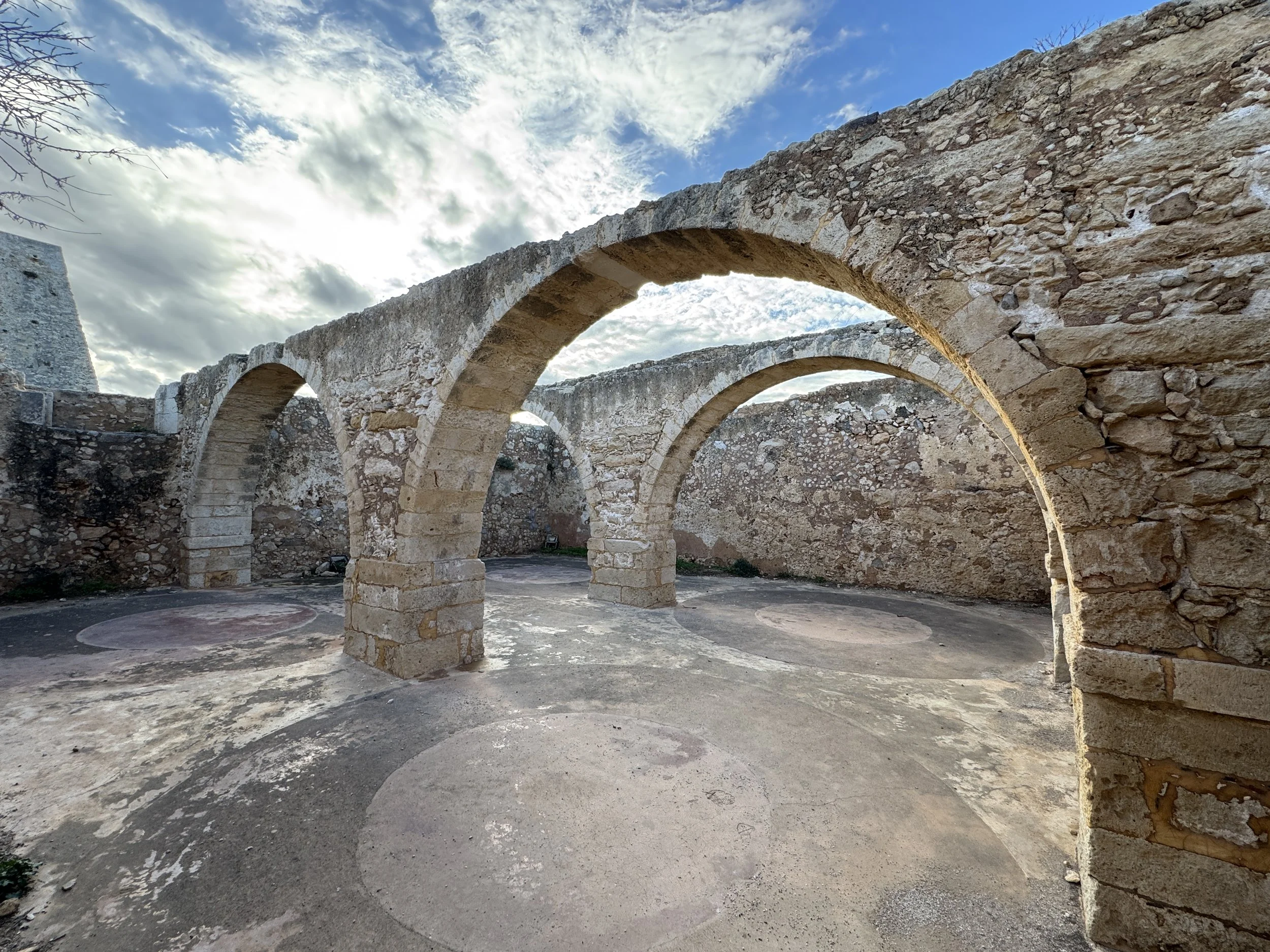
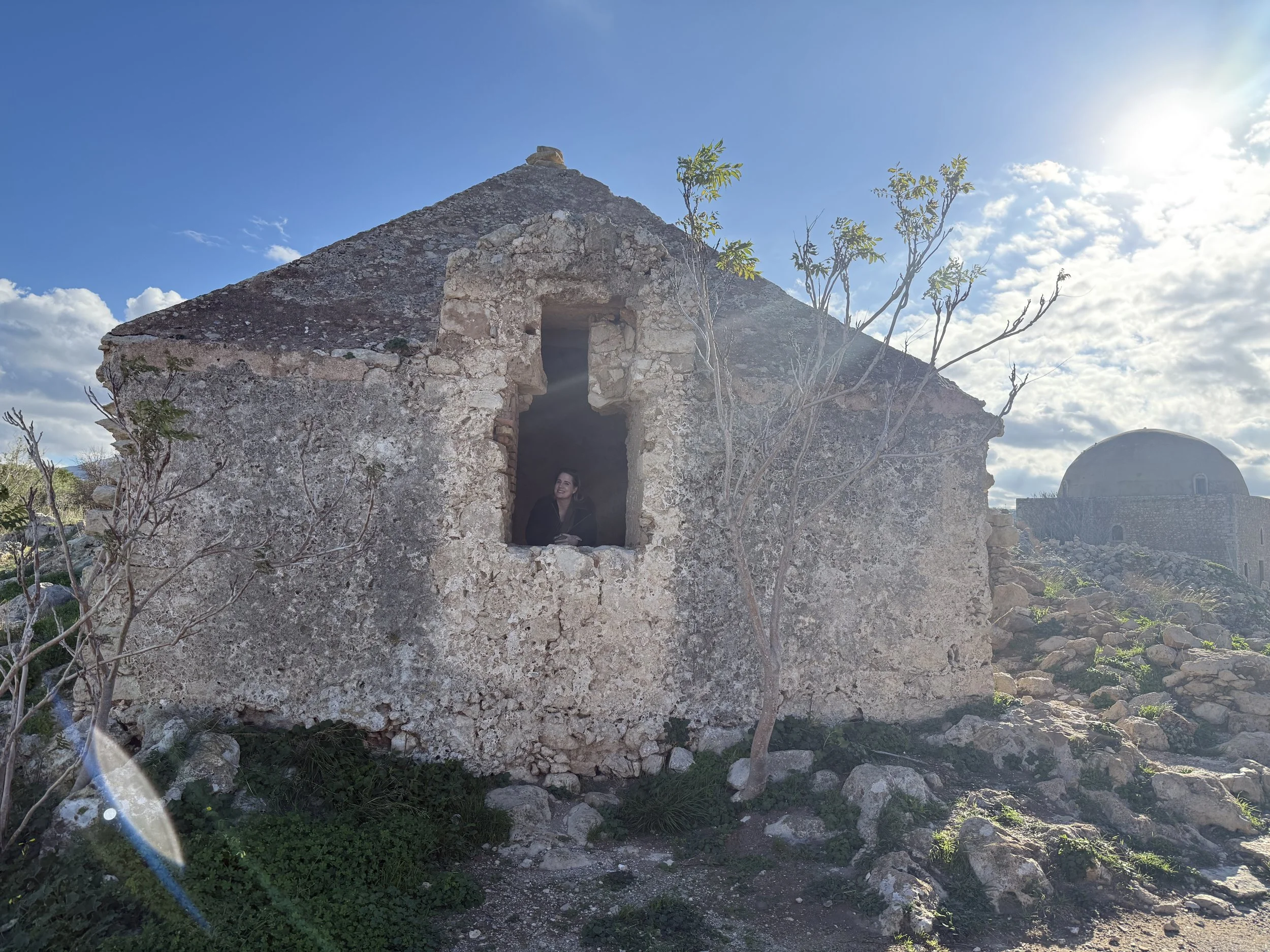
(Φορτέτζα Ρεθύμνου), which was built by the Venetians in the late 16th century after pirate attacks devastated the city. Designed to protect Rethymno from Ottoman and pirate threats, the hilltop fortress reflects Venetian military engineering and the strategic importance of Crete in the eastern Mediterranean.
It was actually really well preserved, and most of the buildings were open to either walk through or peek inside.
It also had magnificent aerial views of the city below and the ocean.
Admission was €10 per person, and honestly I think this site was more worth it than any other ruins or historical sites we saw in Crete.
It also had all the stray kitty friends there to guide you and meow you into submission for pets.
There wasn’t a ton of signage, but there was some information about the food storage areas, prison, and a general overview of the complex.
There was also a tiny cave that had quite a bit of trash in it, which was disappointing. Shame on visitors. Take your trash with you. There are no fewer than five trash cans around the entrance and exit.
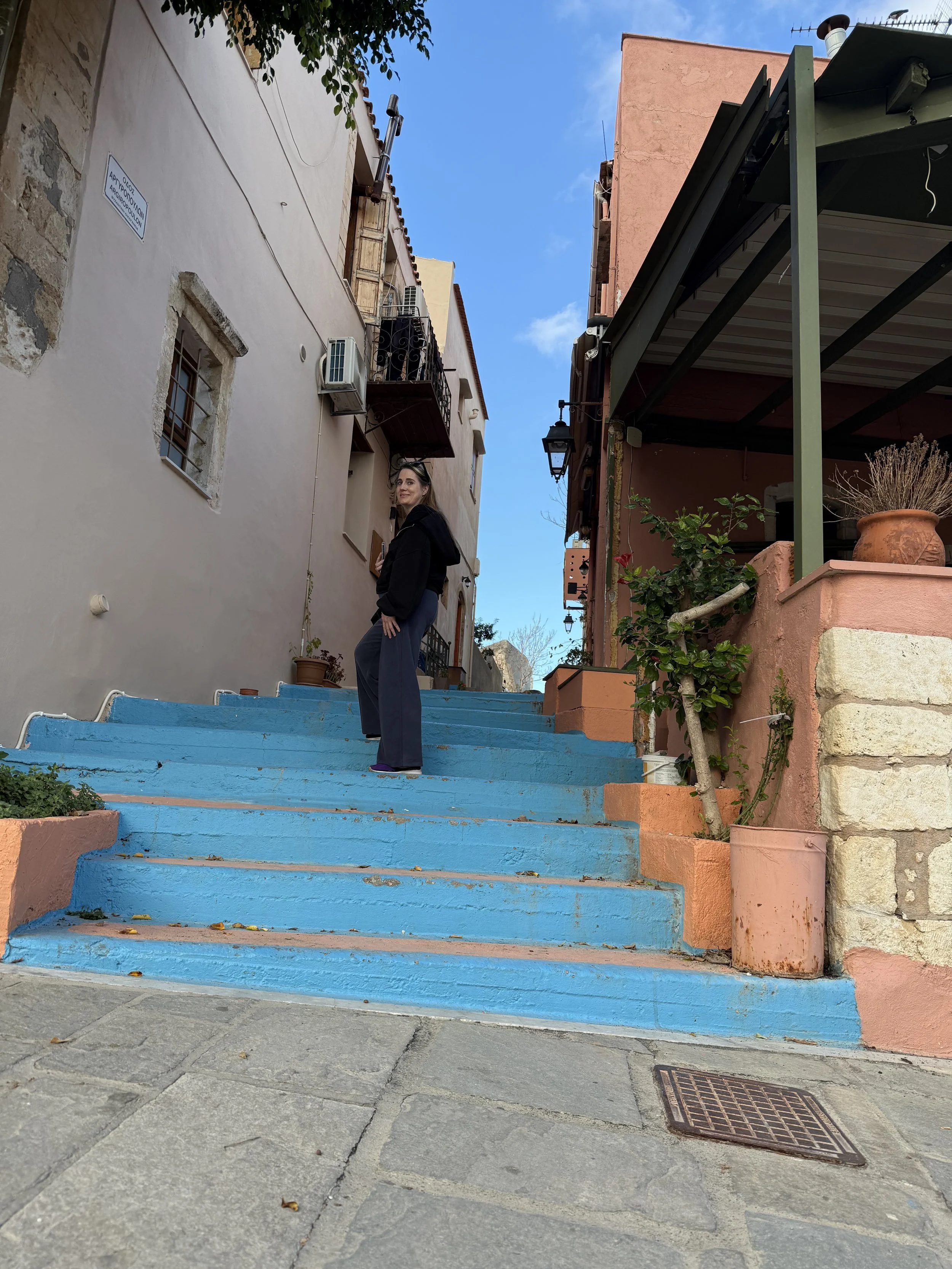
Right near the entrance and exit are the Blue Stairs of Rethymno, a small photogenic stairway in the Old Town painted in vivid blue and framed by Venetian-era buildings. While not a historic monument, they reflect the town’s creative spirit and have become a modern visual symbol of Rethymno’s charm.
One Last Attempt at Olive Oil and Honey
On the drive back to Heraklion, we tried to make one last stop at Paraschakis Olive Oil.
We found it, but the place was complete harvest chaos, with people coming and going everywhere. No one greeted us, but no one was rude either. We just felt awkward, got back in the car, and left.
We also attempted to stop at a honey museum we saw advertised along the route, but that was closed too.
At that point we decided to call it a day and head back to the hotel to relax.
Sunset Drive and a Quiet Final Night in Crete
On the drive back we got some beautiful sunset views over the ocean and made it to the hotel just as it was getting dark.
We ordered takeout from the Wolt app and ate in the room while preparing for an early morning flight back to the mainland.
Crete was a charming and memorable experience, with both some highlights and a few misses.
Chania and Rethymno were both laid-back ancient towns absolutely dripping in history. The food was on point, and overall we really enjoyed our time there.
Having a car gave us a lot of freedom, but it also meant dealing with parking and walking in every city. Parking appeared to be paid in most lots and on many streets, so keep an eye out for signs and QR codes.
December 13: Monasteries, WWII History, and Delphi
An Eerie Early Morning at the Airport
We woke up early to catch our flight and drove to the airport, nearly forgetting to fill up the gas tank. Luckily there was a gas station nearby.
Then we discovered the downside of renting from an unknown car rental company: they don’t open until 7:00 a.m. Our flight boarding time was 7:30 a.m.
We called them and ended up leaving the car with the keys hidden inside. Unfortunately they charge a €40 fee for returning it outside regular hours, which we didn’t exactly have a choice about.
Walking to the airport felt like something out of a zombie apocalypse. The place was nearly empty. We even walked in the driving lane because the sidewalk was terrible for rolling suitcases.
Inside, we walked up to an empty check-in counter and then through an empty security line.
There was at least a little life inside the terminal, but it still felt surreal.
We boarded our plane from the tarmac shuttle and took off on a 35-minute flight. Ironically, waiting for our luggage took longer than the flight itself, but soon enough we were back on the road.
Lunch Stop in Mythical Thebes
Our first stop was Thebes, a city closely tied to Greek mythology.
It is connected to the stories of Oedipus, Antigone, Dionysus (who was said to be born there), and Heracles, Greece’s greatest hero.
We mainly stopped here for lunch.
We found an hourly parking lot and walked to Thebes Square, where we were greeted by the Cathedral of Saint George, which anchors the city’s central square. The cathedral blends Byzantine-inspired architecture with the living rhythm of a modern city built atop one of Greece’s oldest ancient capitals.
Our timing turned out to be a bit off. We arrived around 11:30 a.m., but in Greece lunch usually starts after noon.
The first place we tried had only one dish we really wanted, and we were told it would take at least an hour to prepare. Since we were on a bit of a schedule, we kept walking and passed several coffee shops before landing at Θέατρο All Day Bar, which was serving brunch.
I ordered sweet pancakes, which turned out to be so sweet that I could only finish about half before going into what felt like a diabetic coma (and I’m not diabetic).
The pancakes were covered in chocolate spread and multiple types of candy. It was basically dessert disguised as breakfast.
Afterward we stopped at a small market, then returned to the car and got back on the road.
The Most Beautiful Site We’ve Seen in Greece
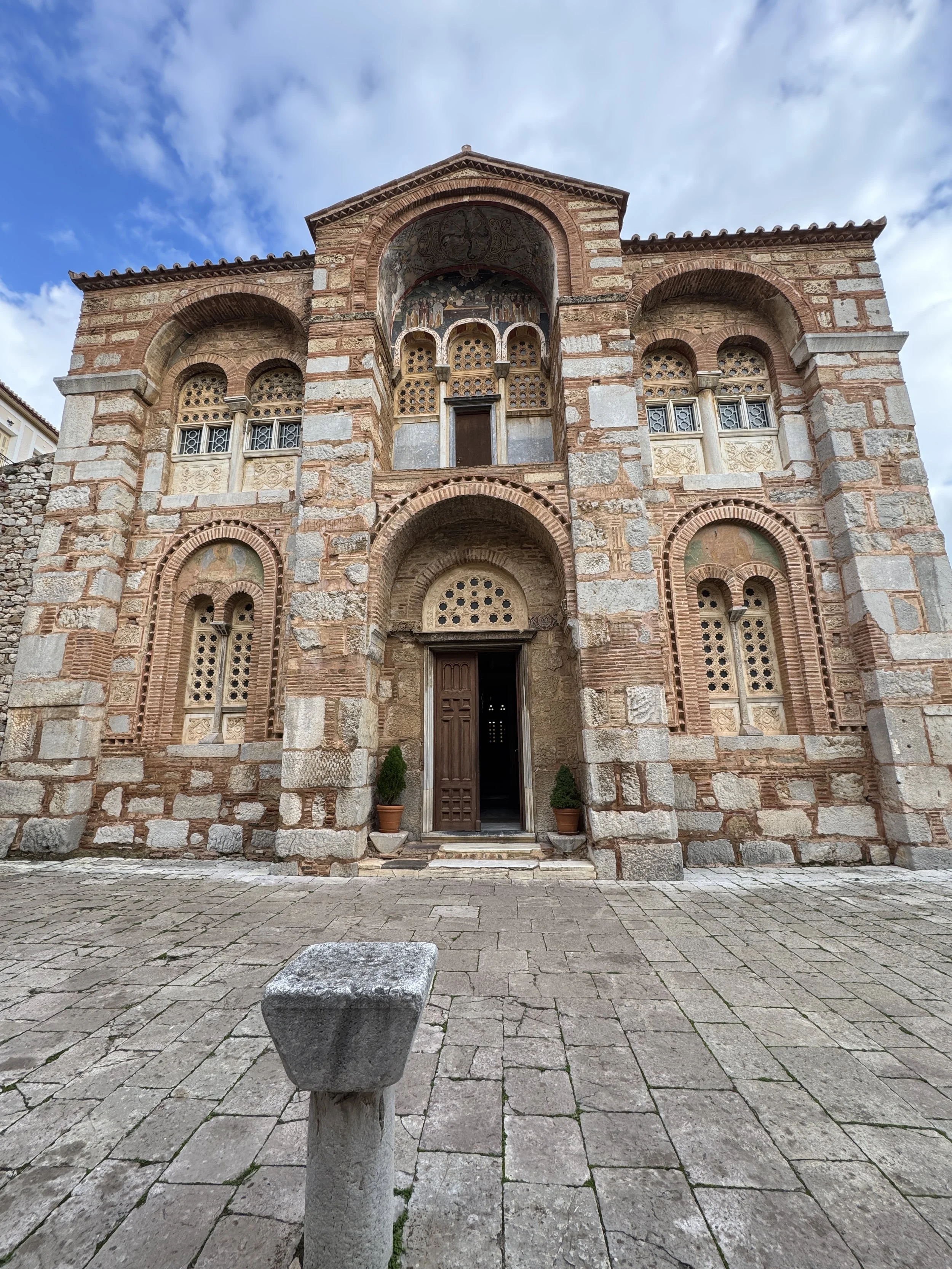
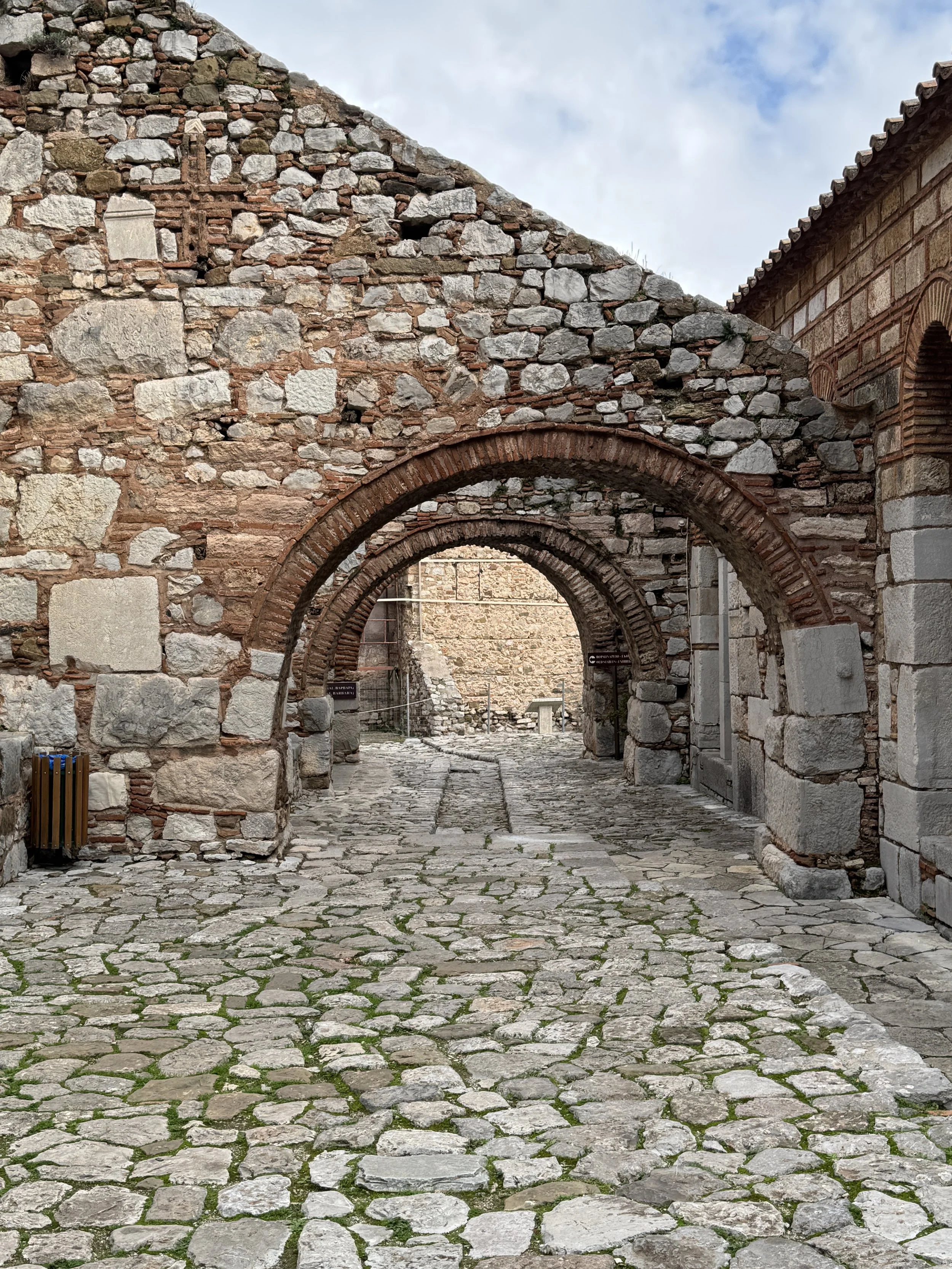
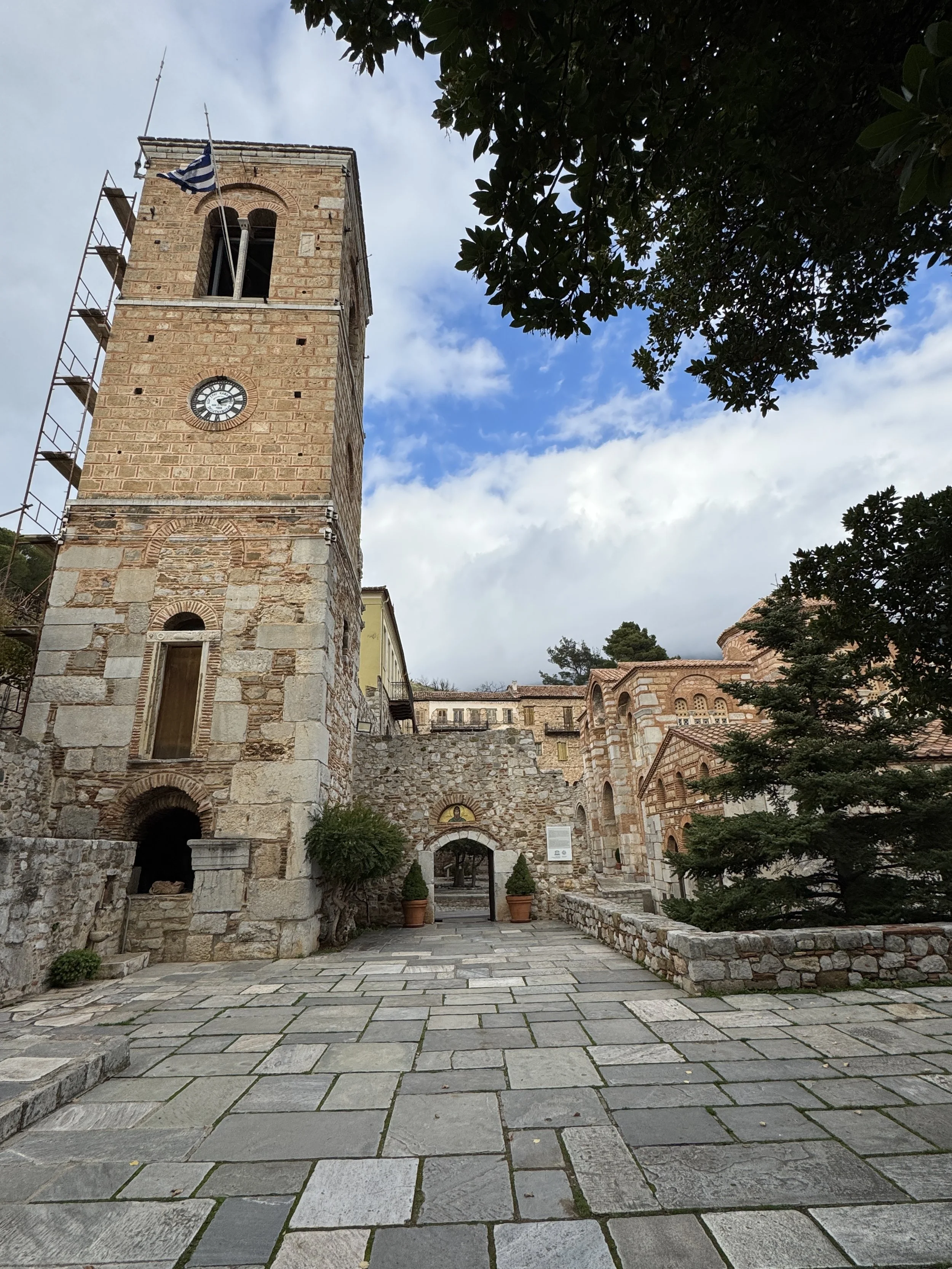
Our next stop was the Holy Monastery of Hosios Loukas
(Ιερά Μονή Οσίου Λουκά).
The monastery was founded in the 10th century around the tomb of Saint Luke the Stiriote, a hermit monk known for healing miracles and prophetic visions.
Its fame grew after Saint Luke correctly foretold the Byzantine reconquest of Crete in 961, which brought imperial patronage and prosperity to the monastery.
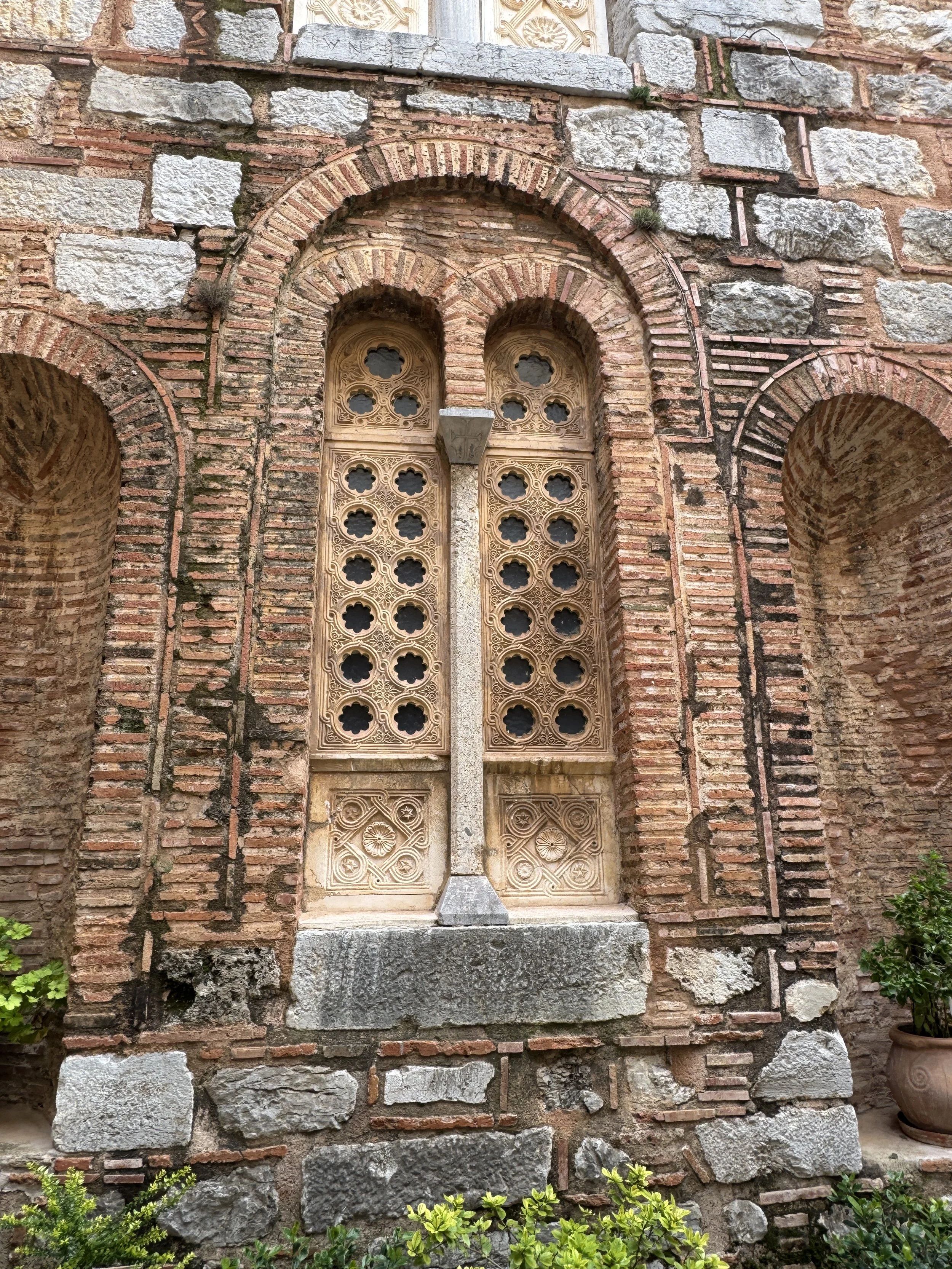
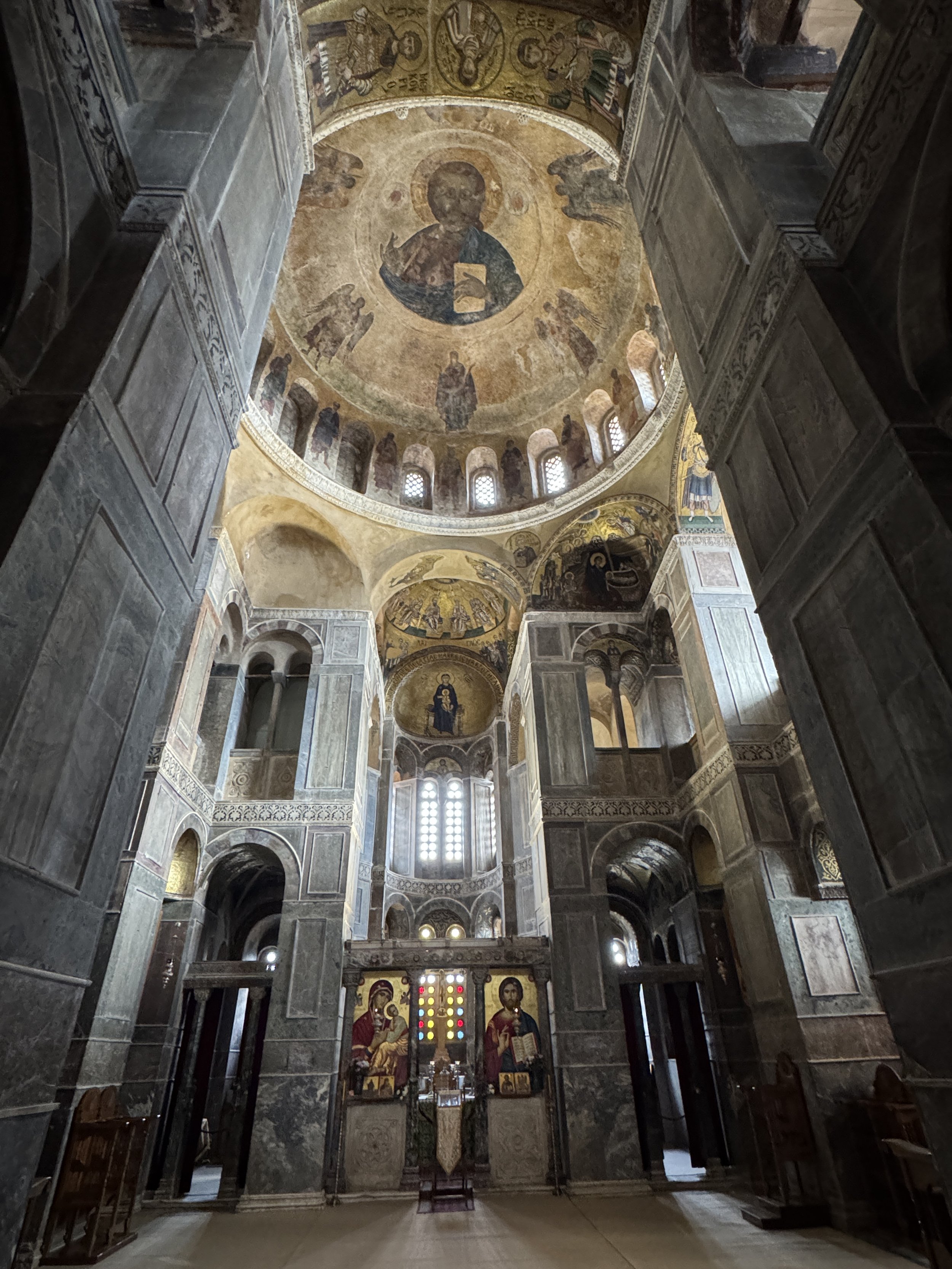
The Katholikon church is one of the finest examples of Middle Byzantine architecture, renowned for its rich mosaics and frescoes.
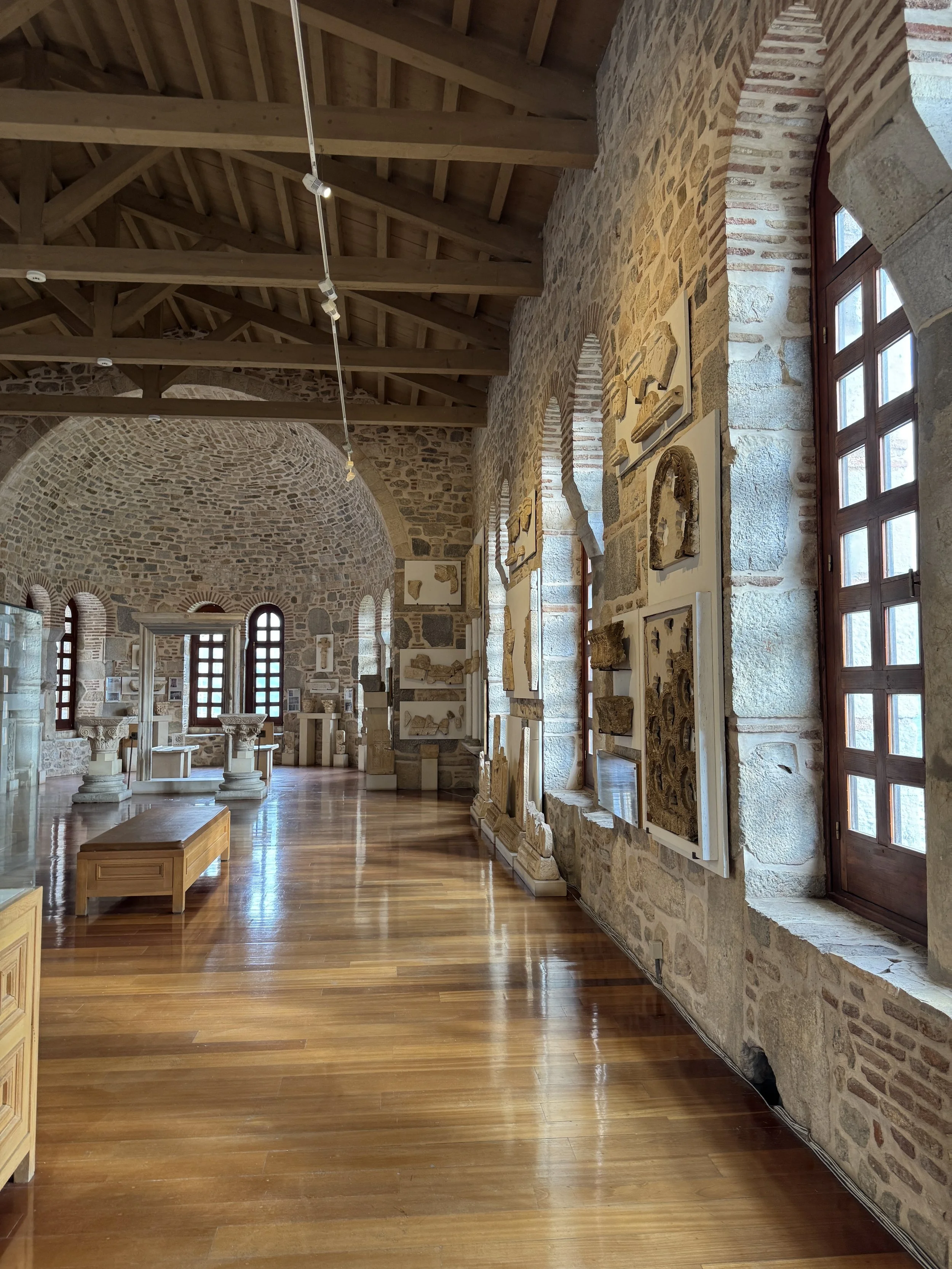
Despite periods of decline, the monastery remained an important spiritual center and today is a UNESCO World Heritage Site, celebrated for its exceptional Byzantine art and architecture.
This place was literally the prettiest thing we’ve seen so far.
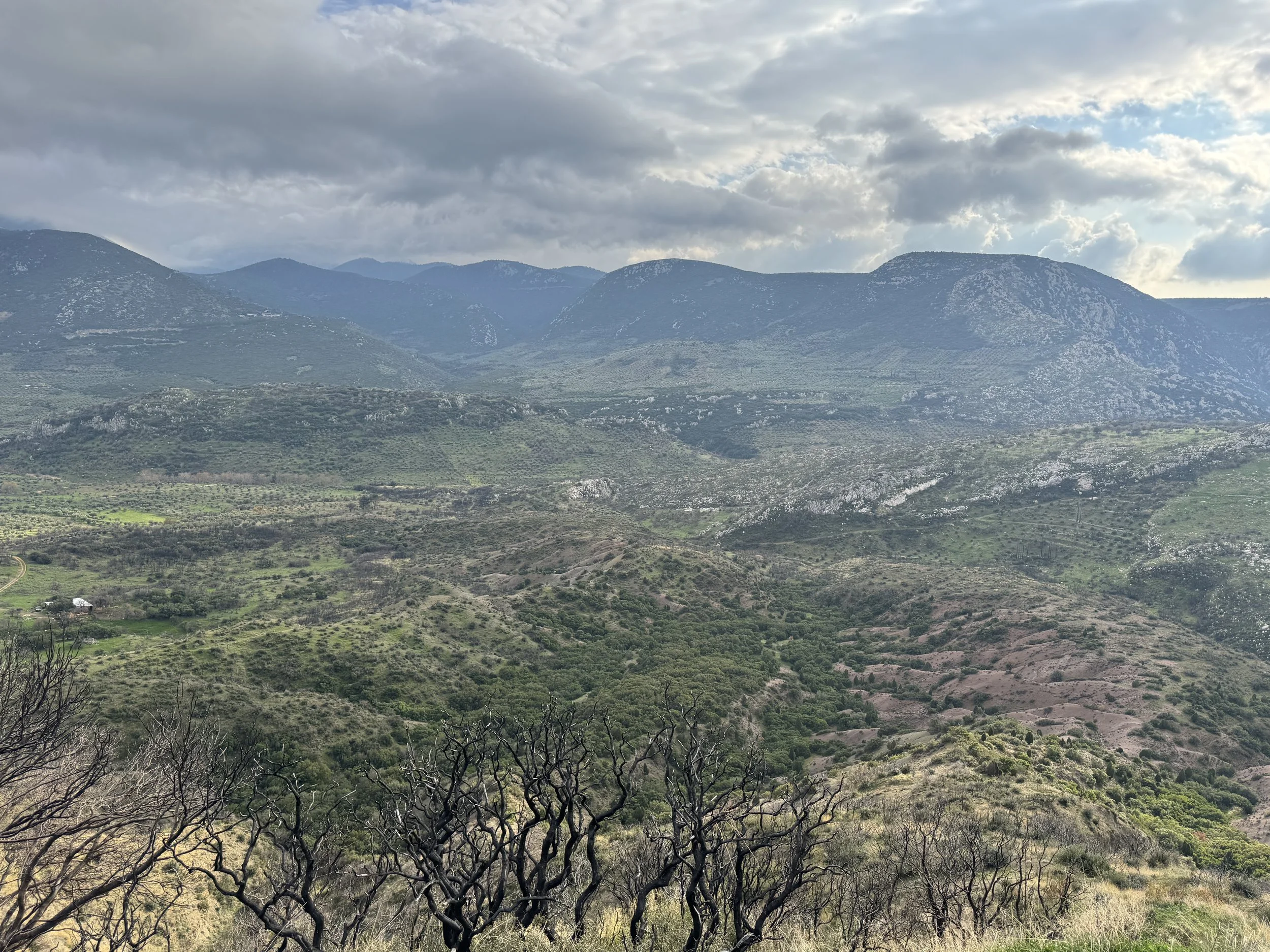
The mosaics covering the walls and ceilings were stunning, and the monastery sits on a hillside with beautiful views of the valley below.
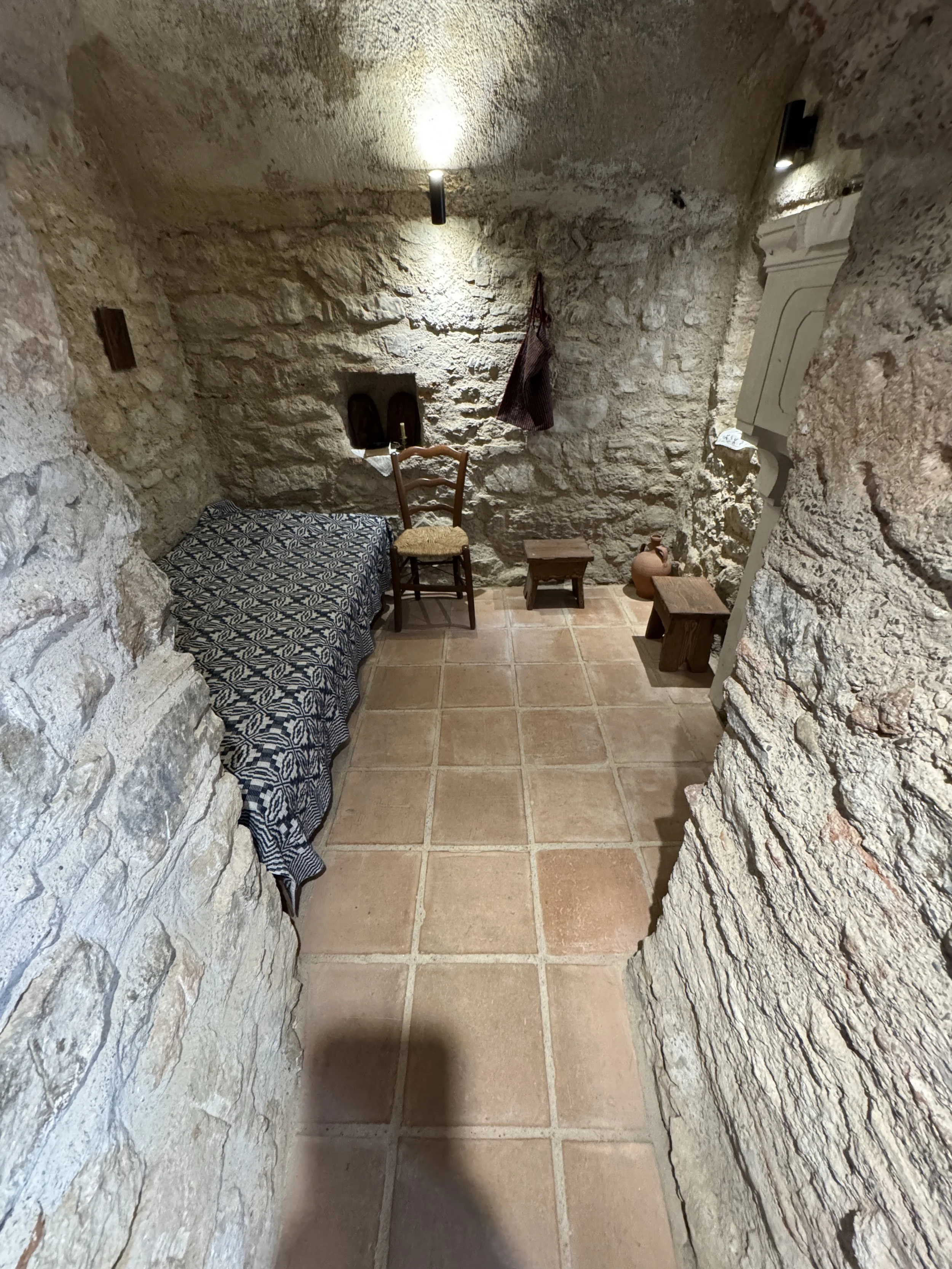
We also saw the tiny cells where monks once lived, which were incredibly small.
Learning About a Dark Chapter of History
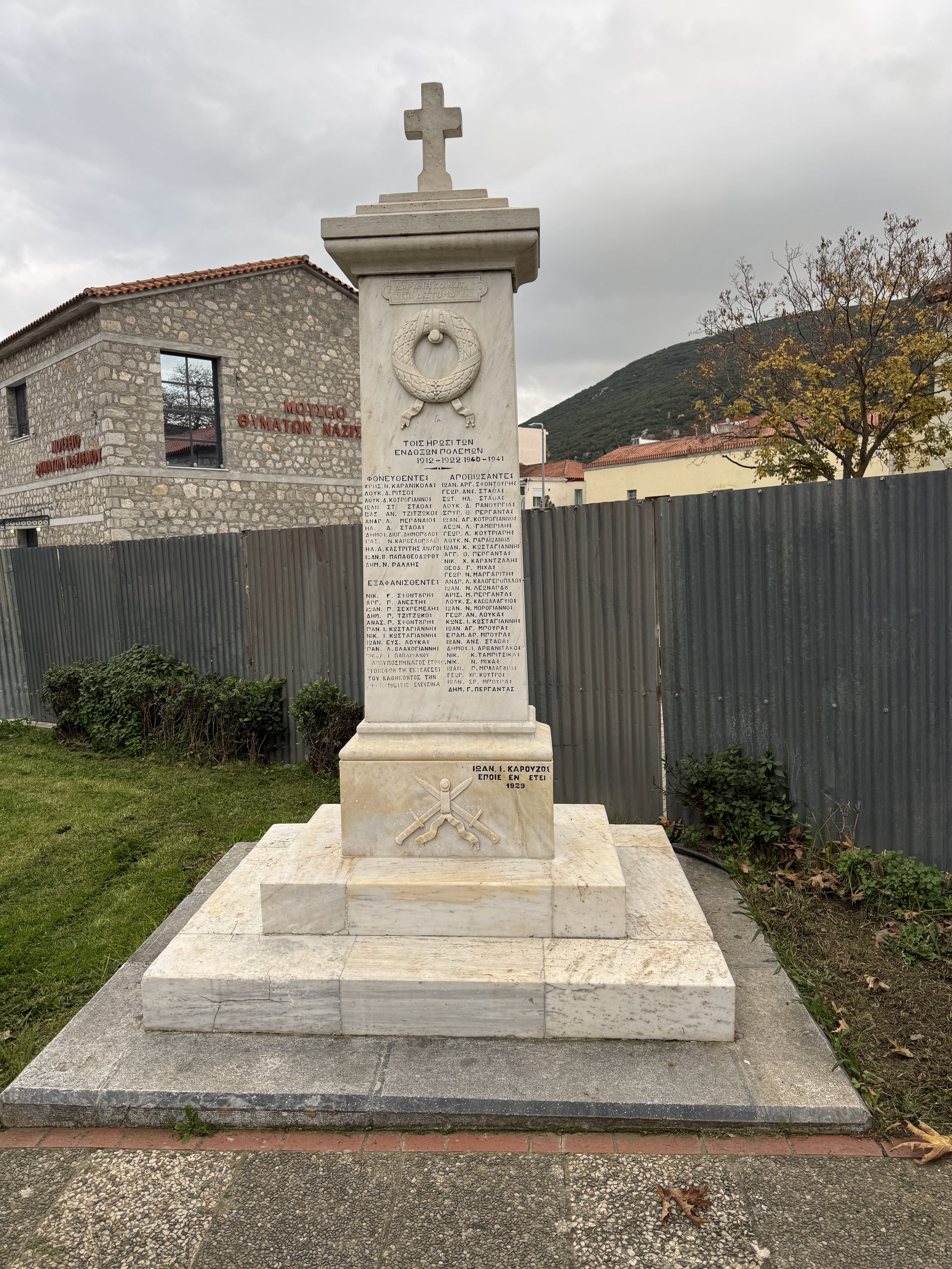
Just down the road we stopped at the Distomo Museum of the Nazi Victims.
The museum commemorates the Distomo Massacre of June 10, 1944, when German SS troops brutally killed 218 civilians, including women and children, in retaliation during the Nazi occupation of Greece.
The museum was created to preserve memory and testimony and documents the events of that day through photographs, personal belongings, survivor accounts, and historical records.
It also places the massacre within the broader context of Nazi atrocities in occupied Greece and the village’s long struggle for justice and recognition.
The museum had recently reopened and allowed us to watch a documentary about the massacre.
It was both chilling and heartbreaking.
I knew very little about this part of World War II history. It wasn’t necessarily something I wanted to learn about, but I’m glad to be more aware of these atrocities of the past.
Passing Through the “Swiss Alps of Greece”
Afterward we drove through Arachova, often called the “Swiss Alps of Greece.”
It’s a charming mountain town, but I’m also glad we didn’t stay there because it was an absolute madhouse of people and almost no parking.
We did manage to see the famous clock tower before continuing toward Delphi, where we would spend the night.
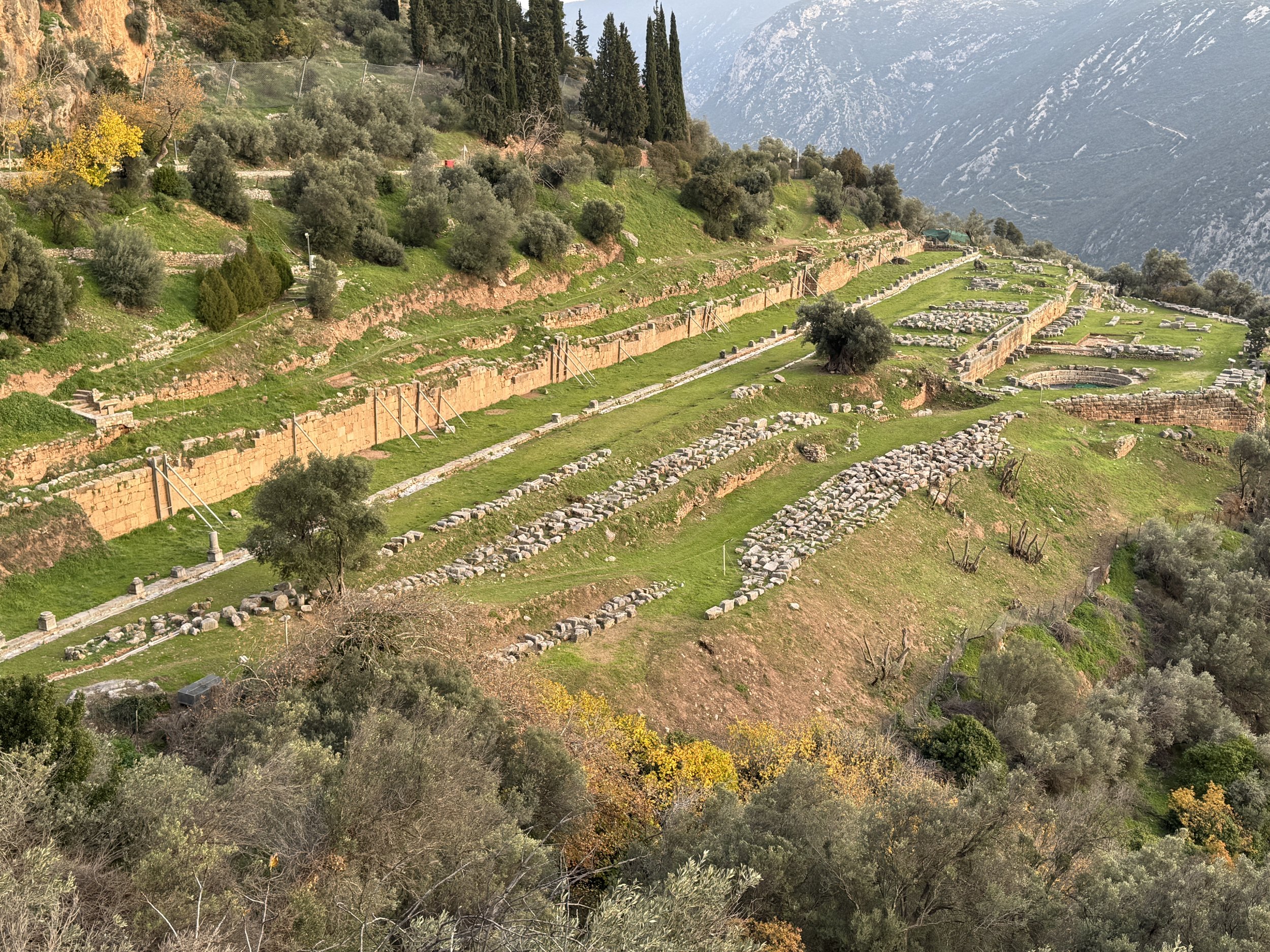
Passing the Ruins of Ancient Delphi
On the way into town we passed several famous archaeological sites:
The Temple of Apollo
The Temple of Apollo at Delphi
(Ναός του Απόλλωνα) was the most important religious site in ancient Greece and the home of the Oracle of Delphi.
Here, the priestess Pythia delivered Apollo’s prophecies, guiding the decisions of city-states and rulers across the Greek world.
Originally built in the 7th century BCE and rebuilt multiple times after natural disasters, the temple symbolized Delphi as the spiritual center of Greece.
The Athenian Treasury
The Athenian Treasury at Delphi
(Θησαυρός των Αθηναίων) was built around 490 BCE by Athens to commemorate its victory over the Persians at the Battle of Marathon.
Located along the Sacred Way, it served as a place to display votive offerings dedicated to Apollo and symbolized Athenian wealth and growing political power.
The Delphi Flag Gallery
The Delphi Flag Gallery is a modern installation within the archaeological site displaying the flags of countries that have participated in international events, excavations, and cultural programs at Delphi.
There are several other sites around town, but we decided to check into the hotel and grab dinner.
Checking Into Kastalia Boutique Hotel
Our hotel was Kastalia Boutique Hotel.
This stay came with a bit of disappointment.
I’m almost positive the hotel advertised parking, but it turned out to be first-come, first-served street parking, which we luckily managed to find.
We were also excited to eat at their restaurant, but when we arrived we were told it was closed because they “needed a break.”
I’m guessing the slow season had something to do with it.
The check-in process itself was easy, and the room was spacious. The bed was the best one we’ve had so far, and the bathroom had more space than the tiny European ones we had gotten used to.
Sunset Dinner with Mountain Views
For dinner we walked next door to PHIVOS Restaurant.
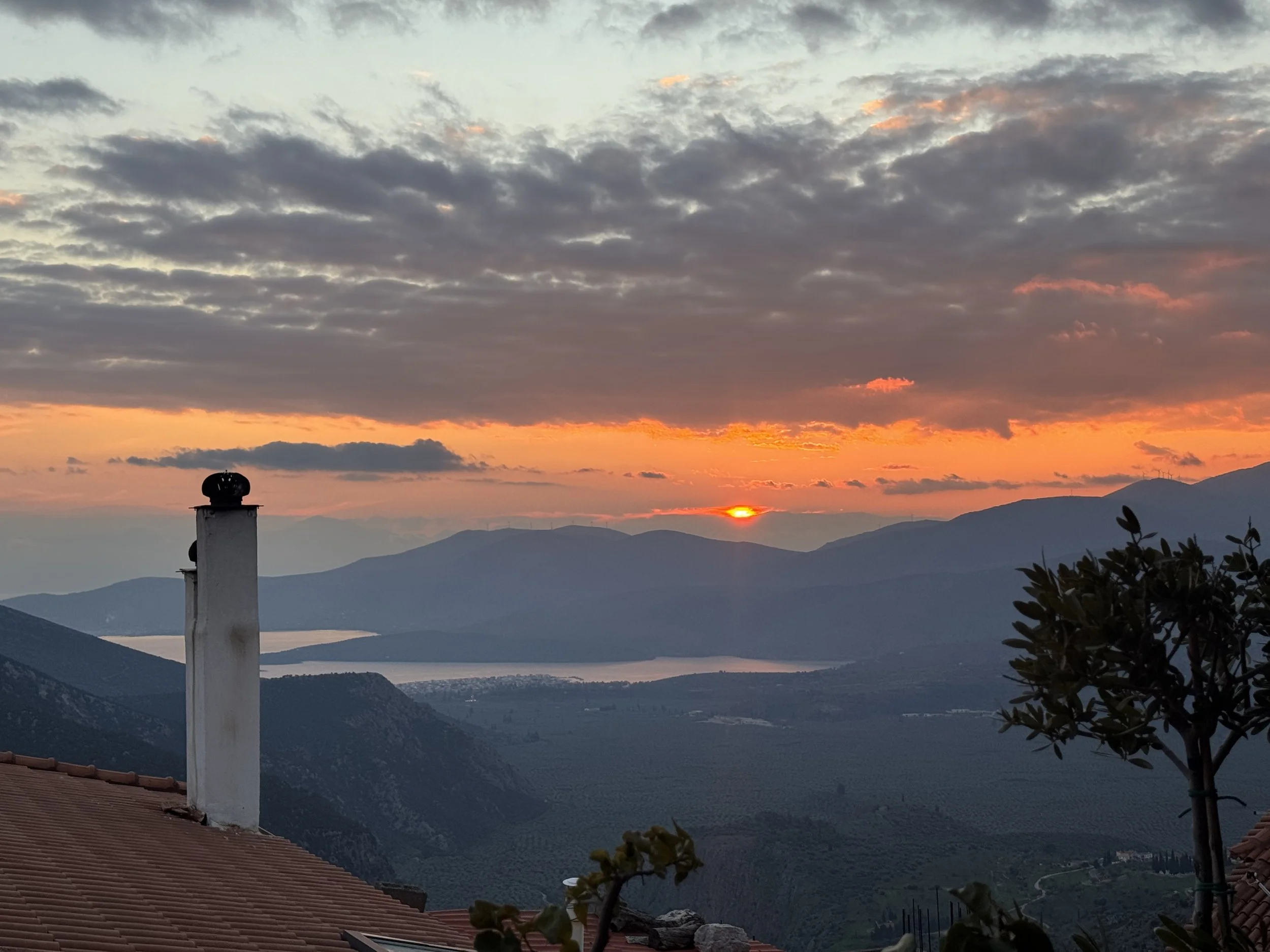
We sat outside on the patio and enjoyed an awesome sunset over the mountains.
I was excited because they had Pastitsio on the menu, but unfortunately they weren’t serving it that night.
The waitress recommended the roasted lamb, and I also tried the Formaela cheese appetizer.
Everything was just okay. The restaurant itself was beautiful and the service was impeccable, but I probably shouldn’t have pivoted so far from what I originally wanted.
They also provided a complimentary Greek yogurt with homemade orange jam. It was interesting, but I’m just not much of a fruit-for-dessert kind of person.
The Best Bakery Stop Yet
Luckily, ROUSSOS Bakery was literally across the street, and it ended up being the best bakery we’ve seen in Greece for desserts.
We picked up a few treats:
Amygdalota in several flavors
Chocolate pie
The chocolate pie appeared to be a chocolate cake soaked in syrup and topped with frosting and sprinkles, and it was fantastic.
I plan to enjoy the amygdalota later.
A Cooler Night in Delphi
Afterward we wandered back to the hotel.
One thing we immediately noticed is that Delphi is definitely cooler than the other places we’ve visited so far.
We turned in for the night after a long day of driving, history, and mountain views.
December 14: Thermopylae and Meteora
A Relaxed Morning and Surprisingly Good Hotel Breakfast
We had a leisure-ish morning. The hotel offered a free continental breakfast, but it didn’t start until 7:30 a.m., so we headed down right when it opened.
The spread included pastries, eggs, bacon, feta phyllo sandwiches, cold cuts, cheese, juice, tea, and coffee. It was pretty good for being free and honestly puts U.S. continental breakfasts to shame.
After breakfast we walked to the car and headed out.
The Hot Gates of Thermopylae
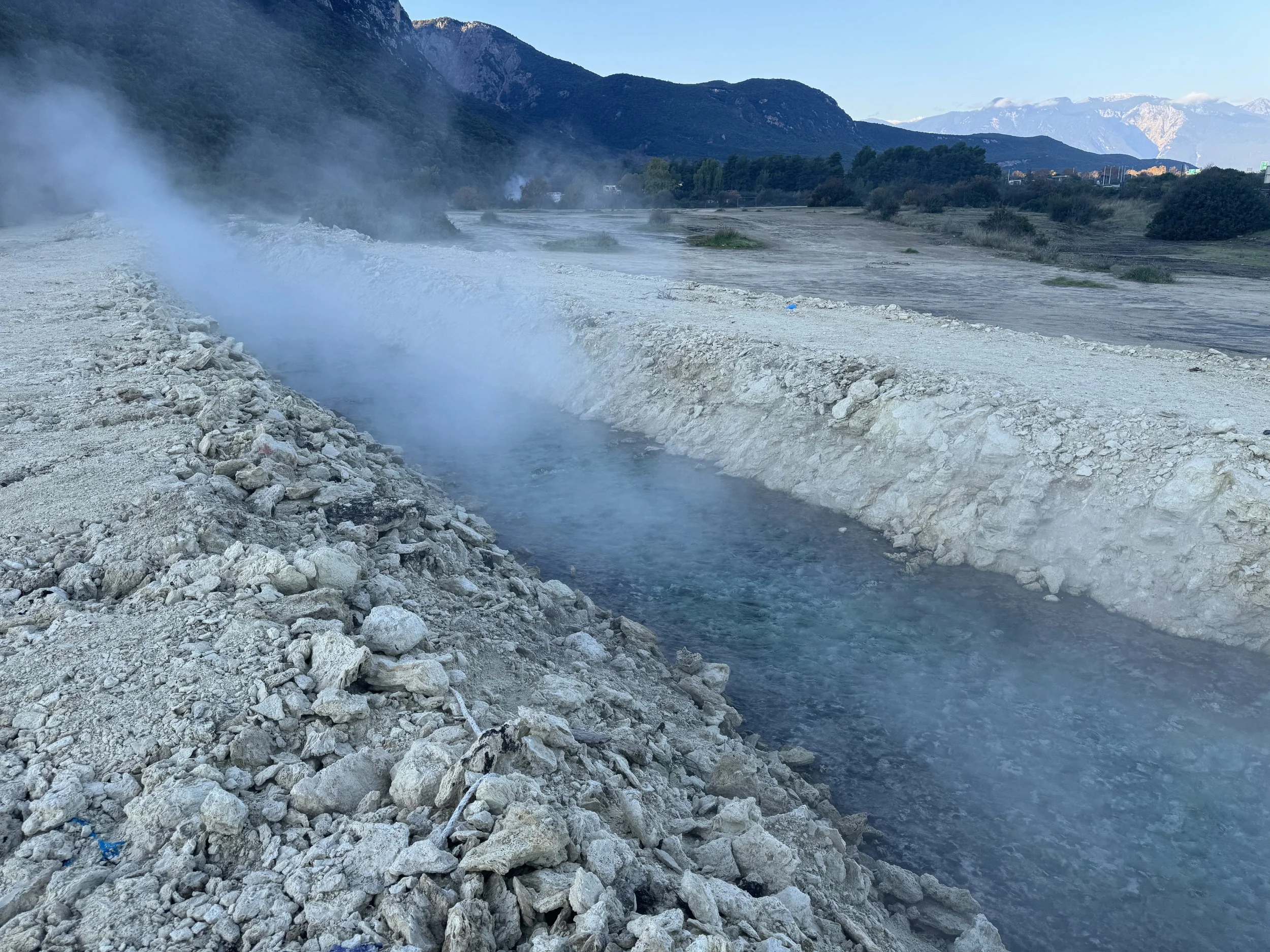
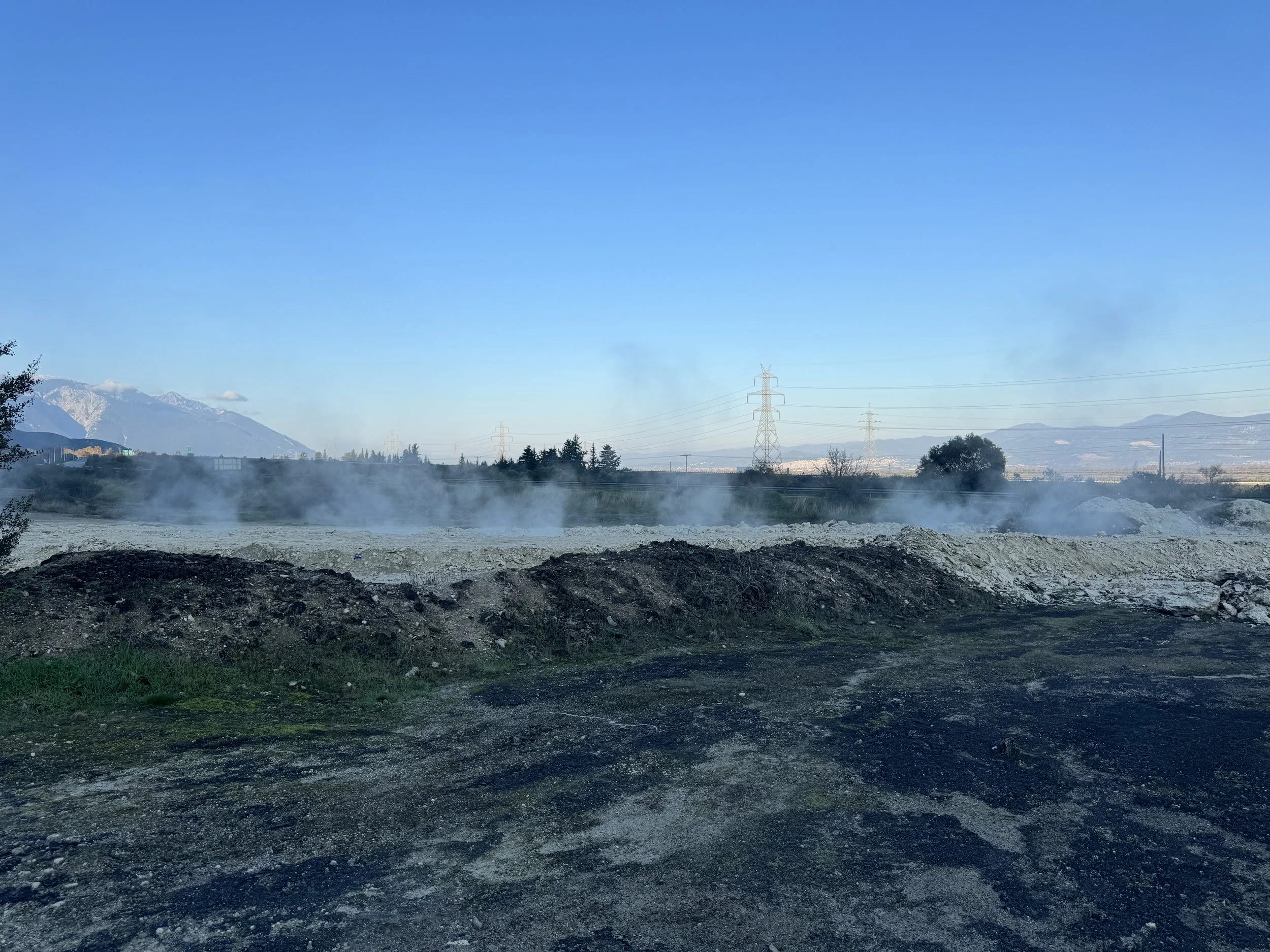
Our first stop was the Baths of Thermopylae, natural sulfur hot springs that have been flowing since antiquity.
The springs were known to the ancient Greeks for their healing properties and were associated with Hephaestus, the god of fire and metalworking. These springs gave Thermopylae its name, meaning “Hot Gates,” and they were flowing during the time of King Leonidas and the Battle of Thermopylae in 480 BCE.
Just across the road is Kolonos Hill (Λόφος Κολωνός).
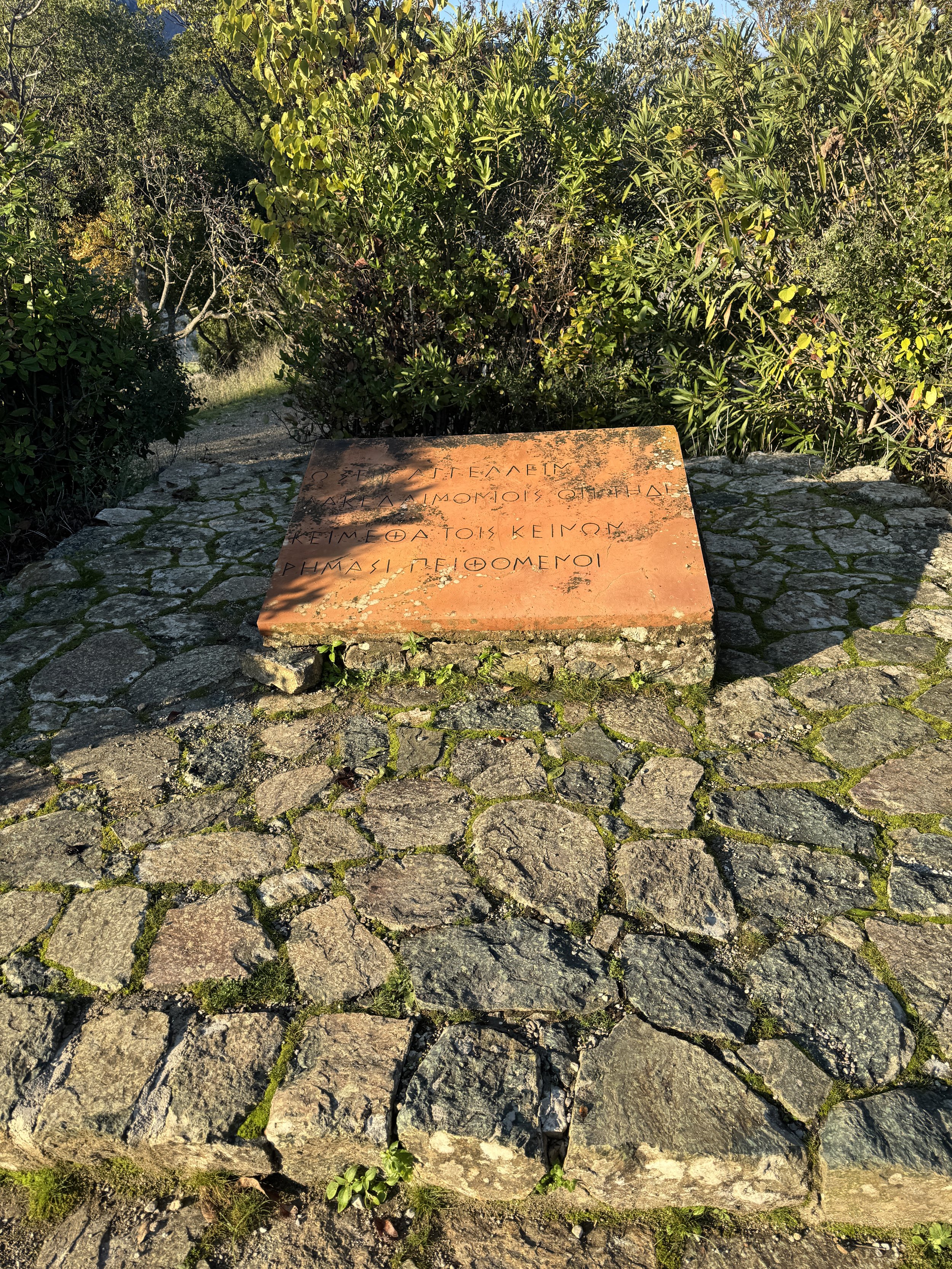
This is considered the actual last-stand site of King Leonidas and the 300 Spartans in 480 BCE. When the Persians outflanked the Greek forces, Leonidas dismissed most of the allied troops and made his final stand on this small hill.
The plaque marks the location where the Spartans were overwhelmed and killed, and where their bodies were later buried. In antiquity, a stone lion monument stood here to honor Leonidas (the original fragments are now preserved in a museum).
Today, Kolonos Hill is considered the most sacred and historically accurate location at Thermopylae.
The Leonidas Monument and Thermopylae Museum
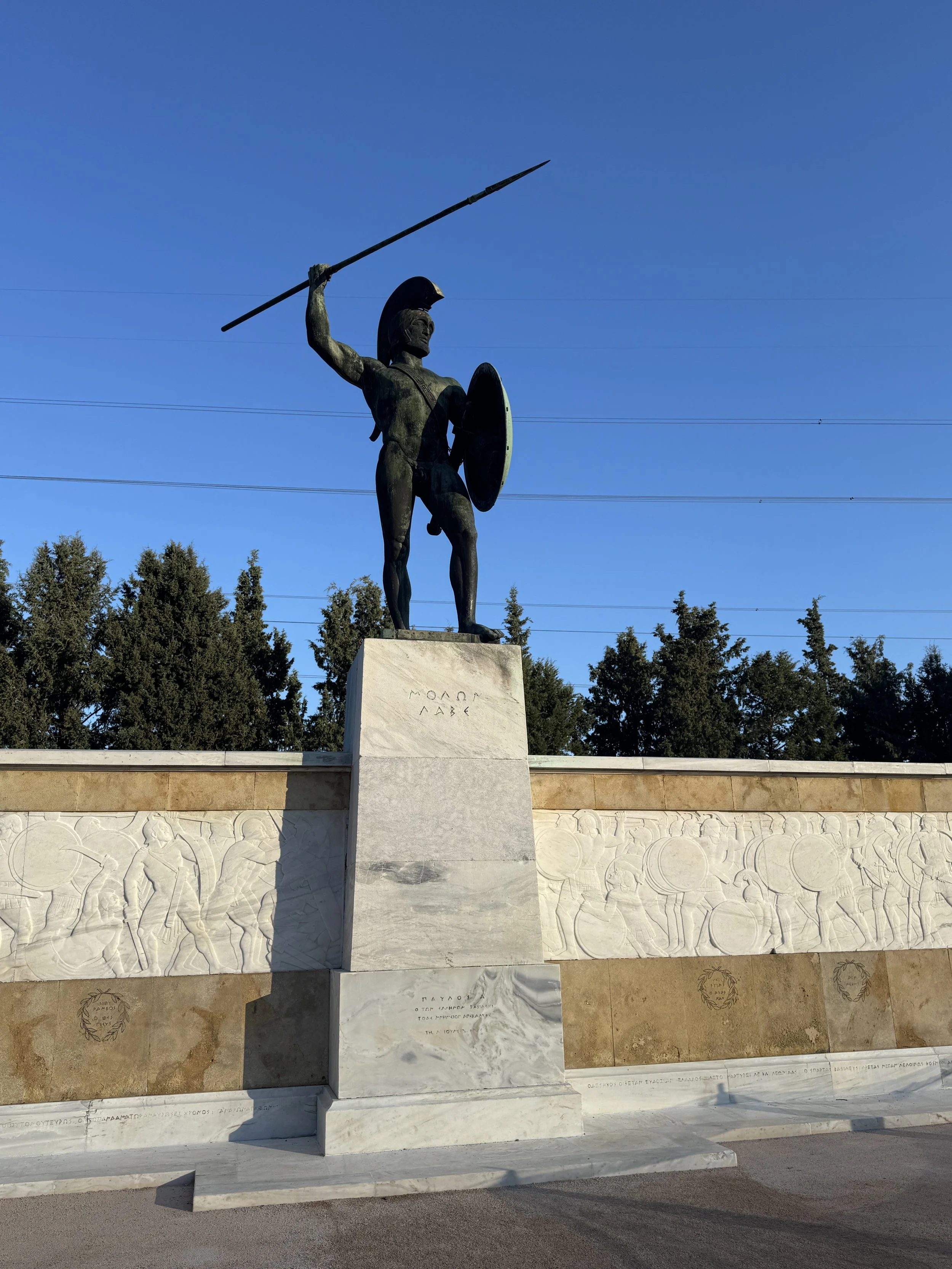
Across the street sits the Memorial to Leonidas and the 300 Spartans, a modern monument near the battlefield honoring the Spartan king and his warriors.
The statue depicts Leonidas in full armor, symbolizing sacrifice and resistance. Nearby inscriptions commemorate the Spartan stand, including the famous epitaph reminding passersby that the soldiers died in obedience to their laws.
Unfortunately, the monument was under construction during our visit, so there was construction tape around parts of it.
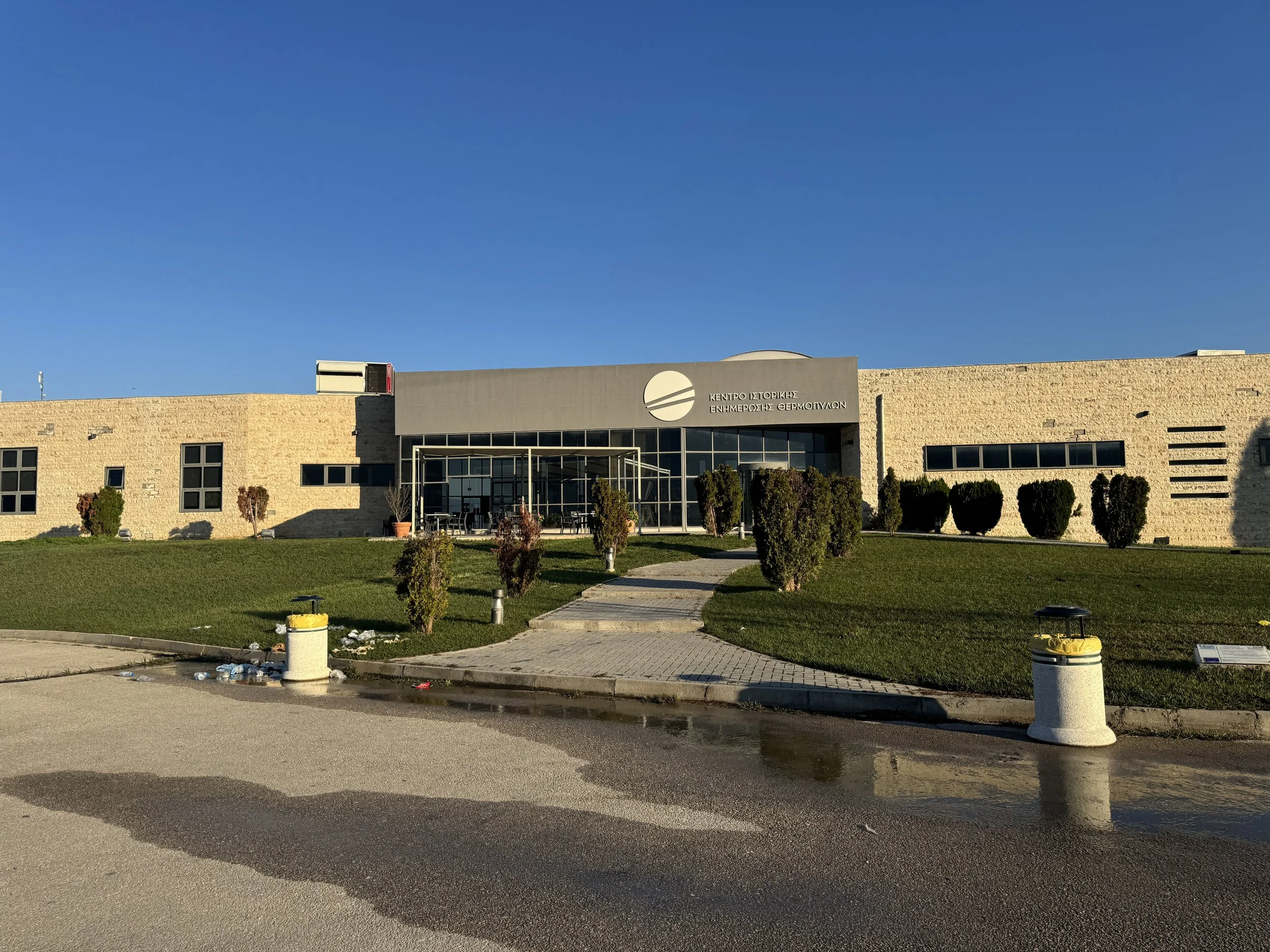
Right next to the memorial is the Historical Information Center for Thermopylae, a modern interactive museum that explains the battle using short films and exhibits.
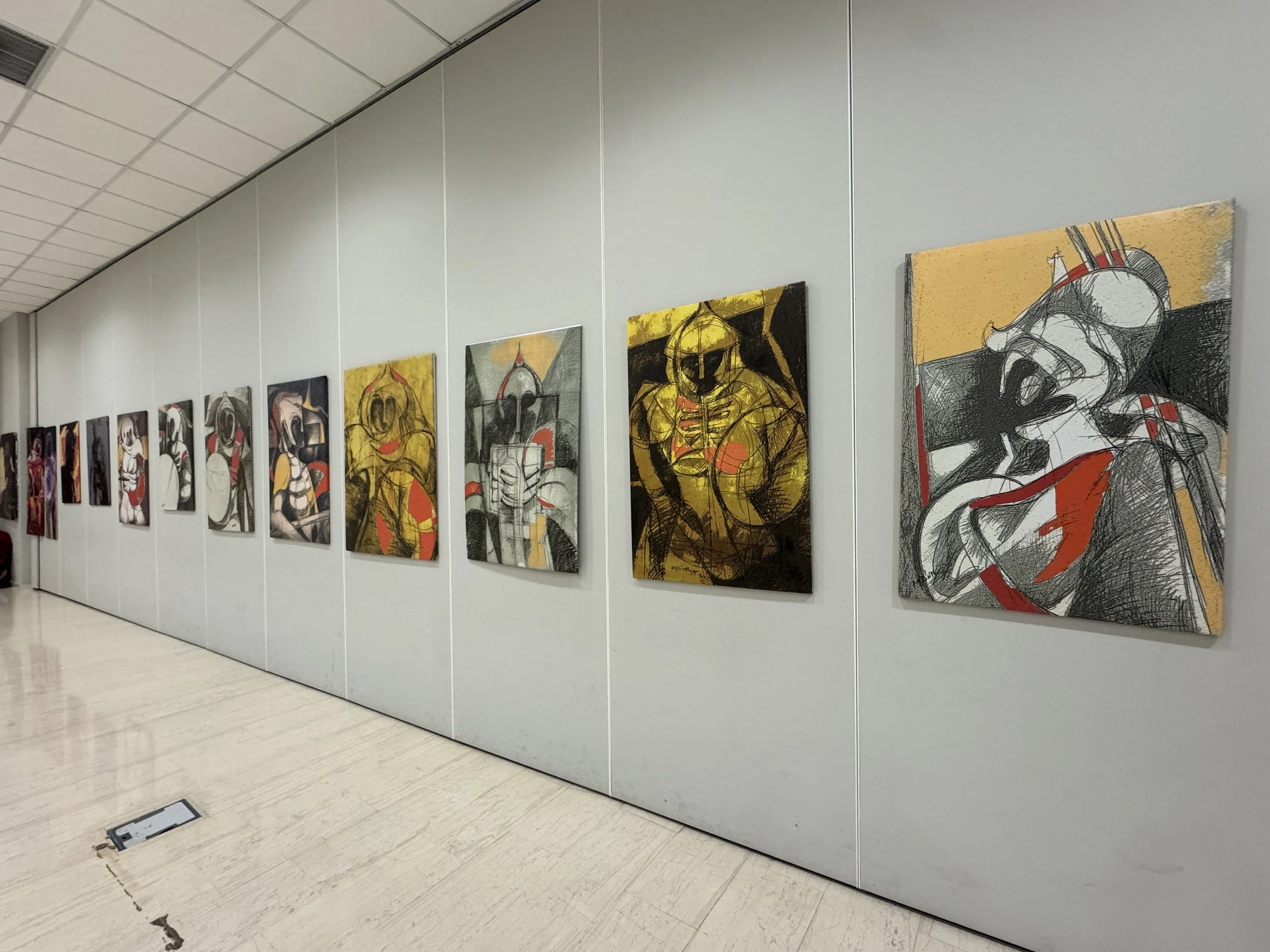
The museum provides context about troop movements, the ancient landscape, and the role of Leonidas and the Greek allies. It also has a large parking lot, shop, café, restrooms, and a free art display.
The short film costs €3, but we skipped it since we were on a tight schedule.
A Peaceful Mountain Monastery
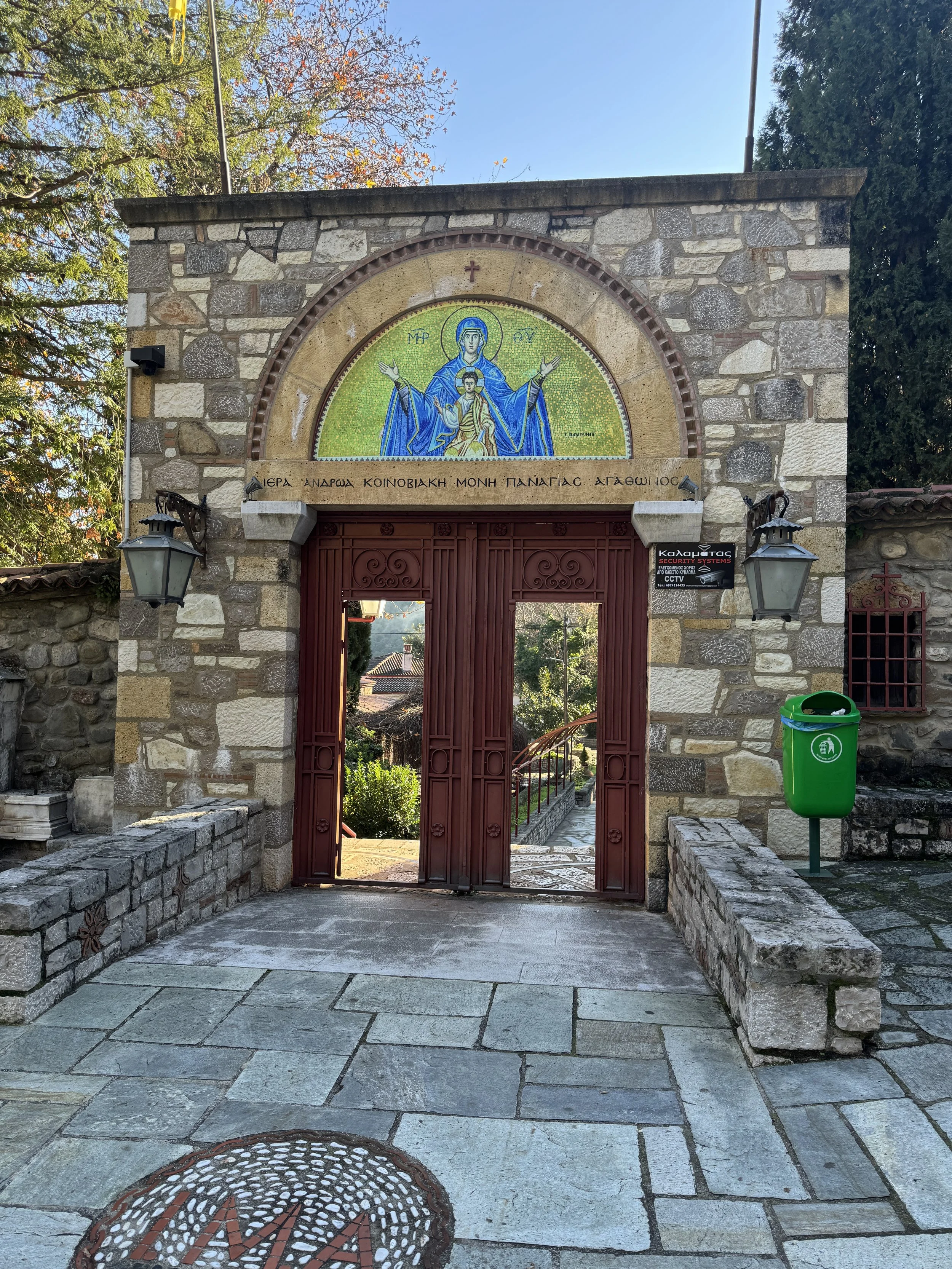
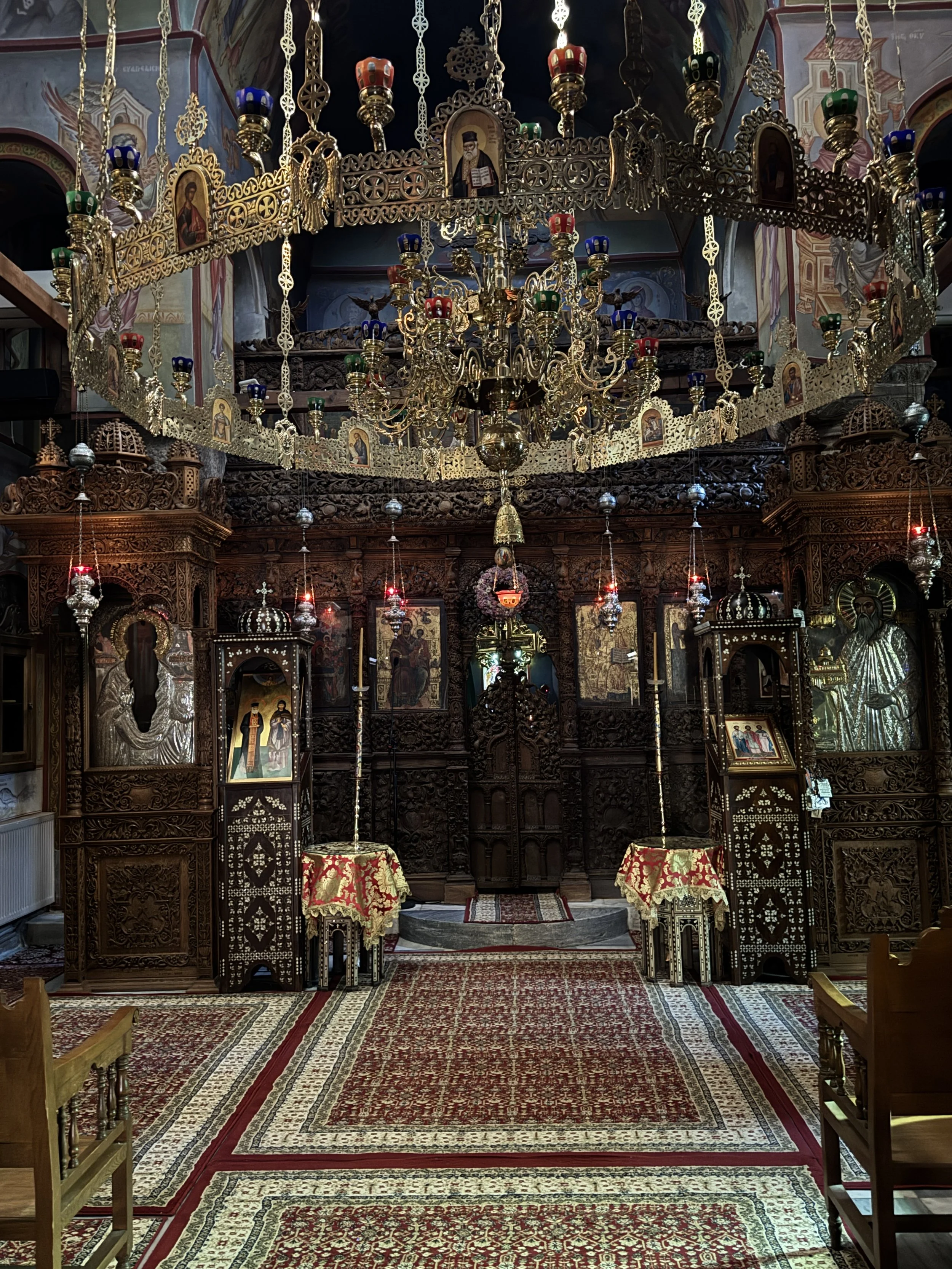
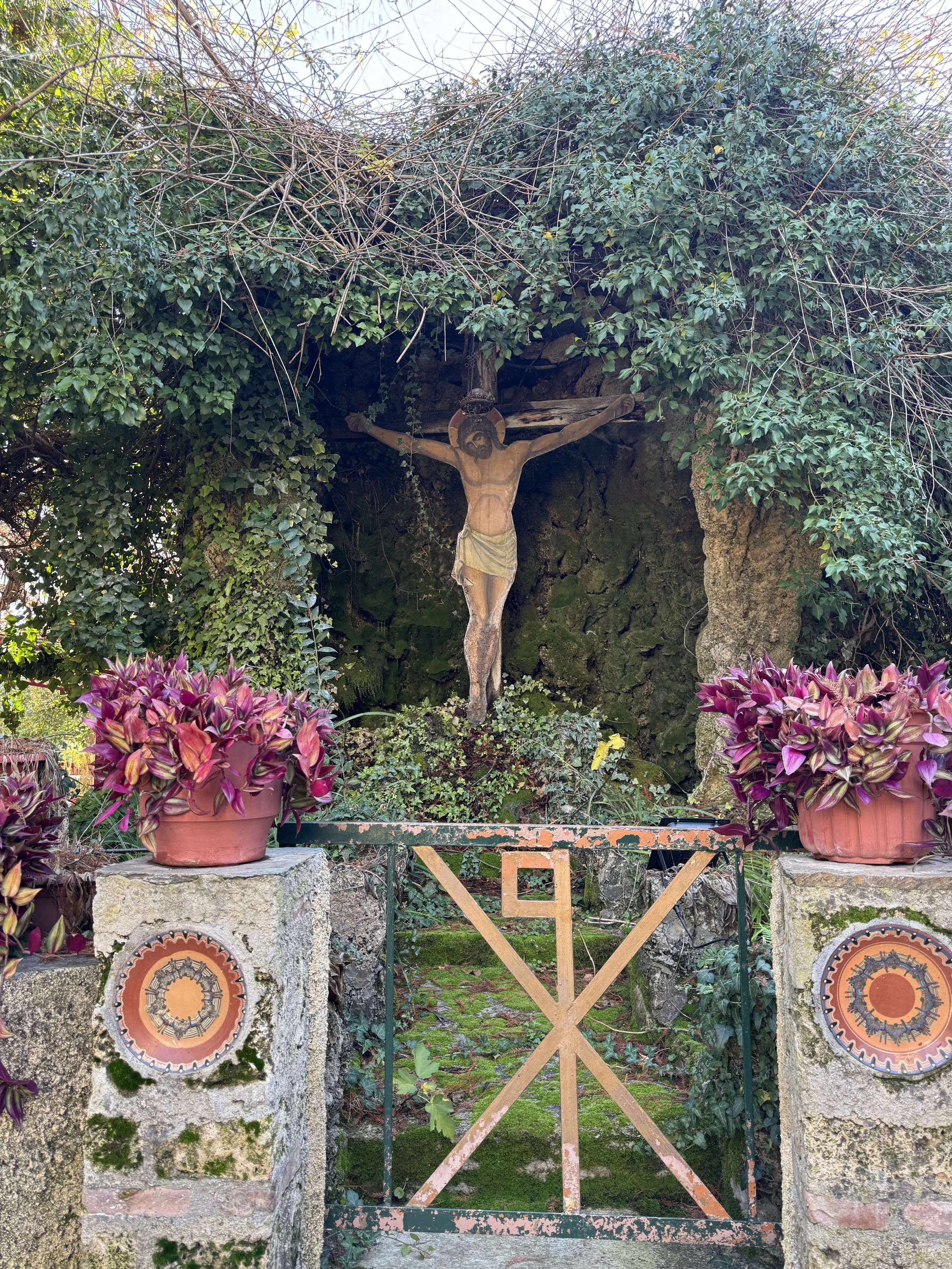
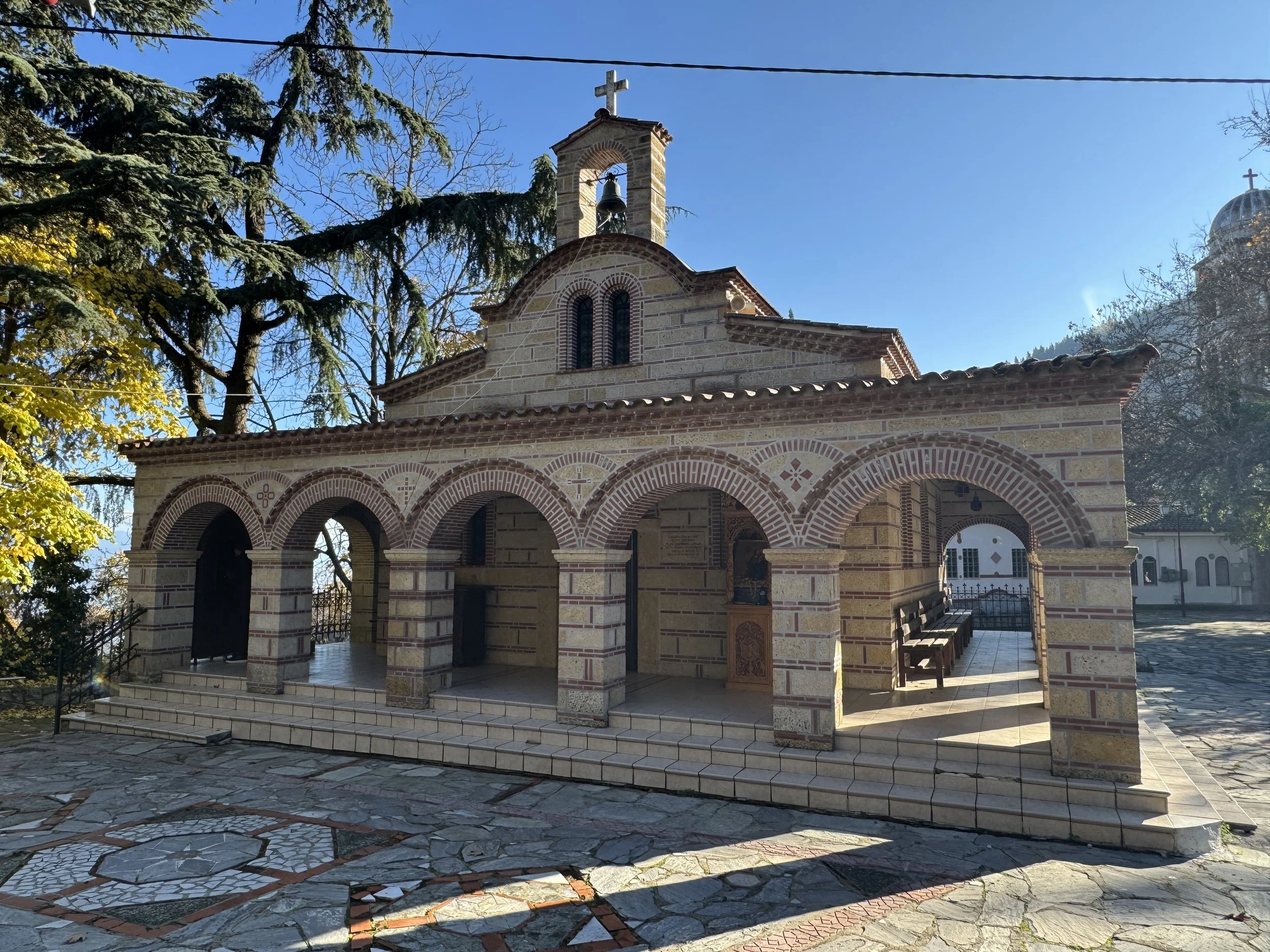
Next we drove to the Monastery of Agathon, a historic Orthodox monastery founded in the 15th century on the slopes of Mount Oiti.
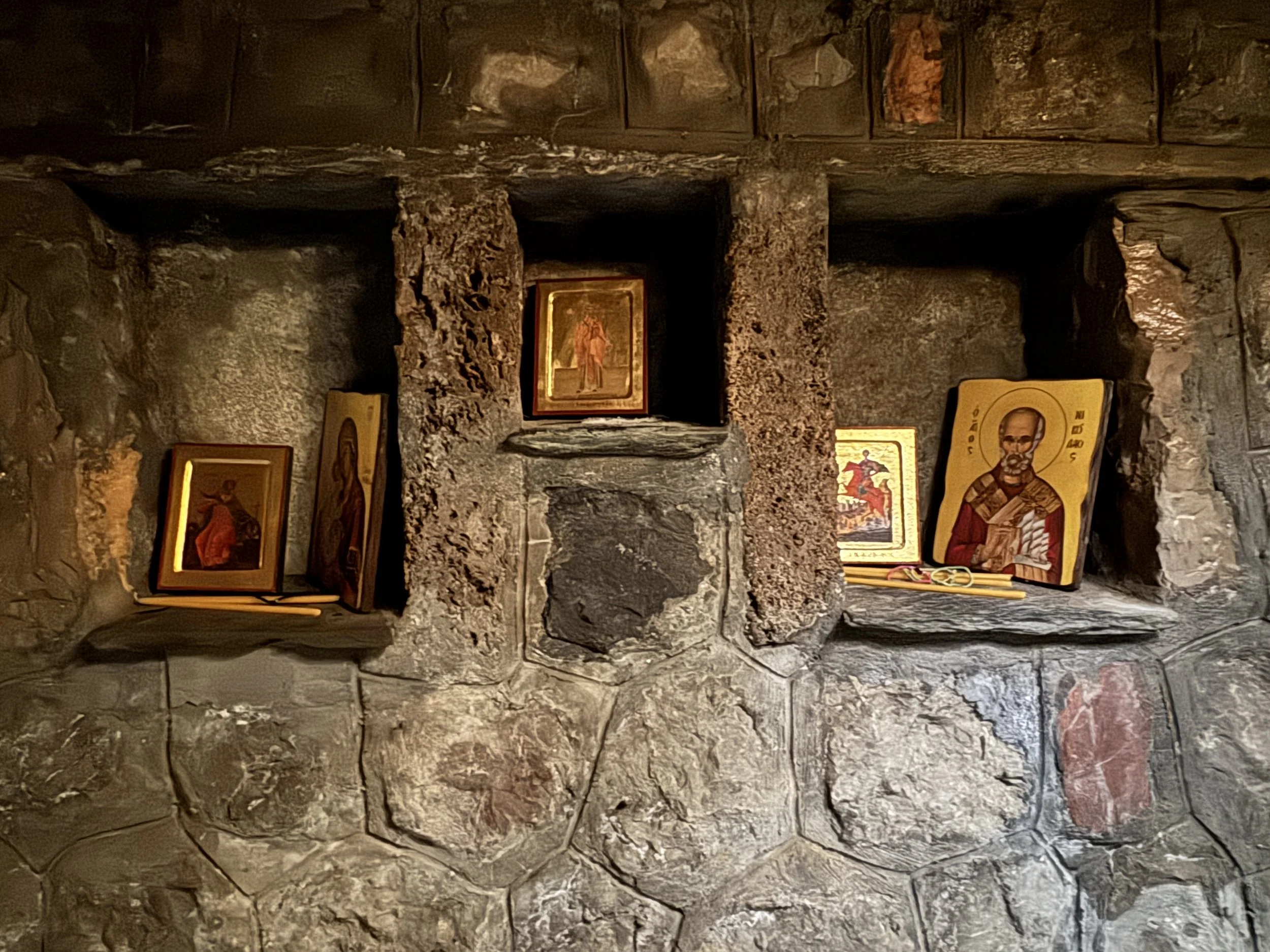
The monastery served as a refuge and resistance center during Ottoman rule and the Greek War of Independence. It is dedicated to Saint Agathon and houses religious relics along with a small museum.
The setting was beautiful and peaceful, with panoramic mountain views.
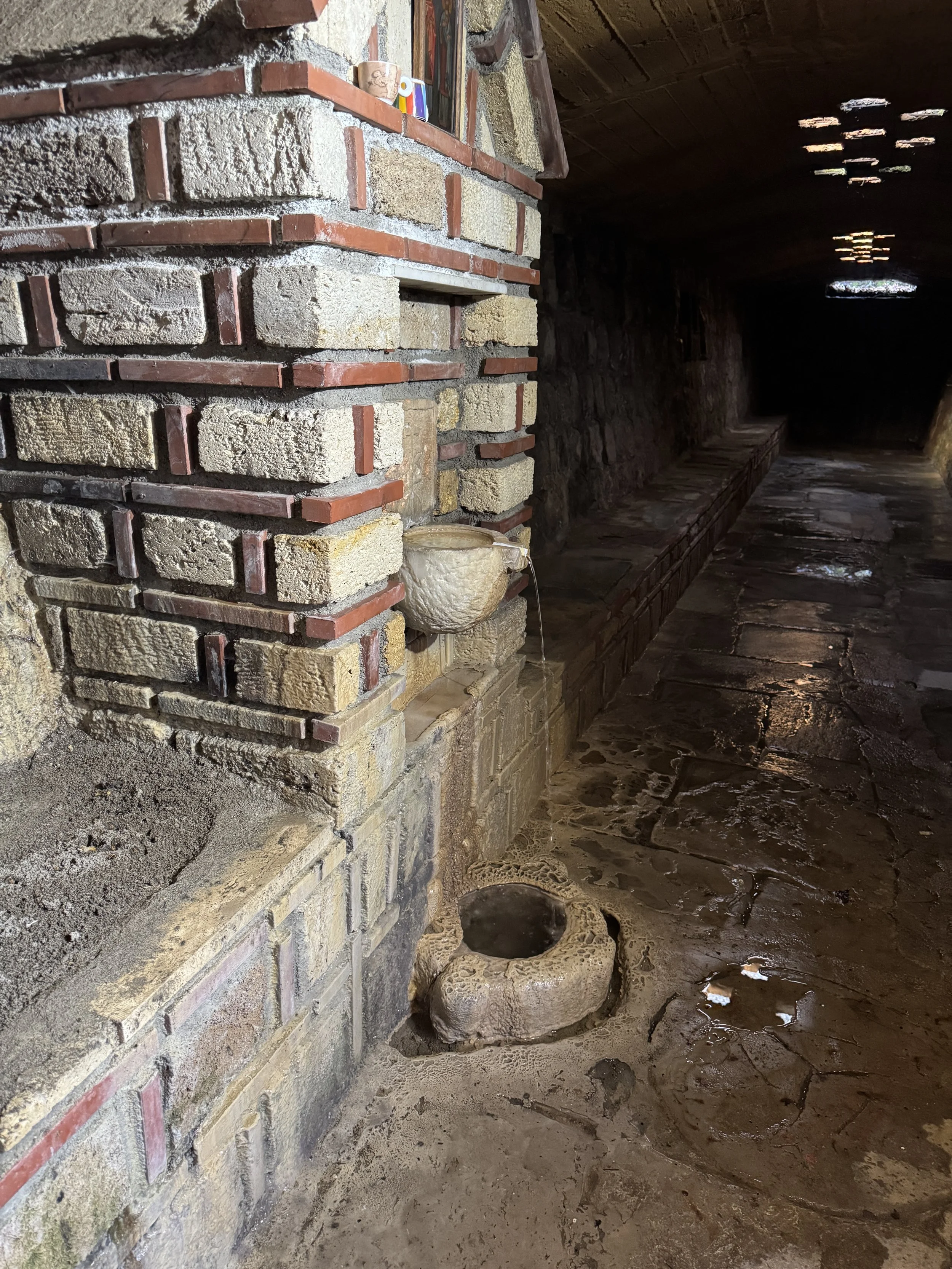
There was free street parking, and the complex included:
a church
a crypt-like underground space containing religious relics
panoramic viewpoints
unique monastery architecture
It was a really serene stop.
Exploring the Historic City of Trikala
Next we headed to Trikala, an ancient city inhabited since antiquity.
In classical times it was known as Trikka and traditionally associated with Asclepius, the Greek god of medicine. Later it became an important Byzantine and Ottoman center, with a hilltop castle overlooking the city.
Today, Trikala blends deep history with a lively modern town atmosphere.
We discovered that parking is free on Sundays, which was a nice bonus.
While driving around we spotted several interesting churches and mosques, so we pulled over, parked, and walked across a bridge over the Lithaios River.
Ottoman and Orthodox Landmarks
Our first stop was the Koursoum Mosque (Osman Shah Mosque).
Built between 1557–1558 by the famous Ottoman architect Mimar Sinan, it was commissioned by Osman Shah, a nephew of Sultan Suleiman the Magnificent.
Its name, Koursoum, means “leaded,” referring to the mosque’s once lead-covered dome. Today it remains one of the best-preserved Ottoman monuments in Greece and stands as a reminder of Trikala’s Ottoman past.
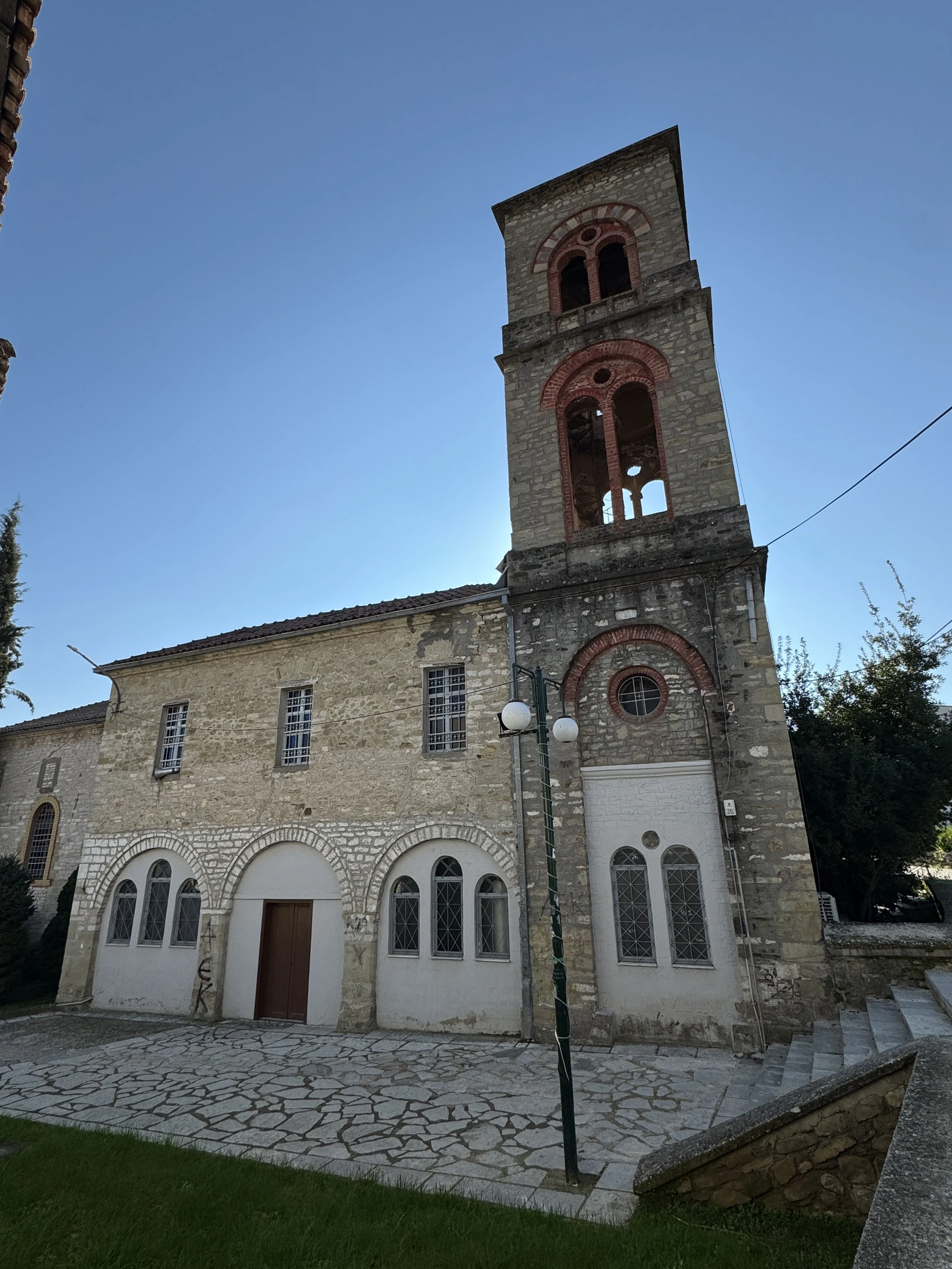
Right next door sits the Church of Saint Constantine and Helen (Ιερός Ναός Αγίων Κωνσταντίνου και Ελένης).
This 19th-century Orthodox church is dedicated to Saint Constantine the Great and Saint Helen, two figures central to the Christianization of the Roman Empire. The church represents Trikala’s revival of Orthodox worship after Ottoman rule.
In the middle of a nearby traffic circle we also spotted an incredible mural, which added a splash of modern art to the historic surroundings.
Trikala’s Hilltop Castle
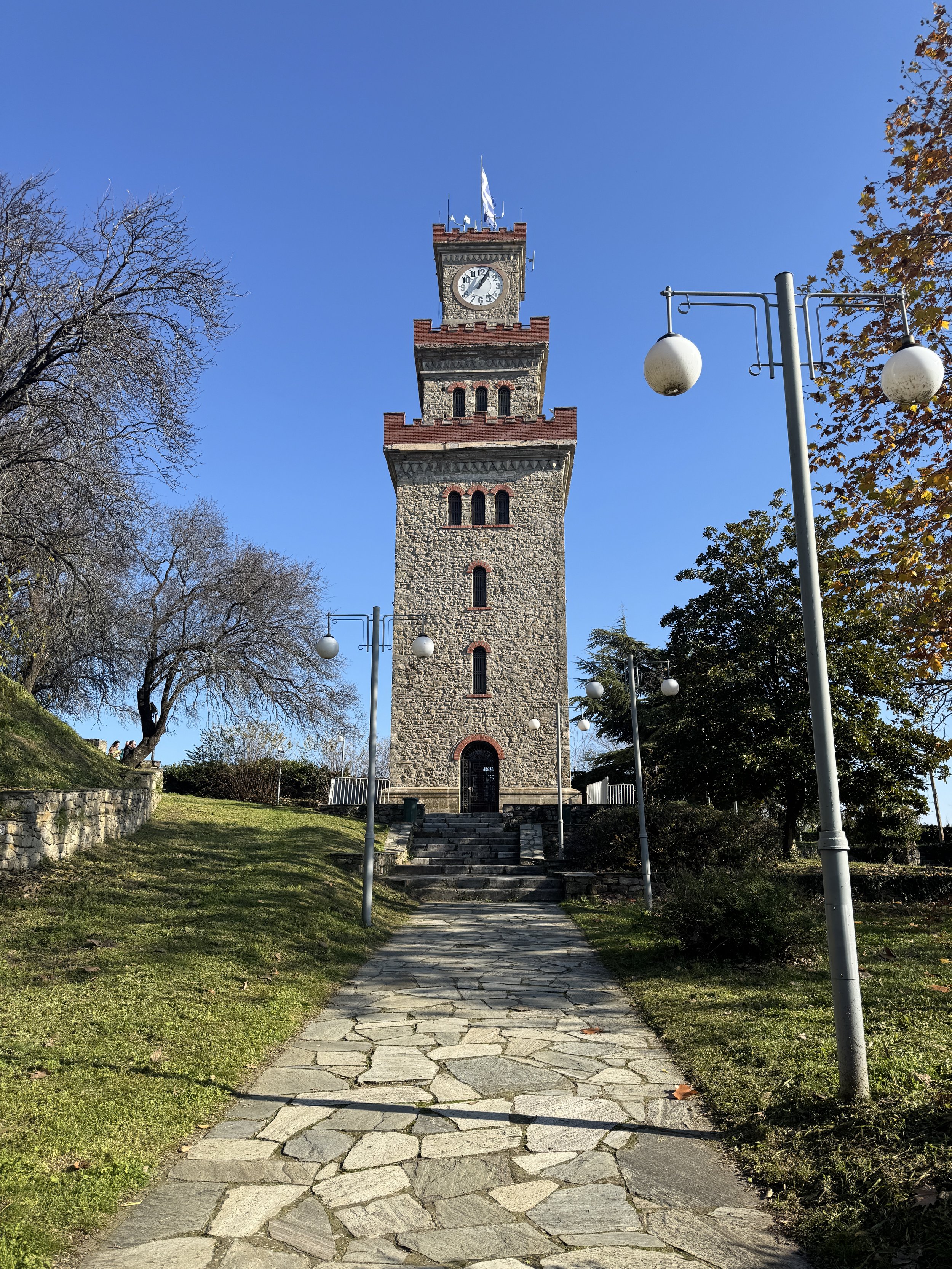
Next we drove up to the Byzantine Castle of Trikala.
Built on ancient foundations and later fortified during the Byzantine period, the castle once guarded the Thessalian plain and the city below. It was expanded under Ottoman rule and remains the city’s most prominent historic landmark.
There’s a parking lot and café near the site.
We sat down at the café but unfortunately never received service, even though a waiter clearly saw us. After waiting a bit we gave up and walked toward the castle itself.
The site mainly consists of a beautiful clock tower and surrounding ruins. You can’t actually go inside the tower, but the grounds are free to explore, which made it a worthwhile stop.
Considering Greece doesn’t have a huge number of castles, it was still fun to visit.
A Small but Historic Church
Just around the corner is the Church of the Holy Unmercenaries (Saints Anargyroi).
This Orthodox church is dedicated to Saints Cosmas and Damian, physician saints known for healing people without payment. The church reflects Trikala’s long connection to medicine and faith.
It’s not the most visually impressive church, but it’s historically meaningful and you pass some interesting ruins and abandoned buildings along the way.
Because of our schedule, we decided to skip a proper meal in Trikala and kept driving.
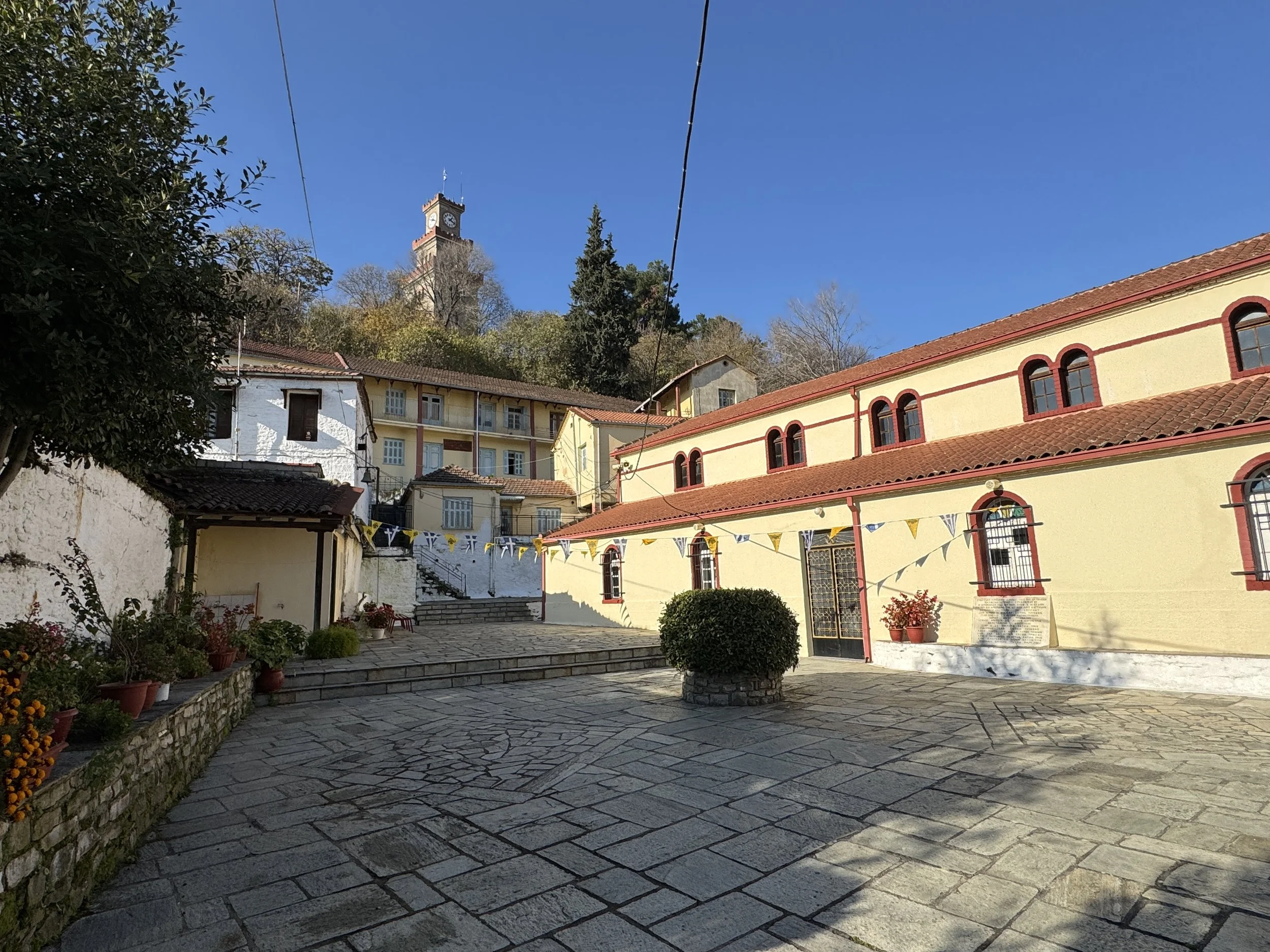
A Grandmother-Style Roadside Café
Along the way we stopped at a small roadside café called Rombo, near Vasiliki.
The place felt like it was run by someone’s grandmother cooking homemade food.
I ordered fried meatballs and potato salad, and both were wonderful. Service was quick and efficient, and it ended up being a really nice surprise stop.
Theopetra Cave: 130,000 Years of Human History
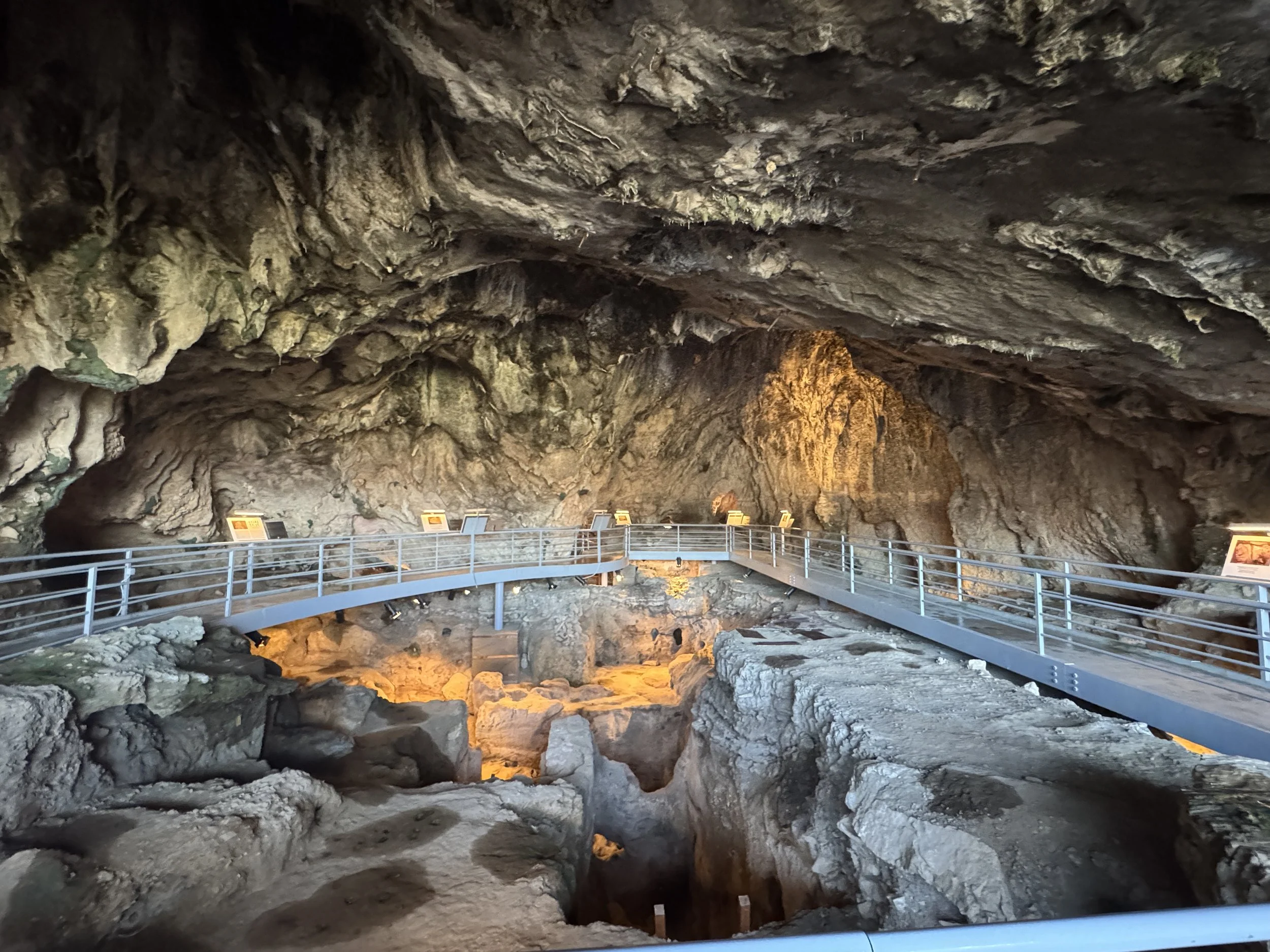
Just down the road was our next destination: Theopetra Cave.
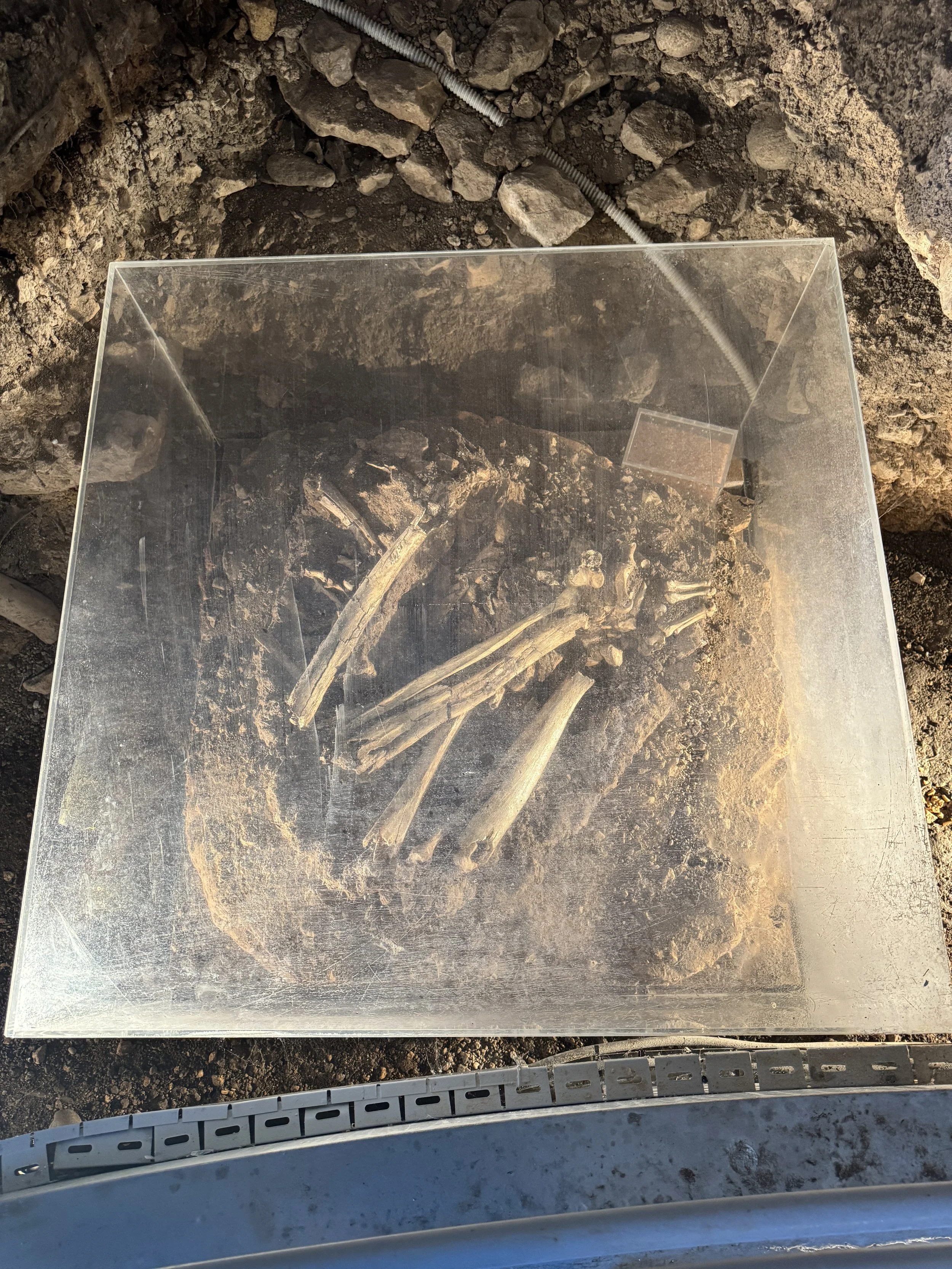
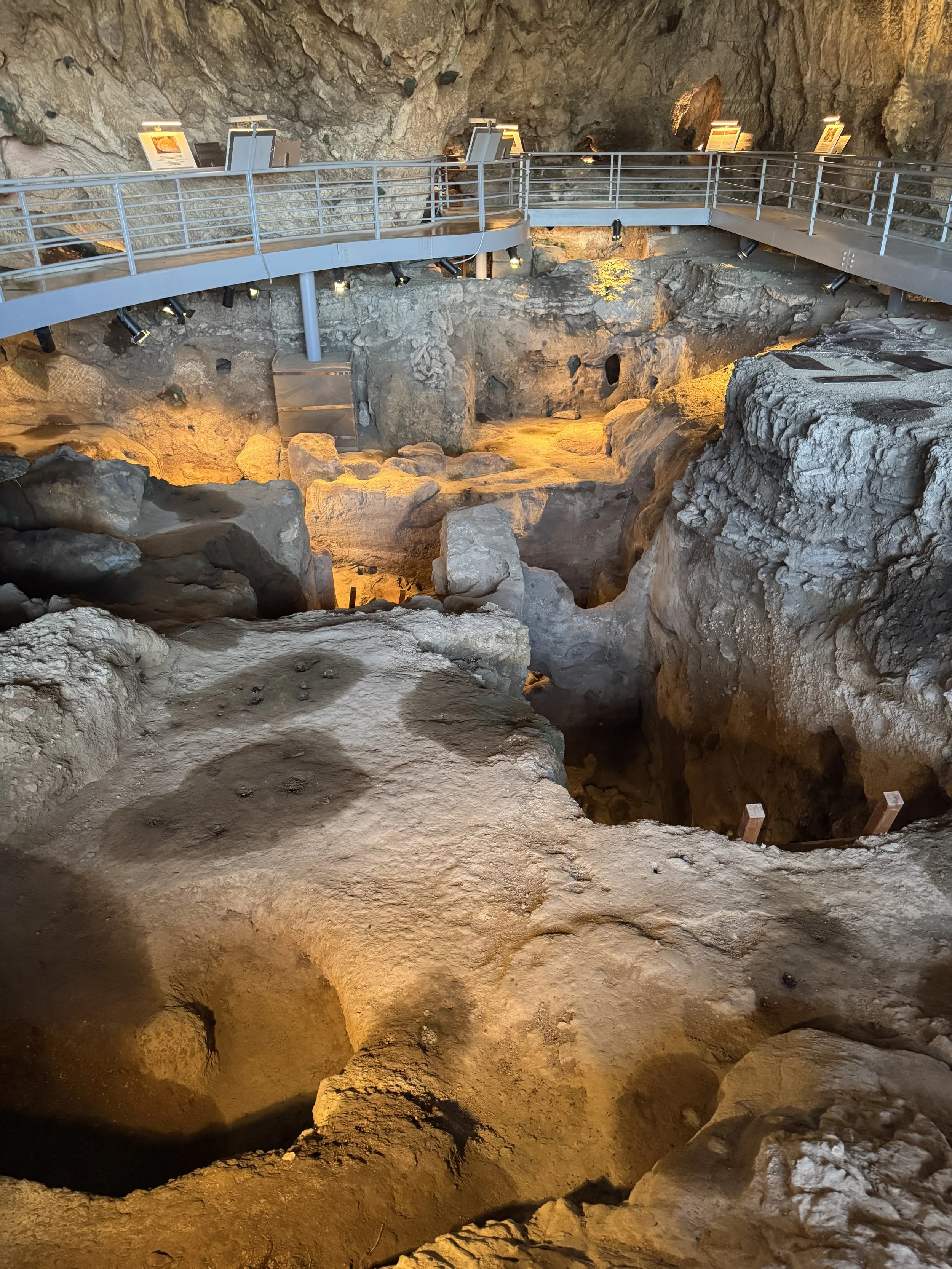
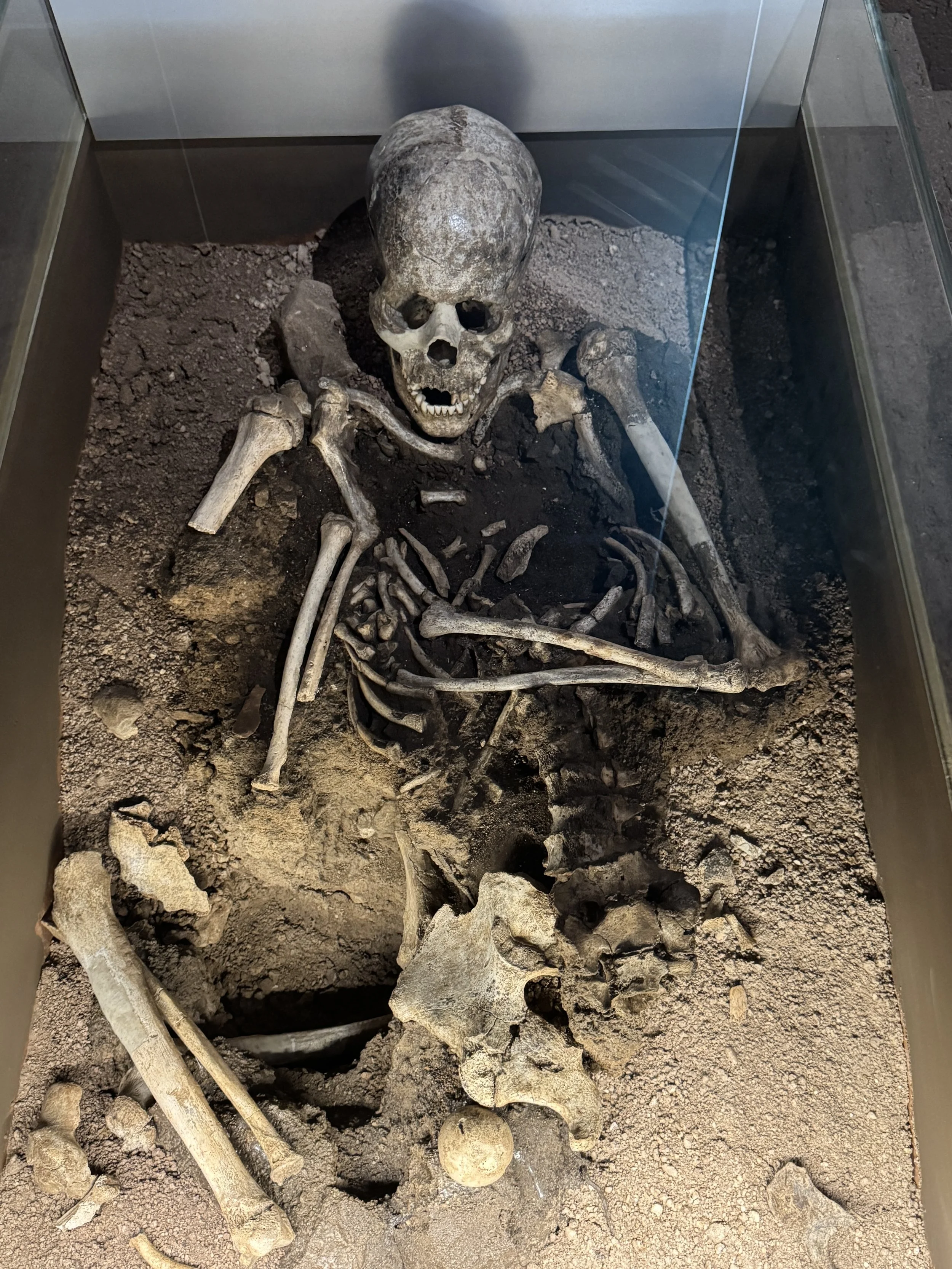
This prehistoric cave was inhabited for over 130,000 years, making it one of the oldest known human habitation sites in Europe.
Archaeological discoveries here show continuous use from Neanderthals to early modern humans. The cave also contains the world’s oldest known man-made structure, a stone wall built to block cold winds.
Admission was €5, which also includes entry to a small museum nearby.
The cave itself requires climbing a few stairs to enter, but once inside it’s easy to explore thanks to platform walkways.
It’s pretty incredible walking through a place that is so historically significant.
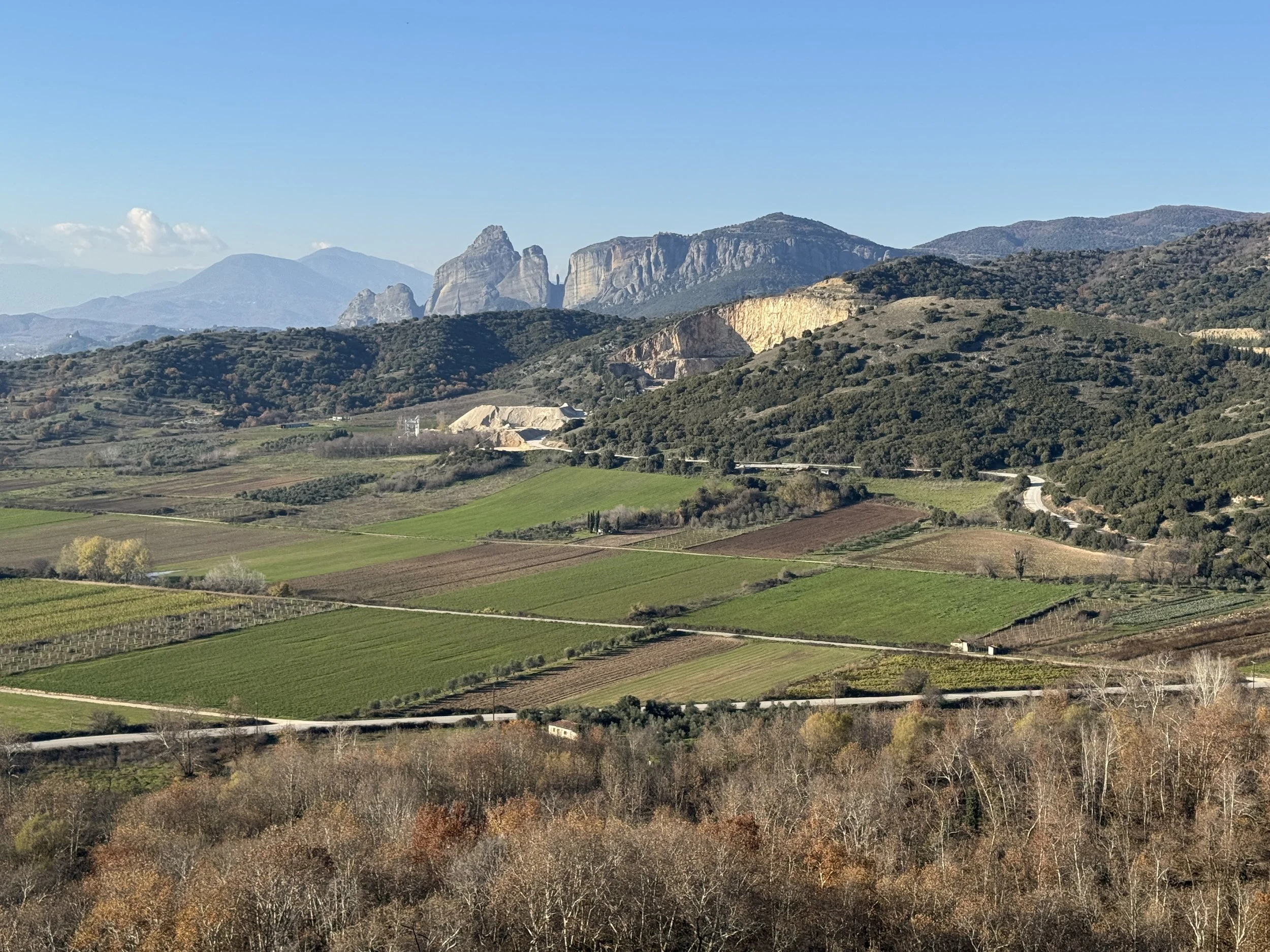
The Theopetra Museum
We then visited the Documentation and Education Centre of Theopetra Cave, located about 1–2 minutes away by car.
This small museum explains the cave’s prehistoric significance with archaeological findings, timelines, and reconstructions related to the Neanderthals and early humans who lived there.
One warning: both the cave and the museum display actual human remains discovered in burial chambers inside the cave.
The museum is small but interesting, and since it’s included with the cave ticket, it’s definitely worth stopping.
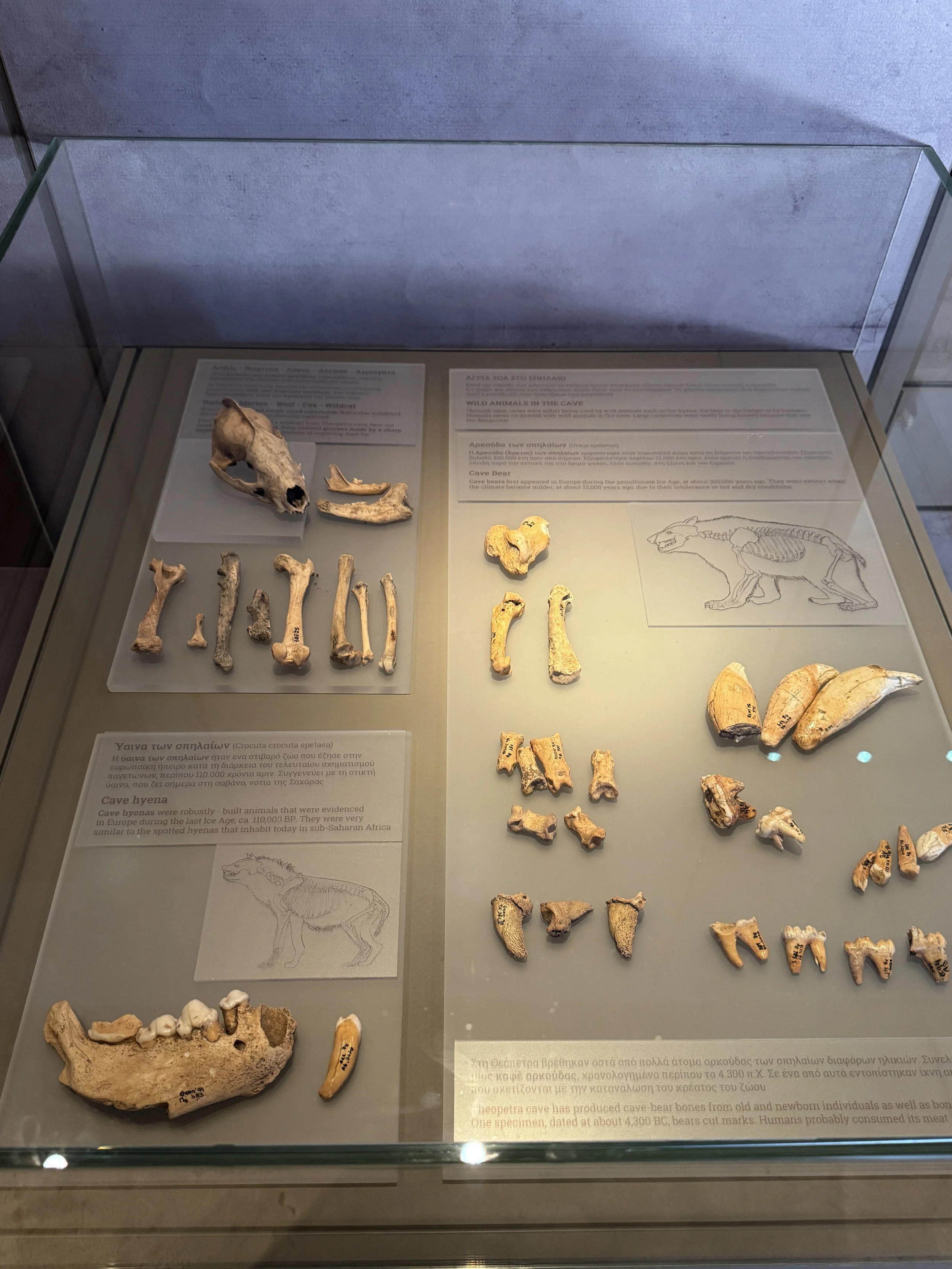
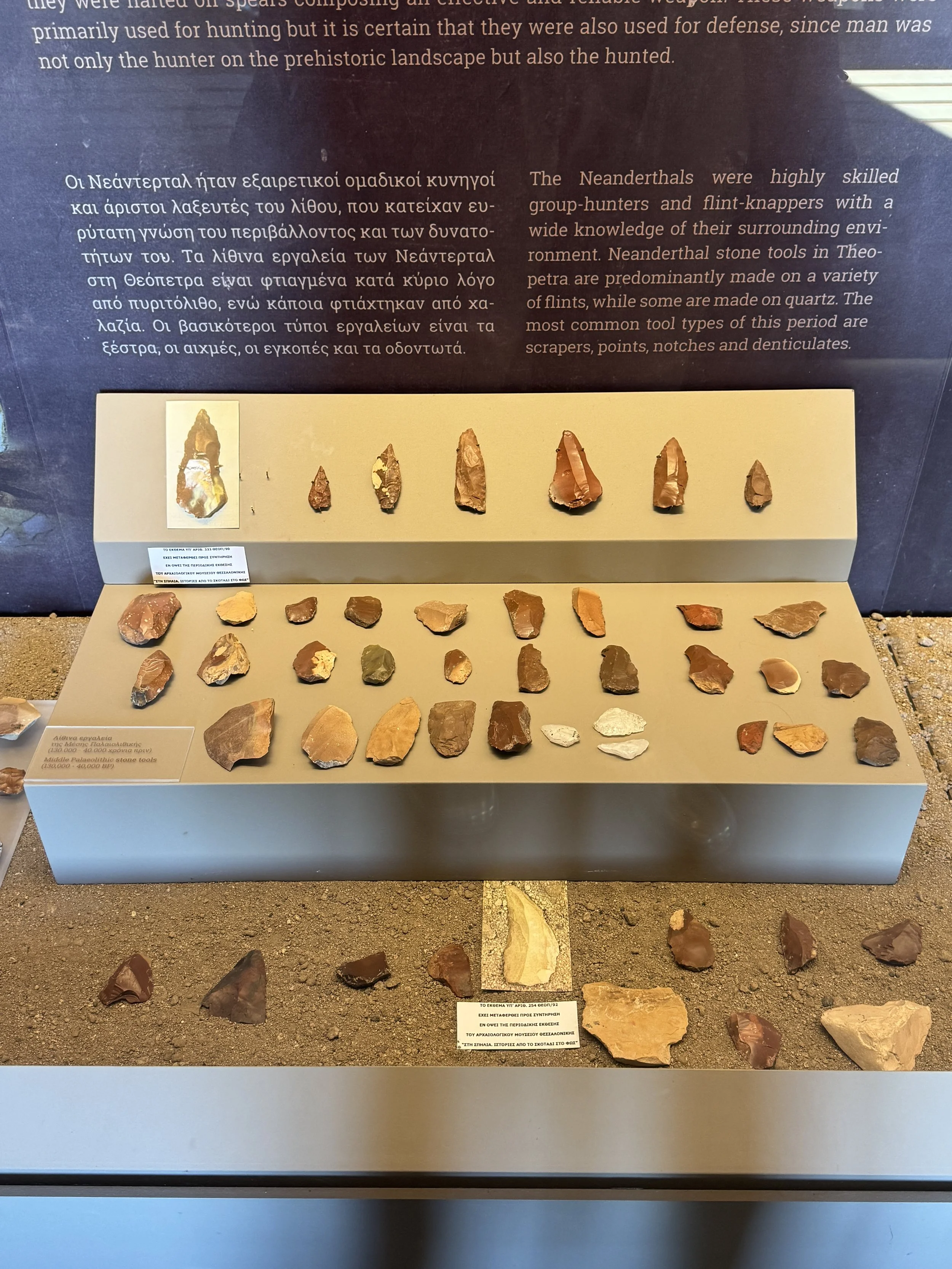
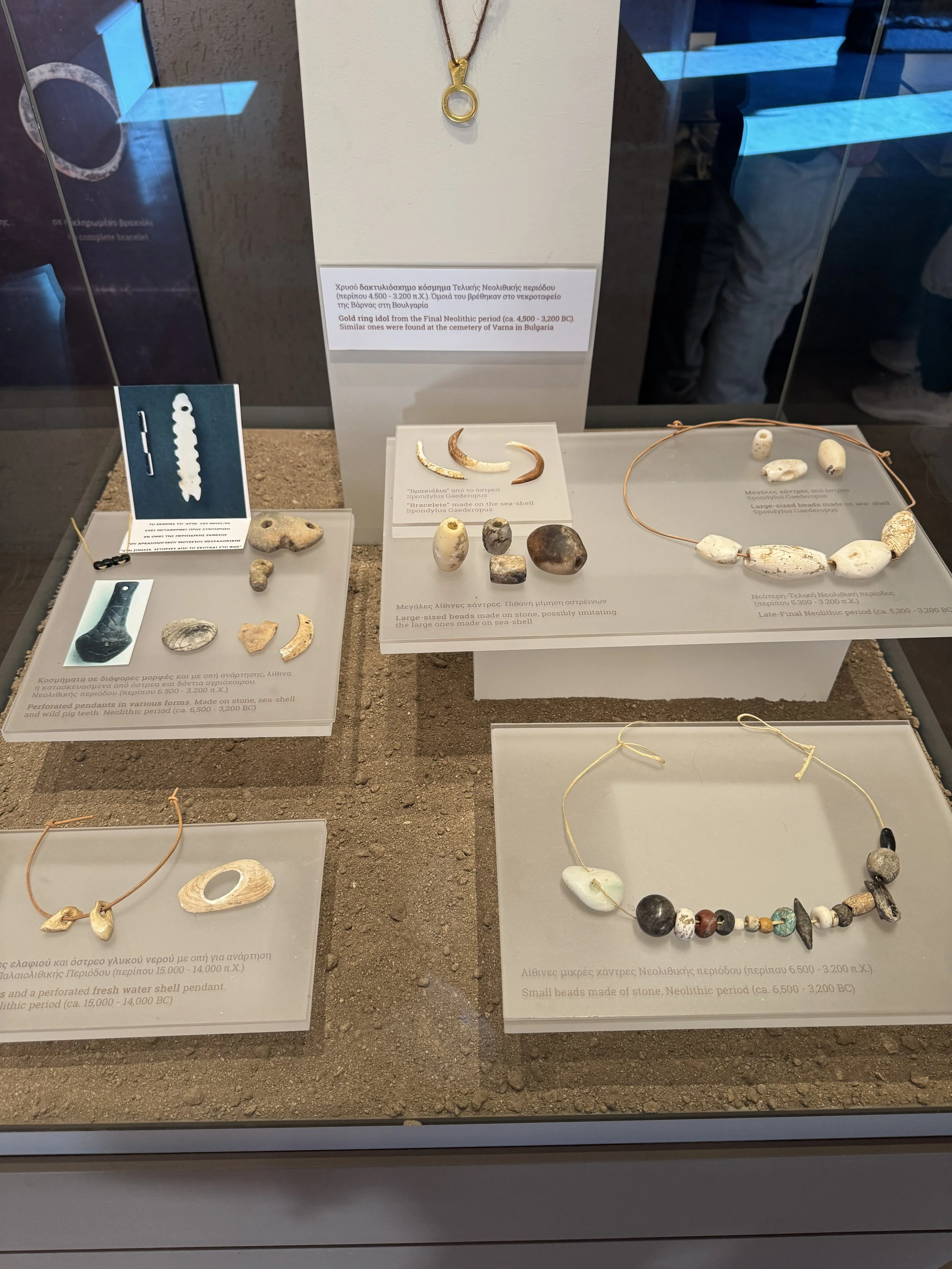
The Stunning Cliffs of Meteora
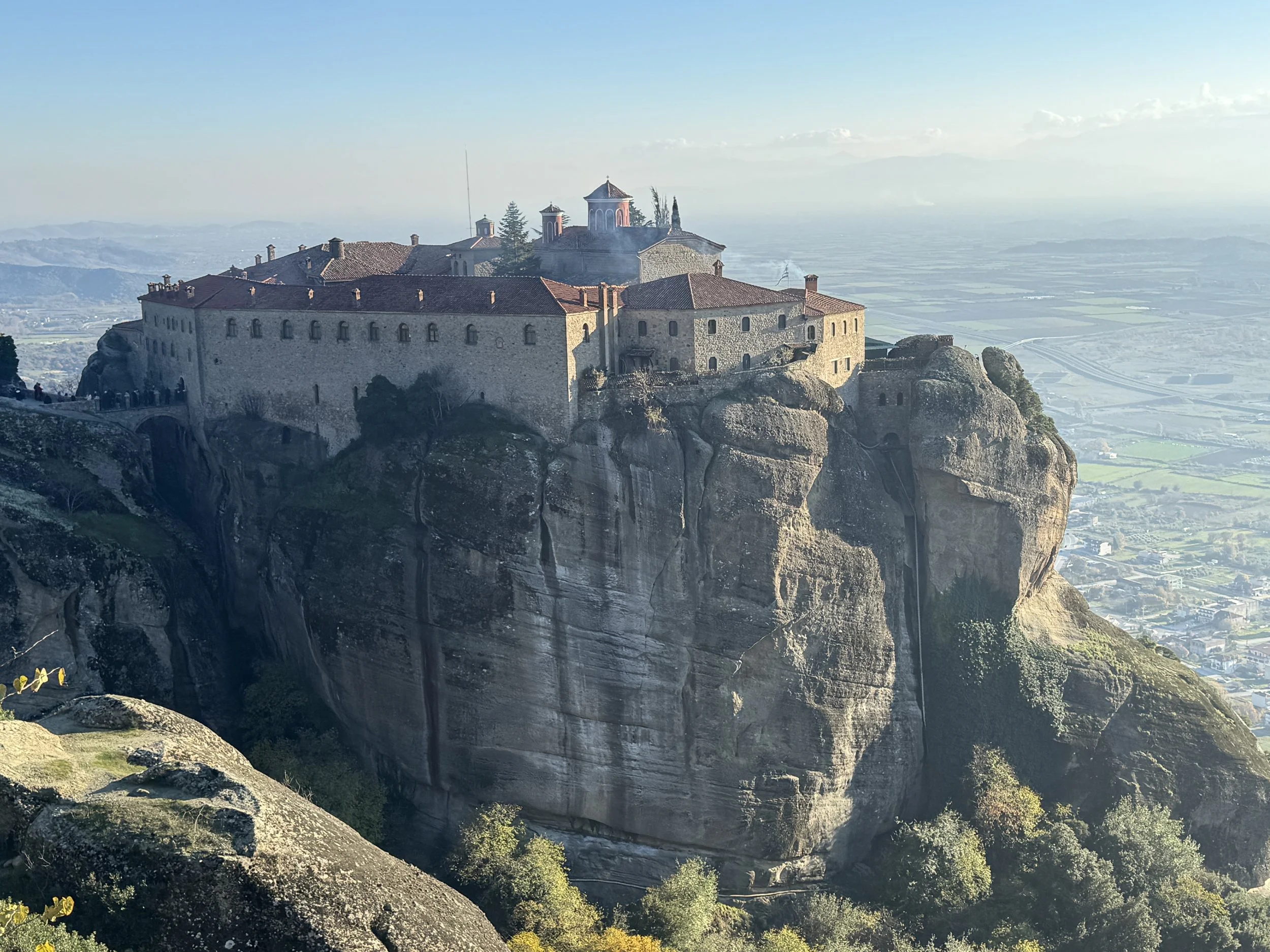
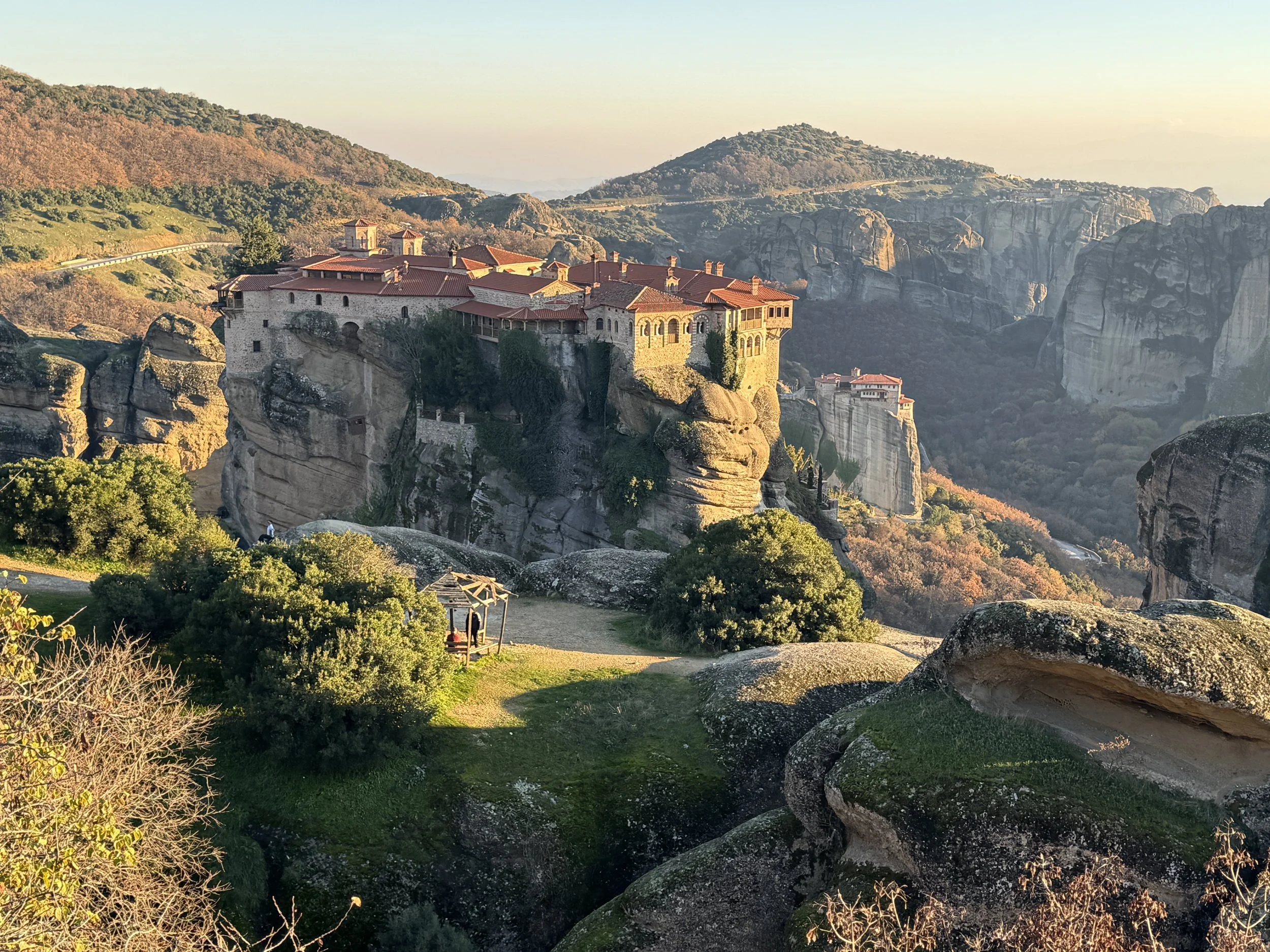
Next we drove into the mountains toward Meteora, with our destination set as the Holy Monastery of Saint Stephen.
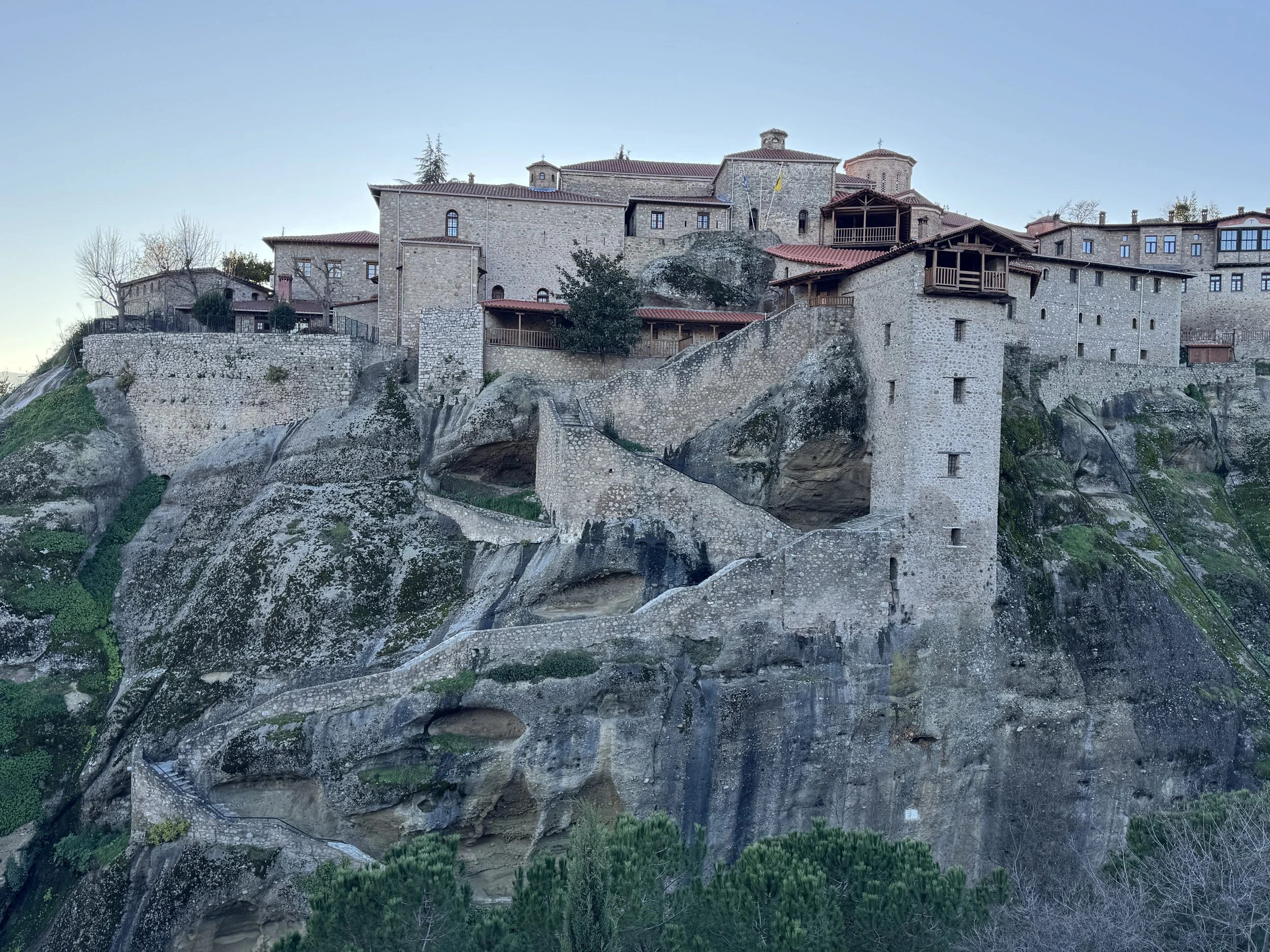
Founded in the 14th century and later converted into a nunnery, the monastery is dedicated to Saint Stephen the Protomartyr.
Unlike some of the other Meteora monasteries, Saint Stephen is easily accessible by a bridge rather than steep steps.
The drive up the mountain was absolutely incredible.
There are several scenic turnouts along the road where you can see the different monasteries perched on towering rock pillars. Each one looks unique and almost impossible to build.
It really makes you wonder how they constructed these monasteries on such dramatic cliffs.
Admission to Saint Stephen Monastery was €5.
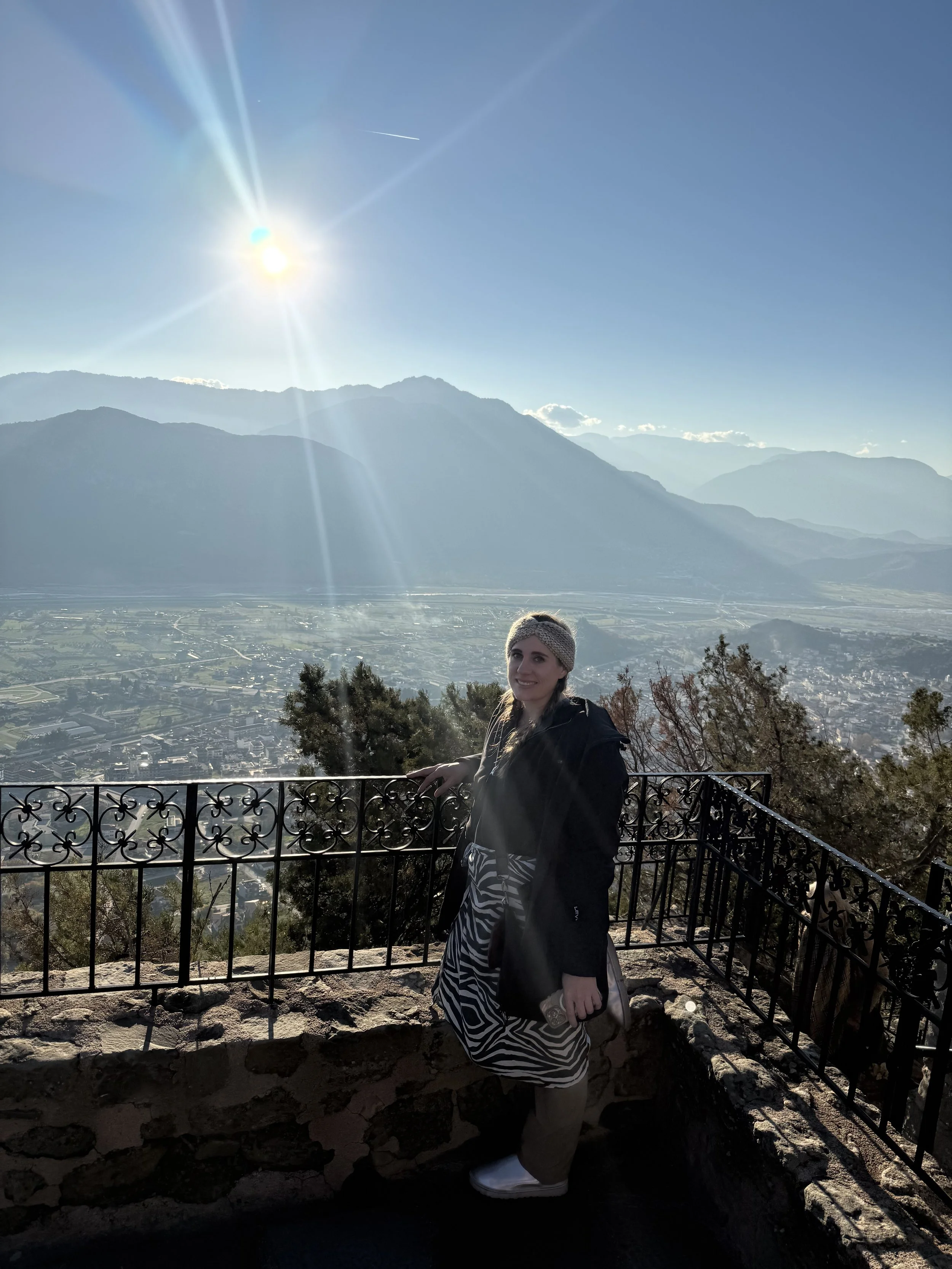
Women are required to wear a long coat, skirt, or dress, or you can borrow one of the wrap skirts they provide at the entrance.
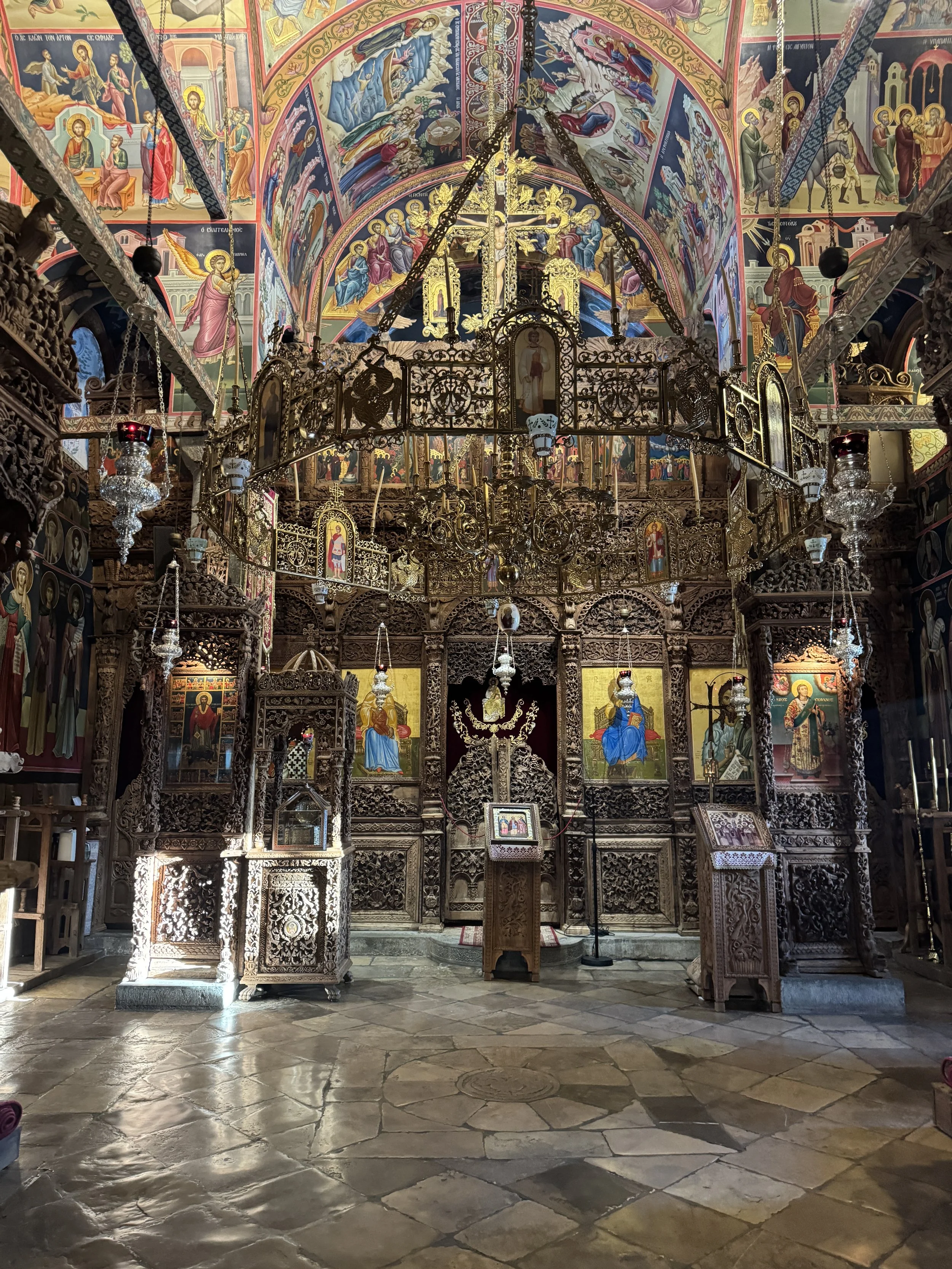
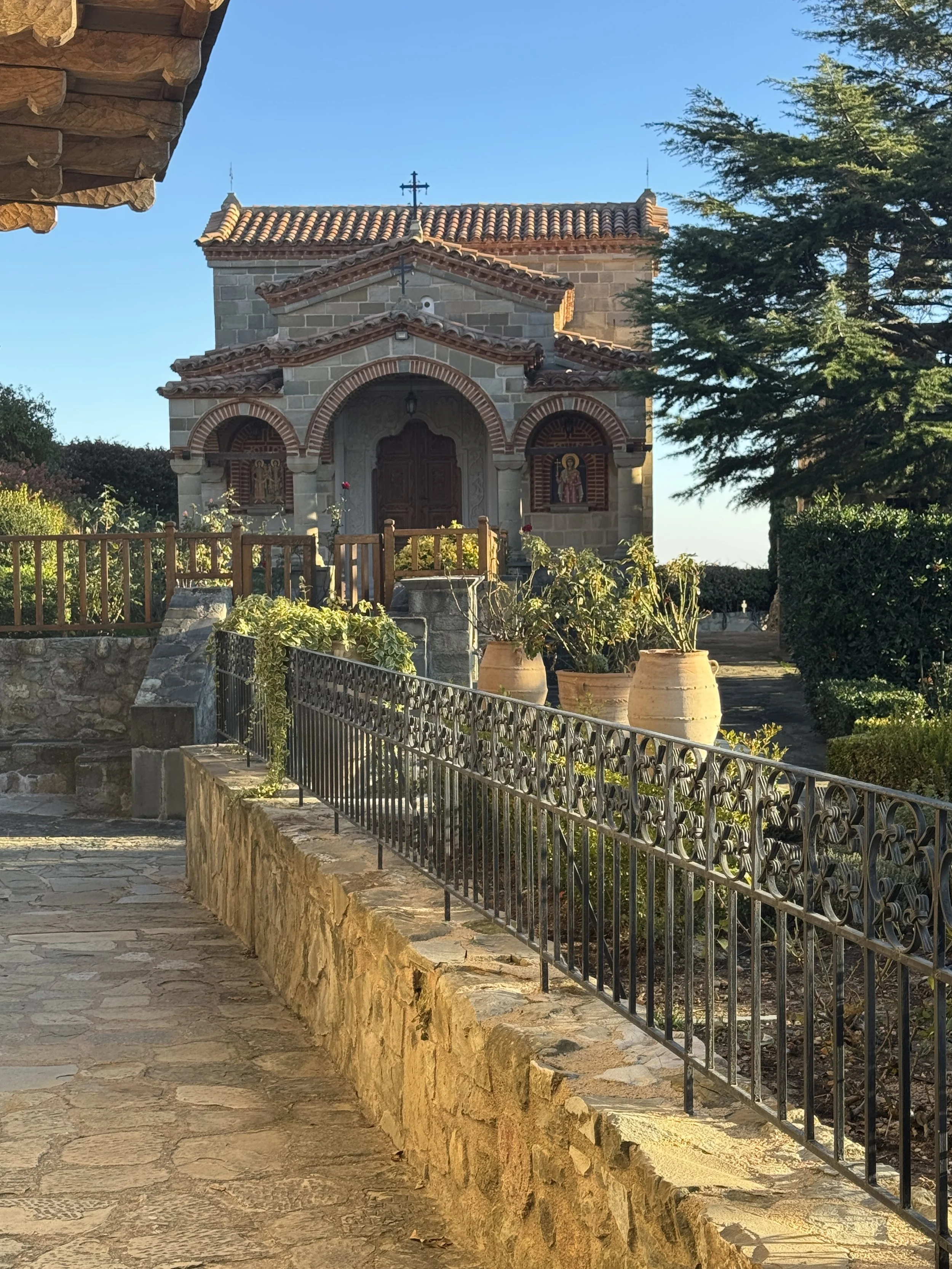
Inside we found beautiful views, monastery buildings open to visitors, a small museum, and souvenir shops.
The panoramic views were impressive, although visibility wasn’t great that day due to smoke in the air.
Checking Into Our Hotel in Kalabaka
After exploring the viewpoints we drove down to Kalabaka, where we stayed at Alexiou Hotel.
Once again we encountered another hotel that advertised parking, but it actually required parking in a nearby free lot.
One advantage was that no one is allowed to park directly in front of the hotel, so we were able to unload our luggage before moving the car.
The room itself was nice, although the bathroom walls were made of glass. Thankfully they installed a curtain for privacy.
The bed was comfortable, but the shower had a drain that didn’t work very well, which meant water tended to overflow.
Christmas Squares and a Well-Earned Dinner
We went out to explore the town.
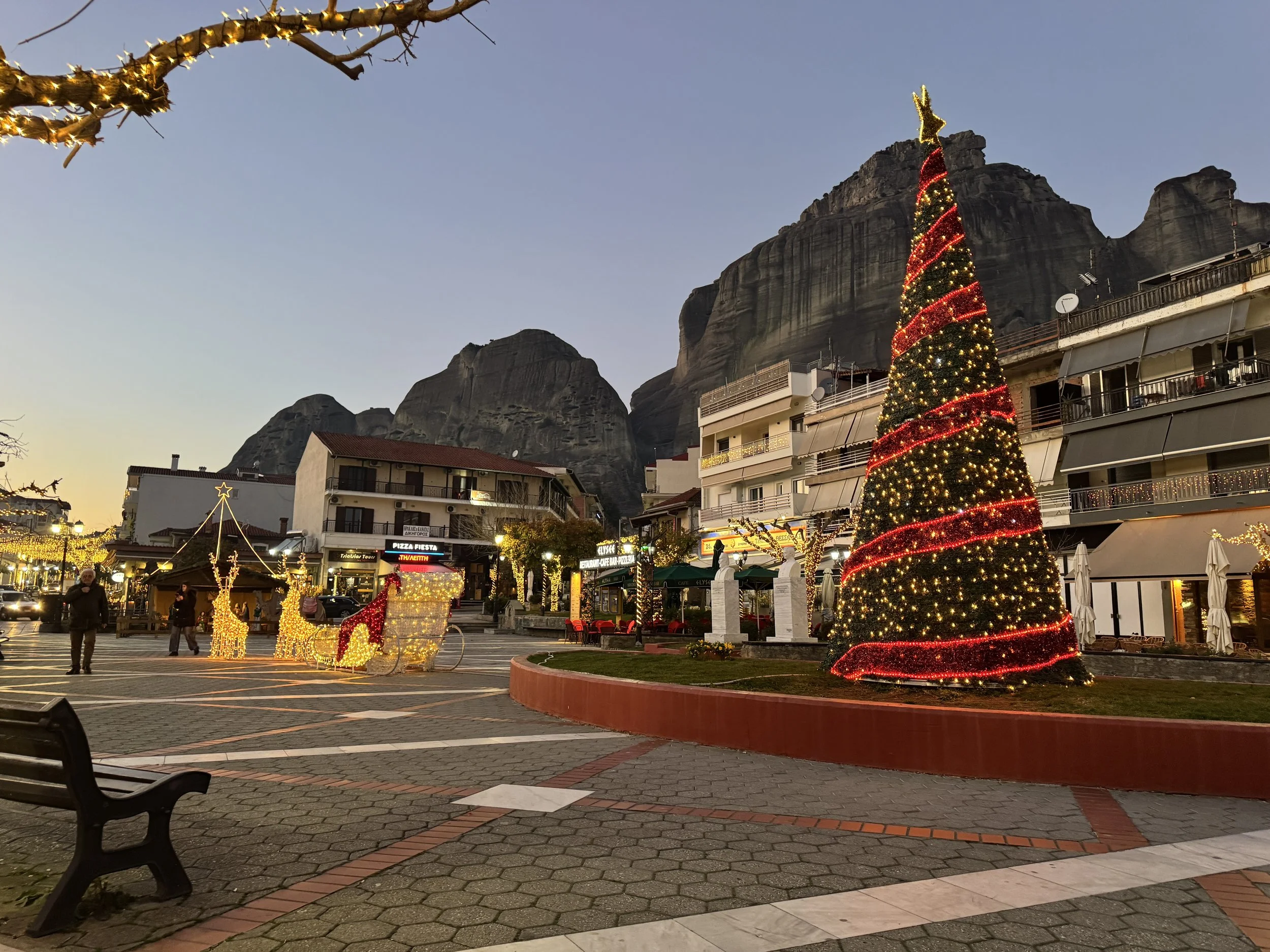
Kalabaka had several small squares decorated for Christmas, along with shops, cafés, and restaurants.
We stopped at Καφέ “babitsas” and picked up some unique pastries that looked too good to pass up.
For dinner we chose Taverna Dias Meteora.
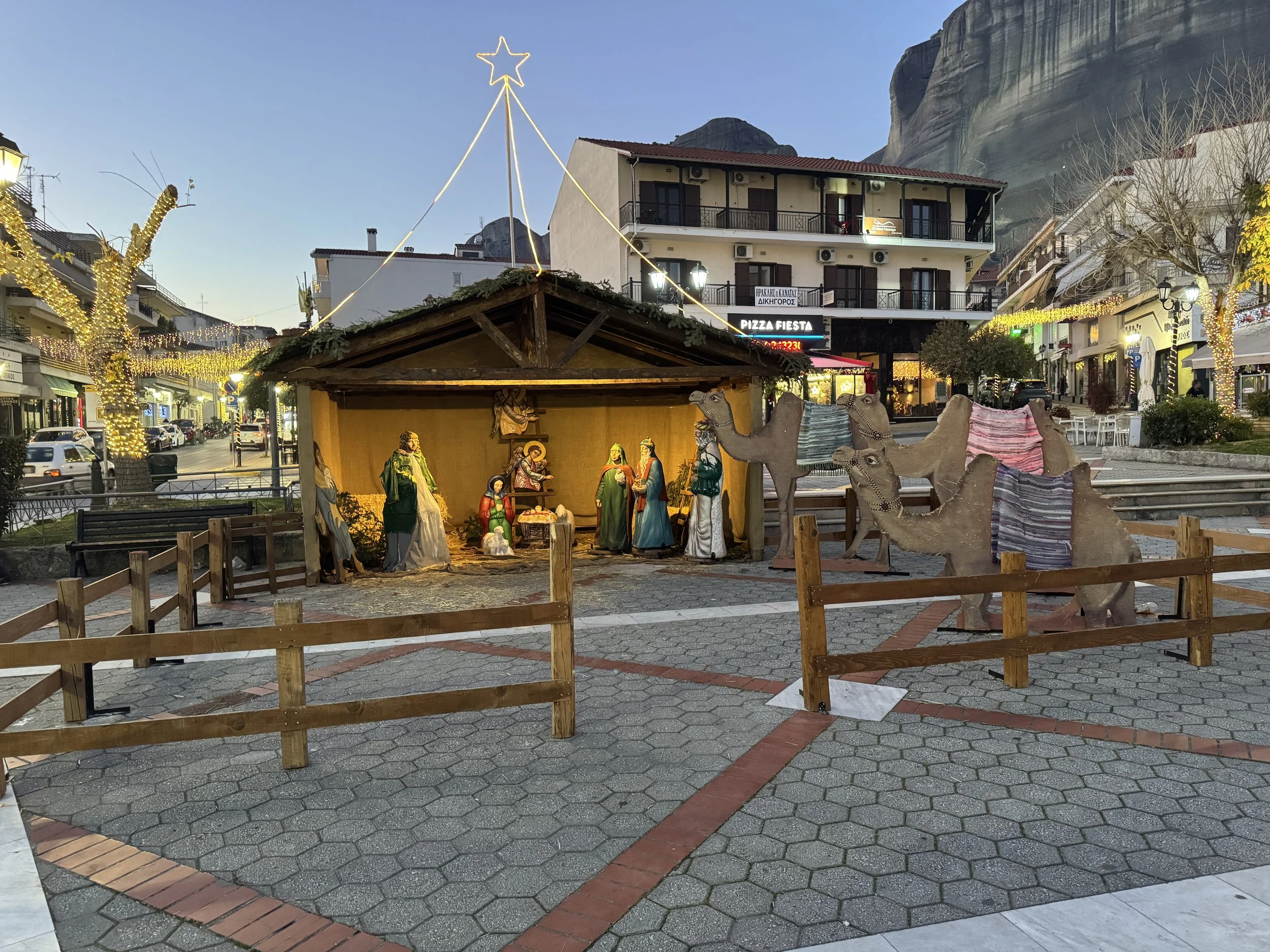
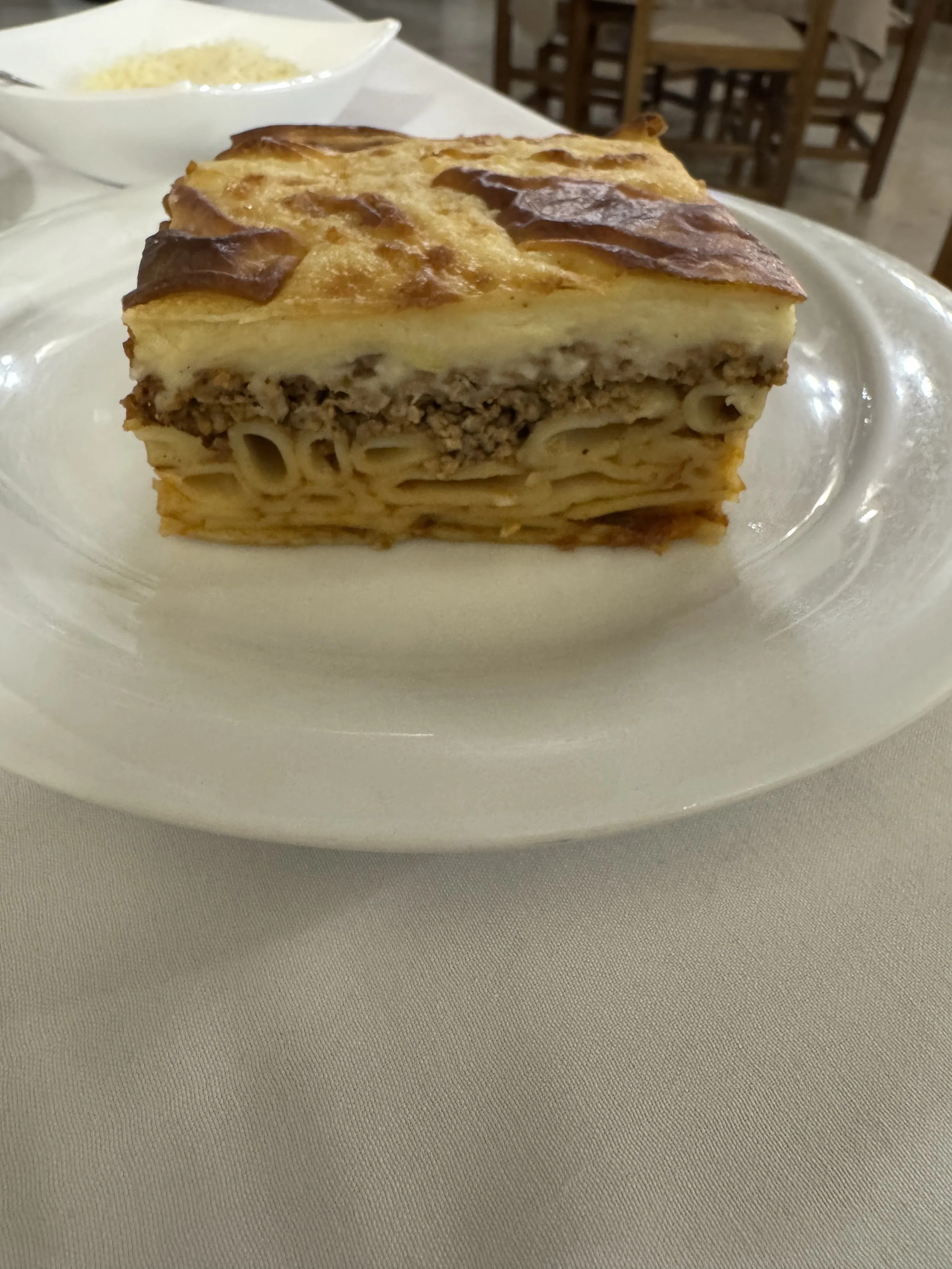
I ordered a cucumber salad and pastitsio, and both absolutely hit the spot.
After several attempts during the trip, I finally got another proper pastitsio experience, and it was definitely worth the wait.
After dinner we walked back to the hotel and planned the next day’s travels.
December 15: Mount Olympus and Dion
A Relaxed Start and a Stop in Larisa
We woke up leisurely and headed toward Larisa. We found an underground parking garage and spent some time walking around town.
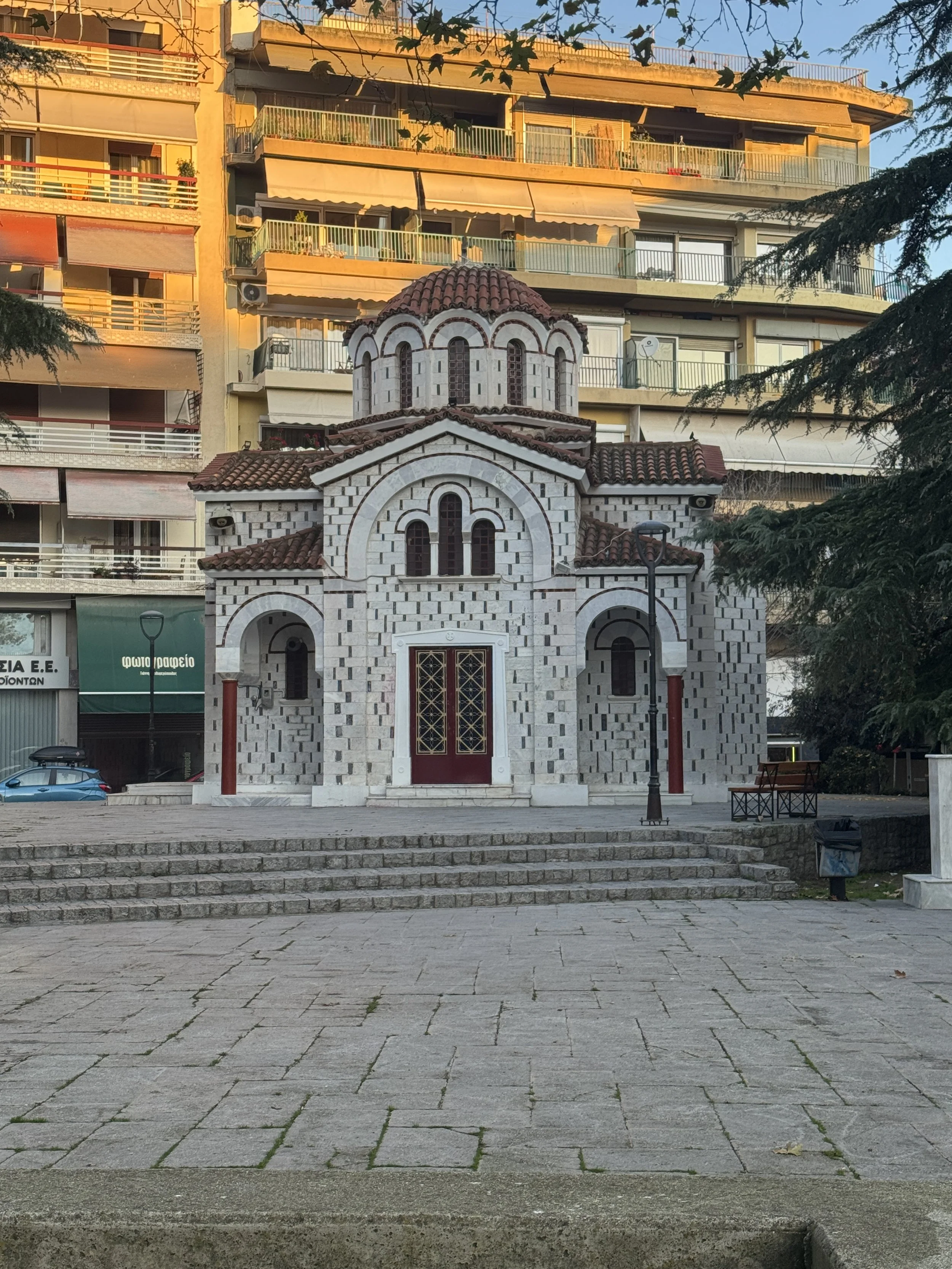
Our first stop was the Church of Saint Achillios. Saint Achillios was a 4th-century bishop of Larisa and participated in the Council of Nicaea in 325 AD. Churches have existed on this site since early Christian times, though they were repeatedly destroyed by earthquakes and damage during the Ottoman period.
The present church was built in the 20th century in a Byzantine Revival style, preserving the historic location connected to Larisa’s patron saint.
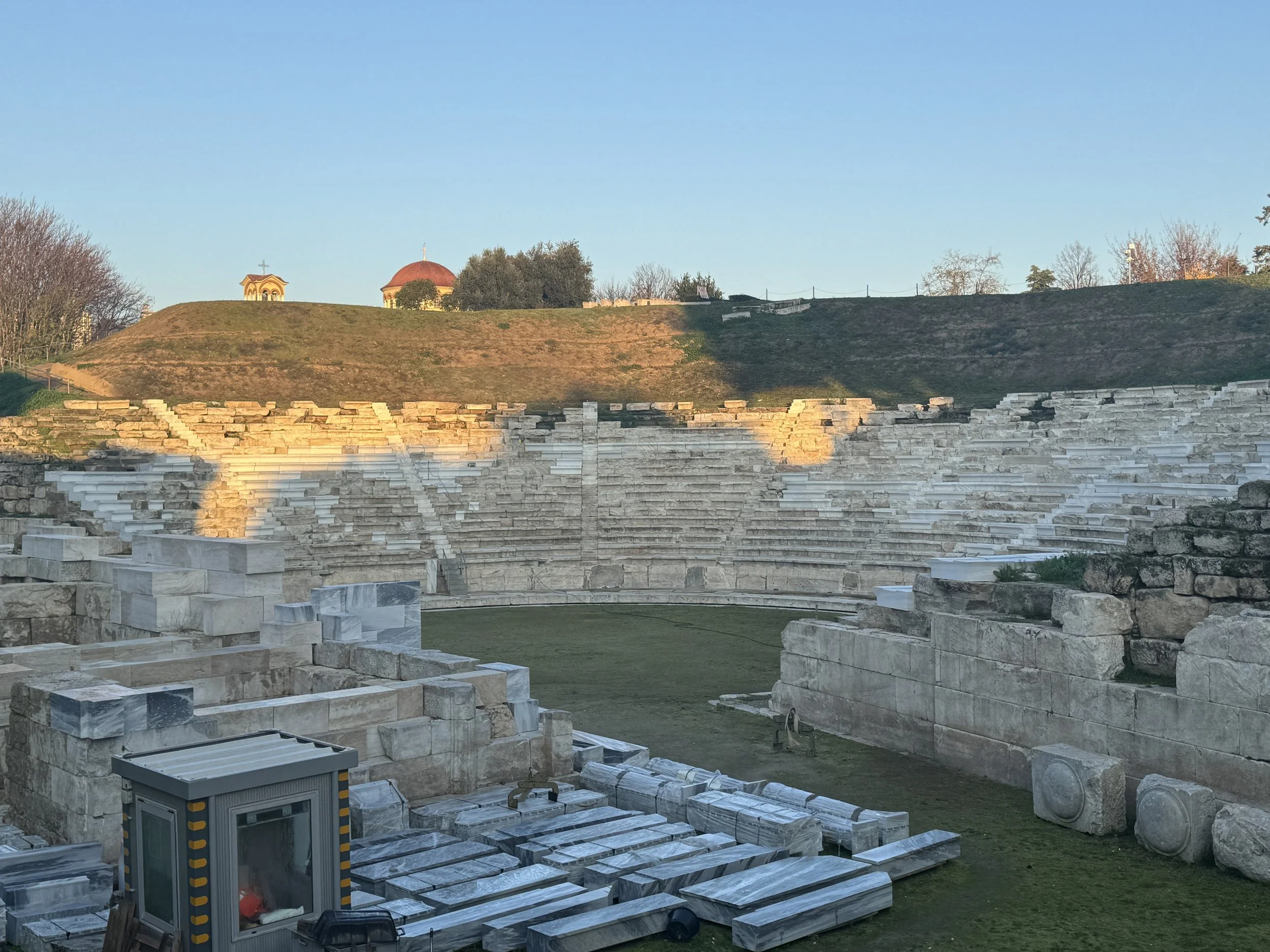
Our next stop was the Ancient Theatre of Larisa, built in the 3rd century BC during the Hellenistic period, likely under King Philip V of Macedon. Carved into the hill of the ancient acropolis, the theatre seated thousands and served not only for drama and music, but also for political assemblies of the Thessalian League.
During Roman times it was adapted for spectacles. Excavated and restored during the 20th and 21st centuries, it is now one of the largest ancient theaters in Greece and a major landmark of the city.
Platamon Castle: A Fortress Between Mountains and Sea
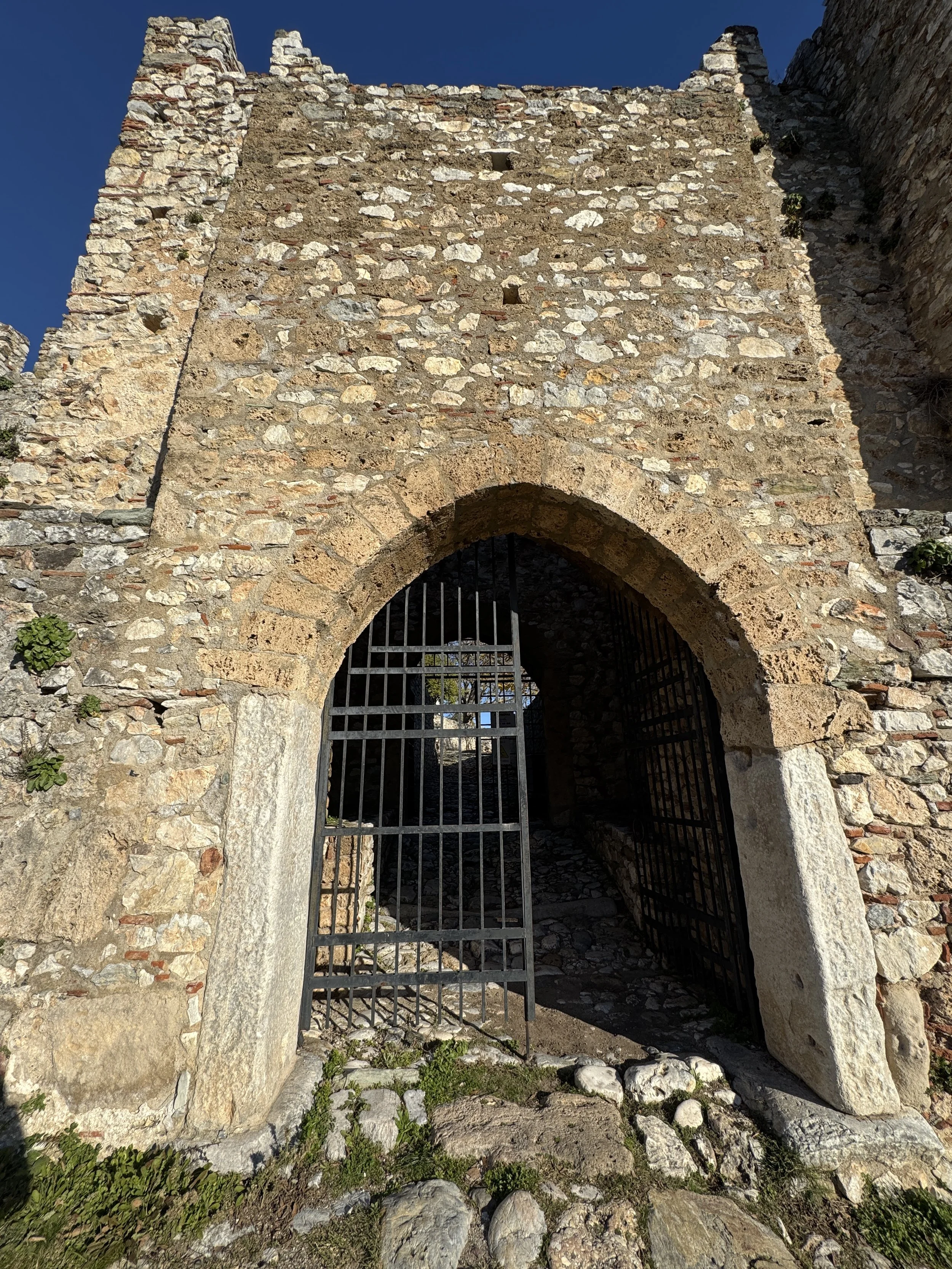
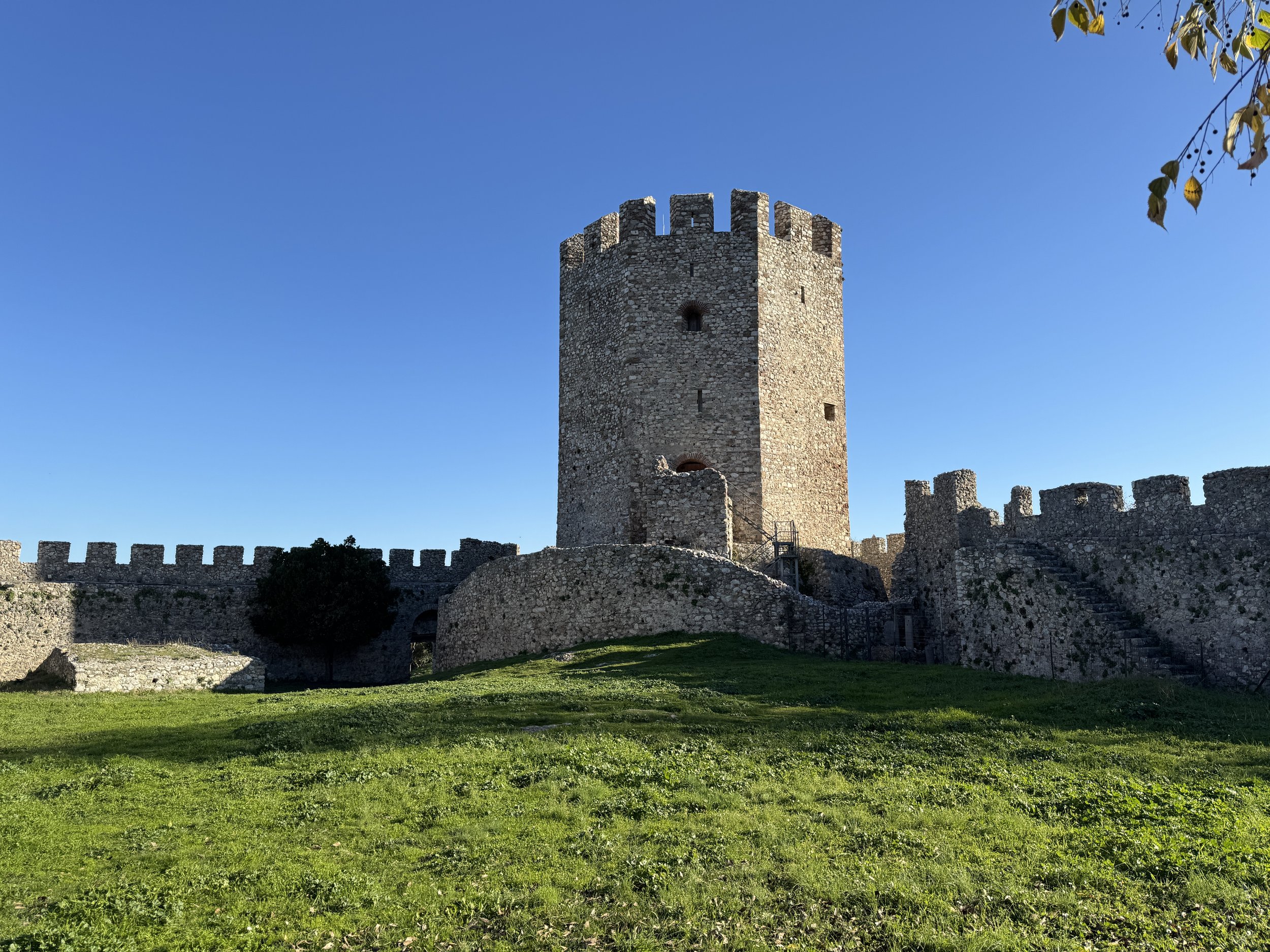
Next we headed to Platamon Castle.
This medieval fortress was built mainly in the 12th–13th centuries by the Crusaders (Franks) on earlier Byzantine foundations. Its location between Mount Olympus and the Aegean Sea made it strategically important, controlling the coastal route connecting Macedonia and Thessaly.
Over time the castle passed between Byzantine, Venetian, and Ottoman control before eventually losing its military importance.
Today it remains one of northern Greece’s best-preserved castles, with stone walls, towers, gates, and inner courtyards still standing.
Visitors can walk the ramparts, explore the ruins of Crusader and Byzantine buildings, and see remnants of cisterns and living quarters. The castle also offers beautiful views of both the sea and the surrounding town.
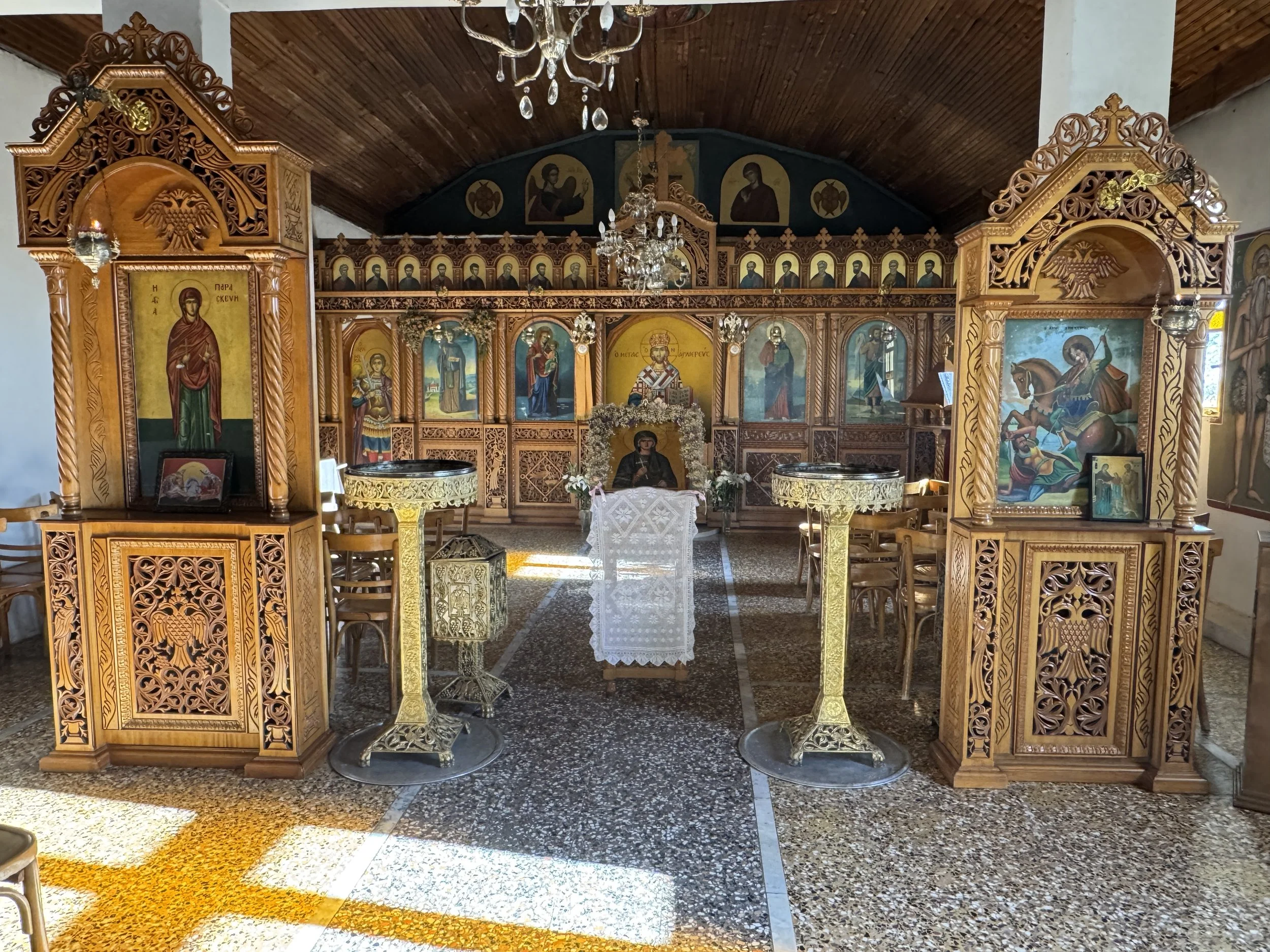
Inside the fortress sits a small Byzantine chapel, likely dedicated to Saint Paraskevi. Built with simple stone construction, it once served the spiritual needs of the castle’s inhabitants rather than functioning as a parish church.
Driving Into the Mythical Home of the Gods
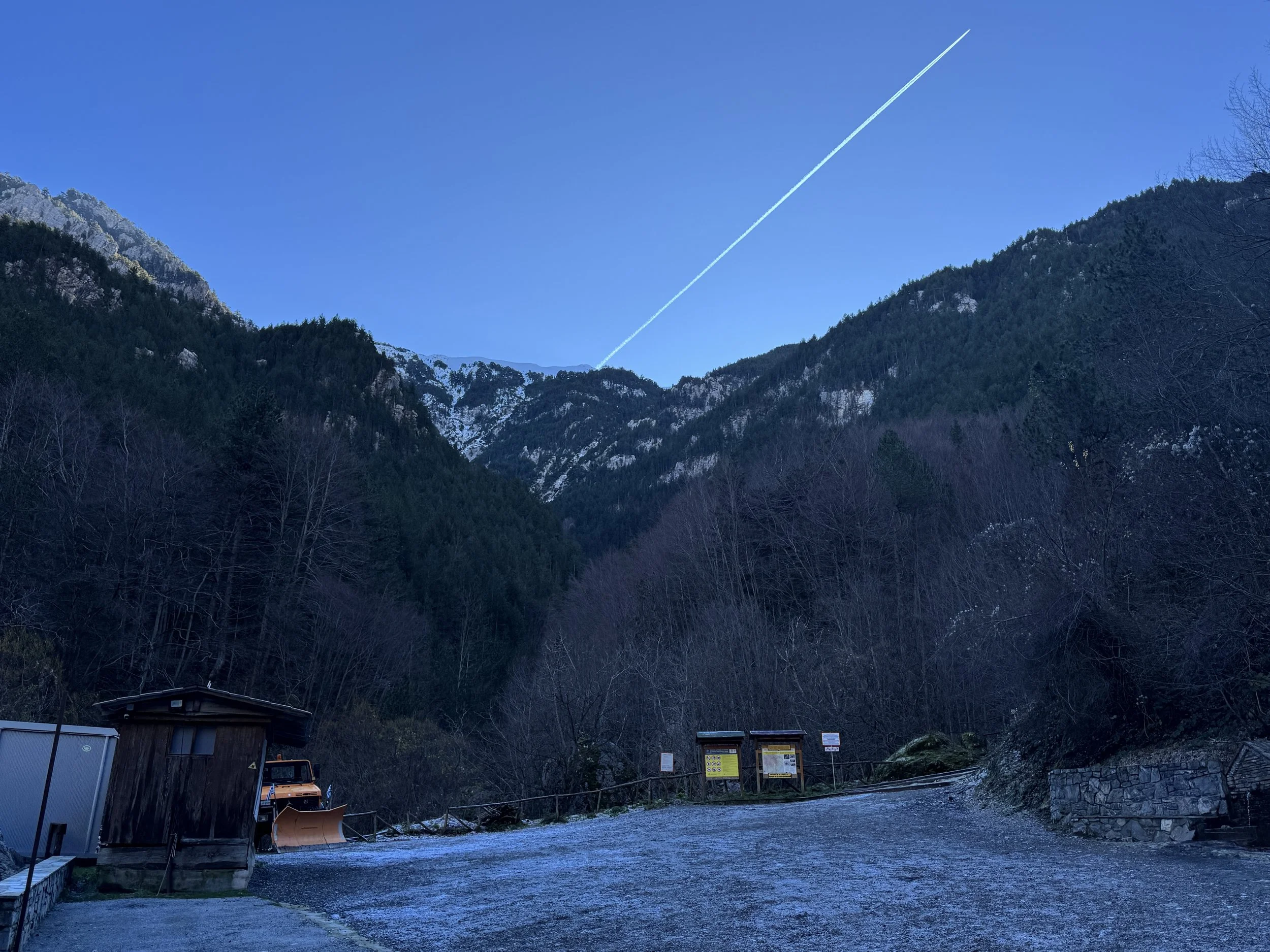
From there we headed toward Mount Olympus National Park.
Our drive took us to Prionia, which marks the end of the road and the main access point for climbing Greece’s highest mountain.
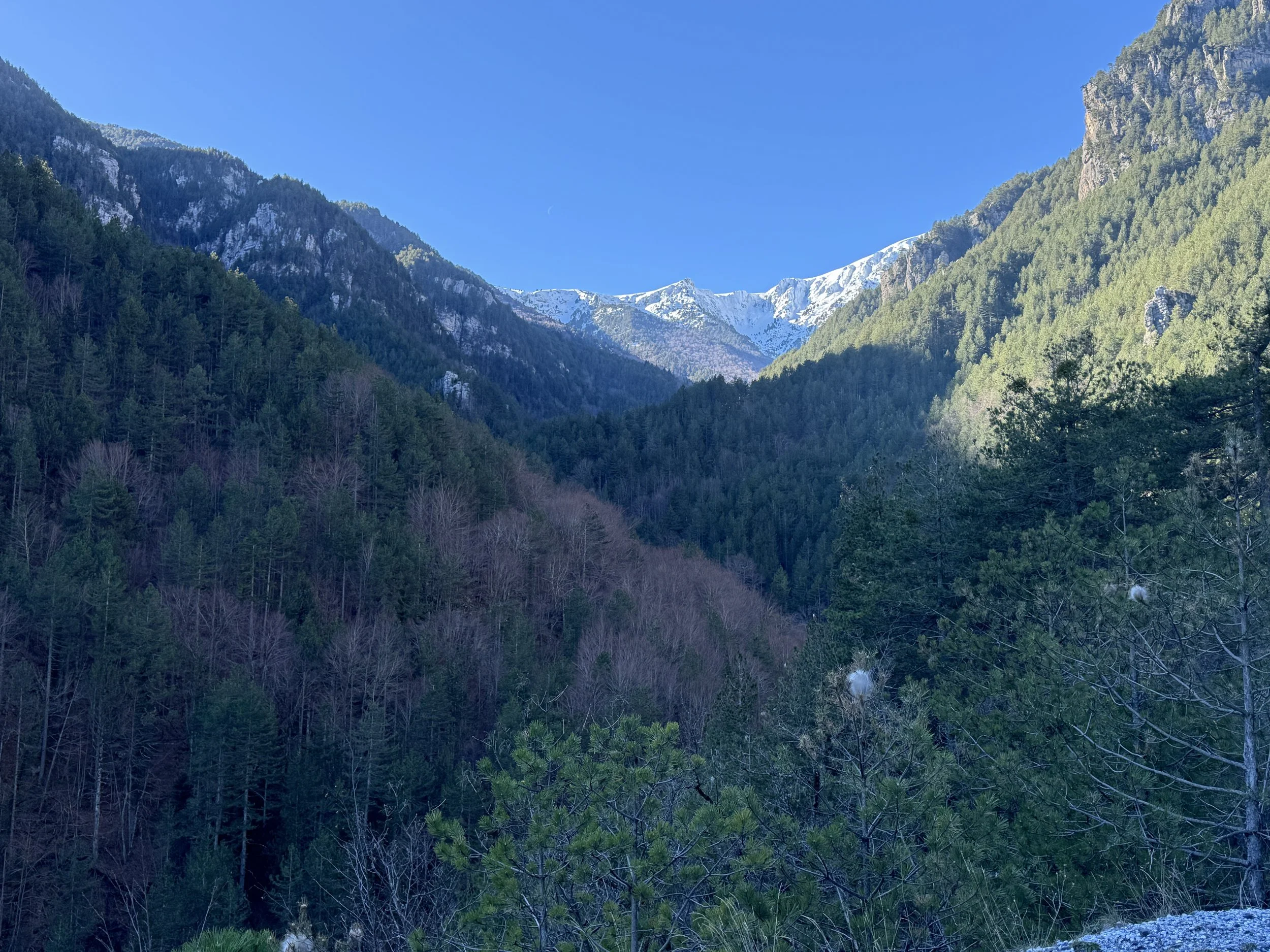
Established in 1938 as Greece’s first national park, Olympus protects dramatic alpine landscapes, forests, deep gorges, and rare wildlife. It is also culturally significant as the mythological home of the Greek gods, making it one of the most symbolically important natural places in Greece.
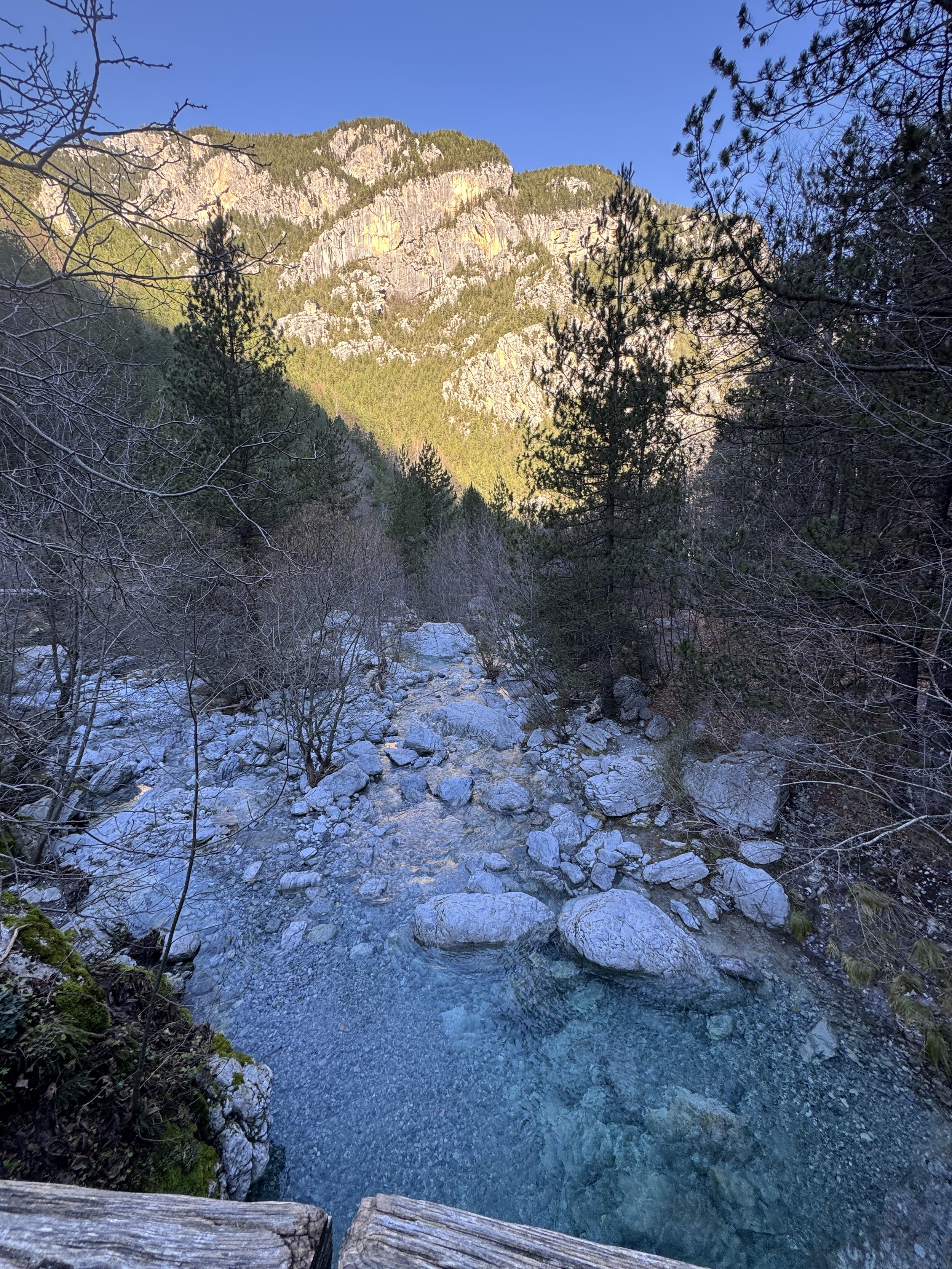
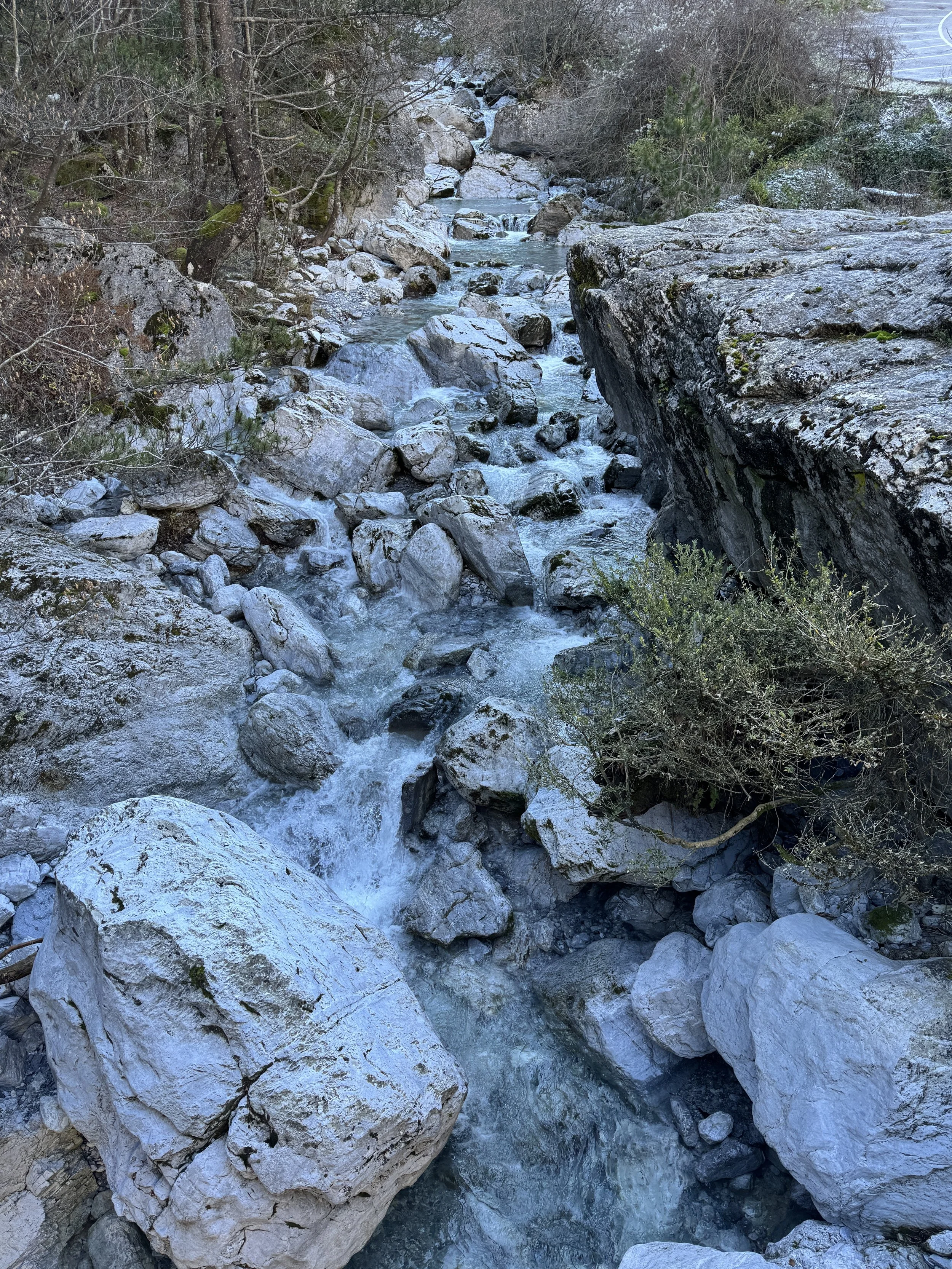
There are several hiking trails and a bridge that crosses a bright blue stream. The water looked beautiful and I imagine it was very cold.
This was also the coldest temperature we had experienced on the trip so far.
The drive up and down the mountain was absolutely beautiful.
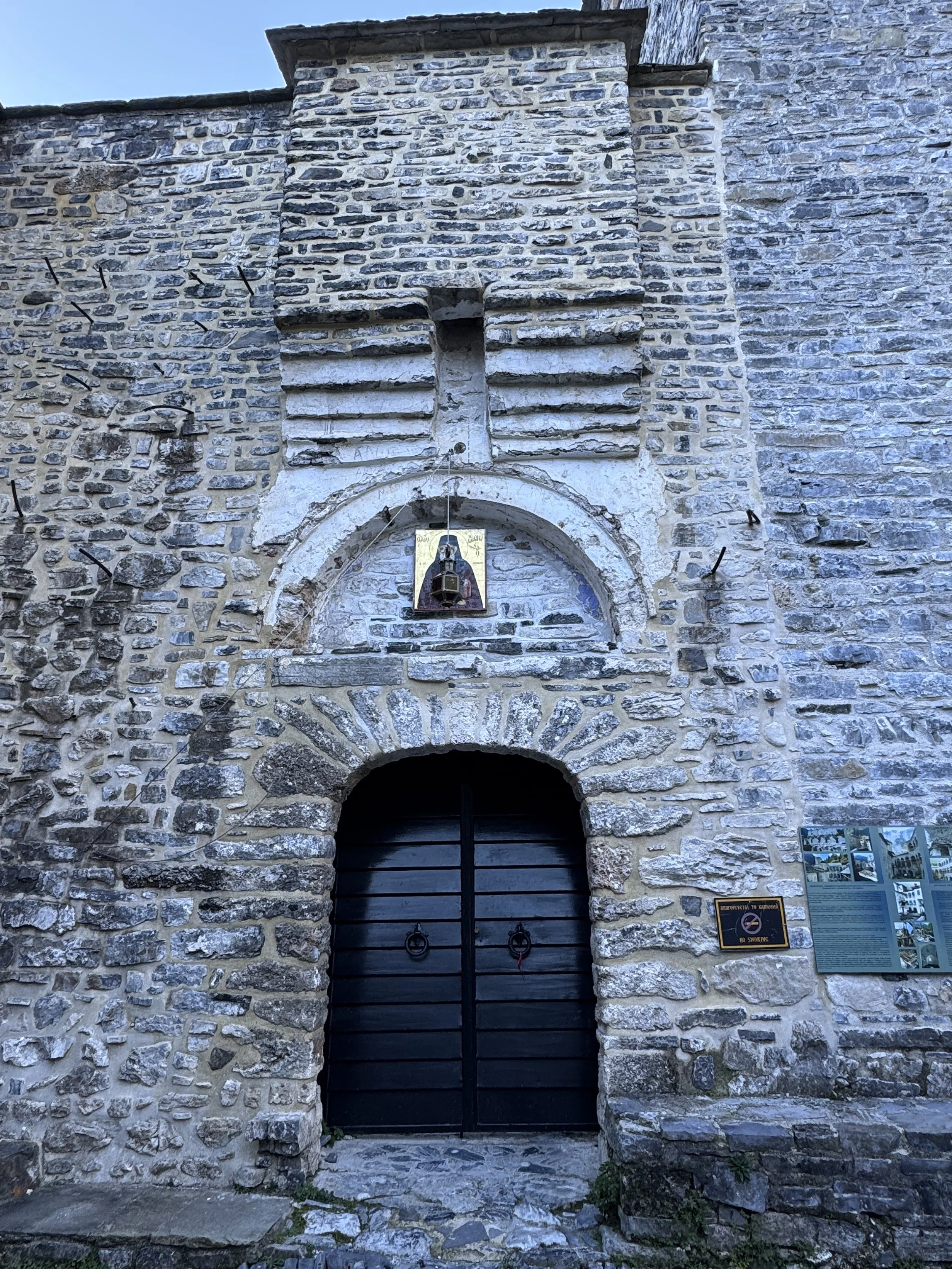
The Ruins of the Old Monastery of Saint Dionysius
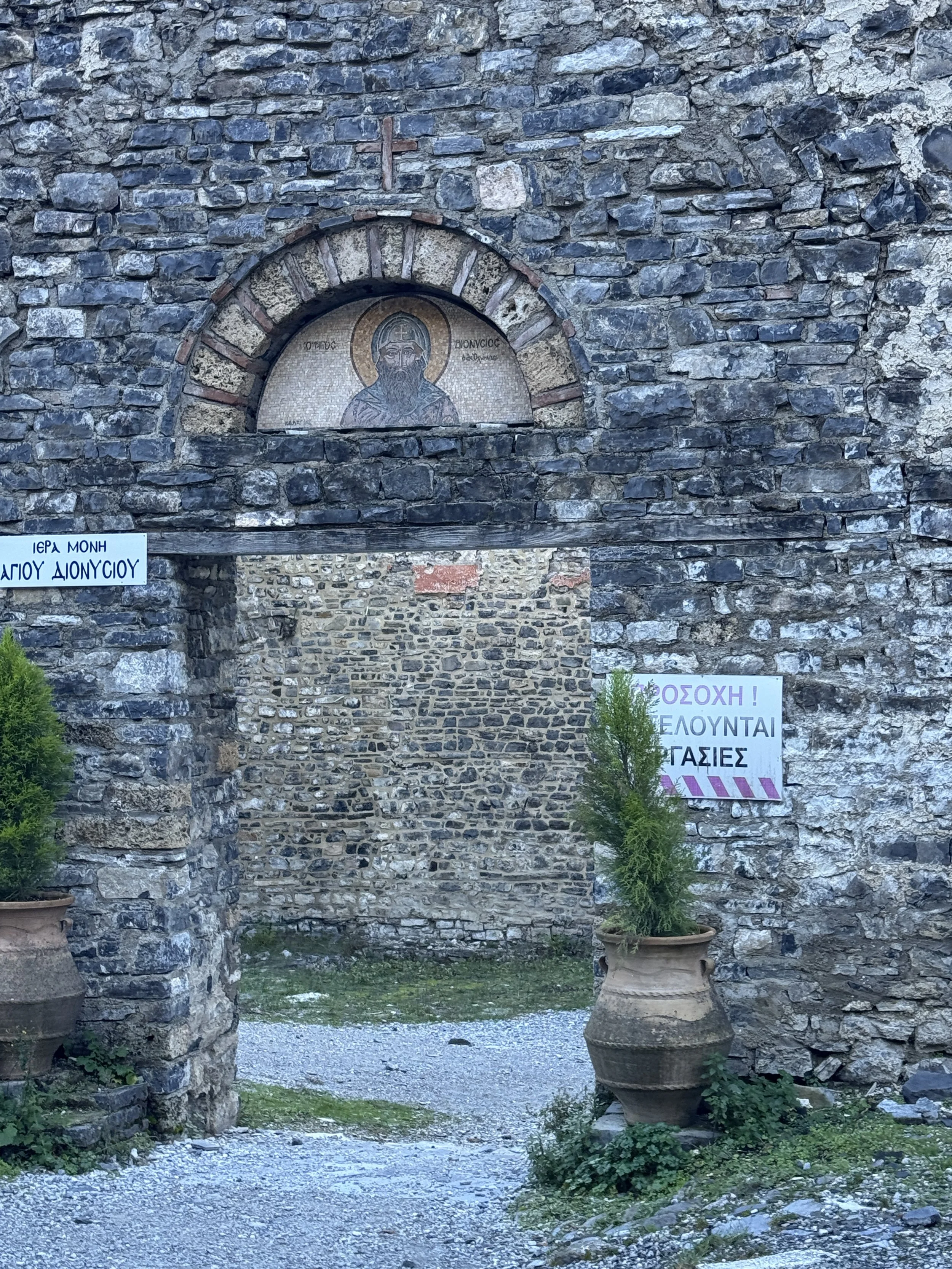
One of the turnoffs leads to the Old Monastery of Saint Dionysius, founded in 1542 by Saint Dionysius of Olympus in the Enipeas Gorge.
Hidden deep in a ravine, the monastery served as a spiritual center and refuge during Ottoman rule. However, it was destroyed multiple times throughout history.
The most significant destruction occurred in 1943, when German forces destroyed the monastery for aiding resistance fighters during World War II.
In fact, the monastery has been burned or damaged around seven times, including:
Late 16th–17th centuries: attacks during Ottoman rule shortly after its founding
1821: burned during the Greek War of Independence
1877–1878: damaged again during revolutionary uprisings in Thessaly
1943: completely destroyed by German troops during WWII
Because the monastery sat in a remote but strategic gorge, it became a target whenever rebellions or resistance movements occurred.
Today its ruins and restored chapel remain within the national park, standing as a symbol of faith, resistance, and endurance.
Exploring the Sacred City of Dion
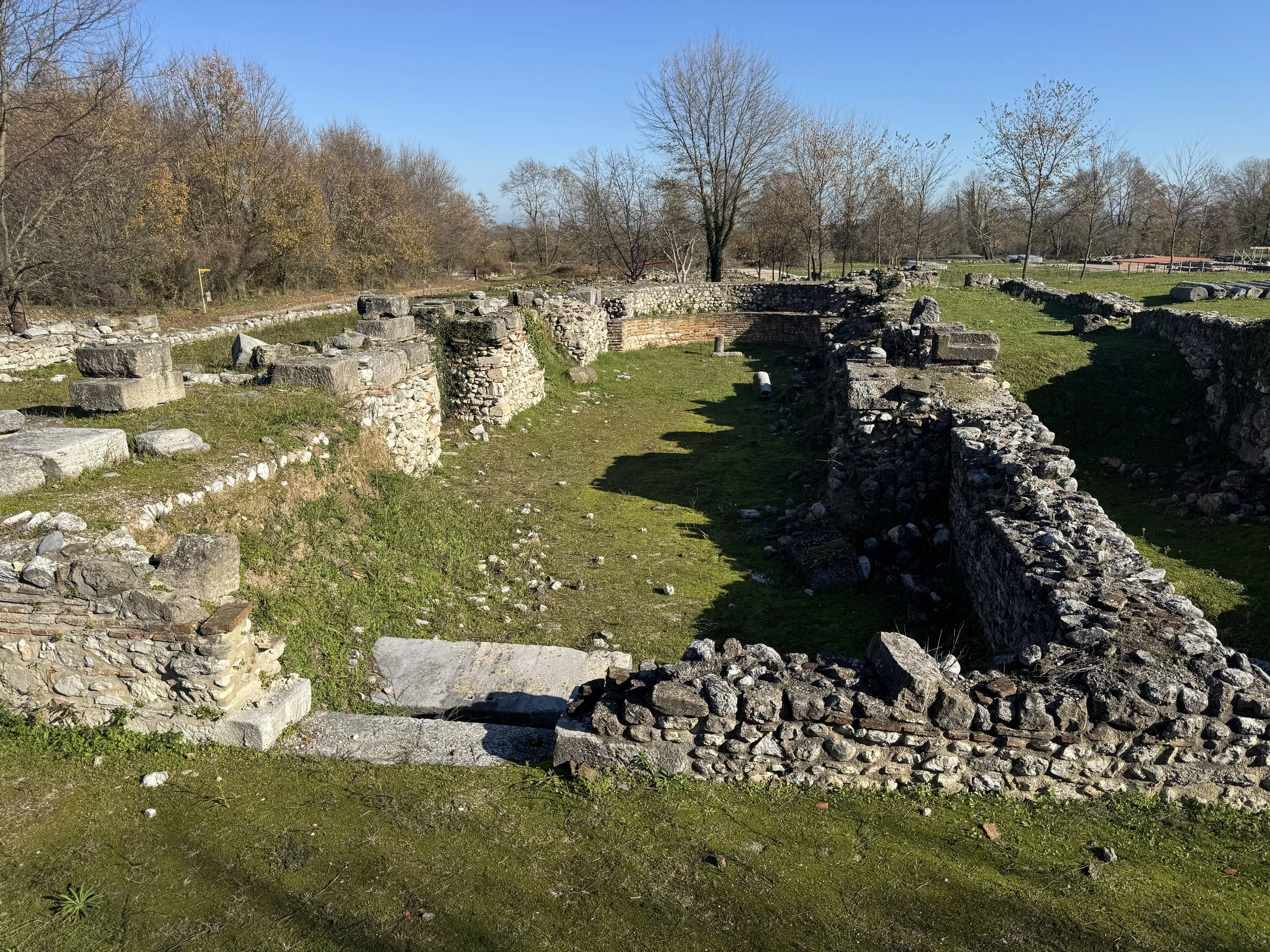
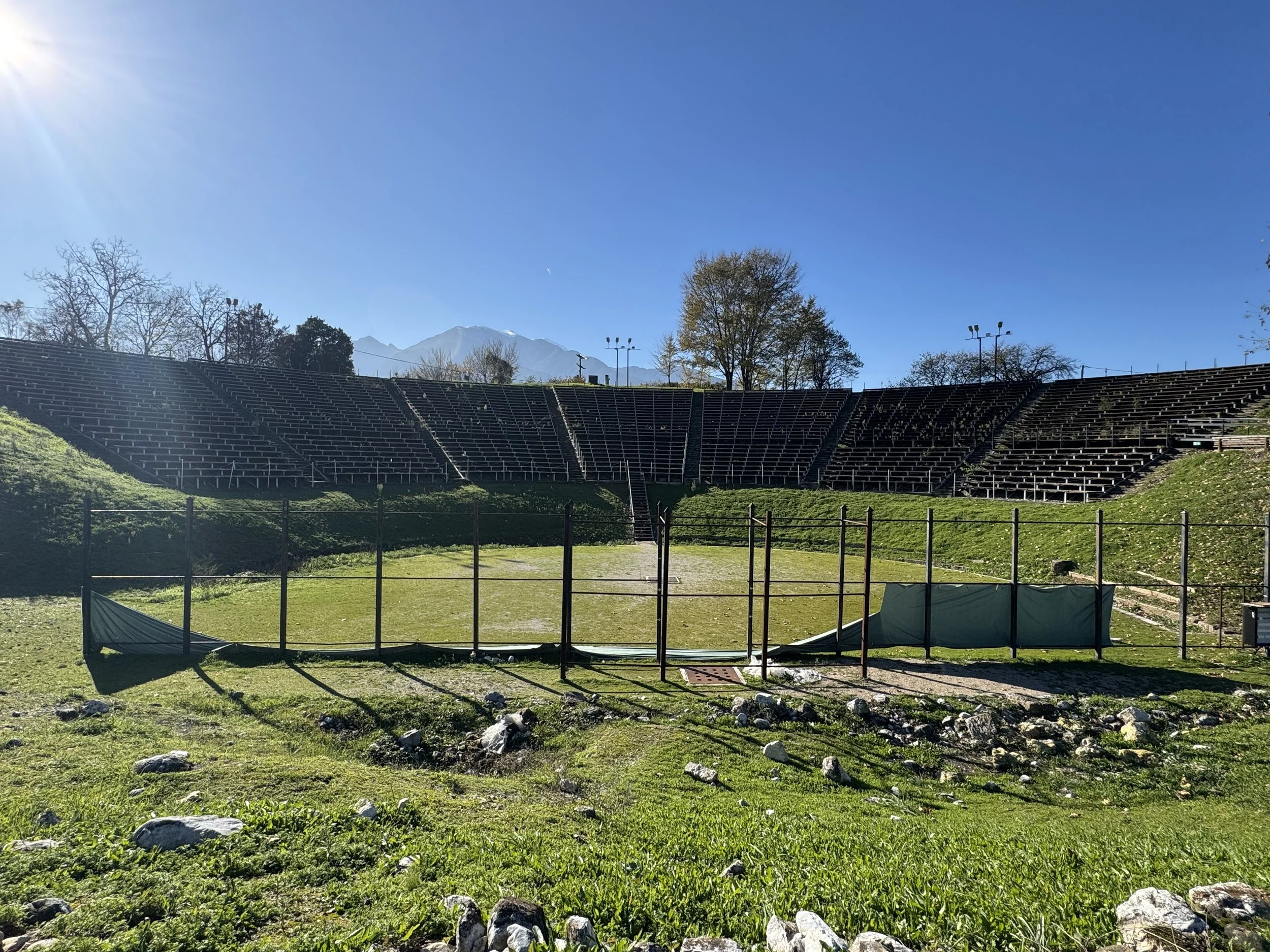
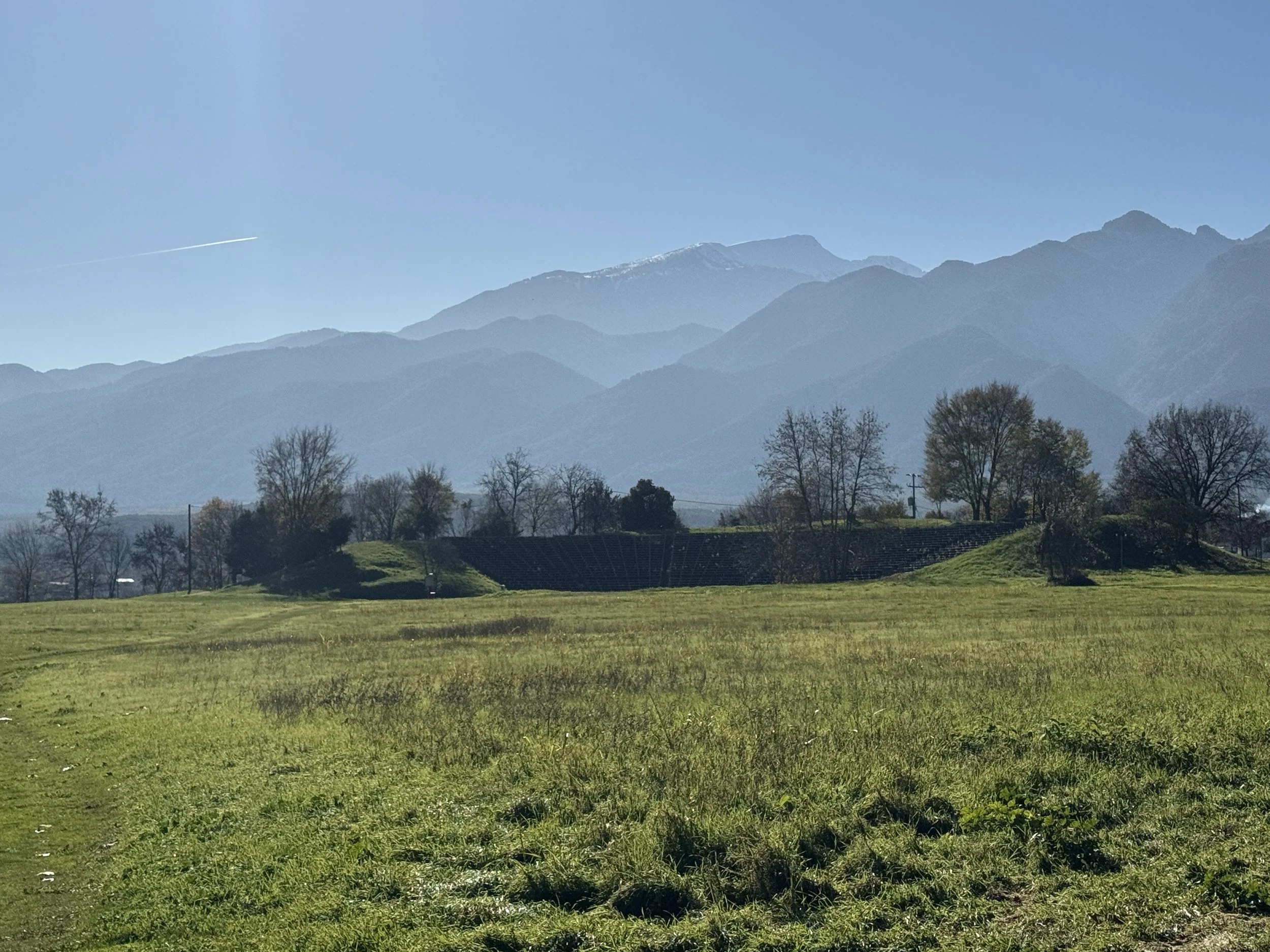
Next we headed to Dion Archaeological Park.
Dion preserves the ancient sacred city of the Macedonians, located at the foot of Mount Olympus. The city was dedicated to Zeus and the Olympian gods, and it served as a major religious and cultural center.
Both Philip II and Alexander the Great made sacrifices here before their military campaigns.
Admission was €10, and the site also has a small gift shop and self-service café.
The archaeological park is extensive and includes:
Sanctuary of Zeus Olympios – the main sacred area for Macedonian kings
Sanctuary of Isis – a water-filled shrine with statues and canals
Ancient Theatre – used for performances and festivals
Hellenistic Theatre – an earlier and smaller performance space
Roman Baths (Great Baths) – a large bathing complex with mosaics
Roman Villas – homes decorated with floor mosaics
Agora (Marketplace) – the city’s civic and commercial center
Ancient streets and drainage systems – remarkably well preserved
Early Christian Basilica – evidence of later religious transformation
City walls and gates – defensive structures
It’s a fascinating site that shows how Dion evolved from a religious sanctuary into a full ancient city.
A Quiet Town and an Excellent Meal in Litochoro
Afterward we headed into Litochoro hoping to browse some gift shops.
Unfortunately most of the shops and restaurants were closed, so we wandered around for a while before finally finding a place called Μεζέ Μεζέ.
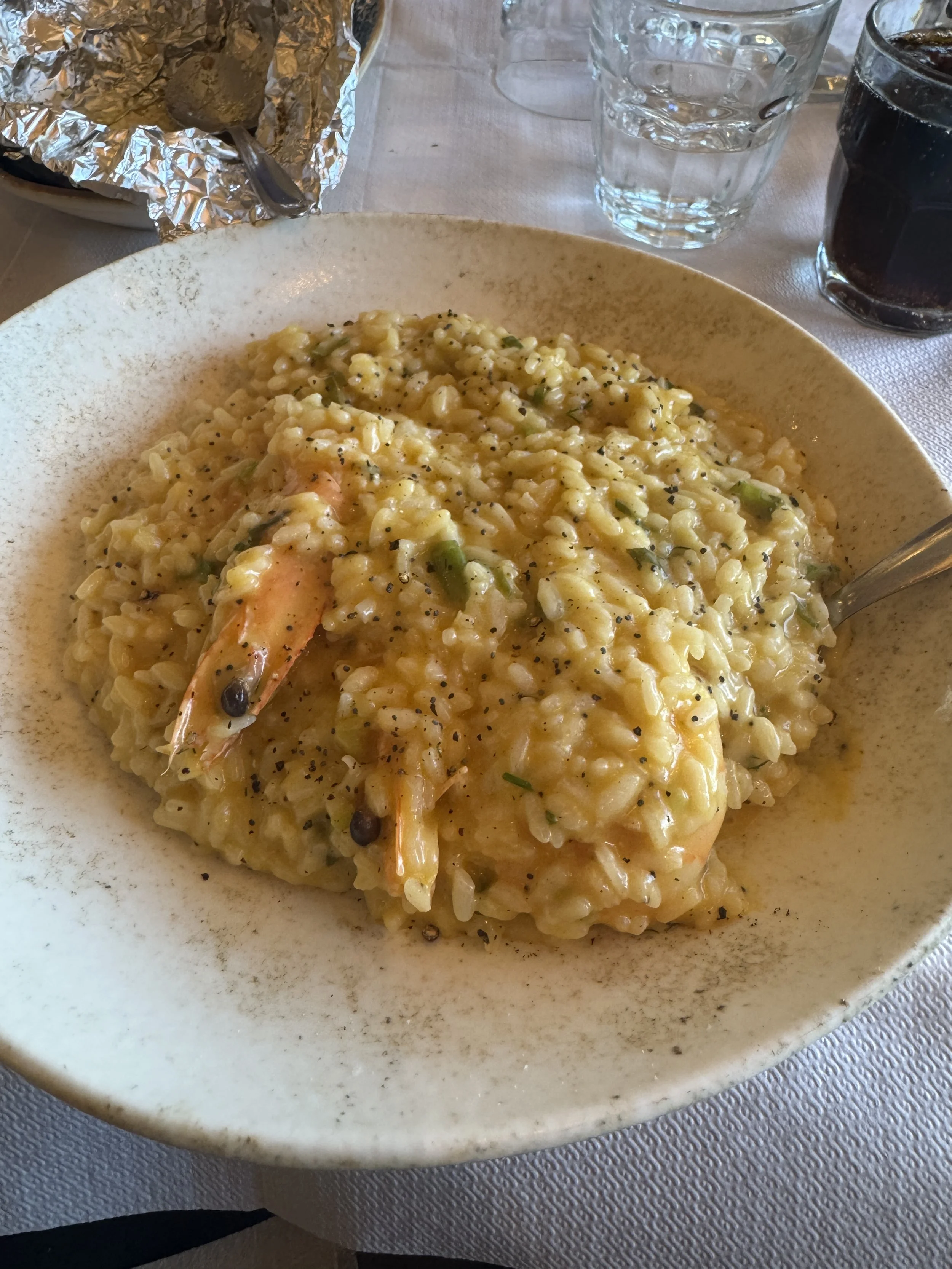
I ordered a pumpkin and shrimp risotto, and we also tried baked feta.
Both dishes were fantastic, and the service was excellent.
Checking Into Leptokarya
For the night we stayed in Leptokarya at the Olympos Hotel.
This hotel actually did have free parking right next to the building, exactly as advertised.
The room was spacious and cozy, and the staff were incredibly friendly and helpful… maybe even a little too helpful.
We were still looking for gift shops, and the staff member suggested one around the corner, which unfortunately turned out to be closed.
A Christmas Shop That Wasn’t Quite What We Expected
We wandered along the beach area looking for somewhere to eat later, then returned to the hotel.
The staff member felt bad that the shop she recommended was closed, so she sent us to another place called Do Fun Do.
We walked over and while it was definitely a fun store, it seemed more geared toward locals rather than tourists, so there wasn’t much in the way of souvenirs.
However, the entire first floor was filled with Christmas decorations, which was pretty festive.
Another Irresistible Greek Bakery
On the walk back we stopped at Bakery 00-24.
At this point we have developed a serious Greek bakery habit. The desserts here have been consistently amazing, and we basically can’t resist stopping whenever we see one.
For Europe, many of the pastries are actually fairly sweet, and there is always a huge variety.
So far I’ve tried several different desserts and never the same one twice, and I’ve loved every one of them.
Dinner at Zorbas Tavern
After returning to the hotel to plan the next day, we headed out again for dinner at Zorbas Tavern.
I ordered a salad and a bolognese, and both dishes were massive.
They were delicious, but the portions were so large that I came nowhere near finishing them.
December 16: Thessaloniki
A Hilltop Monastery Overlooking Thessaloniki
We got up and headed to Thessaloniki.
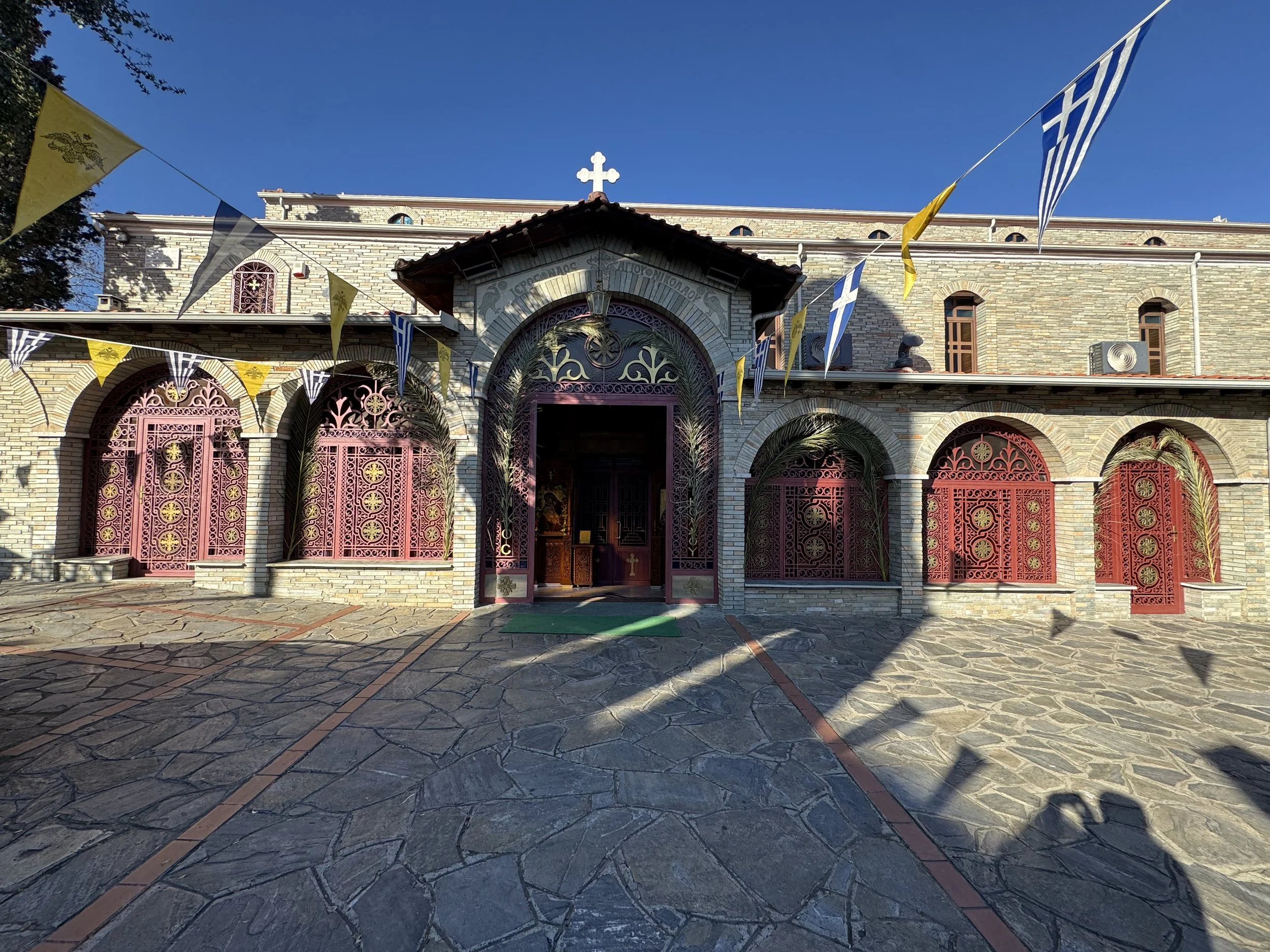
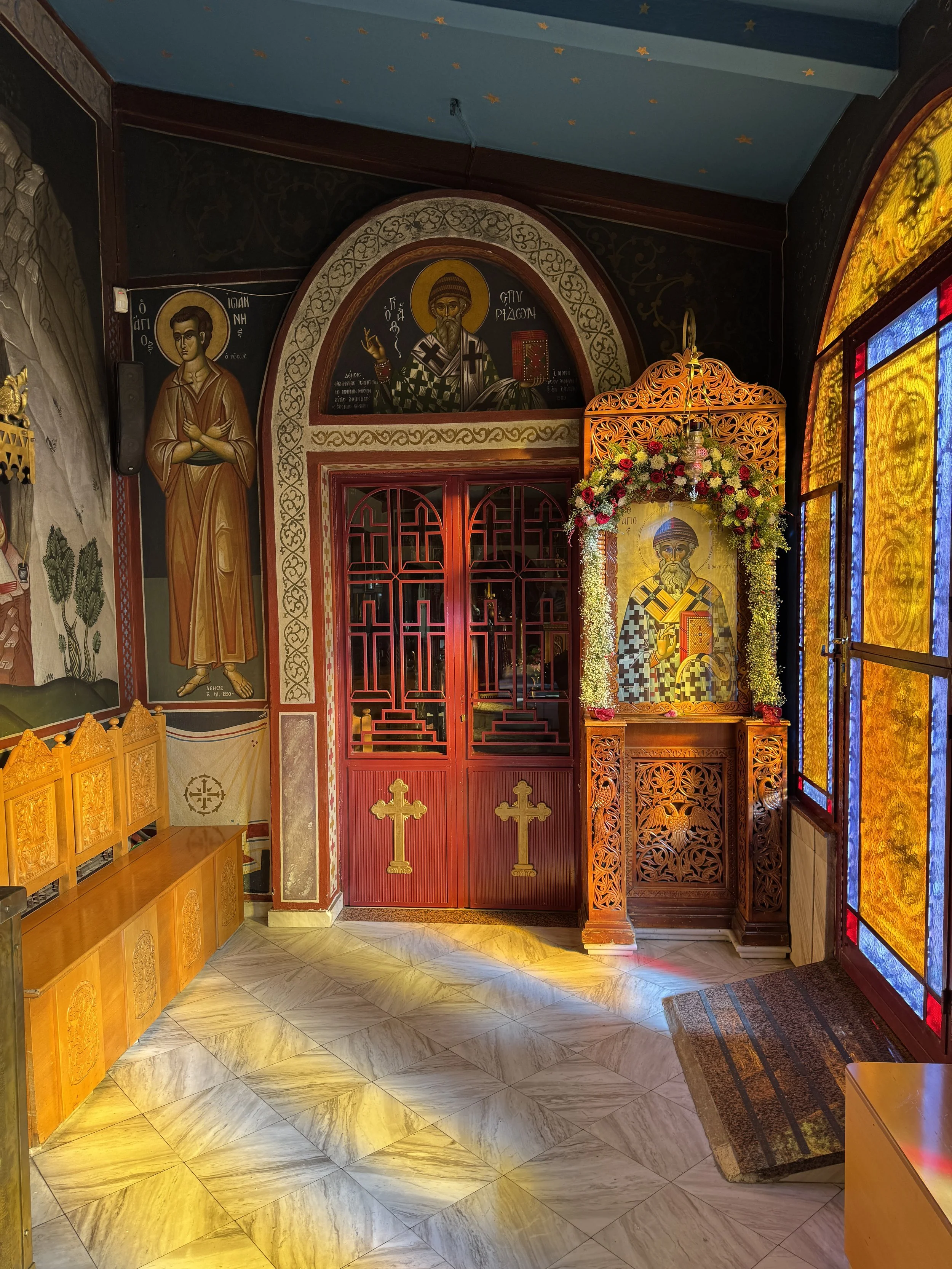
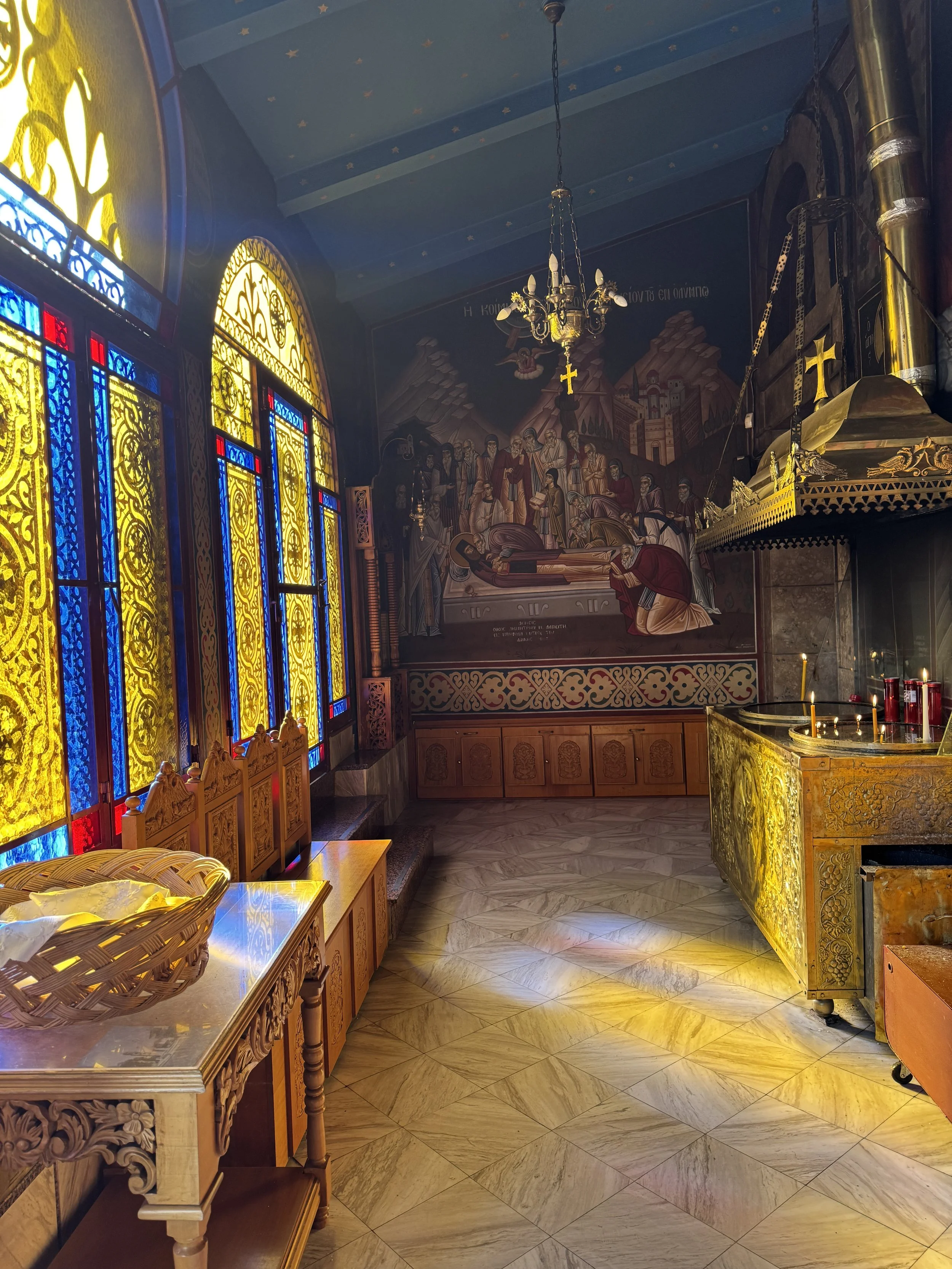
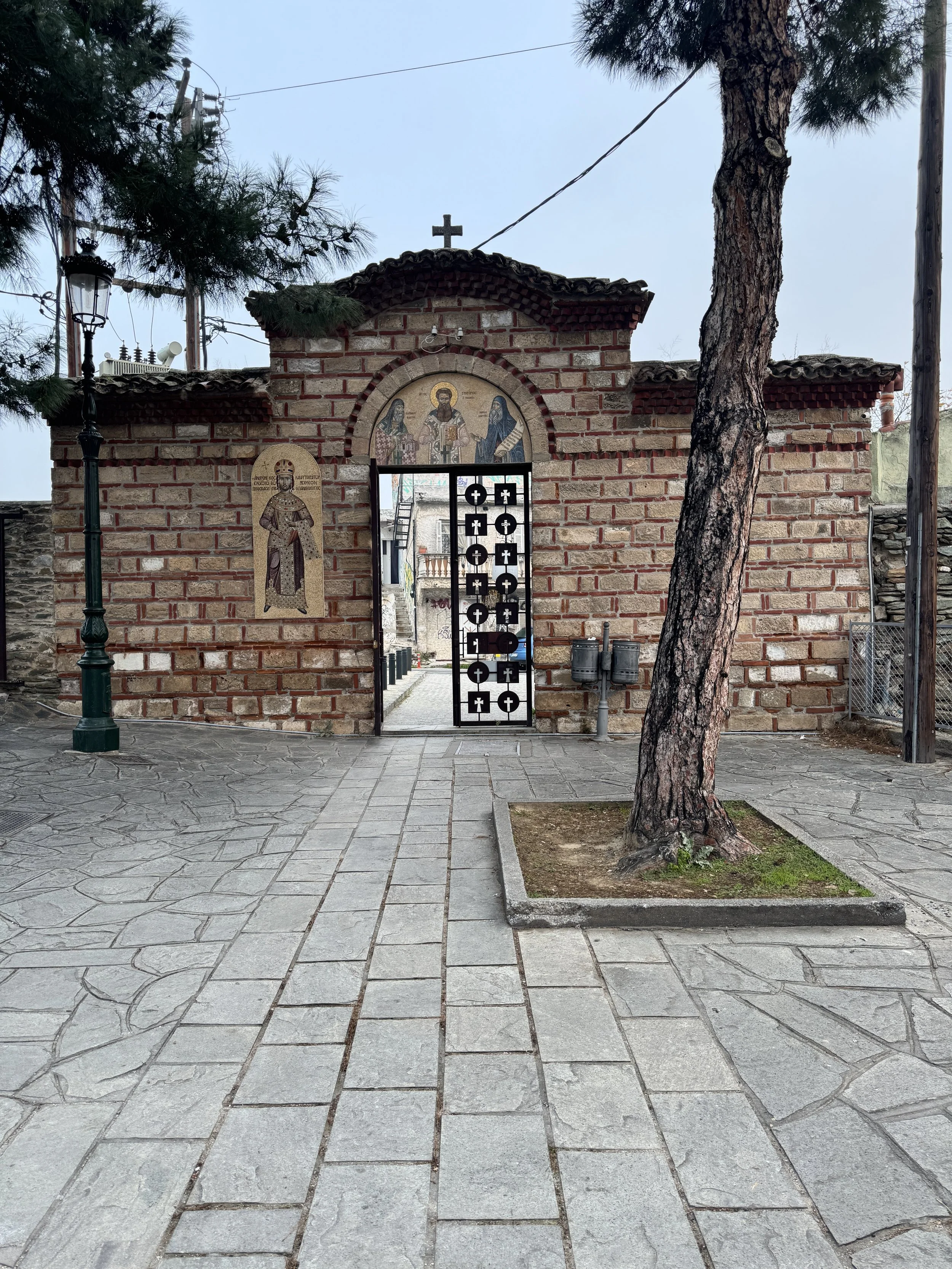
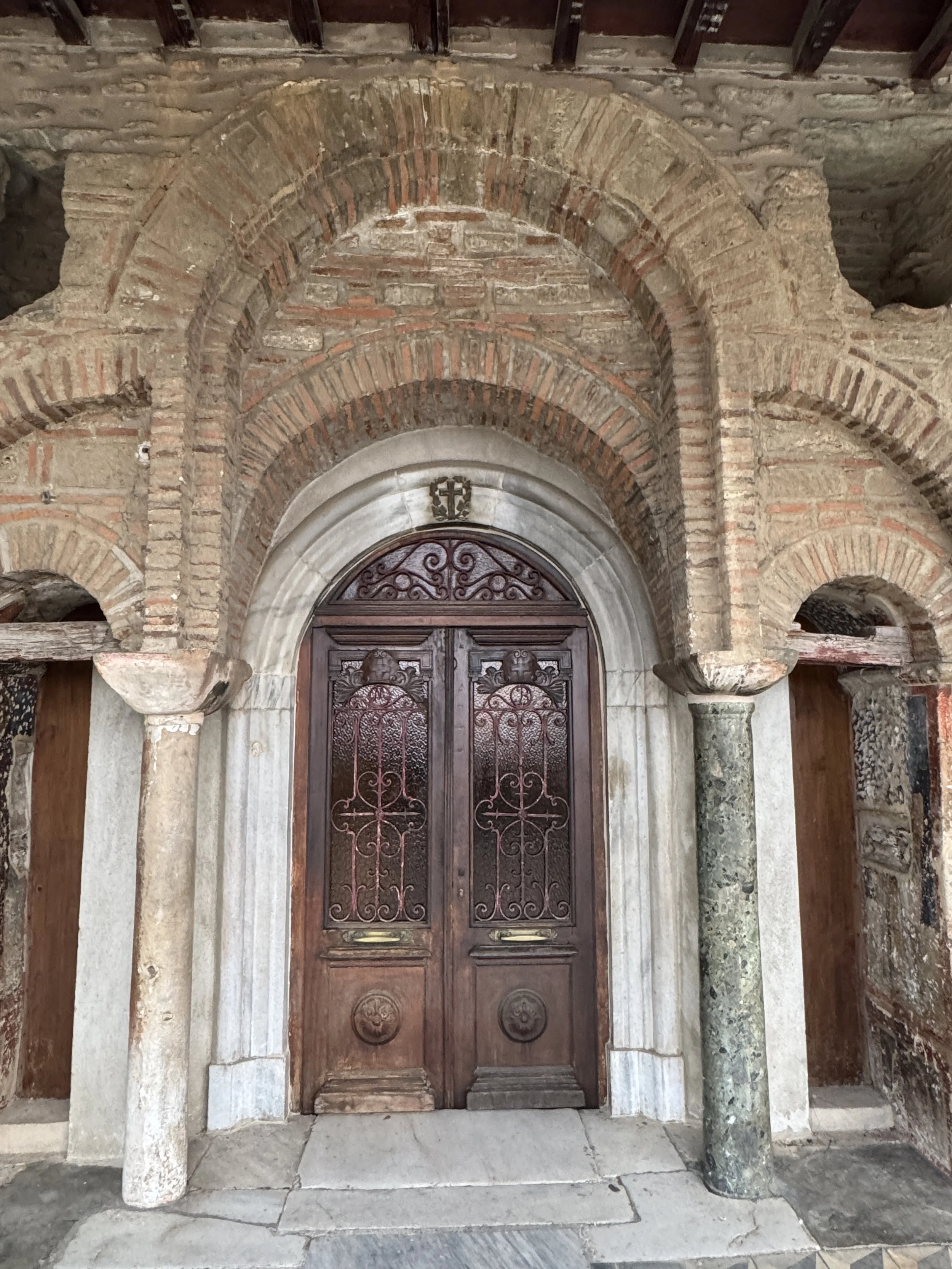
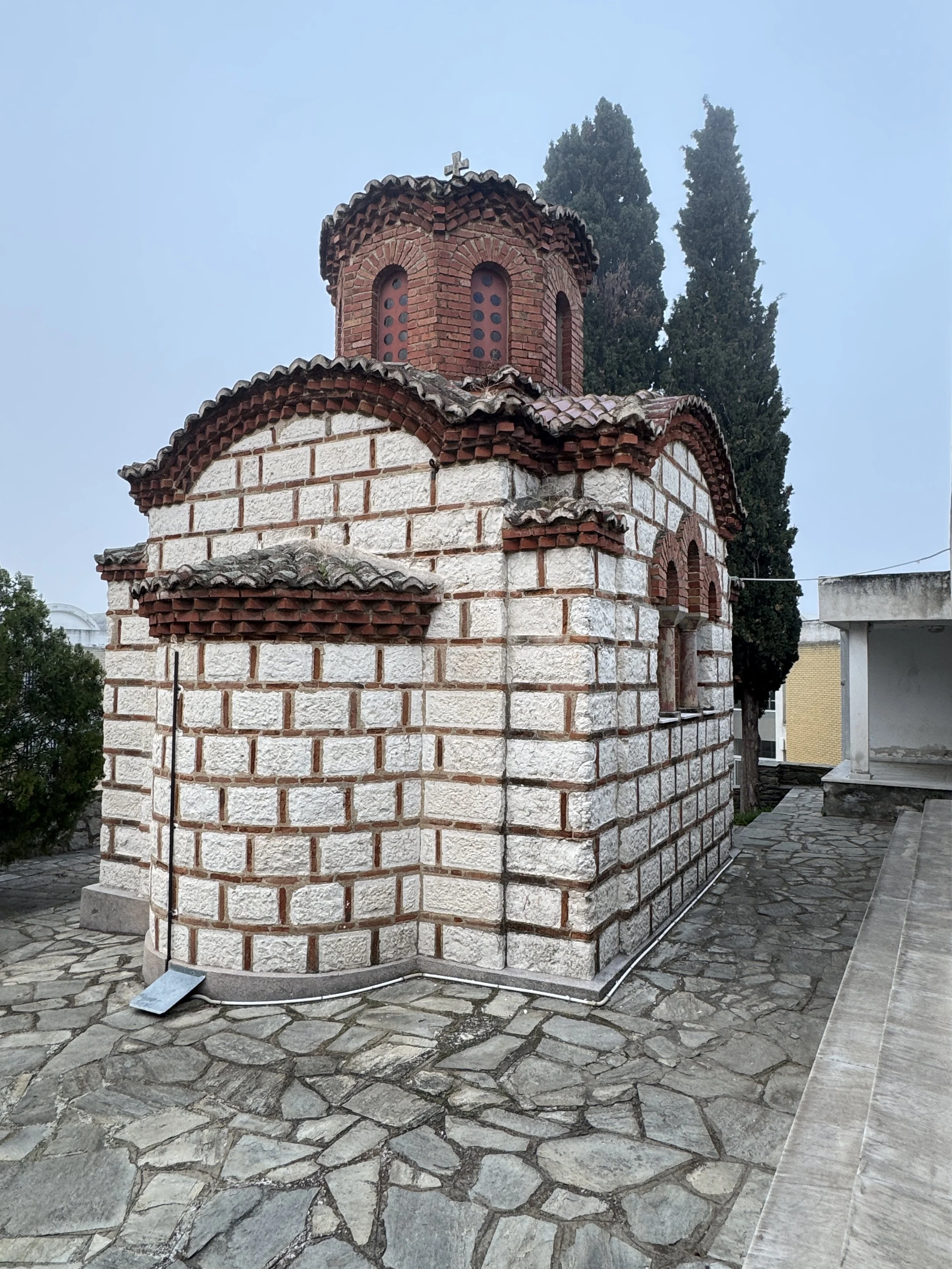
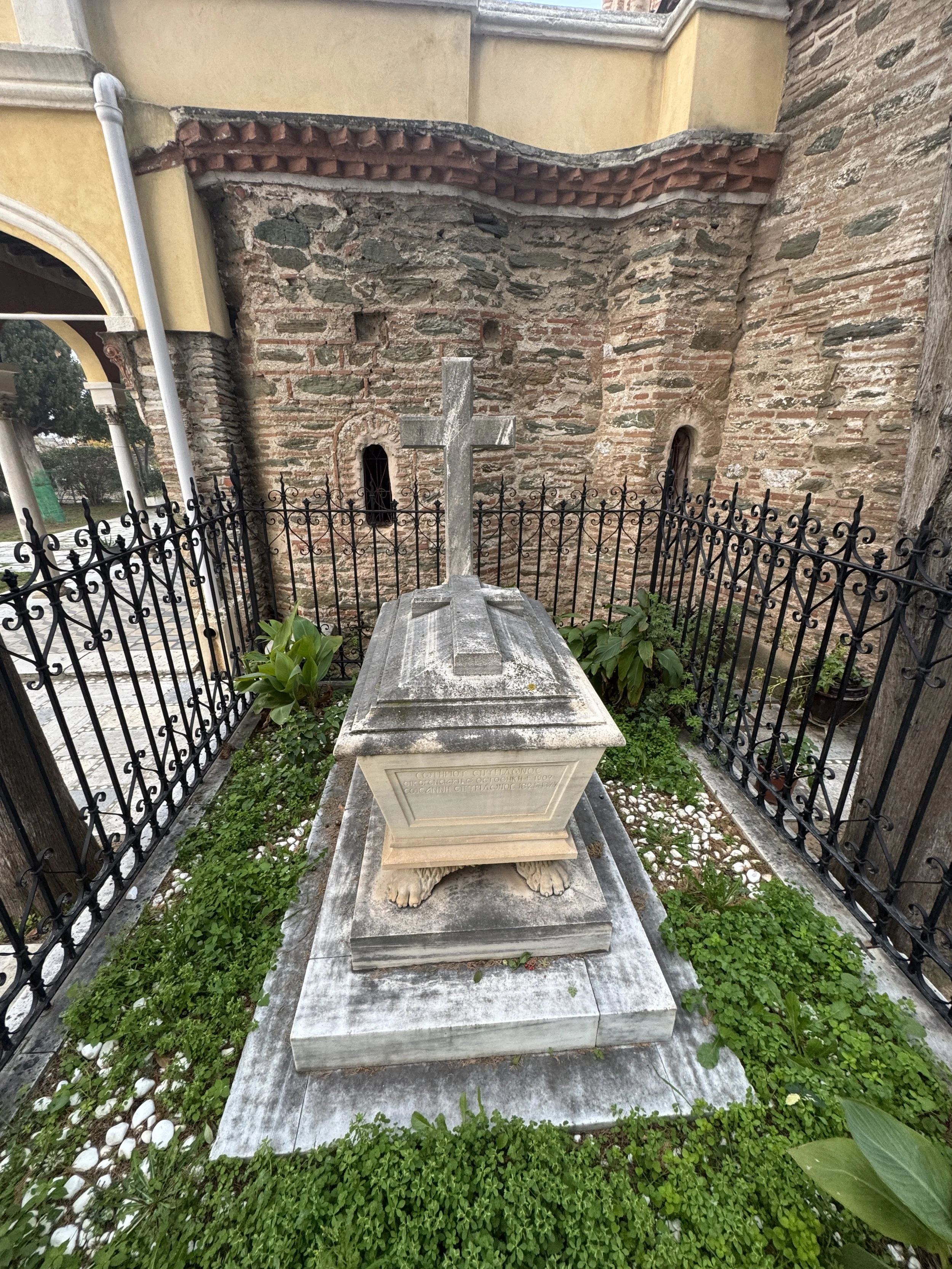
Our first stop was Vlatades Monastery (Moni Vlatadon), founded in the mid-14th century by disciples of Saint Gregory Palamas. It is the only Byzantine monastery in Thessaloniki still in continuous use and is traditionally associated with the place where Saint Paul preached.
The monastery survived Ottoman rule and is known today for its beautiful hilltop views over the city.
The grounds included multiple buildings, a bell tower with large bells, and cages filled with peacocks. There was also a small graveyard.
People were inside the monastery itself, so we decided to just enjoy the outside areas and the views.
A Closed Fortress and a Change of Plans
Next we headed to the Heptapyrgion of Thessaloniki, but unfortunately it was closed on Tuesdays.
So we changed plans and headed down toward the lower part of the city, where we found a parking garage and started exploring on foot.
A Warm Lunch on a Cold Day
We walked toward the White Tower and found a restaurant called Padrino.
I ordered an egg, bacon, and arugula calzone-style entrée. It was pretty good and definitely something a little different.
It was also quite cold outside, so sitting somewhere warm was a welcome break.
Alexander the Great and the Waterfront
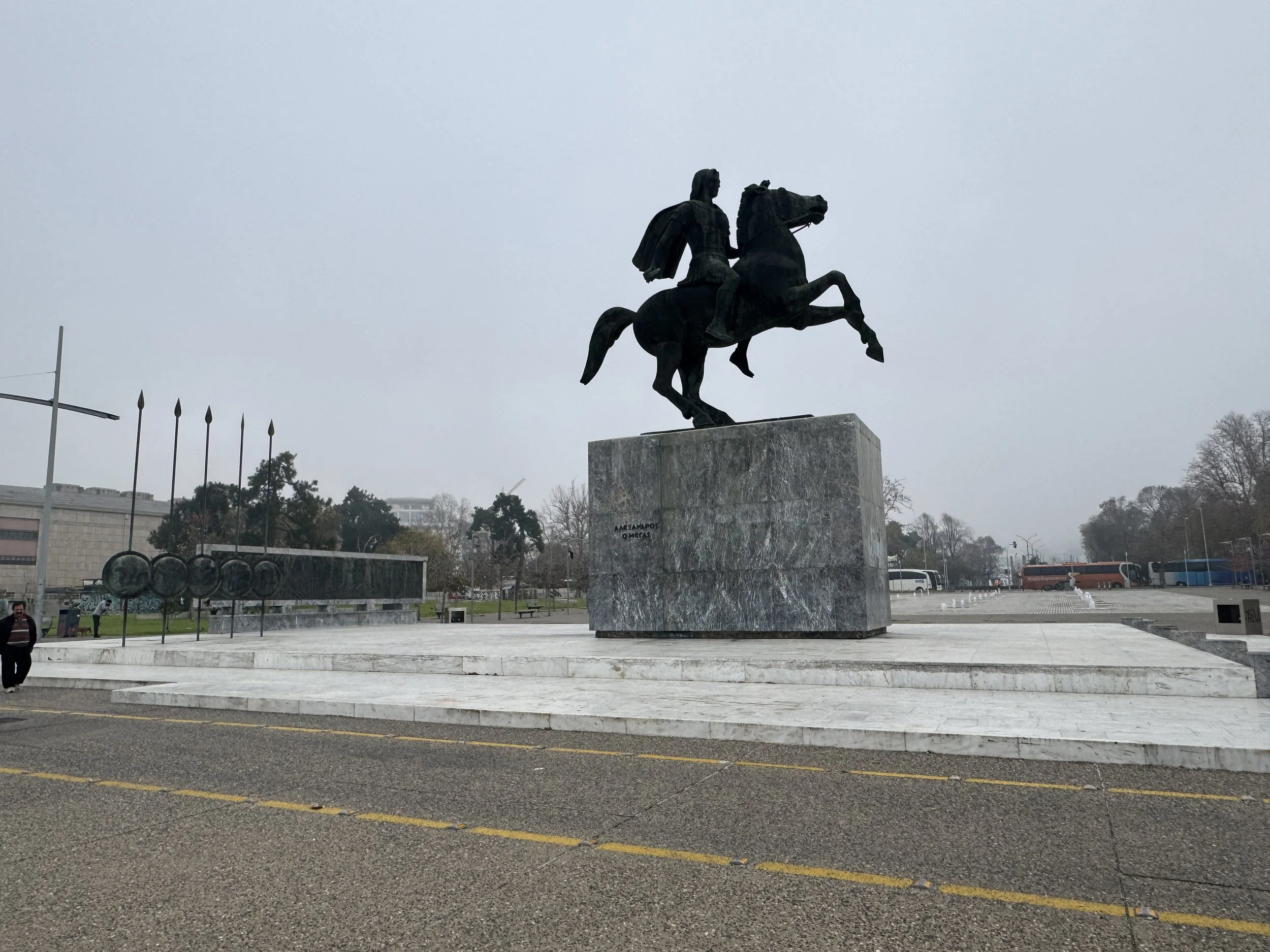
After lunch we walked toward the Alexander the Great statue.
The statue honors Alexander III of Macedon, who was born nearby in Pella and remains one of Greece’s most famous historical figures. It depicts Alexander on horseback, emphasizing his role as a conqueror and unifier of the ancient world.
Nearby we also passed the Aphrodite Water Fountain before continuing toward the city’s most famous landmark.
The White Tower of Thessaloniki
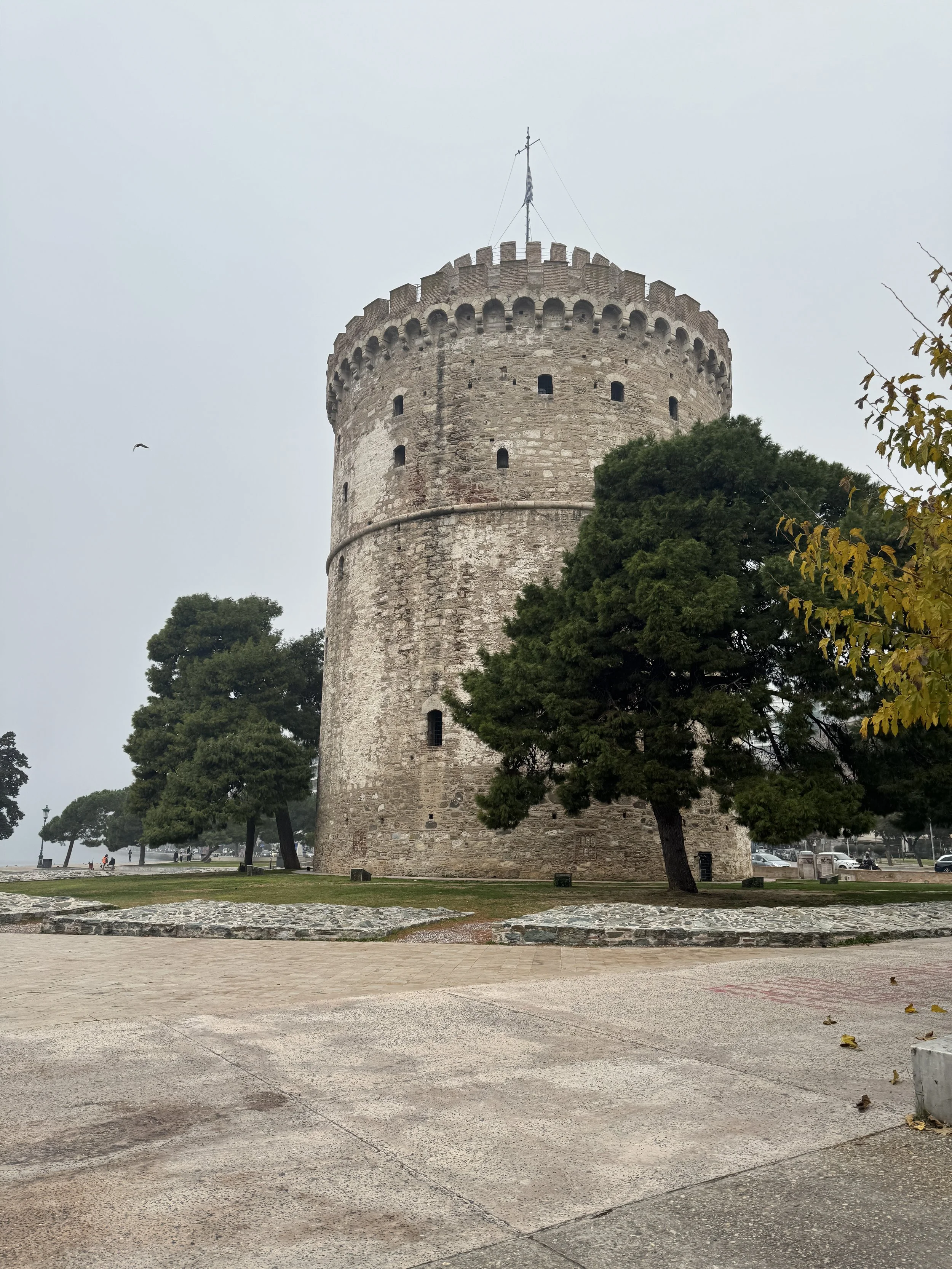
The White Tower is a 15th-century Ottoman fortification and the most iconic landmark in Thessaloniki.
Originally part of the city’s coastal defenses, the tower later served as a prison and execution site and was once known as the “Tower of Blood” (Kanli Kule).
During Ottoman rule, especially between the 17th and 19th centuries, the tower held political prisoners, rebels, and condemned criminals. Executions took place both inside and outside the tower, and bodies were sometimes displayed as warnings.
One of its darkest moments came in 1826, when many Janissaries were imprisoned and executed there following the suppression of the Janissary corps.
In the late 19th century, a prisoner was reportedly ordered to whitewash the tower in exchange for his freedom, symbolically cleansing its violent past.
After Thessaloniki became part of Greece in 1912, the tower was no longer used as a prison and gradually transformed into a symbol of the city rather than oppression.
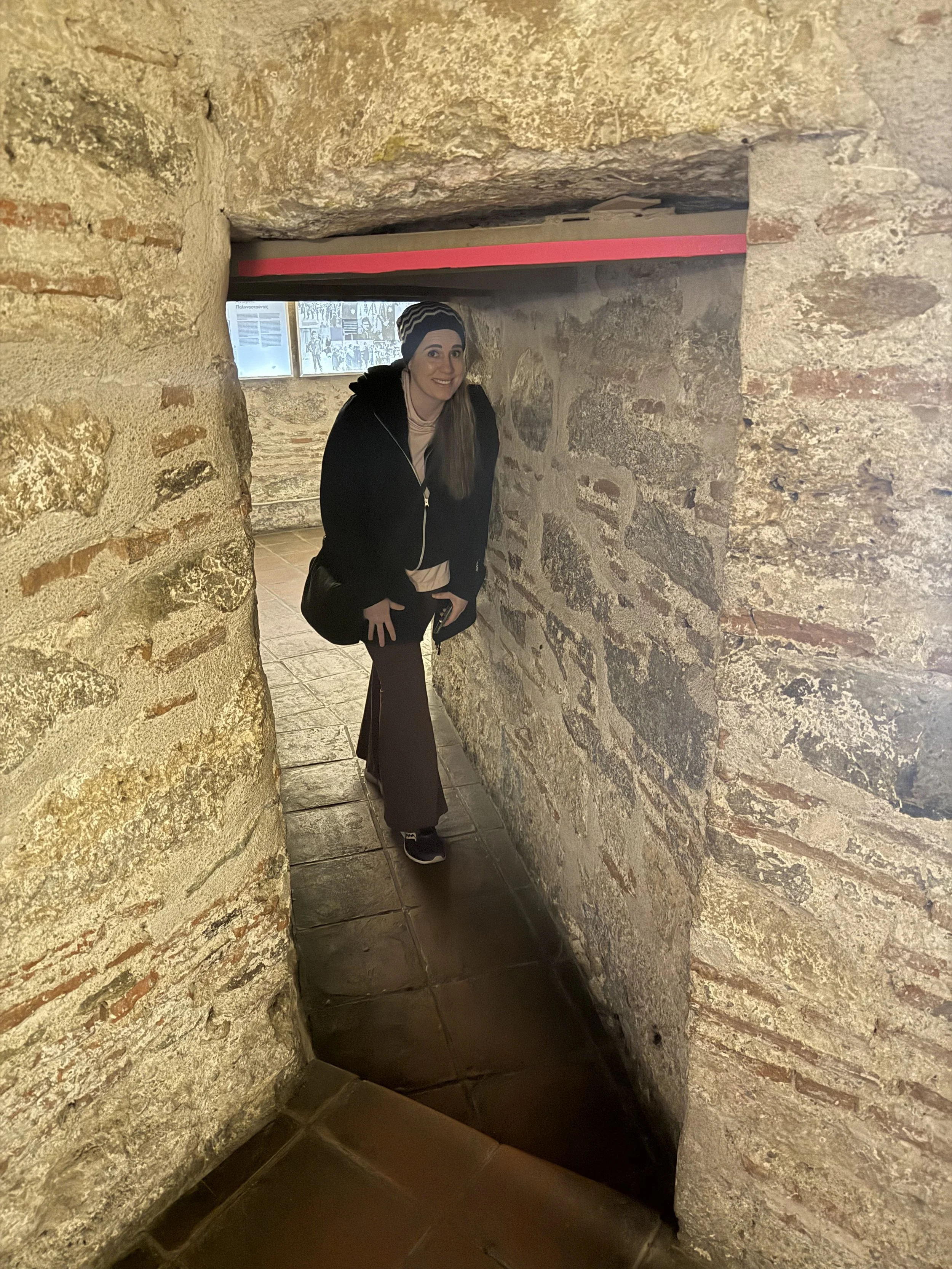
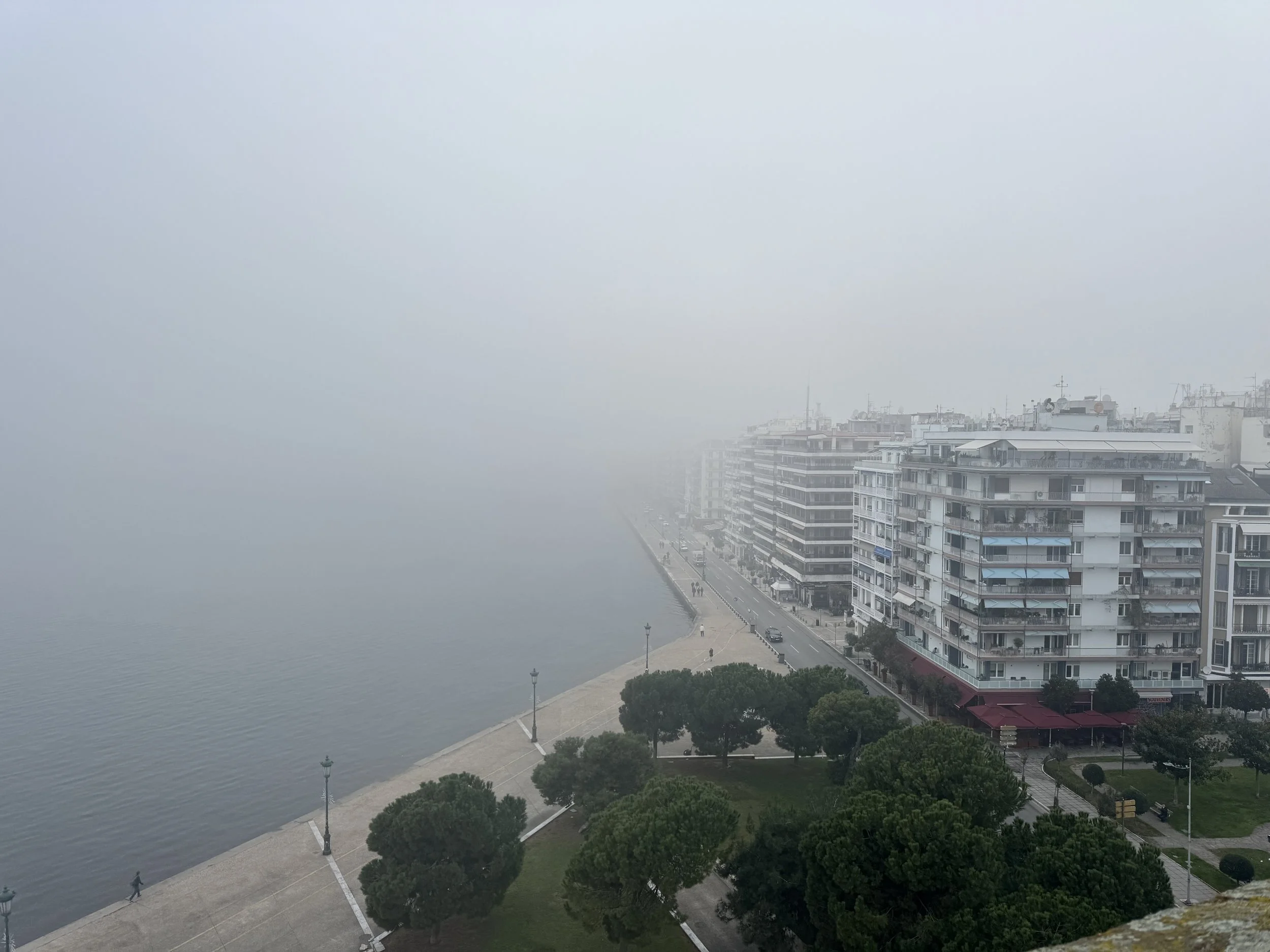
Today the tower houses a museum and offers panoramic views from the top.
Unfortunately, the day we visited there was heavy fog, so the visibility from the top wasn’t great.
Along the Waterfront and Into the Old Market District
From there we walked along Leoforos Nikis, the waterfront road.
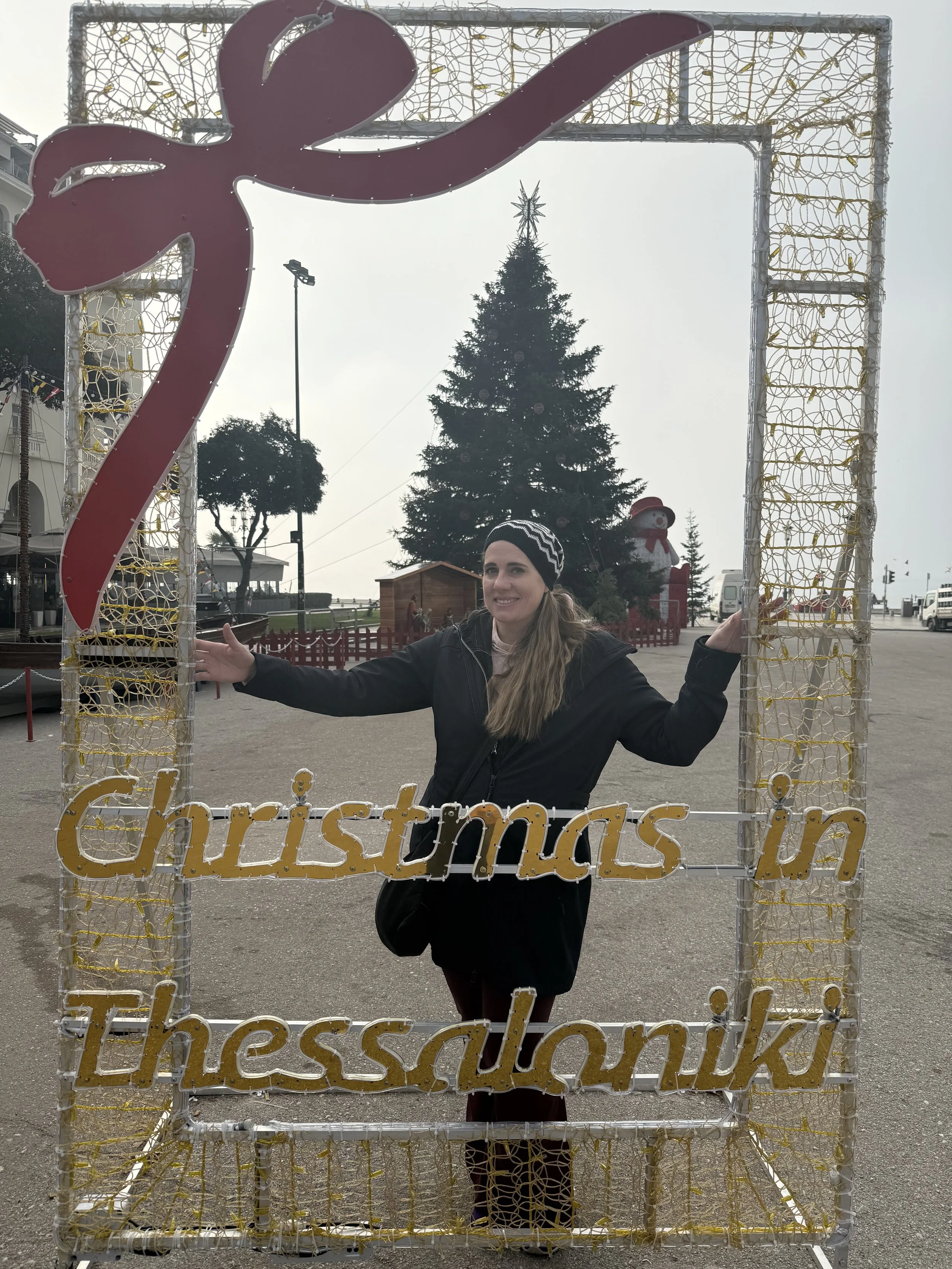
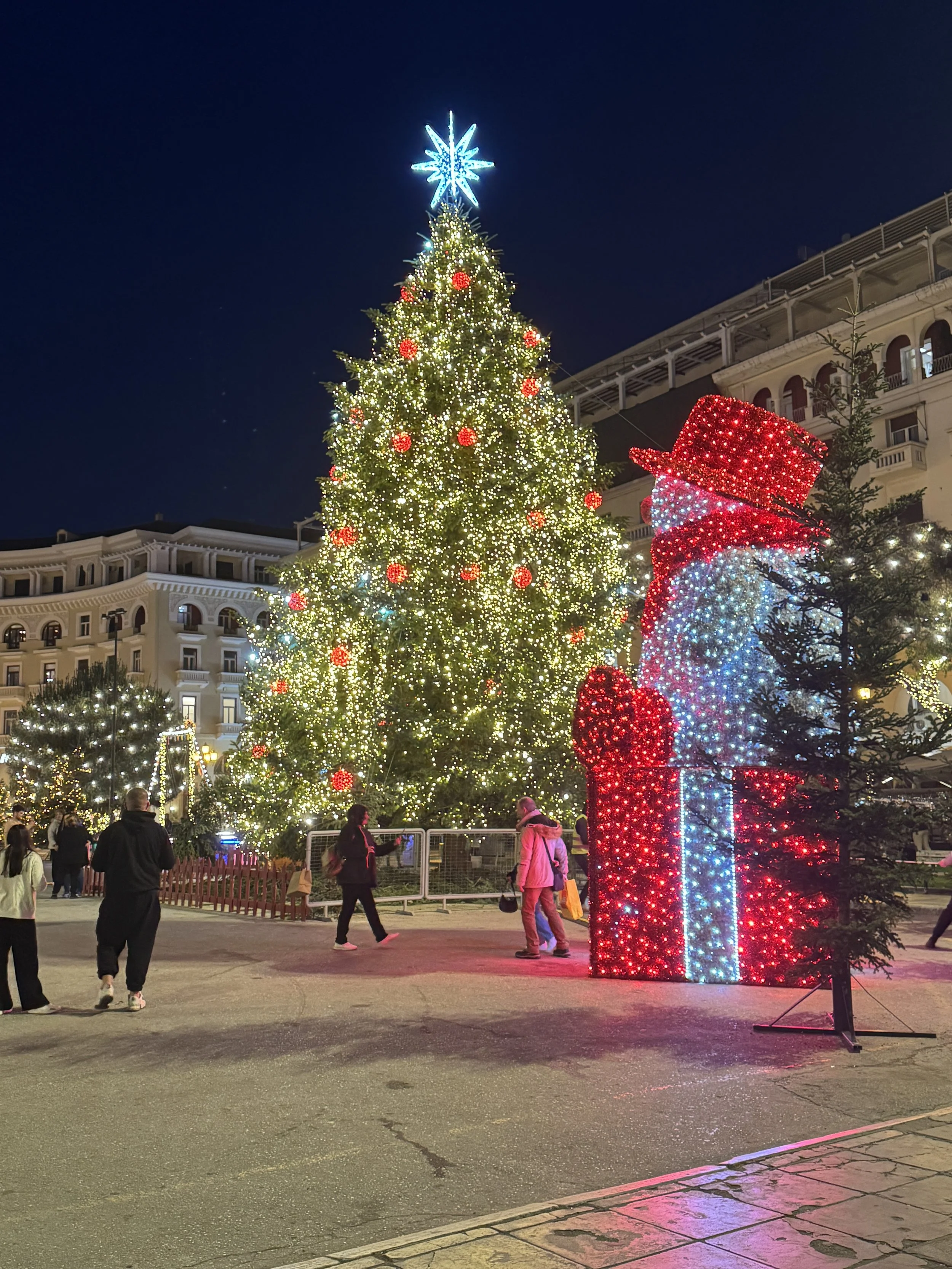
We made our way toward Ladadika and Aristotle Square, which had a lovely Christmas display along with shops and restaurants.
Then we walked up Aristotelous Street, where there were even more shops.
The Perfume That Followed Us Down the Street
We found a cute gift shop filled with handcrafted Greek items, and the store smelled amazing.
I asked what smelled so good, and the shop owner told us it was her perfume.
She explained that she bought it just around the corner at NAREK Boutique Parfumerie, so naturally we had to go investigate.
I ended up buying the exact same perfume, and the shop owner actually mixed it in-house for me. The bottle was also surprisingly affordable at €8.
Thessaloniki’s Markets and Roman Ruins
We continued walking and stopped at Kapani Market, which is basically a mix of a flea market and a farmers market with some great deals.
We picked up a few souvenirs before heading back toward the car.
Along the way we passed several historic landmarks.
Rotunda of Galerius
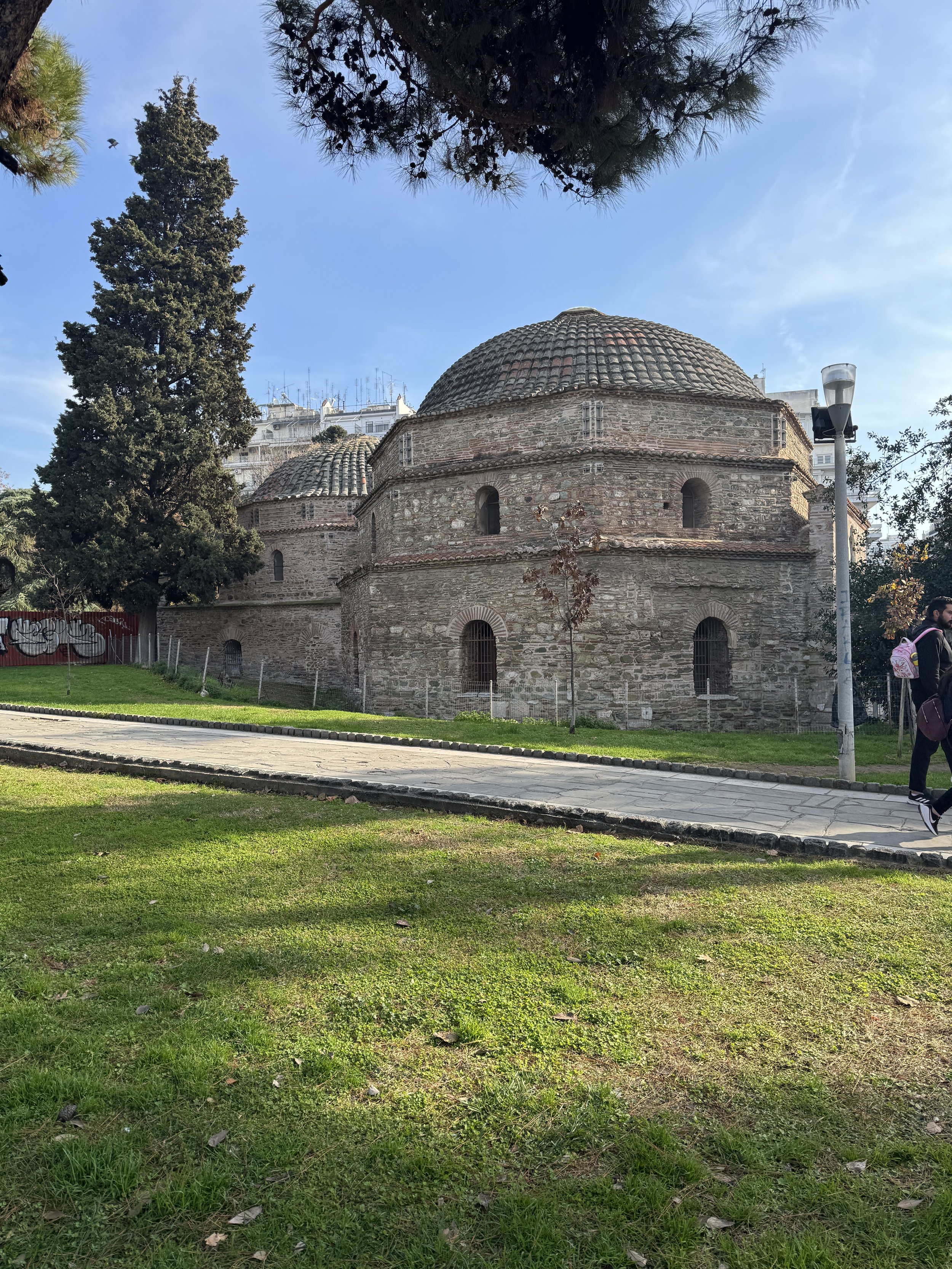
The Rotunda of Galerius, also known as the Church of Agios Georgios (Saint George), was built in the early 4th century (around 306 AD) by the Roman emperor Galerius.
It may have originally been intended as a mausoleum or temple. Over time it was converted into a Christian church, later a mosque during Ottoman rule, and eventually back into a church.
It is one of the oldest and most important monuments in Thessaloniki, known for its massive circular structure, thick stone walls, and early Christian mosaics.
Unfortunately, this site was also closed on Tuesdays.
Roman Forum of Thessaloniki
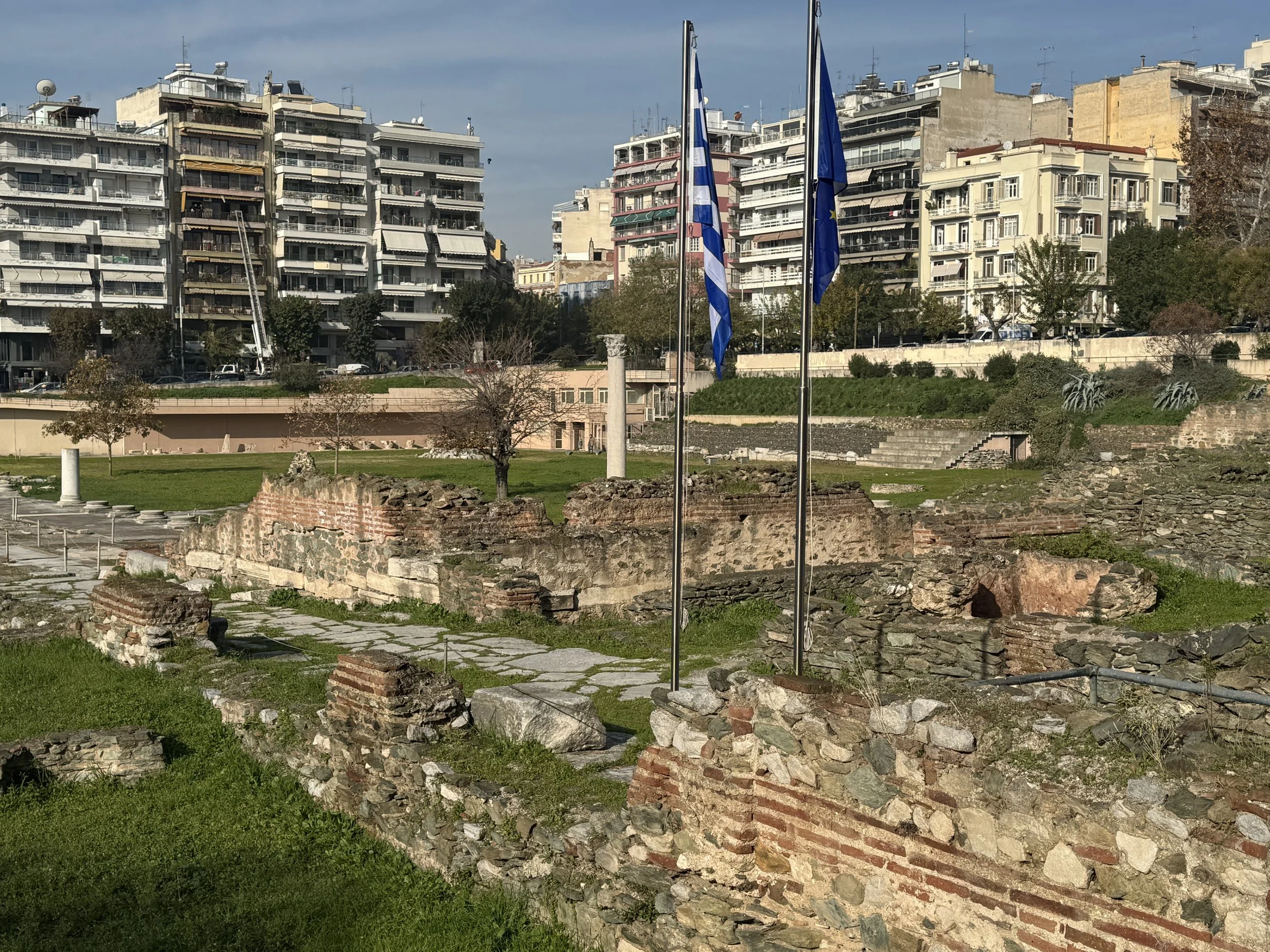
We also passed the Roman Forum (Ancient Agora) of Thessaloniki, dating to the late 2nd–3rd century AD.
This area served as the administrative and commercial center of the Roman city, featuring a large public square, shops, a mint, an odeon (small theater), and other public buildings.
Parts of the forum sit below modern street level, giving visitors a striking glimpse of Roman city life beneath the modern city.
Church of Acheiropoietos
Next we passed the Church of Acheiropoietos, built in the 5th century AD and one of the earliest Christian basilicas in Thessaloniki.
Its name means “not made by human hands,” referring to a revered icon once kept there.
The church is notable for its Corinthian columns, early Christian mosaics, and the fact that it survived conversion into a mosque during Ottoman rule while remaining largely intact.
Hagia Sophia of Thessaloniki
We also wandered past Hagia Sophia of Thessaloniki, built in the 7th century and inspired by the famous Hagia Sophia in Constantinople.
The church is known for its Byzantine mosaics, especially the Ascension mosaic in the dome.
Like many churches in Greece, it was later converted into a mosque during Ottoman rule before returning to Christian worship in 1912. Today it is a UNESCO World Heritage Site.
Checking Into Ester Suites
Eventually we made it back to the car so we could move it closer to our hotel.
We realized the private parking garage charges €18 from 2 p.m. until noon the next day, so we didn’t want to accidentally pay twice.
We checked into Ester Suites, which are converted studio apartments.
The room was nice and the receptionist was wonderful and very friendly.
The only real issue was the shower design. The shower was completely open with just a tiny piece of glass separating it from the sink, and it was also open toward the toilet.
Like Sweden, they just cannot seem to get the showers right.
The handheld shower head was also pointed directly at the toilet, so when I turned on the water absentmindedly, it soaked that entire area.
Dinner Recommendation from the Hotel
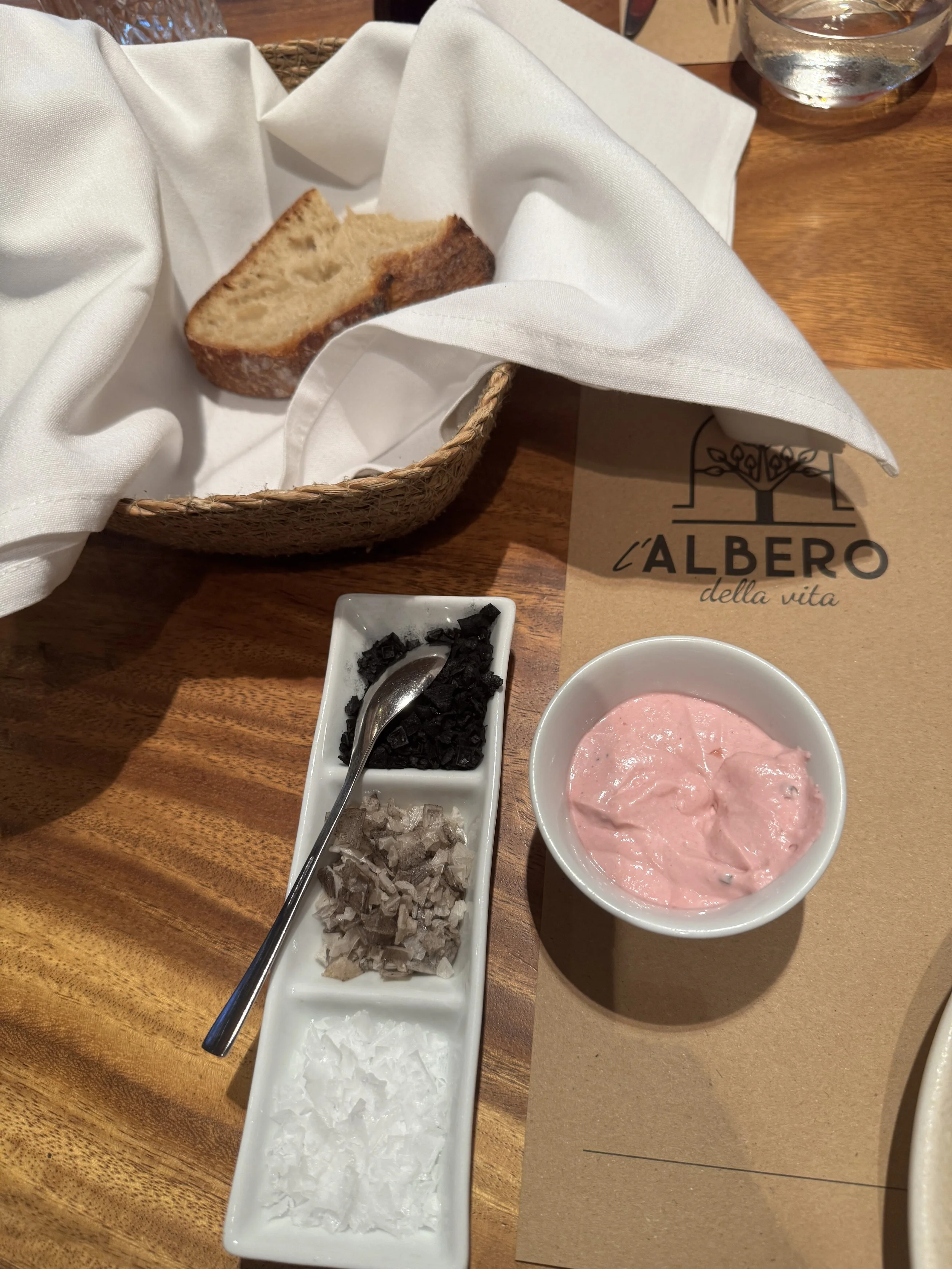
After dropping our bags we headed to L’Albero, which the receptionist recommended.
The restaurant had beautiful décor.
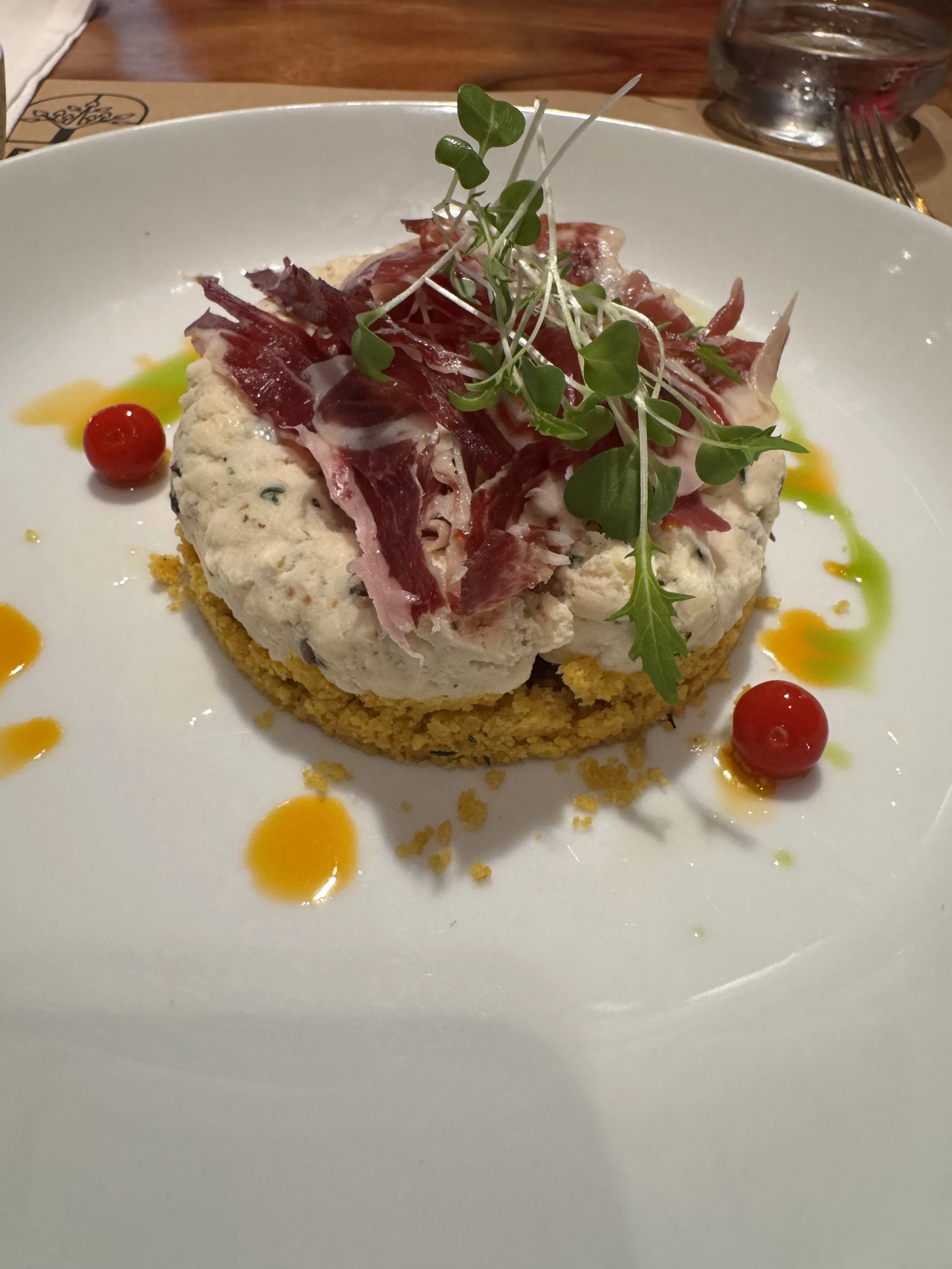
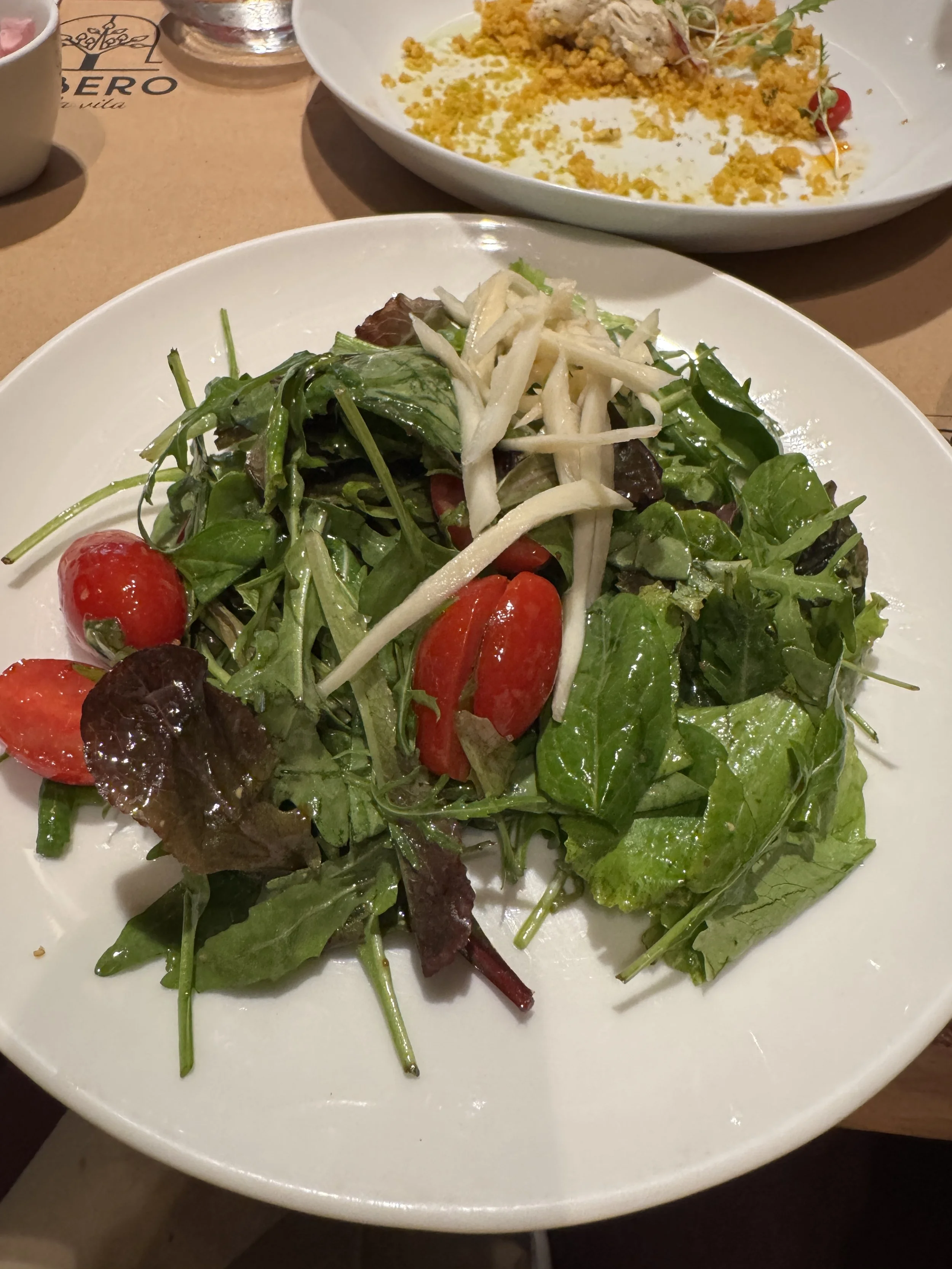
I ordered a Jamón Iberico tart with a corn bread crumble and cream cheese, along with a salad with cherry tomatoes.
The salad dressing was incredible, but the tart itself was just okay.
The service, however, was excellent.
A Greek Artist Shop and Another Dinner
We wandered around for a bit before heading back toward the waterfront.
Along the way we found a shop called ATMOSPHERE HOME, which sold unique pieces created by Greek artists.
I ended up buying my home décor souvenir there.
For dinner we chose 7 Thalasses, a seafood restaurant.
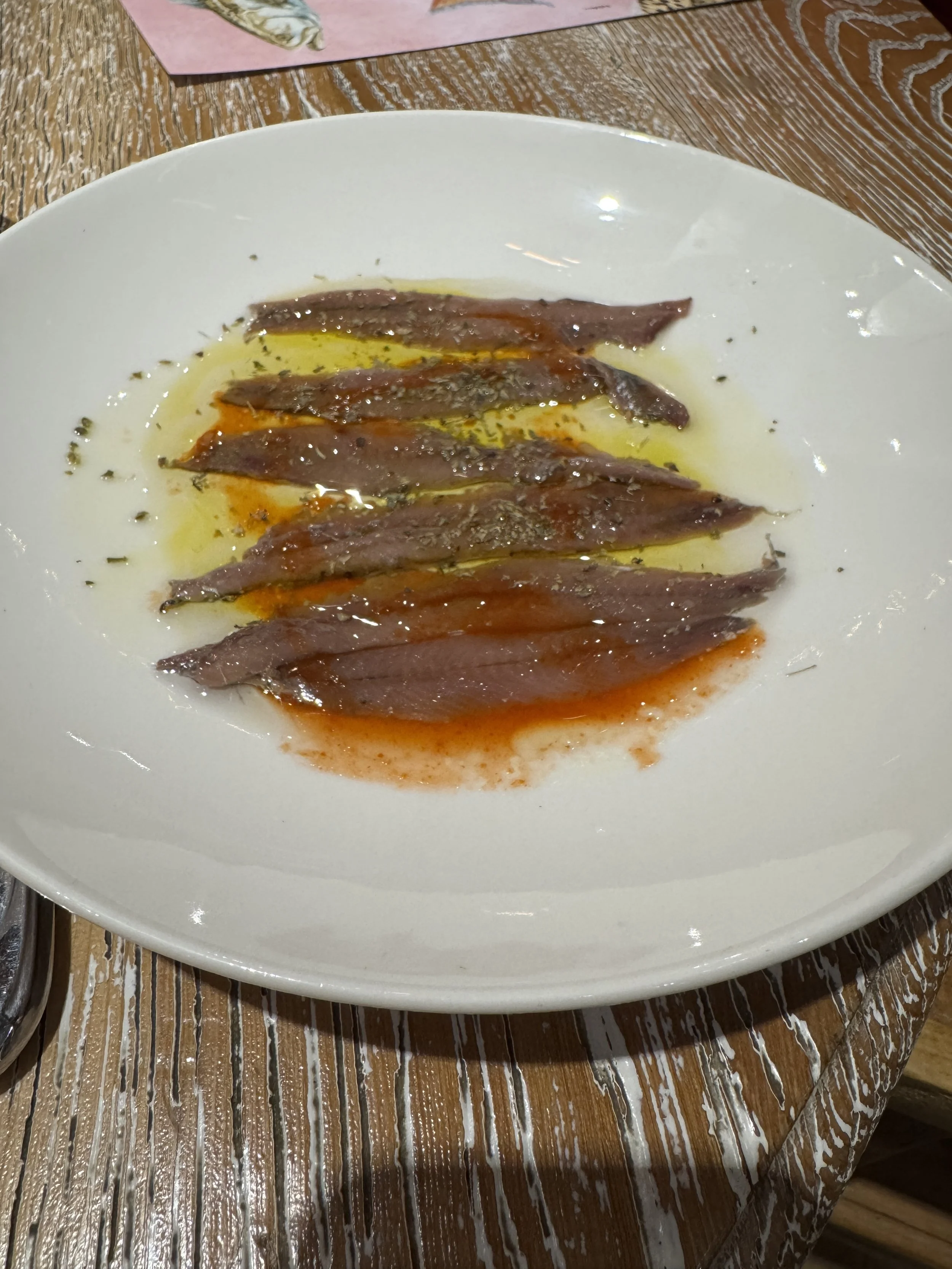
I ordered bread, fish soup, and anchovies.
We kept seeing anchovies on menus everywhere, so I decided this was the time to try them.
Unfortunately, anchovies—whether in Greece or anywhere else—are still not my thing.
The soup and bread were fantastic, though.
The restaurant itself was a bit pricey, and while the food was good, it wasn’t life-changing.
One interesting difference we noticed in Thessaloniki is that restaurants often provide complimentary alcohol at the end of the meal, whereas in most other parts of Greece they tend to bring desserts instead.
Back to the Hotel
After dinner we walked back to the hotel and relaxed.
Tomorrow would be our big drive back to Athens.
December 17: Drive Back to Athens
A Drive That Turned Into an Adventure
We woke up and started our journey back to Athens.
Normally the drive takes about 4 to 4.5 hours, but this turned into quite the unexpected adventure.
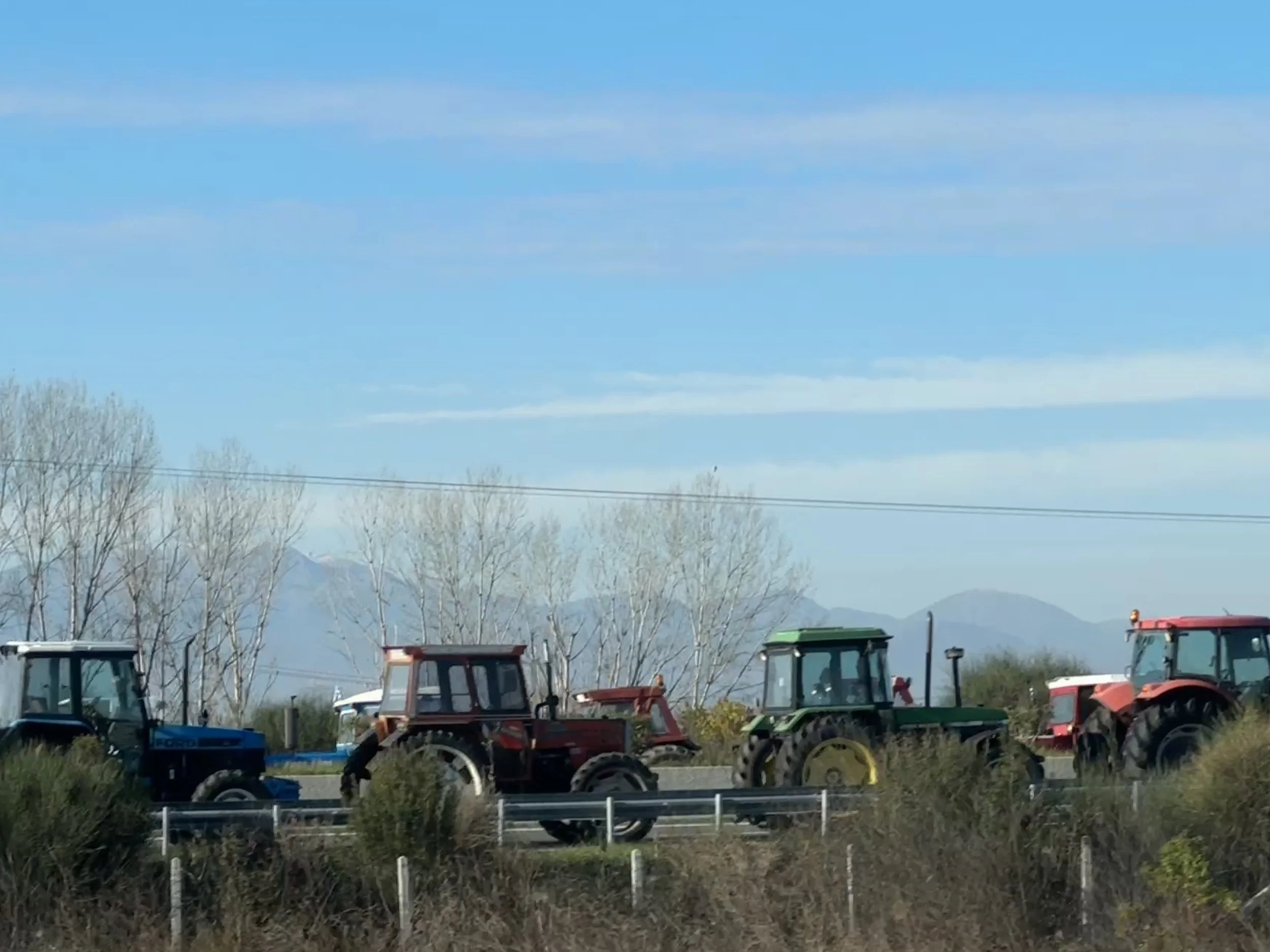
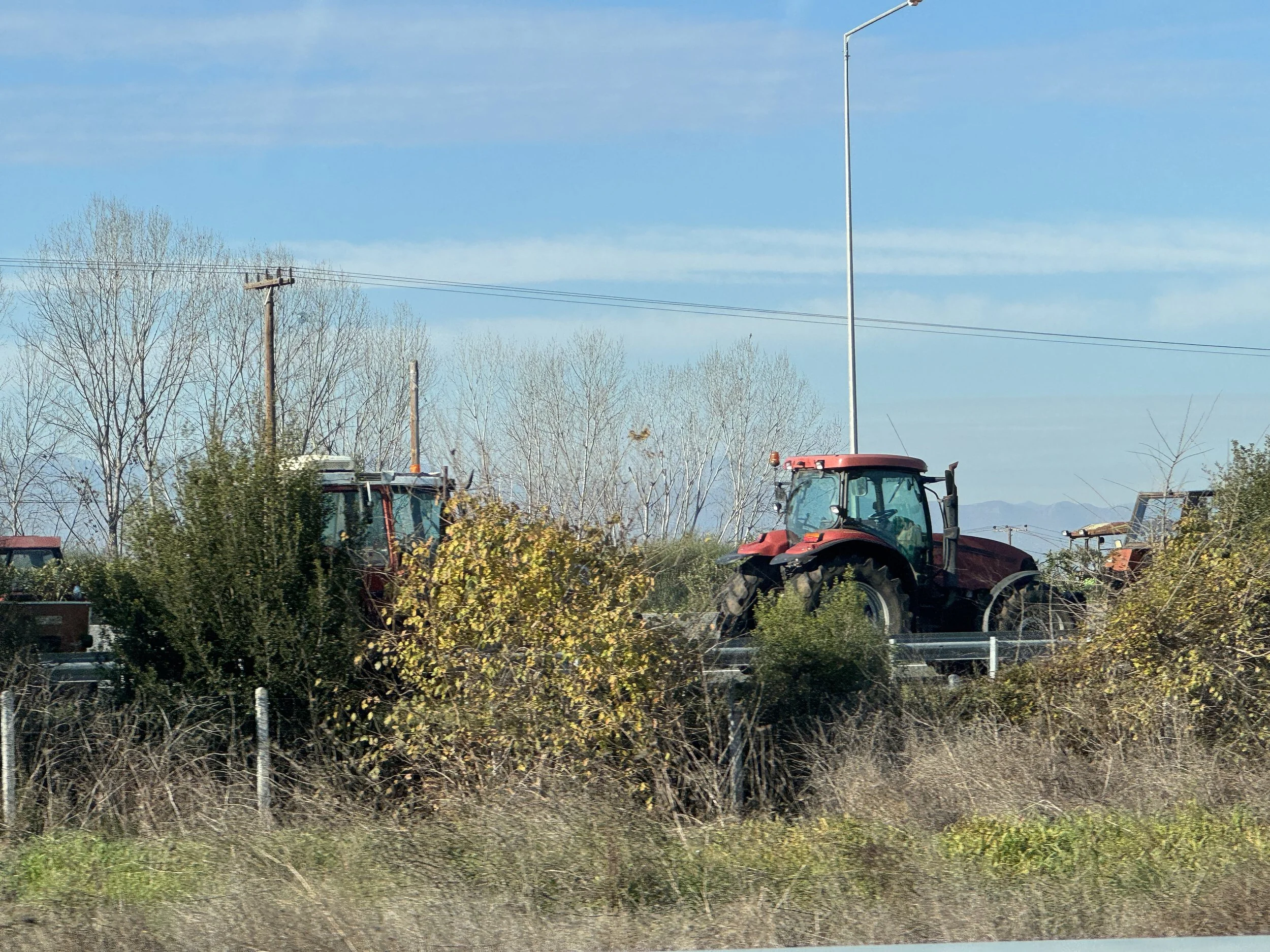
Local farmers had been on strike because they are owed a lot of money, and they had blocked off several areas of the main freeway. As a result, traffic was being diverted onto alternative routes.
Unfortunately, the detours were not simple ones.
On average, each detour added about 40 minutes to the trip. It felt very strategically done because the alternate routes were also extremely slow moving.
What should have been a normal drive ended up taking between 6.5 and 7 hours before we finally arrived.
A Cozy Apartment Near the Airport
For the night we had booked an apartment with a loft-style bed upstairs and another bed on the lower level.
It was a standalone unit, and honestly it was perfect after the long day we had just had.
The place felt very cozy and comfortable, and it was exactly what we needed after hours of detours and driving.
On Booking.com it’s listed as Spitakia Cozy and Comfy Apartment, and it’s located about 10 minutes from the airport, which made it very convenient for our flight the next day.
We ordered food through Wolt (which is basically the Uber Eats of many European countries) and spent the evening organizing our bags and resting up for the long travel day ahead.
After the unexpected detours and extended drive, we were pretty wiped out.
December 18: Travel Day Home
Smooth Travels Back to the United States
Luckily, our travel day turned out to be very uneventful, which was a welcome change.
Thanks to my Delta Medallion status, we were able to get Comfort+ upgrades.
Even better, on the long-haul flight we had a middle row of four seats completely to ourselves, which made the flight much more comfortable.
When we landed at JFK, everything went smoothly.
Immigration and customs moved quickly, our bags came out fast, and the security lines weren’t too bad, especially since we arrived in the evening.
Home Again
It’s always a little sad when a trip comes to an end.
But after a long journey, it’s also pretty nice to finally be back home and sleeping in your own bed.
🗺️ Explore Our Greece Trip on Google Maps
See each stop from our Greece road trip plotted on an interactive map, from ancient ruins and Byzantine monasteries to seaside towns and mountain views.
View Our Greece Trip MapWant to see videos, real-time moments, and extra finds from the trip?
Follow on Instagram for Reels & PhotosFinal Thoughts on Our Greece Adventure ✨
Greece was an incredible mix of ancient history, mountain landscapes, and vibrant cities. From the ruins of Athens and Delphi to the cliffside monasteries of Meteora and the coastal charm of Crete, every stop offered something unique and memorable.
Driving across the country gave us the freedom to see places many travelers miss. While some routes were slow or winding, the scenery and unexpected stops along the way made the journey just as rewarding as the destinations themselves.
The food was consistently good, especially the seafood, pastries, and traditional dishes like pastitsio. Bakeries quickly became one of our favorite daily stops, and we rarely walked past one without going in.
Overall, Greece offered a perfect balance of culture, history, natural beauty, and relaxed exploration. It’s the kind of place where you can spend the morning exploring ancient ruins, the afternoon driving through mountains or along the sea, and the evening enjoying great food in a lively square.
Top Tips for Greece 🧭
- Renting a car gives you the most freedom to explore places like Meteora, Mount Olympus, and smaller towns that are harder to reach by public transportation.
- Parking in cities can be tricky. Many hotels advertise parking but actually rely on nearby public lots or street parking.
- Expect many archaeological sites, museums, and churches to close one day per week (often Tuesdays), so check hours in advance.
- Bring layers if you are traveling through mountainous areas like Meteora or Mount Olympus. Temperatures can be much cooler than coastal areas.
- Greek bakeries are incredible and everywhere. If you see one, go in. The pastries, cakes, and desserts are consistently excellent.
- Many restaurants offer complimentary desserts or drinks at the end of meals. In Thessaloniki we noticed they often provide alcohol instead of dessert.
- Driving distances in Greece can take longer than expected due to mountain roads, detours, or local strikes, so leave extra time between destinations.
- Don’t skip the smaller historical stops. Some of the most memorable places, like Hosios Loukas Monastery and Theopetra Cave, ended up being highlights of the trip.